A heresy that survived
In 1968, Erich von Däniken published Chariots of the Gods. The book was mocked, dismissed as pseudoscience, written off as fantasy. Yet it sold millions, translated into dozens of languages, and seeded a cultural movement that refuses to fade.
Half a century later, the theory is still alive. From late-night documentaries to academic debates, the suggestion that humanity once encountered beings from the stars remains impossible to bury.
Ideas that survive ridicule are rarely without weight.
The persistence of questions
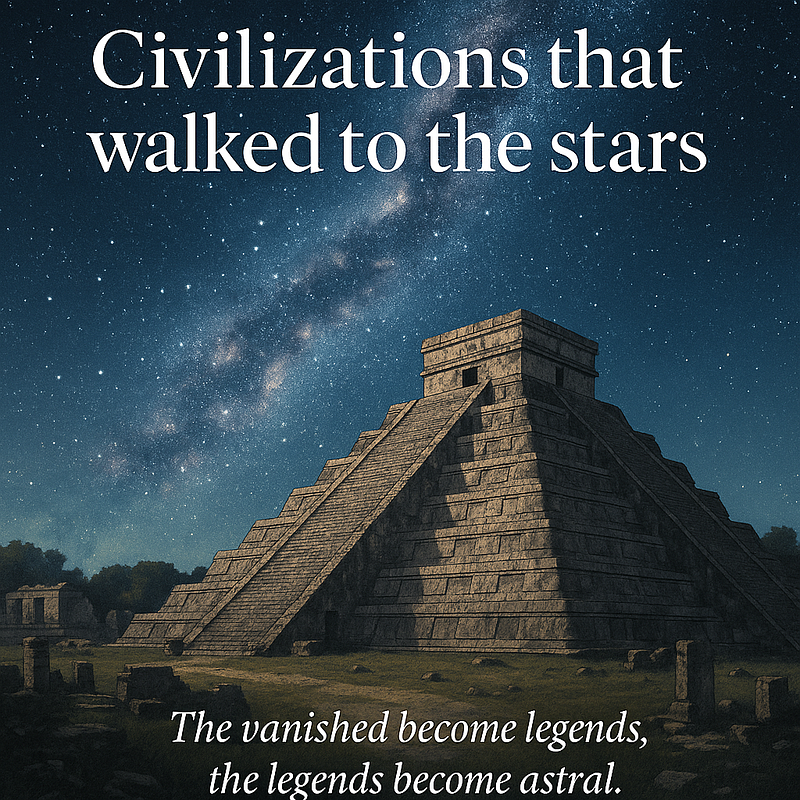
Why do the pyramids align with Orion? Why do myths across cultures describe flying chariots, blazing gods, and teachers descending from the sky? Why do distant civilizations repeat the same symbols, spirals, suns, beings with helmets?
Historians insist these are coincidences, metaphors, symbolic language. But questions, once seen, cannot be unseen.
“Ridicule is not a refutation. It is an admission of unease.”
The machinery of silence
Institutions like the Smithsonian, the Royal Society, and the Vatican archives curate what history is allowed to be. They classify, rename, reframe. The result is not an answer but a silence, a silence that grows louder the longer it persists.
Von Däniken’s work struck a nerve because it pressed against that silence. Not with proof, but with questions.
“The danger of the theory is not that it convinces, but that it invites us to look again.”
Closing reflection
The ancient astronaut theory is less about aliens than about memory. It survives not because of what it proves, but because of what is denied. Myths endure, ruins whisper, symbols return.
“The heresy lives because the questions remain.”
Read the full chapter
For the complete 12,000-word essay on Von Däniken and the persistence of forbidden history, read the full chapter here:
Related from The Manifest Archive