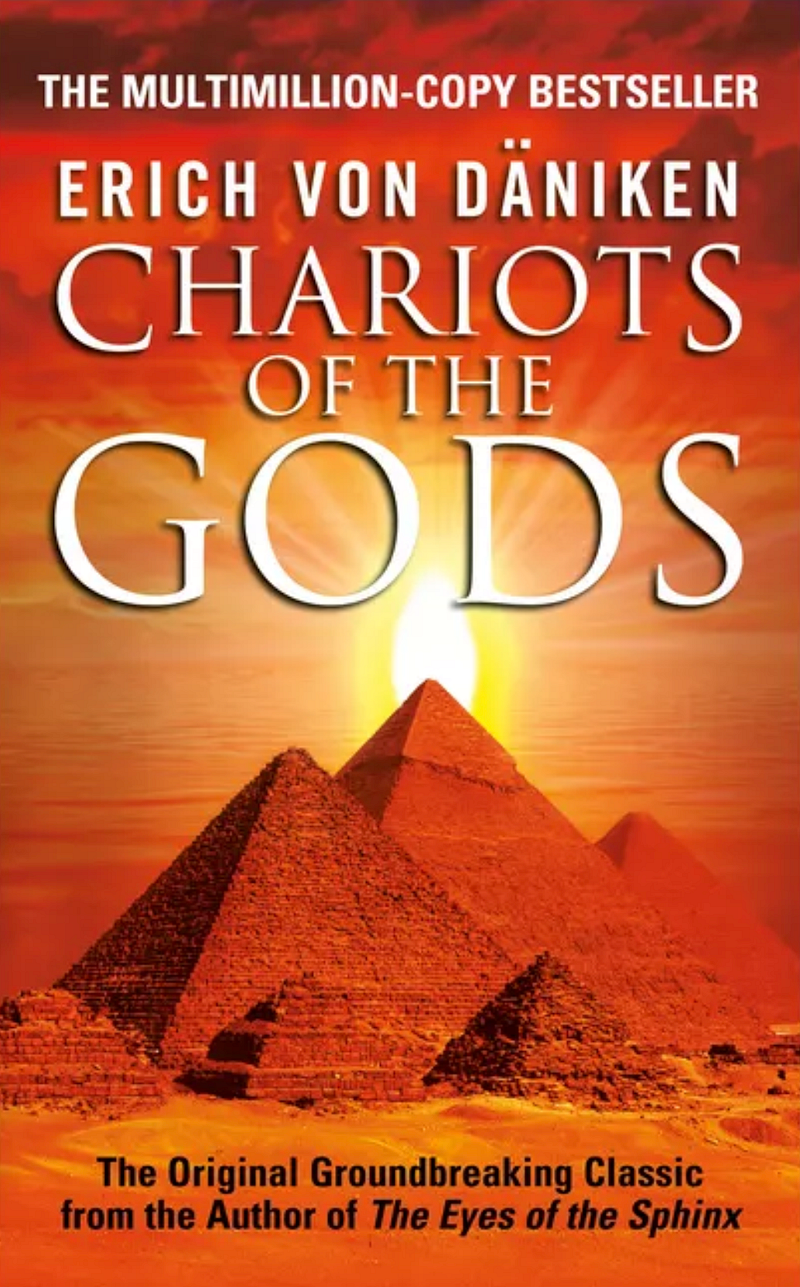
There are books that answer questions, and there are books that create them. In 1968, a Swiss hotelier published a slim paperback with a pulp-like title but a question mark that struck like dynamite: Chariots of the Gods? Within months it was a global bestseller, within years a cultural landmark, and within decades a wound in the smooth skin of history.
Its author, Erich von Däniken, was not a scholar, not a priest, not a scientist. He was a man out of place, and precisely that gave him power. From behind the reception desk of a modest hotel in Interlaken, he gathered photographs, myths, maps, and intuition into a heresy so sharp it could be carried in paperback.
And so I want to say plainly: Erich, thank you. Thank you for your courage, for your refusal to bow to silence, for the handholds you carved into the cliff of history. You may not have proved the gods were visitors, but you gave us the tools to keep asking. That gift is rarer, and more enduring, than any final answer.
The eruption
The year was 1968. Authority cracked on every front. Parisian students tore cobblestones from the streets and hurled them at riot police. Protesters in Chicago were clubbed on live television. Prague’s dream of freedom was crushed beneath Soviet tanks. Mexico City’s Tlatelolco Square ran with blood. And above it all, rockets leapt from the Florida swamps toward the Moon while Vietnam burned on nightly screens.
It was a year when the Church was doubted, universities mocked, governments distrusted. Into this firestorm, a hotelier dropped his book. Chariots of the Gods? exploded not because it was definitive, but because it was permissive. It gave readers permission to imagine that myths might be memories, that monuments might be messages, that the human story was not complete.
Scholars laughed. Journalists sneered. Priests condemned. But crowds read. They read hungrily, feverishly, passing copies from hand to hand.
“Laughter became advertisement. Ridicule became circulation.”
Ridicule is survivable, even useful. Silence is deadlier.
The precursors of heresy
No heresy erupts from nowhere. Every lightning bolt is preceded by storms, and every storm by gathering clouds. Chariots of the Gods? was a shout, but beneath it lay whispers that had circled for decades.
In New York, 1919, Charles Fort published The Book of the Damned, cataloguing anomalies science had thrown away. Frogs falling from skies. Fossils in the wrong strata. Lights wandering across stars. His most enduring line still bites:
“I think we are property.”
In Florida, 1955, Morris Jessup released The Case for the UFO. He drew lines between unidentified flying objects and ancient monuments. He was ridiculed, isolated, and in 1959 found dead in his car, exhaust piped into the cabin. Officially suicide. To readers, a martyr of curiosity.
In Moscow, 1959, mathematician Matest Agrest suggested that Sodom and Gomorrah were not destroyed by God but by nuclear visitors. In the Soviet Union, where materialist orthodoxy was law, his paper still slipped into academic journals. A whisper of heresy inside ideology.
In London, Harold T. Wilkins filled paperbacks with tales of flying machines and lost civilizations. Critics said pulp, readers said wonder.
One of those paperbacks landed in the hands of a Swiss hotelier.
Von Däniken was not the first. But he was the one who shouted where others whispered. He bundled Fort’s suspicion, Jessup’s loneliness, Agrest’s heresy, and Wilkins’s pulp into a single book that sold millions. He became the eruption at the end of a storm front.
The stones that do not fit
The desert does not speak in words. It speaks in lines.
Fly at dawn over Nazca and the ground transforms into geometry. A monkey with curling tail. A hummingbird poised in flight. Lines so straight they slice across ridges as if gravity itself had been mocked. From the ground you see nothing. From the sky, intention.
Archaeologists explained them as ritual walkways, calendars, ceremonies. Von Däniken asked the question laughter could not erase: why carve signs at a scale only visible from above?
In 1968 it sounded absurd. In 2025 it feels prophetic. Satellites and drones have revealed hundreds of new geoglyphs: soldiers etched into hillsides, rings and crosses in Kazakhstan, earthworks hidden beneath Amazonian canopy. Again and again, vantage proves essential.
The same with Baalbek, where stones of 750 tons rest as if they were bricks. With Giza, where pyramids align to true north within a fraction of degrees. With Göbekli Tepe, discovered later but older than agriculture, rewriting chronology itself.
Von Däniken often leapt too far. But his instinct was sound: the stones prove nothing, but they refuse to fit the orthodox script.
“The stones are not answers. They are questions in granite.”
Silence as architecture
Ridicule was noisy, and Von Däniken could take it. His sales grew with every sneer. Mockery filled lecture halls, brought translations, funded his research. Ridicule gave him oxygen.
Silence was different. Silence starves ideas of oxygen. It is not debate, not attack, but the quiet suffocation of exclusion. It is the university that deletes a citation, the museum that locks away a skeleton, the library that preserves a manuscript only to bury it.
Von Däniken felt that silence more than the laughter. Ridicule energized him. Silence stifled him. Because silence does more than laugh: it erases.
And against that erasure, he fought. He wrote. He republished. He lectured. He refused to vanish.
The echo of today
In 1968, Von Däniken had only myths, photographs, and imagination. In 2025, the world has tools that make his questions sharper.
DNA reveals hybrid ancestry. Satellites uncover geoglyphs and lost cities. Artificial intelligence maps motifs across continents. Governments admit UAPs.
Von Däniken did not prove. He permitted.
And now, with new technologies, many of his once-ridiculed instincts look startlingly prescient.
The forbidden questions
Who are we? Hybrids, whispers the genome.
Where do we come from? Myths point skyward.
Who owns us? Charles Fort: “I think we are property.”
Why were we made to forget? Forgetting is policy.
Will they return? Every myth ends with promise.
The living legacy
Von Däniken lives. He writes, he speaks, he defends. His Mystery Park rose and fell. His books stand in dozens of languages. Ancient astronaut theory saturates culture: television, film, forums, even footnotes in academic journals.
Ridicule did not erase him. Silence did not erase him.
“He gave no answers. He gave permission.”
Closing reflection
Von Däniken once said: perhaps we are not only a product of nature, but of intention. That claim was mocked, yet it reached millions. Behind the laughter and behind the silence, another truth flickers: concealment fails.
“Concealment fails.”
Books can be banned, archives sealed, names smeared. But ideas travel, cross borders, find new readers. His success proved that the walls of silence can crack.
And in those cracks lies hope. Hope that we might break through the blocks and see what truly happened in our world, and beyond it.
Von Däniken broke the seal. The Manifest walks through.
Related from The Manifest Archive