In this chapter: the bank that made war permanent · who actually owns the Federal Reserve · the dollar as a weapon · sovereignty as a credit rating · the cleanest case: Greece. For the families themselves: The Black Nobility Explained. For the full debt architecture: The Financial Architecture of Power.
The decision that comes before the state
The decision does not take place in a parliament.
Picture the kind of room this essay is about. It is a composite, not a real meeting: a stress-test session at a central bank or a fund, where no flags hang and no microphones are placed on the table.
On the table lie IMF country reports. Analyses that cite BlackRock without calling it a source. Scenarios calculated by the Federal Reserve, not to decide what should happen, but to determine what can be absorbed if it does.
No one speaks of people or history here. Those words belong elsewhere. Here the language is exposure. Debt capacity. Shock tolerance. The acceptable scale of damage before it becomes systemic.
Someone references a precedent. London, early nineteenth century. Wars that grew too large for taxation. Networks that crossed borders before states could. The name Rothschild appears not as accusation, but as annotation. As the moment financing detached from territory.
You might think this story is about powerful institutions. About who sits at the table. About influence, interests, control.
That is the misdirection.
These spaces do not exist because these actors are powerful. These actors exist because these spaces became necessary.
What happens here is not decision-making in the classical sense. It is selection. A process that determines what may continue to exist without damaging the system that sustains it. Names change. Models remain.
Further on, the story moves to American industrial fortunes such as Rockefeller, DuPont and Mellon. They matter here not as families but as examples of how the same mechanism adapted to a different scale, a different economy, a different century.
No one in the room claims they decide. But everyone knows that without this framework, no decision holds.
When war became larger than states
There was a time when war ended, not because anyone desired peace but because it had to. Armies were expensive, logistics were limited, taxation had boundaries, and prolonged conflict exhausted the state itself. That balance broke at the beginning of the nineteenth century. The Napoleonic wars did not conclude; fronts remained open, armies stayed mobilized, supply chains stretched across seasons and continents, and states no longer fought only for territory but for endurance. Whoever could continue paying longest prevailed.
Taxation proved insufficient and gold was too slow. What was required was something that could move without traveling and expand without physical constraint, which is to say credit. What emerged was not a plan and not a conspiracy but a solution, because states needed speed, continuity, and information beyond their own capacity, and those were found outside territorial sovereignty.
Here the name in the title earns its place, and it is worth being precise about why, because the popular legend and the documented record diverge. Mayer Amschel Rothschild sent his five sons to five cities, London, Paris, Vienna, Naples, and Frankfurt, and what they built was one of the fastest and most integrated cross-border financial networks of its age, a family firm with houses in five cities that could move money and information faster than most governments. When Britain needed to move subsidies to its allies and pay Wellington's armies on the continent, it was the Rothschild network that moved the money, and at Waterloo in 1815 the family's courier brought the news to London ahead of the official dispatch, which Nathan passed to the government. The famous story that he used it to make a fortune on the bond market is a myth that began in an antisemitic pamphlet in 1846. In the years that followed they helped build the international market for government bonds. The clearest example came in 1818, when Nathan Rothschild's London house arranged a £5 million loan for Prussia, issued in sterling rather than Prussian currency, with interest payable in London and other financial centres, and tradable by investors who would never meet the borrower. Historians treat it as a precursor of the modern international sovereign bond, and it quietly relocated part of a state's solvency from its own territory into a market it did not control. A government could now raise more than its tax base allowed, faster than its treasury could move, by promising a future it pledged to keep legible to lenders abroad. That promise, not any family, is the thing that survived. The documented achievement was not secret control. It was infrastructure: a way for a state's future to be financed by capital that no longer lived inside it.
The Rothschild name endured because it marked the moment when function became visible, not power but continuity. They financed not only victory but duration, and that distinction made them indispensable. This moment is often misrepresented as the rise of financial domination, as if finance had seized control of geopolitics, but that framing is incorrect. What occurred was a structural dependency. States discovered that the alternative to financial reliance was collapse, so that the choice was never autonomy versus dependence but dependence versus failure.
From this point onward, financing ceased to be a tool and became a condition, and sovereignty became conditional with it. The visibility of families was temporary; once the mechanism was understood the face was no longer required, what worked was copied, and what functioned was standardized. The next step followed naturally, not less finance but embedded finance, not networks tied to names but procedures tied to continuity.
The bank that made war permanent
Before central banking became a neutral term, it was a wartime necessity.
The Bank of England was not founded to stabilize markets or protect citizens. It was created to solve a specific problem: how to fight wars that could no longer be paid for in real time.
What the Bank introduced was permanence. For the first time in England the state gained access to a standing mechanism that could transform future income into present capacity, so that war no longer had to wait for revenue but could proceed on credit, indefinitely, as long as confidence held. This was the true innovation: not lending, but continuity. From that moment war ceased to be an exceptional condition and became a managed process, and debt ceased to be an emergency measure and became a structural companion of governance. This model did not remove sovereignty. It redefined it.
Once war depended on confidence, confidence itself became strategic. Markets did not need to oppose the state; they only needed to hesitate, because a rise in borrowing costs could achieve what armies could not. Discipline no longer required invasion. It required doubt. The logic spread quietly across Europe, where states that wished to endure modern conflict needed not only armies but mechanisms capable of transforming belief into liquidity, and those that failed to build such mechanisms became dependent on those who had.
What began as an emergency solution became architecture. Debt issuance stabilized, secondary markets formed, obligations circulated independently of the original borrower, and the state's future was increasingly pre-committed to the maintenance of a trust it no longer fully controlled. At this point sovereignty acquired a new and silent condition: it had to remain legible to creditors, and policies that threatened that legibility did not need to be banned. They simply became unaffordable.
The Federal Reserve as normalization
The Federal Reserve was not a rupture but a confirmation. What the Bank of England had operationalized in wartime Britain, the Federal Reserve normalized for a permanent system. It did not transfer power so much as formalize process, creating a buffer between political volatility and systemic collapse, and its mandate was never governance but prevention, never growth but stability, never choice but continuity. From here on financing became infrastructure, and infrastructure does not debate. It persists.
What determines whether a state can continue is rarely debated in public. It is not the constitution, nor the elections. It is whether the debt can be rolled over, whether bond markets still treat the obligations as neutral, whether a downgrade would trigger collateral rules that force institutions to withdraw automatically. When that line is crossed, politics does not intervene. It adjusts. Modern states are not founded first and governed later. They are governed first, and only then allowed to appear. A government once decided what it could afford. Now what it can afford decides the government.
The dollar system, in four moves
Between the Federal Reserve and the present sit four documented moves that turned a national currency into the operating system of the world, and each one deepened the same dependency.
The first was Bretton Woods in 1944. For three weeks that July, in the Mount Washington Hotel beneath the New Hampshire mountains, the delegates of forty-four nations met while the war was still being fought. The setting was almost absurd against the moment: a grand white resort, closed during the war and hastily reopened, restaffed and redecorated for the conference, the British delegation led by a visibly ailing John Maynard Keynes and the Americans formally by Treasury Secretary Henry Morgenthau, with Harry Dexter White as their chief negotiator, who held the leverage because his country held the gold and the factories. What they drafted in those rooms, currencies fixed to the dollar and the dollar fixed to gold, made the United States the anchor of global money before it was even the unquestioned victor of the war. The institutions that would outlast the war by eighty years were drafted in a mountain hotel while the fighting went on, which is itself a lesson in where the real settlements happen, and who is in the room when they do.
The second was 1971, when Nixon ended that gold convertibility overnight. The dollar became a pure fiat instrument backed by nothing but confidence and the demand to hold it, which only widened the role of the institutions that manage confidence.
The third was the petrodollar. Through the 1970s, and especially after the 1974 US-Saudi arrangements, dollar pricing of oil was locked in and oil surpluses were recycled into US assets, so that every nation that needed energy needed dollars, and the currency acquired a demand independent of the country that issued it. This is the move that connects this whole architecture to the world's chokepoints: the dollar's deepest support was not a treaty but a barrel, the simple fact that the most traded commodity on earth was priced, by overwhelming convention, in the issuer's money.
The fourth move happened offshore. From the late 1950s a pool of dollars accumulated outside the United States, the eurodollar market, beyond the reach of any single regulator, and global finance learned to run on dollars that no government fully controlled. By the time anyone tried to measure it, this offshore dollar system had grown vast: by the end of 2025 the BIS counted about fourteen trillion dollars of dollar credit, in loans and bonds, extended to non-bank borrowers outside the United States, and yet every one of those dollars still depended on the Federal Reserve as the ultimate source of the currency. Most of the world's dollars were no longer issued or even fully seen by the United States, and still could not exist without it. The world had built its financial life on an instrument it could neither issue nor escape, which is the purest possible statement of dependency: to run on a money that is someone else's liability and beyond your own reach at once.
The cumulative result is a system in which the dollar is simultaneously a national currency and a global utility, and the body that sets its price, the Federal Reserve, makes decisions for one country that ripple through every other. None of this required a conspiracy to design. Each move solved an immediate problem, and the dependency compounded behind it.
Who actually owns the Federal Reserve
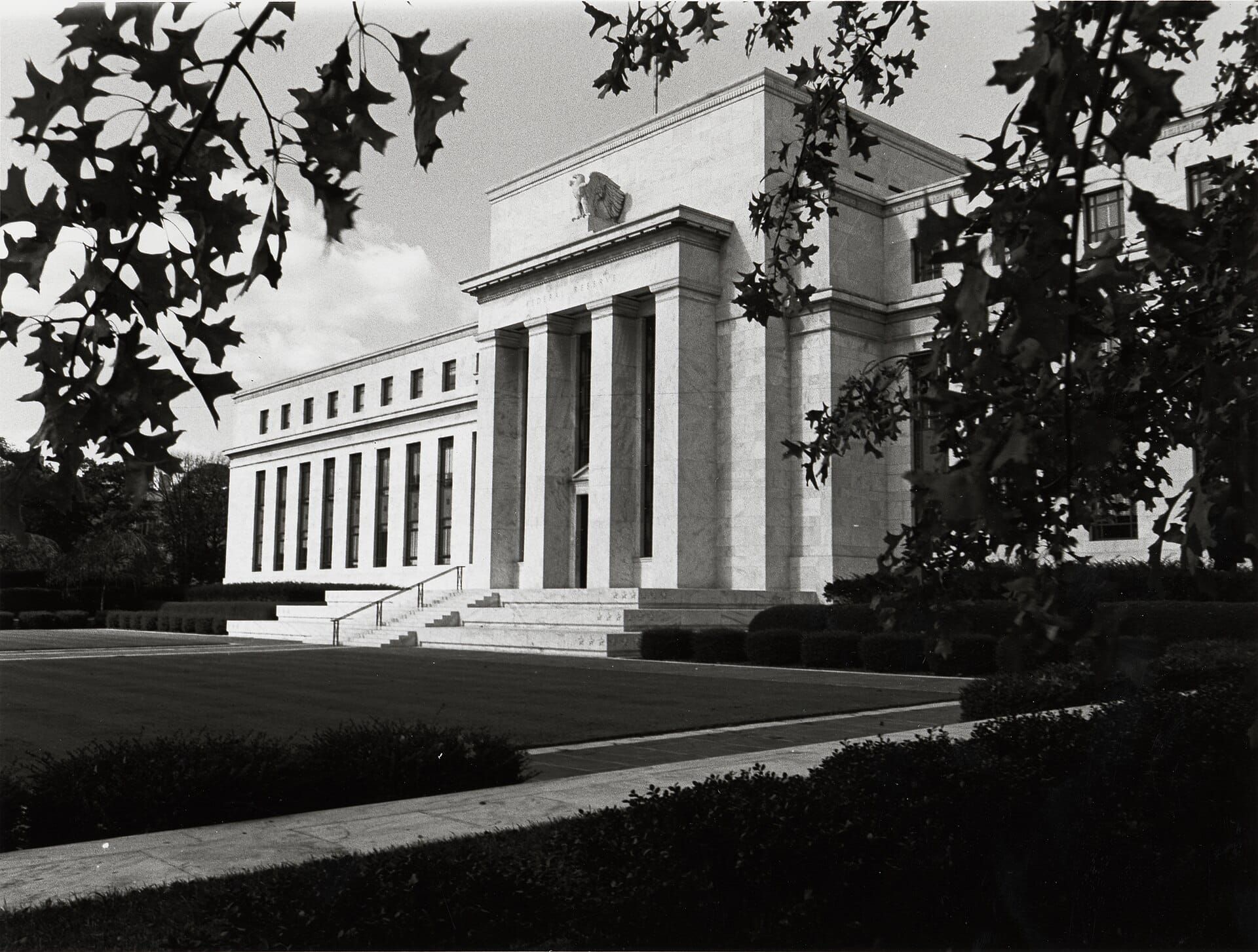
It is worth pausing on the question the name in the title is meant to provoke, because the popular answer is wrong in a way that hides the real one. The claim that the Rothschilds, or any private family, secretly own the Federal Reserve is a myth, and a checkable one. The Fed is a hybrid. Its Board of Governors is a federal agency, its members nominated by the president and confirmed by the Senate. Its twelve regional banks are technically owned by the commercial banks in their districts, which are required to hold stock in them, but that stock cannot be sold or traded, it pays a dividend capped by law, and while member banks help elect regional bank directors, monetary policy is set by the FOMC, where the presidentially appointed Board holds the majority of votes. It is a membership fee dressed as ownership, not a controlling share. No family, foreign or domestic, owns the Federal Reserve.
The myth survives because it points at something real and then names it wrongly. There is a structural dependency at the center of the monetary system, but it does not run through a bloodline. It runs through the mandate. The Fed exists to keep the system liquid and legible, and that function, not any owner, is what constrains what a government may do. Chasing the secret family is a way of not seeing the mechanism in plain sight, which needs no secret owner because it is written into the institution itself. The conspiracy version is almost comforting: it implies that if you removed the family, you would remove the control. The documented version is harder, because there is no one to remove. There is only the architecture, doing what it was built to do.
2008: the function in the open
If you want to see what the architecture is actually for, watch the year it almost failed.
In 2008 the system that had been described in the abstract for a century became visible for a few months, because it nearly stopped. When the largest banks faced collapse, the question that decided the response was never whether ordinary borrowers would be saved. It was whether the institutions whose failure would freeze the whole mechanism could be kept liquid. The Federal Reserve created money on a scale without precedent, extended its backstop to firms it did not regulate, and lent against collateral it would never normally have touched, not to reward anyone, but to keep the circuit closed.
The phrase that emerged from that year said everything: too big to fail. It was not a moral claim. It was a structural one. Certain institutions had become load-bearing walls of the system, and the system could no more allow them to fall than a building can allow its frame to be removed. The citizens who lost homes were not load-bearing. The banks were. That is not corruption; it is the mandate, stated plainly under stress. The Fed exists to preserve the continuity of the system, and in 2008 it did exactly that, demonstrating that the real beneficiary of the architecture is the architecture.
The numbers made the priority explicit. Trillions were created to backstop the financial system within months, while the relief that reached households was smaller, slower, and fought over line by line. The disparity was not malice on anyone's part. It was triage by design. The frame is saved first because everything else depends on it, and the people in the building are, in the system's own logic, contents rather than structure.
What 2008 also established was the precedent for 2020, when the same logic extended past the banks to the markets themselves, and the central bank reached for a private firm to execute the rescue.
The dollar became a weapon
A currency that everyone must hold is not only a utility. It is a lever, and in the last two decades the United States learned to pull it.
Because about half of all international payments, and most cross-currency transactions, run through dollar systems, the network of correspondent banks and the messaging rails that connect them, the power to cut a target out of those systems became a form of force that needs no army. Sanctions are that force. To be excluded from dollar clearing is to be cut off from a large share of world trade and finance, and the United States can impose that exclusion on a country, a company, or a person, largely at will. The dollar's role as the world's settlement layer, built move by move across the twentieth century, turned out to be the most powerful weapon in the American arsenal, and the one that costs nothing to fire.
In 2022 the weapon was used at its fullest. After the invasion of Ukraine, the United States and its allies froze roughly three hundred billion dollars of Russia's central bank reserves, money the Russian state believed it owned, rendered inert by a decision in Washington and Brussels. The message was not lost on anyone watching. If a sovereign's reserves can be switched off, then holding dollars is not only convenience but exposure, and every state with reason to fear American displeasure now had reason to hold something else.
The response is not rhetoric. It is infrastructure. China has built its own cross-border clearing system, CIPS, as a partial alternative to Western payment rails, and pushed to settle a growing share of its trade in yuan. Russia and China now conduct the overwhelming majority of their bilateral trade in their own currencies. The BRICS group has made the search for non-dollar settlement an explicit project, and the world's central banks have turned to gold. None of this displaces the dollar yet, and the commentators who announce its imminent death are wrong; the dollar is still on one side of almost nine in ten currency trades, about half of international payments, and about 57 percent of disclosed global reserves. But the direction was set, and it was set by the weapon's own use. A utility that is never weaponized is simply used. A utility that is weaponized teaches everyone who might one day be its target to build an exit, and the building has begun.
That is the loop that closes the whole argument, and it is visible at this moment in the world's chokepoints. In the spring of 2026, during the Iran war, Tehran demanded passage fees at the Strait of Hormuz, some reportedly paid in yuan, while ships from friendly flags passed more easily than Western-linked ones. In Venezuela in 2026 the United States moved to secure control over the country's oil, a reach for the physical barrel that can be read as a sign of what sanctions alone no longer achieved. Central banks have been buying gold at a near-record pace since that 2022 freeze, accumulating the one reserve that cannot be switched off. Each use of the dollar weapon works in the moment and erodes the trust the weapon depends on, exactly as each rollover of the debt works in the moment and deepens the dependency beneath it. The instrument that enforces the system also wears it down. That is not a flaw the managers can fix. It is the cost of using a utility as a weapon, and it is the same cost, paid in a different currency, that runs through every layer of this story.
When sovereignty became a credit rating
At some point, confidence needed a shorthand, and ratings provided it. States were no longer evaluated primarily by law or legitimacy, but by predictability, reliability, shock absorption. A downgrade could move faster than legislation, faster than elections, faster than war, and once embedded this hierarchy of risk could shift overnight, without debate and without announcement.
Modern states rarely repay debt; they roll it. As long as markets accept the substitution, continuity holds, and when they do not, the system seizes. Interest rates spike, access narrows, collateral tightens, and what was manageable becomes exponential. Intervention arrives not as ideology but as arithmetic. No meeting removes sovereignty and no vote revokes it; the constraint emerges automatically. Portfolio rules trigger sell-offs, sell-offs raise yields, and raised yields compress policy space, so that by the time politics speaks the parameters are already set. Markets are not a will. They are a process: asset managers follow mandates, banks follow collateral rules, insurers follow solvency frameworks, and constraint emerges without intent, which is exactly why it endures.
This is not a theory; it has a recent and precise demonstration. In the autumn of 2022 a new British government announced a budget of unfunded tax cuts. It broke no law and was presented by a government with a large parliamentary majority. Within days the bond market refused it: yields on government debt spiked so violently that pension funds using standard hedging strategies faced collapse, and the Bank of England had to intervene with emergency purchases to stop a chain reaction. The budget was reversed, the finance minister was dismissed, and the prime minister resigned in under seven weeks, the shortest tenure in British history. No army moved, no court ruled, no election was held. The market simply doubted, and the doubt was faster than the entire apparatus of democratic politics. That is sovereignty as a credit rating, shown in real time.
The agencies that issue the rating
If sovereignty has become a credit rating, it is worth naming who issues it. Three private firms, Moody's, Standard and Poor's, and Fitch, rate almost all of the world's sovereign and corporate debt between them. They are companies, not governments, accountable to shareholders, and their judgments move faster and bind harder than most legislation. When Standard and Poor's stripped the United States of its top AAA rating in 2011, Treasuries actually rallied, because the issuer of the world's reserve asset is the one borrower the rating machine cannot discipline. For everyone else a downgrade is consequential not because the agencies command anything but because the system is wired to obey them automatically: pension funds, insurers, and banks operate under rules that force them to sell assets below a certain rating, so a single reclassification triggers waves of selling that no official ordered. The rating is a private signal that the public machinery has agreed, in advance, to treat as law.
When capital acquired a body
In the United States, abstraction gained form. Oil, steel, chemicals, logistics: systems that continue regardless of who governs. Rockefeller in oil, DuPont in chemicals, Mellon in banking and aluminium: examples of how financing moved from lending to states to owning industry, as power migrated from decision to continuity. And the form it took was procedural as much as industrial. Picture a reform that passes parliament, the language precise, the support broad, and then nothing happens. A memo circulates, timelines shift, implementation disappears. The reform exists as text and vanishes as action. No one blocked it. It was simply never scheduled.
The monopoly no one designed
In the present phase the body capital acquired is no longer a family or even a company in the old sense. It is the index fund. Three asset managers, BlackRock, Vanguard, and State Street, together hold around a fifth of the shares of nearly every large American public company, which makes them, collectively, the largest shareholder of most of the corporate economy at once. They did not set out to own everything; they sell cheap funds that simply buy the whole market, and ownership concentrated as a by-product. No one designed the monopoly. It accreted, which is exactly why it is so hard to name and impossible to remove by removing a person.
How fused this layer has become with the state showed in 2020. When the Federal Reserve decided, for the first time, to buy corporate bonds to steady the pandemic markets, it did not build the capacity itself. It hired BlackRock as investment manager to run the purchases, and the program bought, among other things, BlackRock's own bond ETFs: the largest private asset manager administering the central bank's intervention in the very markets it also invests in. The line between the institution that prices the economy and the institution that stabilizes it had thinned to a contract. Capital had not seized the state. The state had simply found that the machinery it needed already existed, privately, and rented it, exactly as it had once rented the Rothschild network to fund a war.
When capital becomes abstract
Capital no longer needs production to legitimize itself. Funds emerge as nodes, aggregators of risk, and BlackRock is not an origin but a condensation. It does not govern states. It prices them. And what is priced is steered without command.
The next form: money that obeys
Every phase of this story has been a step toward finer control with less visible force, from the family network to the central bank to the rating to the index fund. The next step is already being built, and it is the most intimate yet.
Central banks around the world are developing digital currencies, money issued directly by the state in programmable form. The official language is efficiency and inclusion, and those benefits are real. But programmable money is, by design, money that can carry rules inside it: money that can be made to expire, to be spent only in certain places, to be tracked in full, to be switched off for a particular holder as cleanly as a sanctioned bank is switched off today. The legibility that the system has demanded of states for two centuries, the requirement to remain readable to creditors, would extend at last to the individual, whose every transaction becomes a line the architecture can read and, if it chooses, refuse.
This is not hypothetical. China's digital yuan is already the largest pilot of its kind, run across more than two dozen cities with roughly 180 million personal wallets opened, and it has been described by its designers and by analysts as capable of exactly the controls the abstraction implies: balances that expire after a set date, as tested on pilot giveaways, broad visibility of flows to the issuer, which says small payments stay anonymous, and the technical capacity to limit where and by whom money is spent. Not all of those capabilities are deployed, and that distinction matters. But the architecture is built to allow them, and a capability built is a capability available. Other central banks, including the European one, are some distance behind on the same road. Intent differs across jurisdictions, and a democratic digital currency need not become a surveillance instrument; the design can be constrained, and in some places it will be. But the capability is the point. Once money is programmable, the question of what rules it carries is a political choice made by whoever controls the issuance, and the history in this essay offers little reassurance that such a capacity, once built, stays unused.
This is not a prediction of dystopia, and it should be marked as the speculative layer it is. It is the observation that the direction has never changed. Each form of the mechanism has made control quieter, faster, and more automatic than the last, and programmable money is that same logic reaching the final layer, the wallet. The Rothschild network financed states. The digital currency would condition citizens, by the same principle: not by command, but by what the money is permitted to do.
The debt that is never repaid
Underneath all of it is a number that is never meant to reach zero. The national debt of the United States runs into the tens of trillions of dollars, larger than its entire annual economy, and no one in office expects to repay it. That is not a scandal; it is the design. Modern sovereign debt is not a loan to be settled but a permanent instrument that is rolled over endlessly, old bonds replaced by new ones as they mature, for as long as buyers keep showing up. The system works precisely as long as the rollover holds. The danger is never the size of the debt; it is the morning the market hesitates to refinance it, because at that moment the abstraction becomes arithmetic and the cost of the doubt arrives all at once. This is why governments guard their legibility to creditors more carefully than almost any policy goal. The debt does not have to be paid. It only has to remain rollable, and remaining rollable is the quiet condition under which everything else is permitted.
Conditional sovereignty
When states lose market access, they are assisted, and the assistance restores legibility, not autonomy. IMF frameworks narrow fiscal space, bailouts restructure discretion, and survival replaces choice. This is not punishment but stabilization, and stabilization always prefers predictability. Recovery is framed as a return, but in practice it is re-entry under revised terms, because markets remember crises longer than electorates do and risk premiums linger. The state survives. It does not reset.
The cleanest case: Greece
The clearest modern demonstration is Greece. After 2010, shut out of the bond markets, the Greek state was kept solvent by loans from the IMF and its European partners on conditions written into the bailout: deep cuts to spending, pensions, and wages. In 2015 Greek voters elected a government on an explicit promise to reject those terms, and then, in a referendum, rejected them again by a wide margin. For the people it was not abstract. Through that summer Greeks queued at cash machines that dispensed sixty euros a day, pensioners who had voted twice against austerity standing in the heat outside banks that might not open the next morning, while the negotiation that would override their vote ran in Brussels. The referendum result was barely a week old, the No that more than three in five had chosen still fresh, when the government agreed on 13 July to terms harder than the ones the voters had refused, and within weeks Parliament had passed them, because the alternative was the collapse of the country's banks. No tank entered Athens. The vote was real, and it changed nothing material, because the creditors held the only lever that mattered: continued access to the money the state could not survive a week without. Assistance had restored legibility, not autonomy. It is the cleanest case on record of conditional sovereignty, an elected mandate overruled not by force but by the terms of a refinancing.
The strongest defense
It is worth granting the strongest defense of all this, because it is not weak. A system that forces governments to remain solvent, that punishes reckless borrowing with higher rates and rewards discipline with cheap credit, is not obviously tyranny. It can be read as the accumulated machinery of financial stability, the thing that has spared ordinary people the runaway inflations and sudden defaults that destroy savings and wages overnight. On that reading, legibility to creditors is simply prudence, and the market is not overriding democracy so much as protecting it from its own worst impulses. The reading has real force, and any honest account has to carry it.
What it cannot answer is the question of for whom the stability is arranged. The same machinery that disciplines a profligate government also overruled a Greek electorate that had voted, twice, against its own immiseration. Stability for the system is not the same as stability for the governed, and the distance between the two is exactly the space this architecture occupies.
Closing
You think this was a story about families, banks, or funds. That was the entry point.
What it describes is a world in which sovereignty appears only after it has been rendered safe.
The system does not need to be defended. It only needs to be maintained.
Frequently Asked Questions
Does the Rothschild family own the Federal Reserve?
No. No family owns the Federal Reserve. It is a public-private system created by Congress in 1913, overseen by a federally appointed Board, and by law it remits its profits to the US Treasury (payments have been suspended since late 2022, first by operating losses and then until those losses are recovered). The Rothschild name belongs to the nineteenth-century origins of cross-border war finance, not to the ownership of the modern Fed. The real concentration of power lies elsewhere, in the mandate, the bond market, and the index funds.
Who actually owns the Federal Reserve?
The twelve regional Reserve Banks are technically owned by their member commercial banks, but those banks cannot trade or sell the stake, and the system operates under a federal mandate with its surplus paid to the Treasury. Ownership is the wrong lens. Control runs through the legal mandate and the dollar system the Fed administers, not through a shareholder.
Does BlackRock own everything?
No. BlackRock manages assets; it does not own them. The money belongs to its clients, millions of pension holders and savers. But because so much of that money sits in index funds, BlackRock, together with Vanguard and State Street, ranks among the largest shareholders in most major public companies, which concentrates voting influence without concentrating wealth in any single hand.
Who owns most of the US stock market?
No one person or family. The largest blocks of voting shares are held by the big index-fund managers on behalf of ordinary investors. This is a documented and public concentration of shareholder power, the result of how passive investing works, not a hidden bloodline.
Is there a secret family that controls the world economy?
The documented record shows a structure, not a secret family: a central-bank mandate, a global bond market, the credit-rating agencies, and the index funds. The concentration of power is real, but it is largely emergent and on the public record. The interesting question is not who owns it, but how it came to need no owner at all.
Evidence Map
Facts, interpretations, forecasts, and disconfirming signals.
Core claim. Modern states are governed before they are allowed to exist, because financing ceased long ago to be a tool and became a condition: a state continues only so long as it remains legible to creditors and its debt remains rollable. The mechanism is structural, not a family or a cabal; it runs through the mandate of the institutions that manage confidence, from the Bank of England to the Federal Reserve to the rating agencies, the index funds, and the IMF.
Evidence level. Facts (high): the Rothschild international-bond network; the Bank of England's wartime founding; the four documented moves of the dollar system (Bretton Woods 1944, the 1971 gold exit, the petrodollar, the eurodollar market); the Fed's hybrid structure and the falsity of private-family ownership; the 2008 lender-of-last-resort interventions and the 2020 hiring of BlackRock; the 2022 freezing of ~$300bn of Russian reserves; the S&P 2011 US downgrade; the 2022 UK gilt crisis and Truss resignation; the 2015 Greek bailout reversal; the Big Three index managers' combined ~one-fifth ownership of US public companies. Interpretation (medium, marked): that these form one continuous mechanism rather than separate episodes; that the dollar weapon erodes the trust it depends on. Forecast (speculative, marked): that programmable central-bank money extends creditor-legibility to the individual.
What would confirm this. Continued use of dollar exclusion as statecraft met by continued central-bank diversification into gold and non-dollar settlement; sovereign policy reversals driven by bond markets rather than elections.
What would disprove this. States routinely sustaining bond-market defiance without crisis; the rating-and-collateral machinery ceasing to bind policy automatically; reserve managers returning to the dollar despite its weaponization.
Watchlist. The pace of central-bank gold buying and non-dollar oil settlement; CBDC pilots and whether programmability includes restriction; the next sovereign forced to choose between an elected mandate and a refinancing.
Correction, 9 October 2026. After an independent fact-check, this essay was revised. The opening meeting is now identified as a composite. The story that the Rothschilds profited from early news of Waterloo is identified as a myth that originates in an 1846 pamphlet. The text now states plainly that no family owns the Federal Reserve. Several figures, dates and attributions were updated. The full list of changes is recorded in the corrections log on the archive's Standards and Corrections page.
Jerry van der Laan writes The Manifest Archive, Forensic Narrative Intelligence Writing on the systems beneath power, money, and history. He traces the structures beneath them.
Related from The Manifest Archive
- Who Owns the Federal Reserve? The Answer Is Stranger Than the Conspiracy
- Everyone Is Watching the Reopened Strait. Nobody Is Asking Who It Reopened For.
- BlackRock, Vanguard and State Street: The Monopoly No One Designed
- How the IMF Quietly Defines What Democracies Can Afford
- Is the U.S. Dollar Losing Reserve Currency Status? The Quiet Erosion Explained