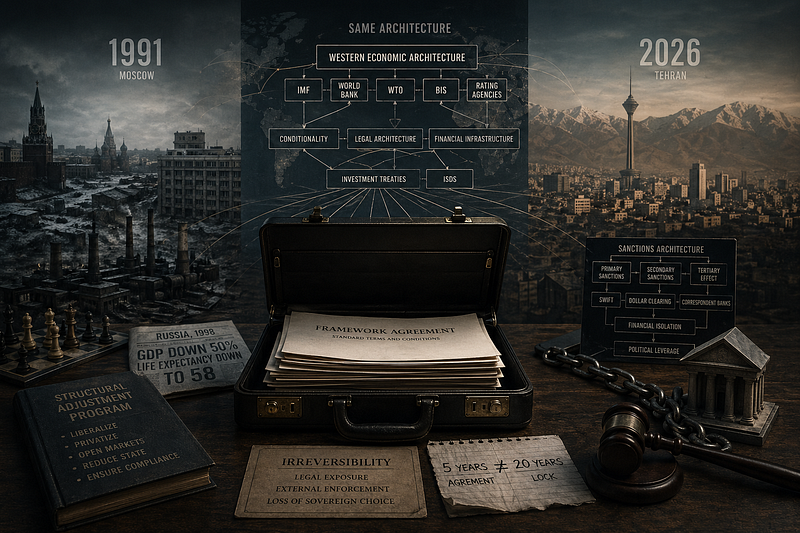
Every country that has entered the Western economic architecture under duress has received the same document. Different names on the cover. The same conditions inside. This is not a theory. It is a thirty-year record. Iran read the record, and what looked across the table in Islamabad like intransigence was in fact the most rational thing in the room: a government declining to repeat an experiment whose results are already known.
The determining variable in those talks was never the number of years of uranium suspension on the table. It was a memory the negotiators on the other side could not see and could not price. The architecture that the United States brought to Islamabad is very good at modeling incentives, leverage, and cost. It has no column for what a country remembers about what was done to the last country that signed.
August 1991, Moscow
The Soviet Union is collapsing outside the windows. Inside, the briefcases are already open.
Western economists arrived with a blueprint. Jeffrey Sachs, then a Harvard professor in his late thirties, had already tested the model in Bolivia and in Poland. The diagnosis was the same everywhere. The prescription was the same everywhere: liberalize immediately, privatize rapidly, open the borders to capital. They called it shock therapy, and the word therapy did a great deal of quiet work, because it framed what followed as treatment rather than as transfer.
What followed is not in dispute. By 1998 Russia had lost roughly half of its gross domestic product, a contraction deeper than the United States suffered in the Great Depression. Life expectancy for Russian men fell to around fifty-seven years by the mid-decade low, a collapse in lifespan with no precedent in an industrial country not at war. A generation of state assets passed, through the rigged loans-for-shares auctions of 1995 and 1996, into the hands of a small group of oligarchs. The mechanism is worth seeing plainly, because it shows the cure and the looting were the same operation. A cash-strapped government, told to privatize fast, borrowed from a handful of well-placed banks and put up the crown jewels of Soviet industry, oil, nickel, metals, as collateral. When the loans were not repaid, the banks kept the collateral, at auctions they themselves administered, for a fraction of its worth. Entire energy companies changed hands for sums a serious buyer would pay for a single refinery. The state did not sell its industry. It pawned it to men who had arranged in advance never to be repaid, and the program that demanded the speed called the result reform. This was not a famine or an invasion. It was the result of a policy, administered by advisers, described in the language of medicine. Tehran watched a nuclear superpower take the prescribed cure and come out the other side with the lifespan of a much poorer country.
That is the human figure under the abstraction, and it is worth holding still. A Russian man who was forty in 1991 belonged to a country that could end the world. By the time the therapy had run its course, the actuarial tables said he would not see sixty. The assets that had been his state's were now seven men's. Nothing had been bombed. The damage came in a briefcase.
The model did not fail. It completed.
The temptation is to call this a botched experiment, a good idea poorly executed. The record does not support that reading. The International Monetary Fund's standard structural adjustment program had been applied to dozens of countries through the 1980s, and its conditions were consistent everywhere: devalue the currency, remove subsidies, privatize state enterprises, open the capital account. The outcomes, in the cases Iran reads as the rule, ran the same way. Bolivia stabilized its currency and broke its workforce. Poland stabilized inflation and produced mass unemployment. Argentina completed the model and defaulted. When the Asian financial crisis hit in 1997, Indonesia accepted the Fund's conditions, and the photograph of the IMF's managing director standing with arms folded over President Suharto as he signed became the era's defining image of what the relief actually looked like; within months Suharto's government had fallen. In every case the program did exactly what it said it would do to prices, and exactly what it never admitted it would do to the society underneath them.
The model did not fail. It completed. That distinction is the whole of Iran's reading. A policy that produces the same result across dozens of applications is not malfunctioning. It is functioning, and the result is the function. When the architects call that result an implementation failure, they are describing the one outcome the design reliably produces as though it were the exception.
There was, occasionally, proof that the architecture served more than one purpose at a time. In 2004 a United States federal court found that Andrei Shleifer, one of the Harvard advisers running the privatization program, had been liable for conduct tied to personal investments in Russian assets made while he administered the American aid contract meant to build Russia's market. Harvard settled the matter in 2005, paying 26.5 million dollars. The men writing the rules for the new Russian market had positions in it. The architecture served the reform and the reformer in the same motion, and a court said so.
The lock that makes the cure permanent
Iran's memory is not only of the damage. It is of the mechanism that made the damage impossible to reverse, and this is the part the coverage of any nuclear talks always omits. Economic integration is the entry point. Conditionality is the price of entry. And the legal architecture is the lock.
Once a country accepts the package, it enters a web of bilateral investment treaties and the investor-state dispute settlement clauses inside them. Those clauses make reversal not merely difficult but legally actionable, in arbitration tribunals seated outside the country's own courts and beyond the reach of its own legislature. A government that later tries to renationalize an asset, or to claw back a privatization it judges to have been theft, does not face a political argument. It faces a damages claim, often for billions, decided by three arbitrators in Paris or Washington or Stockholm. Russia learned the shape of this after 2014: when sanctions followed the Crimea annexation, it could not simply seize Western assets in retaliation without triggering exposure that would outlast the political dispute by decades. It had already learned the scale of it. In 2014 an arbitration tribunal awarded the former shareholders of the dismantled oil company Yukos some fifty billion dollars against the Russian state, the largest arbitral award in history, and the litigation has dragged through European courts for years afterward, attaching to Russian assets wherever they surface. A sum on that order, decided by arbitrators a government never appointed under a treaty its predecessors signed, is not a fine. It is a demonstration that the lock has teeth measured in the tens of billions.
The mechanism is path dependency in its purest form. The early decision to enter the architecture creates switching costs so large that every later government inherits them, regardless of who wins the elections in between. The lock is not enforced by an army or even, day to day, by a sanction. It is enforced by the simple fact that the cost of reversal has been engineered to exceed what any state can bear, so that the choice, once made, makes itself permanent.
What the lock removes, in the end, is exit. A country that has not entered still has the option to walk away, which is the only real bargaining power a weaker party holds. A country inside the architecture has traded that option away and is left with voice, complaint, appeal, lobbying, none of which moves a system designed to be deaf to it. Iran's whole strategy is the preservation of exit. It would rather keep the option to leave a room it has not entered than gain the comforts of a room it could never leave. Stated that way, the refusal is not even unusual. It is what any party does when it has watched the door lock behind everyone who walked in ahead of it. The lock works precisely because it is not political. A government can win an election promising to reverse the deal and still be unable to, because the deal was wired into a legal order it does not control. The architecture that makes any agreement irreversible is the same architecture that makes any agreement unacceptable to a government that has read the record.
The other memory: what happened to those who disarmed
There is a second register to Iran's memory, and it runs in parallel to the economic one. The same lesson, that surrendering your leverage is not rewarded but exploited, was taught a second time in the language of weapons.
In December 2003 Libya agreed to give up its nuclear, chemical, and long-range missile programs. Inspectors from the United States and Britain dismantled them. Muammar Gaddafi was welcomed back into the international order as the model of a state that had chosen disarmament over confrontation. Eight years later, in 2011, a NATO air campaign helped remove him, and he was killed by the forces it enabled. The lesson was not lost on any government weighing whether to trade away a deterrent for a guarantee. Analysts said so at the time, openly: Libya taught the world that the state which disarms first disarms alone.
Ukraine learned the same thing on a different timeline. In 1994, under the Budapest Memorandum, it surrendered the nuclear arsenal left on its soil when the Soviet Union dissolved, the third largest stockpile in the world, in exchange for written assurances of its territorial integrity from the powers that signed. Those assurances were tested in 2014, when Crimea was annexed, and shattered in 2022, when the full invasion came. The country that gave up the weapons was invaded by one of the states that had guaranteed it would not be. Iraq completes the pattern from the cruelest direction. By 2003 it had, in fact, no active weapons program; the arsenal it was accused of hiding did not exist, as the searches after the invasion confirmed. It was invaded anyway, on the strength of the accusation alone. The lesson a watching government drew was not subtle. Disarming had not protected Libya. Surrendering the deterrent had not protected Ukraine. And in Iraq, even being disarmed already, even having nothing left to surrender, had not protected a state once the decision to remove it had been taken. There was no version of compliance that bought safety. The demand to give up the weapons and the outcome of giving them up were, across these cases, simply unrelated.
And then there is the case that proves the rule by inverting it. North Korea did the opposite of Libya and Ukraine. It refused every demand to disarm, endured the sanctions, the isolation, and the condemnation, and built the weapon anyway. It was not invaded. Its leadership was not removed. It sits today as a recognized, if pariah, nuclear state that no one seriously proposes to attack, precisely because it kept the one thing the others gave away. Tehran could hardly have been handed a cleaner natural experiment. Of the states that faced the choice in the past quarter-century, the ones that surrendered their leverage were removed or invaded, and the one that kept it survived. A government drawing the obvious inference from that record is not being paranoid. It is being empirical, and the empirics point one direction.
Hold the two registers together and the memory is coherent. The country that took the economic cure ended with the lifespan of a poorer nation and its assets in seven hands. The countries that took the disarmament deal were removed, invaded, or both. In neither register did surrendering leverage produce safety. Iran did not need a conspiracy theory to reach its conclusion. It needed only to read the obituaries.
What Iran read in the wreckage
Iran and Russia share no deep historical alliance. What they share is a reading of the same sequence of events, and Iran has had thirty-five years to study it from the outside, having never once entered the architecture far enough to be locked inside it.
The sequence, as Tehran understands it, is simple and repeatable. Economic integration is offered as relief. Conditionality is attached as the mechanism. Legal architecture is installed as the lock. Once the lock closes, reversal is no longer a sovereign choice but a justiciable offense. Iran has watched this sequence run, in one register or another, for three and a half decades, and has declined to step onto the first stair of it. That is not stubbornness. Stubbornness is refusal without reason. This is refusal with a bibliography.
Four readings, one conclusion
By now the memory has more than one source, and that is what turns it from a grievance into a finding. Four independent records point the same way. The economic record: the long list of countries that took structural adjustment under duress and emerged stripped. The legal record: the lock of investment arbitration that turns any reversal into a justiciable offense priced in the tens of billions. The military record: the states that surrendered a deterrent and were removed or invaded, against the one that refused and was not. And Iran's own controlled test: the 2015 deal, near-total compliance, and a withdrawal and re-sanctioning regardless.
No single one of these would have to be decisive. A skeptic could call any of them a special case, a matter of bad luck or bad faith in one instance. But four separate bodies of evidence, drawn from economics, from law, from war, and from Iran's own direct experience, converging on the same conclusion is not a coincidence a serious government is obliged to ignore. It is corroboration, the same standard of convergent proof that any investigator trusts more than a single perfect witness. Iran's refusal does not rest on one story. It rests on the point where four of them intersect, and they intersect at no.
The Islamabad framework
This is the memory that sat, unspoken, on Iran's side of the table in April 2026. The talks in Islamabad ran twenty-one hours across three days. The American team, led by Vice President JD Vance with Steve Witkoff and Jared Kushner, presented a framework whose core demand was twenty years of uranium suspension, with economic reintegration described as sanctions relief.
Iran's negotiators did not need the conditionality explained to them, because they had already lived through a controlled experiment in it. The 2015 nuclear deal was that experiment. Iran reduced its enriched-uranium stockpile by ninety-eight percent and accepted the most intrusive inspection regime ever negotiated. In 2018 the United States withdrew from the deal anyway. The stockpile was rebuilt. The sanctions returned. Iran had run the test of whether compliance produces the promised outcome, and the test had returned a clear result: it does not. The architecture survives the deal, and it survives the compliance.
So the gap between five years and twenty years, which the coverage treated as a technical haggle, was nothing of the kind. It was the distance between an agreement Iran believed it could still exit and one it believed it could not. Araghchi offered five. The American side required twenty. The difference was the difference between a door and a lock, and a government that has studied the record will take the door every time. The same memory is visible again in the framework now moving toward a signing, where Iran's resistance to long-horizon, deeply wired terms is read, once more, as obstruction rather than as recall.
What no number could buy
This is why the haggling over years missed the point entirely. The American side kept adjusting the offer, twenty years of suspension, perhaps fewer, more relief, a different inspection schedule, as though the obstacle were the size of the package. But there was no number that could buy what Iran actually required, because what Iran required was a guarantee of reversibility: the assurance that it could enter and, if betrayed again, leave with its sovereignty and its assets intact. That is the single thing the architecture is structurally unable to give, because giving it would dismantle the lock that is the architecture's whole purpose. The negotiators were offering better terms inside a cage. Iran was asking for a door, and a cage cannot grow a door without ceasing to be a cage. No concession on duration could close that gap, because the gap was never in the duration. It was in the nature of the thing on the table.
The architecture outlasts the deal
The sanctions system Iran was being asked to re-enter was built to outlast any particular agreement. Juan Zarate, the Treasury official who helped design the post-2001 version, called it, in the title of his own account, Treasury's War. It works in three layers. Primary sanctions bar American entities from dealing with the target. Secondary sanctions bar non-American entities that deal with the target from American markets. Tertiary pressure threatens the financial institutions that clear for the secondary violators with exclusion from dollar clearing itself. It is a structure that reaches outward through the whole dollar system, which is to say through almost all of world trade.
The proof that the architecture outlasts the deal arrived before any deal was even broken. Iran was cut out of the SWIFT messaging system in 2012. When the nuclear agreement was signed in 2015 and sanctions were formally lifted, European banks stayed away from Iran regardless, unwilling to risk the residual exposure. The legal lifting of sanctions did not restore the access, because the architecture had taught the world's banks a caution that no signing ceremony could undo. This is the over-compliance effect, and it is the architecture's quiet masterpiece. A bank in Frankfurt or Tokyo, weighing whether to finance a now-legal Iranian transaction, knows that a single misstep could cost it access to dollar clearing, the artery through which most of its global business flows. The expected penalty for caution is nothing. The expected penalty for boldness, even lawful boldness, is catastrophic. So the rational bank stays out regardless of what any treaty says, and the sanction enforces itself through the private risk calculations of institutions no government has to order around. Iran got the deal and did not get the economy the deal promised, which is the most precise possible demonstration that the structure is the thing, and the agreement is only the surface.
What would falsify the argument in this piece is a single documented case: a country that accepted full structural adjustment under duress, retained sovereignty over its strategic assets, and emerged with functioning independent institutions and a recovered society. Across dozens of applications of the model, that case has not been established. If it could be, Iran's refusal would look paranoid rather than empirical. Until it can be, the refusal is the conclusion of a long and careful reading.
The honest objection
The strongest case against Iran's reading is that it is selective. Not every country that took the medicine collapsed. Poland, after its brutal early years, grew into one of Europe's success stories. The Baltic states integrated and prospered. South Korea took IMF conditionality in 1997 and emerged stronger. A fair critic would say that Iran has read the worst cases as the rule and ignored the recoveries, and that structural adjustment is a genuine if harsh tool that sometimes works, not a designed extraction that always strips.
The objection is real, and it narrows the claim rather than dissolving it. The recoveries share a feature Iran lacks: they occurred in states that were, or were being pulled into, the Western security and political community, where the same powers that imposed the conditions had a stake in the outcome succeeding. Poland was becoming NATO and the EU. Iran is the designated adversary of the system offering the cure. For a state inside the tent, conditionality can be the painful price of membership. For a state the architecture is built to contain, there is no membership at the end of it, only the lock. Iran is not reading the model wrong. It is reading correctly that the model behaves differently toward those it intends to absorb and those it intends to constrain, and Iran knows which it is.
Institutional memory as the variable that cannot be priced
Step back and the mechanism is clear, and it is more general than Iran. A negotiating architecture built on incentives can model everything an opponent wants and everything it fears. It can price leverage, calculate cost, and find the number at which a rational actor should fold. What it cannot model is a memory. It has no variable for what a government learned by watching the fate of the governments that signed before it, because that learning does not show up as an incentive or a threat. It shows up as a refusal that looks irrational to anyone reading only the current terms, and entirely rational to anyone reading the thirty-year record behind them.
This is institutional memory functioning as a determining variable, the kind of slow, accumulated knowledge that outlasts any single negotiator and any single deal. The American team optimized the terms. Iran was not negotiating over the terms. It was answering a different question, the only question that mattered on its side of the table: what happened to everyone who accepted a version of this before. The two sides were playing different games at the same table, and the architecture, which is superb at the game of terms, has no move for the game of memory.
None of this comes free to Iran, and the cost is the proof that the choice is sincere rather than merely defiant. By refusing the architecture, Iran has accepted decades of sanctions, isolation, a battered currency, and a population that has paid in lost prosperity for its government's unwillingness to step onto the first stair. The refusal is expensive. That it persists despite the expense is exactly what tells you it is memory and not posture, because posture folds when the price gets high enough and memory does not.
And here is the part that should trouble the architects most. The system works by making the lock airtight, the reversal impossible, the commitment total. But the more perfectly it forecloses exit, the more rational it becomes for an informed adversary to refuse entry altogether. The architecture's great strength, its irreversibility, is precisely what teaches the careful student never to sign. It defeats itself most reliably against exactly the opponents who have read it most closely. Iran is the proof that a trap visible enough to be studied is a trap that the studied will not enter.
What the briefcase contained
In August 1991, economists arrived in Moscow with a briefcase and a blueprint that had been tested in dozens of countries. The tests had produced consistent results, which the architects described as implementation failures. In April 2026, negotiators arrived in Islamabad with a framework and a deadline. The framework had been tested too. The test was the 2015 deal, and it had produced a consistent result, which the architects described as Iranian non-compliance. In both rooms the same thing was being offered under two names, and in the second room someone in the chair had read the file from the first.
Iran said no. The coverage described it as a breakdown in talks. The talks did not break down. They reached the limit of what the template could produce against a party that had memorized its history.
A country does not only remember what was done to it. It remembers what was done to others who signed first.
The briefcase is still open. Russia reached inside first, and Libya, and Ukraine, each in its own way. Iran has spent thirty-five years studying what happened to the hand. The architecture accounts for every actor in the room. It does not account for institutional memory. That is the one variable it cannot price, and in Islamabad it is the variable that decided everything.
Evidence Map
Facts, interpretations, forecasts, and disconfirming signals.
Core claim. Iran's refusal at the April 2026 Islamabad talks, and its resistance to long-horizon nuclear terms generally, is best read not as stubbornness but as institutional memory: a thirty-year reading of what happened to states that surrendered economic or military leverage under duress (Russian shock therapy, the IMF structural-adjustment record, the ISDS legal lock, Libya's 2003 disarmament, Ukraine's 1994 nuclear surrender, and Iran's own JCPOA experience). The determining variable is a memory the incentive-based architecture cannot model or price.
Evidence level. Facts (high): Russia's roughly 50 percent GDP fall and the collapse in male life expectancy in the 1990s; the IMF structural-adjustment record; the 2004 liability finding and 2005 $26.5M Harvard settlement in the Shleifer case; Iran's 98 percent JCPOA stockpile reduction, the 2018 US withdrawal, the 2012 SWIFT exclusion; Libya's December 2003 disarmament and 2011 removal; Ukraine's 1994 Budapest Memorandum and the 2014/2022 invasions. Interpretation (marked): that these form a single coherent record Iran is rationally reading, and that institutional memory is the operative determining variable. The reading is explicitly narrowed in the objection section (recoveries exist for states being absorbed, not contained).
What would confirm this. Iran continues to refuse long-horizon, deeply wired terms while accepting short, exitable ones; its negotiating red lines track reversibility and legal exposure rather than the headline numbers.
What would disprove this. A documented case of a state that accepted full structural adjustment under duress, kept sovereignty over its strategic assets, and emerged with functioning independent institutions, which would make the refusal paranoid rather than empirical; or evidence that Iran's red lines track immediate cost rather than the irreversibility of the architecture.
Watchlist. Whether Iran's terms in the current framework center on duration and exit rights; the fate of states currently entering conditionality; whether any reversal of a privatization or integration succeeds without ruinous arbitration exposure.
Related from The Manifest Archive
- Jeffrey Sachs Had Six Weeks to Restructure Russia. The Contracts He Left Behind Are Still Running
- The Iran Talks Failed. The Language Failed First
- Everyone Is Watching the Iran Deal. Nobody Is Watching the Veto Outside the Room
- In 1990, James Baker Promised Russia NATO Would Not Move One Inch Eastward
Jerry van der Laan writes The Manifest Archive. He traces the structures beneath the events.