On Friday the United States and Iran are due to sign the memorandum that is supposed to end their war. Two delegations, two signatures, a ceremony in Geneva, sixty days of talks to follow. Everyone is watching whether the ink goes on the page. And the country that can dissolve the entire agreement will not be holding a pen, because it was never asked to sign and has already said it considers itself unbound.
This is the part of the deal that the framing as a US-Iran agreement hides. The document is bilateral. Its survival is not. In the last days of the negotiation, by Iran's own account, it secured into the terms a condition that has nothing to do with its own conduct and everything to do with a third party: Israel must withdraw its forces from Lebanon, or, in the words of Iran's foreign minister, "the war cannot be considered fully concluded." With that single clause, the fate of an agreement between Washington and Tehran was handed to a government that is party to neither, and that government has already refused. The determining variable in whether the Iran war ends is not a term the signatories control. It is the decision of the actor who is not at the table.
Two cautions belong here at the start, not buried at the end, because everything that follows rests on them. The first is a limit on the case. The agreement is not public, and its two signatories do not even agree on whether the Lebanon condition is in it: Iran says it is, an American official says it is not. So the specific claim, that Iran wired an Israeli withdrawal into the deal, is reported rather than confirmed, and if that clause turns out not to exist, much of the reading below dissolves with it. The second caution pulls the other way and is the more important of the two. The structure this clause creates is not peculiar to Iran or Israel. It is a recurring shape: an agreement whose outcome is controlled by a party who never signed it. The Iran deal is only the clearest current instance of a pattern that runs through debt restructurings, trade pacts, UN resolutions, and alliance politics. Hold both at once. The specific fact is uncertain. The general mechanism is not, and the mechanism is the reason this is worth reading even if the particular clause is later denied.
The signing, and the seat that is empty
Look first at the architecture of the thing, because the architecture is the story. The agreement is between the United States and Iran. The ceremony, set for the nineteenth, has two principals. The sixty-day clock that follows is a US-Iran clock. By every visible feature, this is a bilateral deal, and it is being reported as one, a war between two powers brought to a close by those two powers.
But the condition that now dominates the headlines concerns a third country that is at neither end of the table. Iran's position, stated this week, is that the deal requires Israel to leave nearly all the Lebanese territory it occupied during the war, keeping at most a few hilltop points along the border. Israel did not negotiate that term, did not agree to it, and is not a signatory to the document that contains it. It is being asked to perform the decisive act in an agreement it had no part in writing. The seat that determines whether the deal lives is the one seat that is empty.
The condition Iran appears to have wired in
If the condition is real, it did not appear by accident, and seeing the apparent deliberateness is what turns it from a complication into a mechanism. By regional accounts, Iran insisted on including Lebanon in the accord in the final days of the negotiation. That timing, if those accounts hold, matters. A condition inserted at the end, after the substance is largely settled, is not a negotiating position being worked through. It is a lever being installed. Iran took a front it influences through its regional partners and bound it to the central agreement, so that the question of the war's end would no longer rest only on Iranian and American choices but on an Israeli one.
The logic is cold and effective. Iran cannot compel Israel to do anything. But it can structure an agreement so that Israeli inaction collapses the deal, and then point at Israel as the party that broke the peace. By making its own compliance conditional on someone else's withdrawal, Iran converted a weakness, its inability to dictate to Israel, into a form of leverage: it no longer has to win the argument with Israel, it only has to make Israel the reason the war resumes. Foreign Minister Araghchi's framing, that the war "cannot be considered fully concluded" without the withdrawal, is not a description of facts on the ground. It is the construction of a tripwire, with Israel's boots on it.
Why Lebanon is the lever Iran reached for
Of all the conditions Iran could have attached, it chose this one, and the choice is not arbitrary. Lebanon is the front where Iran's influence runs through a partner rather than its own forces, and that is exactly what makes it usable as a lever without exposing Iran directly. Through Hezbollah, Iran has a stake in southern Lebanon that it can press while keeping its own hands off the trigger. And the choice is sharpened by how weak that stake has become. Hezbollah, Iran's prototype partner, was badly degraded through 2024, its senior command struck, its arsenal thinned, and its overland resupply corridor severed when Assad fell in Syria. With its Lebanese proxy no longer able to project force at the scale of earlier years, Iran's remaining lever in Lebanon is less a military threat than a political one, which is precisely why it reaches for a clause rather than a rocket. A withdrawal condition written into someone else's deal is the instrument left to a patron whose forward militia can no longer do the pressing itself. Earlier ceasefire arrangements in this war did not formally cover Lebanon, and the fighting there simply continued, which taught both Iran and its partners that an agreement which leaves Lebanon out leaves the war effectively running. So Iran moved to close that gap, not by fighting harder in Lebanon, but by making Lebanon a clause.
Hezbollah's own posture shows the lever working. The group has demanded a full Israeli withdrawal from Lebanese soil and has warned explicitly against a repeat of the 2024 ceasefire, under which Israeli forces stayed on Lebanese ground after the guns went quiet. It has framed Lebanon's inclusion in the broader deal as a major achievement, a step toward the return of residents displaced from the border villages. Whatever one makes of the group, the structural point holds: Iran and its partners are running the linkage strategy deliberately and openly, tying the conclusion of the larger war to a local withdrawal they know Israel is unwilling to make. The lever was chosen because it is the one place Iran can apply pressure through someone else, and someone else's pressure is harder to answer than your own.
Israel never signed, and says so plainly
The party holding the veto has not been quiet about holding it. Israel's prime minister said this week that Israeli forces would remain in Lebanon "as long as necessary." His national security minister was blunter still: "Trump's agreement does not bind us." That sentence is the entire mechanism in five words. A government is announcing, in public, that an agreement signed by the United States and Iran imposes no obligation on it whatsoever, which is simply true, because it is not a party to it.
And this is what makes the veto so durable. A signatory can be held to a deal; there is a signature to point at, a commitment to invoke, a cost to breaking faith. A non-signatory can be held to nothing. Israel owes the agreement no compliance because it promised the agreement nothing. So the one actor whose decision determines whether the war ends is also the one actor under no obligation to decide either way. The deal has placed its survival in the hands of the party least bound to preserve it. That is not a flaw the negotiators overlooked. It is the predictable result of making an agreement depend on someone who never agreed.
Why Israel can afford to say no
A veto is only as strong as the holder's willingness to use it, and here the willingness is overdetermined, because refusing serves Israel's domestic logic regardless of the war. The current Israeli government depends on a coalition in which hard-right ministers hold real weight, and for that coalition, remaining in southern Lebanon is not a cost to be minimized but a position to be defended. The national security minister's flat declaration that "Trump's agreement does not bind us" is aimed as much at a domestic audience as at Washington or Tehran. It tells the coalition that the government will not be maneuvered off Lebanese ground by a deal it did not sign, and that message has its own value at home, independent of anything happening in the war.
This is the part that makes the veto reliable rather than merely available. An outside party that held the power to collapse the deal but had no desire to use it would be no obstacle; the linkage would resolve quietly. The danger in this structure is that the outside party's incentives point toward using the veto. Staying in Lebanon costs the Israeli government little domestically and arguably helps it, while withdrawing on the schedule of a US-Iran agreement would read at home as taking orders from a deal struck with the enemy. So the agreement has not only handed its survival to a non-signatory; it has handed it to a non-signatory whose own politics reward refusal. The geometry and the incentives line up in the same direction, toward the deal not holding.
What Iran bought with the linkage
It is worth asking what Iran actually gained, because the answer shows the linkage is not desperation but design. By most accounts Iran came out of the war badly damaged: bases and infrastructure hit, its leadership thinned, the bulk of its missile force destroyed, by the American president's own count something like eighty-five percent of it, a figure independent assessments treat with some caution. On the battlefield, Iran lost. Whether by design or not, the linkage has the effect of converting that military setback into a political position.
Consider what the Lebanon condition does for Tehran regardless of whether Israel ever moves. It changes who the defeated party appears to be. An Iran that simply accepted terms after losing would be a supplicant. An Iran that conditions the war's end on an Israeli withdrawal is, in its own telling, no longer the party that lost but the party demanding a just conclusion that another government refuses to grant. The military result and the political result are pulled apart, and the political result is set not on the battlefield but by the clause. Commentators have noted that Iran is, in effect, winning the contest over what the deal means even as it lost the war the deal is ending. That is the deeper function of linkage for the weaker side: it cannot change the outcome of the fighting, but it can change the story of the ending, and the story is often what survives. The battlefield decided who was stronger. The clause, if it stands, decides who gets blamed if the peace fails, and on Iran's own account the clause is written so that the blame lands on the one party that never signed.
The signatories cannot agree on what they signed
Here the structure becomes almost vertiginous, and it is the detail that confirms the whole reading. The deal is not public. And the two parties who are signing it do not agree on whether the Lebanon condition is even in it. Iran says the withdrawal is required. An American official has said the deal does not call for any Israeli withdrawal at all. So the central term, the one the entire agreement now hangs on, exists or does not exist depending on which signatory you ask.
Sit with what that means. This is not a dispute over how to interpret a clause. It is a dispute over whether the clause is there. The veto-holder, Israel, is being asked to act on a condition that one signatory insists is binding and the other signatory says was never agreed. An agreement whose two authors cannot confirm its contents has not closed anything. It has created a space in which each party can tell its own public a different story: Iran can say it secured an Israeli withdrawal, Washington can say it conceded no such thing, and Israel can say it is bound by none of it. Three accounts, one unsigned page, and a war suspended on top of the contradiction.
How linkage manufactures a veto
Step back and the general mechanism is visible, the one that outlives this particular war. The move Iran made has a structure, and the structure recurs wherever agreements are built. Take an agreement between two parties. Make it conditional on an action controlled by a third party who is not in the agreement. You have just handed that third party a veto, whether or not anyone intended to. The third party now decides the fate of a deal it never joined, because the deal cannot complete until it acts, and it is under no obligation to act.
This is the quiet power of linkage. It does not require the third party's consent, only its relevance. By tying the end of the war to Israeli withdrawal, Iran did not need Israel to agree to anything; it only needed Israel's action to become load-bearing. And once an outside party's action is load-bearing, that party's inaction becomes a weapon it can fire by doing nothing at all. Israel does not have to lift a finger to collapse this deal. It collapses by Israel remaining exactly where it is, which is precisely what Israel has announced it will do.
The asymmetry is the proof. On one side of the scale, the end of a war that closed the Strait of Hormuz, convulsed oil markets, and drew in the United States. On the other, a few square miles of occupied hillside in southern Lebanon and the question of whether one government moves off them. The smaller fact governs the larger one, not because the hillside matters more than the war, but because the agreement was wired so that the hillside controls the war. That is what a manufactured veto does: it makes a small, local, controllable thing into the switch for a large, regional, uncontrollable one.
The variable, said out loud
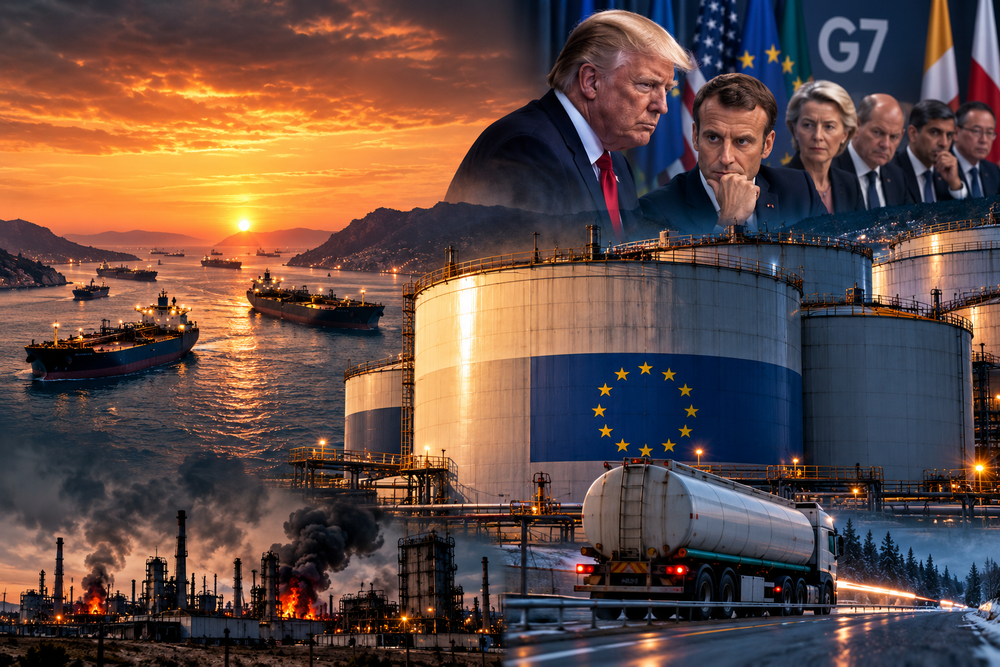
The Manifest's usual task is to surface the determining variable that no one will name. This time the variable was named, on the record, by the most powerful participant in the war. Asked at the G7 summit in France why he had moved to end it, the American president did not cite victory, or the nuclear question, which the deal in fact defers rather than resolves. He said he did not want to continue the war because it would "ruin the world market," that he did not want to see economic catastrophe. That is the determining variable spoken aloud. The war was not ended because a side had won. It was ended because the global economy could not keep paying for it, and the man with the most power inside the conflict said so plainly.
The scale behind the admission is not rhetorical. The International Energy Agency called the disruption the largest in the history of the global oil market. The International Monetary Fund's adverse scenarios put global growth as low as around two percent, with inflation climbing past five and toward six percent, as the strait that carries a fifth of the world's oil sat effectively shut. The war's cost was never confined to the two countries fighting it. It fell on every economy that runs on the oil and the trade routes the conflict closed, which is to say all of them. The president's phrase was not hyperbole. It was an accurate description of who actually pays for this war: everyone.
And yet, in the same days, the same president has threatened to resume the bombing if Iran does not comply. Hold the two statements together, because they do not fit. If continuing the war would ruin the world market, then restarting it would ruin it just the same; the bombs do not become cheaper to the global economy because there has been a pause. The threat to resume the strikes is a threat to do the very thing he has just said he cannot afford to do. That is what strains the threat on its own terms: a demand for compliance backed by a weapon the threatener has publicly admitted is too expensive to use. He keeps brandishing the bombing as if it were the enforcement mechanism, but the threat appears bound by the same economic limit that ended the war, and its credibility becomes, at the least, unclear: the bombs that would ruin the world market cannot easily be the credible price of enforcing a deal struck to protect it. And to the degree force is constrained by that limit, the deal's enforcement does not rest only on American bombs. It rests also on the parties the bombs were never going to reach, which carries the question back toward the one government sitting outside the agreement entirely.
And this is where the admission collides with the veto, and the collision is the whole point. Trump named the world economy as the reason the war must end. Iran then wired that ending to an Israeli withdrawal from Lebanon. Israel owes the deal nothing. So the entire global stake that the American president invoked, the world market he said he was acting to protect, has been placed at the mercy of a single non-signatory government's decision about a strip of occupied hills. The larger the stake, the more powerful the veto, because the more the world needs the deal to hold, the more leverage flows to the one party that can refuse to let it. In the same week that the stake was stated out loud as nothing less than the world economy, that stake was handed to the one actor under no obligation to safeguard it. The president named the price of failure, and the power to trigger that failure sits with a government that will not pay it.
The party that refused the table holds the table
There is a principle here that reaches past Iran and Israel, and it inverts the usual way we read negotiations. We assume the power in a deal sits with the parties at the table, and that whoever stays away has forfeited influence. The opposite is often true. The party that refuses to sign frequently ends up holding the most decisive position, because it keeps all of its freedom while the signatories spend theirs. The signers are bound; the abstainer is not. The signers have made commitments that can be called in; the abstainer has made none. When the deal then depends on the abstainer, the people who signed discover they have negotiated away their own leverage to a party that kept all of its.
Israel, by staying out of the US-Iran agreement while remaining the hinge on which it turns, occupies exactly this seat. It carries no obligation, faces no penalty for the deal's failure, and yet decides that failure. The empty chair is not empty of power. It is the only chair in the room whose occupant can walk away from the table without having lost anything, which is why it is the chair that decides whether there is a deal at all. The decisive vote in this agreement belongs to the one government that was careful never to cast one.
The shape recurs far outside this war, which is what makes it worth naming. A single permanent member of the UN Security Council can void the will of all the others by doing nothing but raising a hand. A lone holdout creditor can block a debt restructuring that every other bondholder has accepted, because the deal needs unanimity and the holdout kept its refusal in reserve. One European Union member can freeze a decision the other twenty-six want, simply by withholding the consent that unanimity requires. In each case the structure is identical: a rule makes completion depend on a party who can always choose not to complete, and that party's power comes entirely from its freedom to abstain. The most decisive actor in a system is often not the strongest one but the one whose participation is required and whose refusal costs it nothing. Find the seat that can say no without paying for it, and you have found where the real decision lives.
The spoiler has a long history
This is not the first time the decisive actor in a deal was the one who refused to join it, and the pattern has a name in the study of peace processes: the spoiler, the party outside an agreement with both the incentive and the capacity to break it. Agreements between the willing are routinely undone by the unwilling who were never asked to sign, because a settlement that does not include everyone with the power to wreck it has simply postponed the wrecking. The lesson of decades of failed truces is that the relevant question is not who signed, but who could break it and was left free to.
The closest precedent sits in the same conflict. When the United States and other powers reached the nuclear agreement with Iran in 2015, Israel was not a party to it. It signed nothing, was bound by nothing, and opposed the deal openly, its prime minister going so far as to argue against it before the American Congress. A non-signatory's sustained opposition helped set the conditions under which the United States abandoned the agreement three years later. The deal was made by its parties and unmade, in part, by a country that had never been one of them. The structure now visible in the 2026 agreement is the same structure, stated earlier and more explicitly: the actor outside the room shaping the fate of the deal inside it. What is new in 2026 is only the honesty of the wiring, the linkage written in at the end rather than left to play out over years.
Who waits on the hilltops
It is worth being concrete about who actually waits on the outcome, because the architecture is abstract and the consequence is not. The clause everything turns on is a line of occupied hills in southern Lebanon, and below those hills are villages whose residents fled the fighting and have not gone back. For them, whether they return is not a question of memoranda or ceremonies. It is the question of whether soldiers on a ridge, soldiers who answer to a government that signed nothing in Switzerland, receive an order to move. A family from a border village does not wait on the signatures in Geneva. It waits on a hilltop decision made by a third government for its own reasons, and that is the whole mechanism rendered in human scale: the people most affected by the deal are waiting on the one party to it that never agreed to anything and feels no obligation to them. The agreement can be signed in full and change nothing on the ridge, and the ridge is where the people are.
Why everyone narrates it as a deal between two
If the veto is this visible, why is the war still being reported as a bilateral settlement between Washington and Tehran. Because the ceremony is built to be read that way. There will be two flags on Friday, two principals, two signatures, and the image of a two-party agreement is so much cleaner than the reality of a three-body problem that the coverage will take the image. The cameras frame the room that exists, not the seat that is missing, and a missing seat does not photograph.
And the bilateral frame survives because it serves all three governments at once, each for its own reason. Washington gets to present a war ended, a diplomatic achievement with two signatures and a date. Tehran gets to present a hard-won conclusion in which it dictated terms about Lebanon to the stronger side. Israel gets to stand outside the frame entirely, bound by nothing the cameras recorded. A two-party story lets each of the three tell its own domestic audience the version it needs, which is exactly why none of them has an interest in correcting it. The empty seat is not hidden by accident; it is left out because its absence is convenient to everyone who is present. The structural truth would embarrass all three at once, and a fact that embarrasses everyone with the power to state it tends to stay unstated.
This is the same substitution the Manifest keeps finding, the visible story standing in front of the structural one. The visible story is a deal between two powers. The structural reality is a deal between two powers whose survival is controlled by a third, and the third is the only one of them under no compulsion to keep it alive. To watch the signing on Friday is to watch the two parties who can be held to the agreement perform their commitment, while the one party who cannot be held to anything decides, off camera and at its leisure, whether their performance will mean anything at all.
What would have to be true for this to be wrong
The honest test of this reading is to name what would refute it. If Israel quietly withdraws from the Lebanese territory in the coming weeks, whether under American pressure or for its own reasons, then the veto was never decisive, the linkage resolved itself, and the deal will have held on its own terms. Equally, if it emerges that the Lebanon condition was never truly part of the agreement, that Iran asserted it for domestic consumption and the operative deal never contained it, then there was no external veto, only an Iranian talking point, and the agreement between Washington and Tehran stands or falls on its own bilateral terms after all. The mechanism described here depends on the linkage being real and binding. If the linkage dissolves, so does the analysis.
The strongest objection to this whole reading is that the veto is not really free at all, because the United States holds substantial leverage over Israel, through military aid, weapons resupply, and diplomatic cover, and could in principle compel the withdrawal it needs to save its own deal. If Washington chose to spend that leverage, Israel's refusal would fold, and the external veto would turn out to be soluble after all. This is a serious objection, and it is the right place to test the thesis rather than dodge it. But notice what it does: it does not remove the determining variable, it relocates it. The deal's survival would then depend not on the signatories' terms but on whether Washington is willing to coerce its closest ally on the ally's most sensitive front, something it has historically been deeply reluctant to do. So the veto is "free" precisely to the degree that the United States declines to pay to override it, and that decision sits outside the agreement too, in the politics of the US-Israel relationship rather than in anything Iran or the document controls. The objection does not restore the deal to its two signatories. It hands the deciding choice to a different actor outside the room, the American domestic and alliance politics that determine whether Washington will lean on Jerusalem. Either way, the outcome is set offstage.
And it would be easy, and it would be wrong, to read this as a story about Israeli obstruction or Iranian bad faith, to assign the villain and move on. The point is structural, not moral. Iran installed the linkage because linkage is what a weaker party reaches for when it cannot compel a stronger one. Israel refuses the obligation because a non-signatory has no reason to accept one. The United States accepts the ambiguity because an ambiguous deal is easier to sign than an honest stalemate. Each party is behaving exactly as its position dictates, and the veto is not a betrayal by any of them. It is the geometry of an agreement that was built to depend on someone who was never part of it.
The chair that was never filled
So watch Friday's ceremony. Watch the signatures and the flags and the language about a war brought to an end. But if you want to know whether the war is actually over, do not watch the two governments signing. Watch the one that is not there. Watch whether Israeli forces move off the Lebanese hills, because that movement, by a government that signed nothing and owes nothing, is the only event that will tell you whether the deal was real. The signatures bind the people who can be bound. The outcome belongs to the people who cannot. The bound cannot decide it, and the one who decides it is not bound.
By now the count has risen. There is not one empty chair outside the room but two. The first belongs to Israel, which can break the deal by staying where it is. The second belongs to the government that could force it to move and chooses whether to. Neither sits at the table, neither is bound by what is signed, and between the two of them they hold the outcome the signatories will perform on Friday. The deal has two authors with pens and two deciders without them.
An agreement that depends on a party who never signed it is not an agreement. It is a wager on a stranger. And the stranger, this time, has already said that the bet does not bind him.
This is the part worth carrying out of the specific war, because it is true wherever deals are made. The decisive seat at any table is often the one that is empty. When an outcome is made to depend on a party who can refuse at no cost to itself, the power has already left the room before the signing begins, and the signatures only record who agreed to be bound while the one who matters stayed free. Before you ask what a deal says, ask who can break it and was never asked to sign. That name, not the ones on the page, is where the decision lives.
Evidence Map
Facts, interpretations, forecasts, and disconfirming signals.
Core claim. The US-Iran agreement due to be signed on 19 June 2026 is structurally trilateral, not bilateral: Iran made the war's conclusion conditional on Israeli withdrawal from occupied Lebanese territory, handing an effective veto to Israel, a non-signatory that has rejected the condition and owes the deal nothing. The determining variable of whether the war ends is therefore an Israeli decision the signatories do not control, compounded by the fact that the two signatories publicly disagree on whether the Lebanon condition is even in the deal. The American president has stated the stake openly, that he moved to end the war because it would "ruin the world market," while simultaneously threatening to resume bombing on non-compliance, a threat whose credibility appears constrained by the same economic limit, which pushes enforcement away from US force and back toward the external veto-holder.
Evidence level. Facts (high): the planned 19 June US-Iran signing and 60-day window; Araghchi's statement that the deal requires Israeli withdrawal from Lebanon and that the war "cannot be considered fully concluded" without it; Iran's insertion of the Lebanon condition late in talks; Netanyahu's "as long as necessary" and Ben-Gvir's "Trump's agreement does not bind us"; a US official's statement that the deal does not call for Israeli withdrawal; the deal being non-public with contradictory official accounts. Interpretation (marked): that this constitutes a deliberately manufactured external veto, and that a non-signatory's freedom from obligation is what makes the veto decisive.
What would confirm this. The deal stalls or collapses over the Lebanon question rather than over US-Iran terms; Israeli action or inaction in Lebanon, not the signatures, becomes the event that determines whether the ceasefire holds.
What would disprove this. Israel withdraws from the Lebanese territory and the deal proceeds (the veto was not decisive); or the Lebanon condition turns out never to have been part of the operative agreement (there was no external veto, only an Iranian assertion), and the deal stands or falls on its bilateral terms.
Watchlist. Whether the 19 June signing occurs on schedule; Israeli troop movements in southern Lebanon; whether US and Iranian accounts of the Lebanon clause converge or stay contradictory; Hezbollah's posture on the withdrawal demand; the 60-day talks.
Related from The Manifest Archive
- Everyone Is Watching Trump and Iran. A Committee in London Decides If the Peace Is Real
- The Iran Talks Failed. The Language Failed First
- Everyone Is Watching the Iran War. Nobody Is Watching What It Is Breaking
- Iran Never Forgot What Happened to Russia. That Is Why the Islamabad Talks Failed
Jerry van der Laan writes The Manifest Archive. He traces the structures beneath the events.