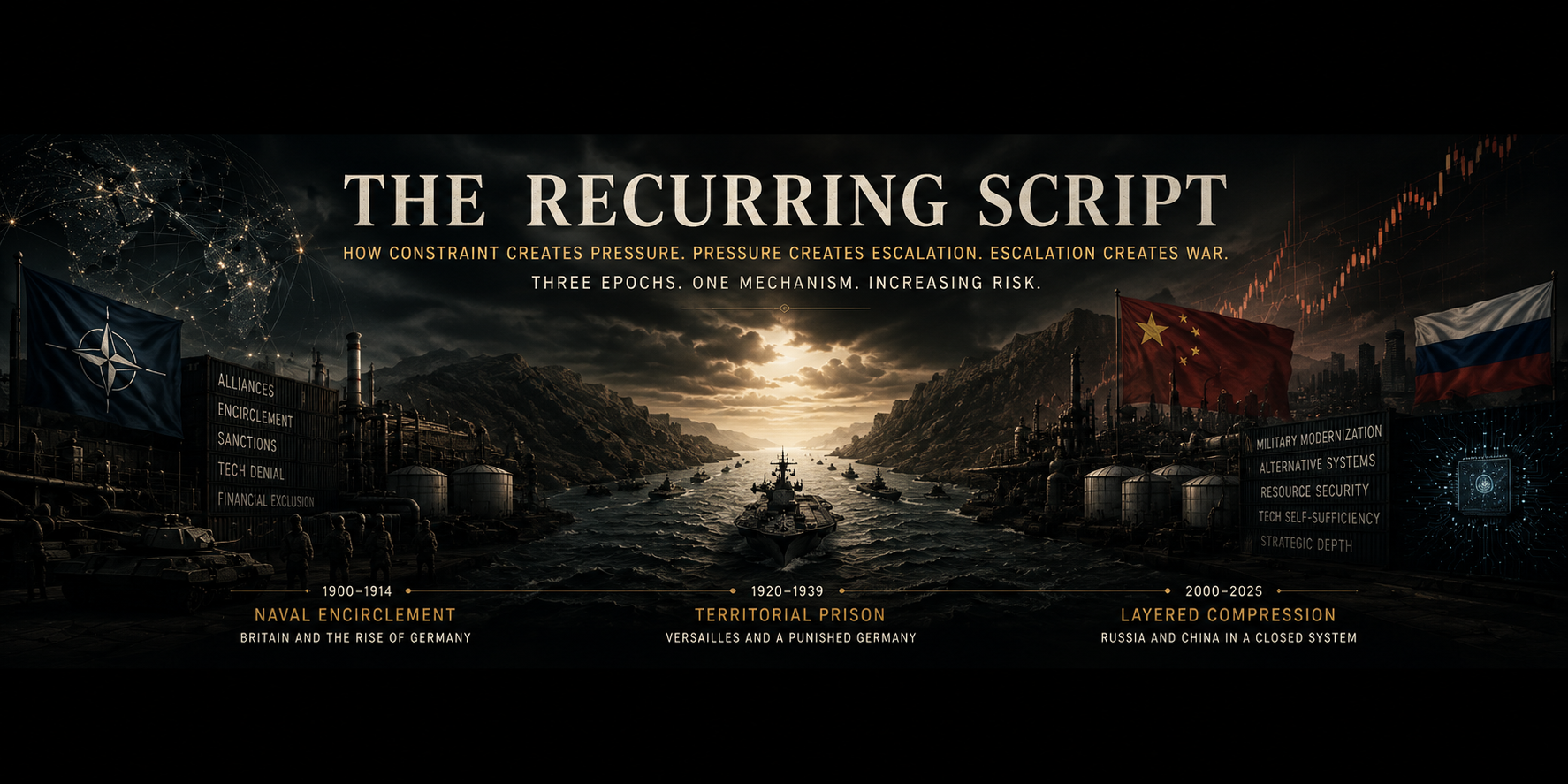
There is a pattern in how dominant powers respond to rising challengers. It appears three times in modern history with nearly identical institutional logic: the dominant power constructs a constraint-architecture designed to slow the challenger's rise. The constraint generates pressure. The pressure accumulates. Both sides escalate. Neither side can stop without admitting that dominance itself might not be permanent.
This is not inevitable. It is not the inevitable result of power-shift dynamics. It is the result of how institutions respond to power-shift dynamics. how military establishments, political parties, media systems, defense industries, and nationalist movements all have incentives to interpret constraint-pressure as requiring escalation.
The pattern repeats: 1900-1914 (British naval encirclement of rising Germany), 1920-1939 (Versailles constraint on Germany plus territorial prison in Eastern Europe), 2000-2025 (NATO expansion plus economic/technological exclusion of rising Russia and China). Each time, the dominant power built constraints knowing they would generate pressure. Each time, institutions on both sides locked into escalation logic. Each time, the system lost flexibility.
What we are watching now is the third repetition of this pattern reaching its critical phase.
Naval Encirclement: 1900-1914
Britain in 1900 faced a structural problem: it had built global dominance on naval supremacy, but that supremacy was eroding. Germany was rising. economically, militarily, technologically. It had the Ruhr, the chemical industry, rapid industrial expansion, and ambitions in naval power that directly challenged British Atlantic control.
Britain's response was constraint-architecture: the Entente Cordiale with France (1904), the Anglo-Russian Accord (1907), naval agreements that defined spheres, alliances designed to absorb or encircle rising German power. From Britain's perspective, this was balance-of-power maintenance. From Germany's perspective, it was encirclement. strategic pressure designed to prevent German expansion.
The constraint was real and measurable. Britain's naval budget in 1900 stood at 46 million pounds annually; by 1910, responding to German naval expansion, it had risen to 68 million. Germany's naval spending, meanwhile, grew from 34 million marks (1900) to 98 million marks (1912). The symbolic moment came with the launch of HMS Dreadnought in 1906: a revolutionary battleship designed to neutralize German numerical advantages through technological superiority. The ship's launch triggered an arms race spiral that neither side could escape. Germany felt enclosed: French alliance to the west, British sea-power to the north (with nearly 30 dreadnoughts by 1914), Russian alliance to the east. The constraint generated pressure. German military planning became focused on breakthrough: the Schlieffen Plan envisioned a crushing two-front victory because waiting, accepting permanent encirclement, was not strategically acceptable.
But why did Britain constrain when constraint would generate pressure? Because British military establishments, political systems, media, and defense industries had structural interests in perceiving German rise as threat. The Royal Navy's budget depended on German naval expansion being visible as existential. Admiral Jackie Fisher, reforming the Navy from 1904 onward, required threat narratives to justify new Dreadnought production and force modernization. British politics required German hostility to justify naval investment to taxpayers. The Daily Mail and The Times, Britain's dominant newspapers, profited enormously from naval threat narratives; circulation jumped during the 1905, 1908, and 1911 naval crises. British defense industries (Armstrong-Whitworth, Vickers-Maxim, John Brown shipyards) benefited directly from shipbuilding contracts justified by German competition. Each announced German building program triggered parliamentary debate and new British construction orders.
From Germany's side, the same institutional logic operated. German military leadership saw constraint as requiring military expansion. Grand Admiral Alfred von Tirpitz, commanding German naval development from 1897, required threat narratives (British encirclement, Russian containment) to justify the Navy Laws of 1898, 1900, 1908, and 1912, each escalating German battleship production. Each law passed the Reichstag because deputies understood them as responses to British pressure. German politicians required these threat narratives to justify rearmament and domestic mobilization to their constituencies. German media profited from war narratives; nationalist papers like Alldeutscher Verband publications benefited from circulation spikes during crisis moments. German industry profited from military contracts justified by external threat: the Krupp works, Blohm and Voss shipyards, and Daimler-Benz all expanded production capacity as government military orders expanded. The constraint-pressure cycle locked every major industrial actor into escalation logic.
A German finance minister, reviewing naval spending in 1910, noted in private correspondence that the budget had become self-justifying. Every British ship announcement triggered German spending plans. Every German spending plan was reported in British newspapers as German aggression, triggering British counter-spending. The political dilemma was rational and desperate: slow rearmament meant accepting German subordination; accelerate rearmament and be accused of aggression; accept subordination and face nationalist uprising. Every solution created a new constraint. The machinery had acquired momentum independent of anyone's will to slow it.
Neither side created the constraint-pressure spiral with intention to destroy; both sides had institutional incentives that made de-escalation impossible. No British politician could reverse naval expansion without admitting British dominance might be temporary. No German politician could accept permanent subordination without triggering nationalist backlash. The system locked. By 1914, flexibility had narrowed to single shots. The constraint ruptured.
Territorial Prison: 1920-1939
Versailles represents a different constraint-architecture: punitive constraint designed not to balance but to suppress. Germany was not rising after 1918; it was imprisoned.
The terms were clear: territorial loss (Alsace-Lorraine, Rhineland, Polish corridor), reparations designed to be unpayable, military limitations (100,000-man army, no air force, no submarines), and a treaty structure that made German recovery impossible without international consent. The reparations schedule reveals the punitive intent: annual payments of 2.5 billion gold marks (later restructured under Dawes Plan 1924 and Young Plan 1929), a sum that dwarfed Germany's annual tax revenue. The initial reparations demand stood at 132 billion gold marks, a figure deliberately calibrated to be politically acceptable in France while mathematically impossible for Germany to pay. The Dawes Plan (1924) offered restructuring, but only as a tool to extract payments; the Young Plan (1929) promised an end date (1988) only to reset the cycle when enforcement became politically difficult.
This was constraint with a different character than Britain's encirclement. It was overtly punitive, designed to keep Germany subordinate permanently, not to manage rising power but to prevent rising power from emerging. The constraint generated pressure through accumulated grievance rather than military threat. Versailles created a power with legitimate complaint but no legal pathway to status change. A German diplomat, surveying the treaty terms in 1919, understood the rational trap: accept the terms and remain permanently subordinate; reject the terms and be militarily crushed again. Accept subordination and face domestic collapse; seek revision and be branded aggressor. The constraint was so architecturally complete that escape itself became the only logical option, even knowing escape would trigger the very war the constraint was designed to prevent. The constraint was so tight that the only exit was through the constraint itself: territorial revision, rearmament, rejection of the treaty system.
Simultaneously, Eastern Europe was locked into territorial prison by design. New states created by Versailles (Poland, Czechoslovakia, Romania, Yugoslavia) contained 15 million ethnic minorities trapped across redrawn borders. The Polish Corridor, separating East Prussia from Germany, created permanent territorial grievance for German-speaking populations exceeding 2 million in border regions and endless German-Polish tension. Sudeten Germans (3.3 million) in Czechoslovakia found themselves in a minority state with linguistic barriers. Transylvanian Hungarians (1.5 million) in Romania experienced similar structural subordination. Yugoslav borders grouped Serbs, Croats, and Muslims under centralized Serbian control. Each state was economically weak, dependent on foreign capital, and structurally unstable. All were trapped between German and Soviet pressure, unable to achieve genuine independence, captured in a constraint system designed by outside powers to serve outside interests (French security against Germany, British restraint of French dominance).
The institutional logic was identical to 1900-1914. French military establishments required German threat narratives to justify Maginot Line spending (completed 1938, cost approximately 5-7 billion francs). British political systems required threats to justify rearmament (which came slowly, and too late: 1935 Anglo-German Naval Agreement preceded full rearmament by three years). Media systems in Britain, France, and Germany all profited from escalation narratives. The German press (controlled by Nazi apparatus from 1933 onward) reported Versailles as deliberate strangulation; the French press reported German rearmament as existential threat; the British press oscillated between appeasement and alarm depending on political winds. Defense industries benefited from rearmament contracts: Krupp received expanded orders for artillery and tank production as German rearmament accelerated; French arms manufacturers (Schneider, Hotchkiss) benefited from Maginot Line construction and military modernization; British shipyards and aircraft manufacturers expanded during the rearmament period. Nationalist movements in both rising (Germany) and declining (Britain, France) powers benefited from threat-based mobilization. German nationalism fed on Versailles grievance; British nationalism fed on restored power; French nationalism fed on security fear.
The constraint ruptured in 1939, not because escalation was inevitable but because the constraint-pressure-escalation cycle had locked institutions into positions that made negotiated exit impossible. No French political leadership could negotiate territorial revision without domestic collapse. No German political leadership could accept permanent subordination without nationalist backlash. The system had no release valve.
Layered Compression: 2000-2025
The modern iteration shows all three constraint types simultaneously. defensive constraint (NATO expansion), punitive constraint (sanctions on Russia), and systemic exclusion (technology denial, economic isolation for China and Russia).
NATO Expansion and Encirclement (1999-2022)
Russia after 2000 was not militarily rising but strategically rising. recovering economic capacity, asserting regional influence, claiming space that had been subordinate during the 1990s. The Western response was NATO expansion: a precise timeline of institutional encirclement. Poland, Hungary, and Czech Republic admitted 1999 (Madrid Summit decision, 1999 implementation). Estonia, Latvia, and Lithuania admitted 2004 (NATO meeting, military integration beginning); Russian response immediate: increased military spending in Western Military District, doctrine shifted toward NATO as primary threat. Romania and Bulgaria admitted 2004 (Black Sea NATO presence established); Russian response: military modernization in Southern Military District accelerated. Georgia and Ukraine consideration 2007-2008 (Bucharest NATO Summit signals eventual membership); Russian response: military exercise escalation, 2008 Georgia military intervention as constraint-breaking attempt. Finland admitted 2023, Sweden admitted 2024 (Arctic NATO presence); Russian response: Arctic military command restructuring, doctrine updated to include NATO Arctic threat.
From the Western perspective, this was balance-of-power maintenance and alliance protection for smaller states. From Russia's perspective, it was precision constraint designed to prevent Russian recovery through graduated institutional enclosure. Both perspectives are structurally true. Each expansion wave followed the same pattern: Western decision justified by Russian military behavior; Russian military behavior escalated in response to Western constraint.
Technology Sanctions and Economic Exclusion (2020-2025): The Architecture of Humiliation
China after 2000 was economically rising at historically unprecedented pace. But this rise was read through a specific institutional lens: not as normal development but as reversal of a humiliation that institutional memory had never released. The Century of Humiliation (1839-1949) remained the psychological touchstone of every Chinese institutional actor. Foreign powers had carved the country into spheres of influence. Western technology had been withheld. Western capital had dominated development pathways. Western institutions had defined China's role in the global system. By 2000, a generation of Chinese leadership had come to power with institutional mandate: never again. Technological self-sufficiency was not mere economic goal. It was civilizational requirement. National rejuvenation was not optional political positioning. It was Party legitimacy itself.
The Western response layered three constraint mechanisms. First, defensive constraint: Pacific military presence expanded from 2010 onward ("pivot to Asia"), alliance structures deepened (AUKUS 2021, Quad 2022), "First Island Chain" military positioning explicit. Second, technological exclusion: US Semiconductor Design Restrictions Act (2023), TSMC manufacturing constraints (Taiwan export controls, 2022-2023), ARM processor access denial to Chinese companies (2023), x86 architecture restrictions, advanced chip manufacturing technology embargoed. Semiconductor restrictions directly prevent civilian semiconductor industry from accessing 7nm manufacturing, cutting off technological parity pathway. Third, systemic exclusion: separate payment systems developed (China's Cross-Border Interbank Payment System, bypassing SWIFT), trade restrictions expanded (tariffs, export controls), technology transfer restrictions formalized.
But where Western institutions read these constraints as "security measures," Chinese institutions read them through the architecture of historical exclusion. Not new oppression, but renewed oppression. The constraint was experienced as deliberate technological imprisonment. A Chinese technologist, watching 7nm manufacturing frozen, understood it as: the West has declared you forbidden from the technological pathways that lead to equality. This is not policy. This is structural subordination masquerading as security.
The Party's legitimacy depended on visible rejuvenation. Xi Jinping's entire political positioning rested on "national rejuvenation" language. A government that admitted permanent technological subordination would be admitting institutional failure. That admission could trigger cascading legitimacy crisis inside Party structures. Constraint was not experienced as temporary restriction. It was experienced as Western veto over Chinese civilizational recovery. De-escalation would require Chinese leadership to accept that it could not achieve technological independence. No Party structure could survive that admission.
China's maritime anxiety added another layer. The South China Sea carried 30 percent of global maritime trade. Taiwan Strait controlled access to Pacific shipping. If Western powers controlled these straits through alliance structures and military presence, they controlled Chinese economic bloodstream. The First Island Chain was not abstract geopolitics. It was economic asphyxiation potential. Chinese military modernization was not aggression. It was the institutional response to perceived blockade architecture. Not intended blockade, but functional blockade created by alliance structures and military positioning.
The constraint generates pressure proportional to its tightness. Russia accelerates military spending (defense budget increased from $34 billion 2008 to $70 billion 2024), develops new strategic systems (hypersonic missiles, Arctic capability), expands regional influence (Syria intervention 2015, Ukraine intervention 2022), and intensifies confrontation with NATO. China accelerates technological development (domestic chip design companies expanded, AI research accelerated), builds alternative financial systems (digital yuan, CIPS expansion), expands regional trade dominance (Belt and Road Initiative expanded across 149 countries), and increases military capability in contested zones (South China Sea military buildup, Taiwan strait military exercises). Each escalation appears to the Western side as validating constraint strategy. Each constraint appears to the Chinese side as validating escalation requirement.
Defense Industry Incentive Alignment
Both rising powers have genuine strategic interests independent of Western constraint. Russian regional security concerns are real. Chinese economic growth is real. But the constraint-pressure cycle amplifies both into escalation pathways. More critically, defense industries on both Western and non-Western sides profit from the cycle. Lockheed Martin, Raytheon Technologies, Boeing profit margins increased 2022-2025 as "China threat" and "Russia threat" drove US defense spending from $820 billion (2021) to $900+ billion (2025). European defense primes (Rheinmetall, Leonardo, Airbus DS, EADS) similarly benefited from "Russian threat" spending surge (German Sondervermogen defense investment 100 billion euros 2022, Polish defense spending increased 50 percent 2022-2025). Chinese defense industrial complex (AVIC, China State Shipbuilding Corporation) benefited from "Western containment" narrative driving domestic military spending. Russian defense industry (Rostec corporations, UAC, Almaz-Antey) benefited from NATO expansion narrative justifying military modernization.
The institutional lock-in is now mature. No Western defense contractor benefits from China-Russia de-escalation. No Chinese military manufacturer benefits from Western technological access. No Russian defense industry benefits from NATO dissolution.
Institutional Lock-In Mechanism
The institutional machinery operates identically across all three periods.
Military establishments on both sides interpret constraint as requiring military expansion. NATO expansion is justified by Russian military capability. Russian military expansion is justified by NATO encirclement. Both are simultaneously true. No military establishment on either side has institutional incentive to signal de-escalation because de-escalation signals weakness and threatens budget allocation.
Political systems require escalation narratives to maintain legitimacy. American political systems require "strategic competition" language to justify defense spending and alliance leadership. Russian political systems require "existential threat" language to justify mobilization and centralization of power. Chinese political systems require "century of humiliation reversal" language to justify party control and state expansion. All three are simultaneously true and mutually reinforcing.
Media systems report constraint-pressure as existential threat, which justifies escalation responses, which validate threat narratives, which justify further constraints. The feedback loop operates identically on all sides. Russian media reports NATO expansion as invasion threat. Western media reports Russian military buildup as threat. Chinese media reports Western technological exclusion as containment. All three reports are accurate; all three feed escalation logic.
Defense industries profit from both constraint and escalation. Constraint justifies military spending. Escalation justifies industrial expansion. Weapons manufacturers, military suppliers, strategic technology firms, and logistics providers all benefit from both sides' expansion. No industrial constituency has institutional incentive to signal de-escalation because de-escalation removes justification for military contracts.
Nationalist movements in both rising powers (Russia seeking to recover lost status, China seeking to reverse humiliation) and declining powers (American, European nationalist movements seeking to restore lost dominance) all benefit from threat narratives and escalation language.
The system locks. Both sides have genuine security concerns. Both sides' escalation appears to justify the other's escalation. No institution inside either power structure has incentive to signal flexibility because flexibility becomes institutional liability. Constraint tightens. Pressure accumulates. Escalation pathways narrow. Adaptive flexibility collapses.
Why Constraints Exist: The Security Dilemma and Institutional Dominance
To understand the constraint-pressure-escalation pattern, we must understand both why dominant powers constrain and why rising powers escalate. Both are structurally rational from their own perspectives.
Dominant powers constrain because they face genuine security concerns. British constraint on Germany was not paranoia; German industrial capacity was genuinely rising (Ruhr production 1900-1914 increased 300 percent), naval ambitions were genuine (Dreadnought program documented), and Germany's location created genuine strategic vulnerability for Britain. NATO expansion is not baseless; Russian regional interests are genuine, and smaller states' security concerns are real. Western constraint on China is not irrational; Chinese military modernization is real (defense spending $280 billion 2024, 10 percent annual increases 2015-2025) and focused on regions of Western interest (South China Sea, Taiwan strait).
But genuine security concerns become institutional escalation machinery through budget justification processes. Pentagon budget process requires threat assessment; threat assessment requires adversary capability documentation; capability documentation drives worst-case scenario planning; worst-case scenario planning justifies larger budgets. Each step is logically sound, but the system escalates threat perception automatically. Russian military doctrine updates in response to NATO expansion create NATO "threat assessment" data; NATO responses create Russian "threat assessment" data. Chinese military exercises create US Pacific Command threat assessments; US alliance building creates Chinese threat assessments. The machinery grinds forward independent of anyone's intention to escalate. No actor designed it this way. Every actor built exactly this.
Rising powers escalate because constraint is experienced as threatening. German constraint was experienced as encirclement threatening existence. Russian constraint is experienced as NATO expansion threatening security. Chinese constraint is experienced as technological exclusion threatening development (semiconductor restrictions directly prevent civilian semiconductor industry from accessing 7nm manufacturing, cutting off technological parity pathway).
Both sides are structurally right. Both sides have rational security concerns. Both sides' escalation appears to justify the other's escalation. The machinery operates automatically.
Constraint Types and Their Functions
Defensive constraint operates through alliance structures. Its function is to maintain favorable balance by absorbing potential rivals or making their expansion costly. British Entente, NATO expansion, Pacific alliance-building all fall here. From the constraining power's view: balance maintenance. From the rising power's view: encirclement.
Punitive constraint operates through imposed restrictions. Its function is to prevent the rising power from rebuilding capacity. Versailles is the clearest historical case. From the constraining power's view: preventing future threat. From the rising power's view: permanent subordination.
Systemic exclusion operates through technology denial, financial restriction, and information barriers. Its function is to prevent the rising power from achieving systemic integration or technological parity. Semiconductor restrictions on China, SWIFT sanctions on Russia, technology export controls on sensitive domains all fall here. From the constraining power's view: security protection. From the rising power's view: structural strangulation.
All three types generate the same institutional response: pressure accumulation that cannot be safely released without admitting dominance might be temporary.
The Institutional Lock-In Mechanism
The narrowing persists because reversing it requires the dominant power to admit that dominance might not be permanent. But this admission would trigger institutional collapse inside the dominant power.
If American political leadership admitted that American dominance might be temporary, it would have to justify American military spending to American voters without the dominance narrative. That is institutionally impossible. The same applies to French leadership in 1930, British leadership in 1910, and Russian leadership vis-a-vis China.
Similarly, rising powers cannot accept permanent subordination because that would require their political systems to justify permanent status subordination to their populations. That too is institutionally impossible. German populations could not accept permanent Versailles subordination. Russian populations cannot accept permanent NATO encirclement. Chinese populations cannot accept permanent technological exclusion.
Neither side can change course without institutional rupture inside their own power structures. The enclosure tightens. Pressure accumulates. Escalation pathways narrow. The system locks.
The machinery grinds forward. It has been grinding for 126 years across three continents. No one designed it as a grinding machine. No one intended it to operate this way. It grinds because each piece of it responds rationally to pressure. And rational pieces, assembled together, create something larger than the sum of their rationality. The grinding has its own weight.
Institutional Lock-In in Practice: Four Historical Moments
The theory becomes concrete in moments when de-escalation was possible but institutional structures prevented it.
Cuban Missile Crisis (October 1962). This moment reveals de-escalation functioning through institutional override. President Kennedy and Secretary Khrushchev, acting outside their military establishments' escalation logic, negotiated privately and reached settlement. The US Joint Chiefs of Staff advocated bombing Cuba; the Soviet military pushed for defense escalation. Kennedy and Khrushchev's personal negotiation superseded both militaries' institutional incentives. The lesson: de-escalation requires institutional override at the highest level, not institutional consensus. The system's default is escalation.
Georgia 2008. Georgia attacks Russian-backed Ossetia; Russia responds militarily. The EU negotiates ceasefire (six-point peace plan, August 2008). But the constraint structure holds: Georgia not admitted to NATO, but Western movement toward it continues. NATO non-entry prevents tripwire escalation; Russian inability to accept Georgian NATO membership prevents true settlement. The pressure release is blocked by the constraint architecture itself. Military establishments on both sides rejected true de-escalation because neither could achieve security through negotiation: Georgia military wanted territory back; Russia military wanted security guarantee neither side could provide under constraint. The system locked again.
Ukraine 2014-2022. Ukraine moves toward EU/NATO; Russia responds with Crimea annexation. Minsk agreements (2014, 2015) attempted de-escalation but failed because constraint structure made implementation impossible. NATO cannot accept Ukraine as member without creating tripwire effect for nuclear power. Russia cannot accept Ukrainian NATO membership without admitting constraint failure. Ukraine cannot remain independent without external support. Institutional incentives made every negotiation point a non-starter. The constraint became fully self-sustaining: constraint generates pressure, pressure prevents negotiation, pressure prevents de-escalation, constraint intensifies.
Taiwan 2022-2025. US constraint (military support, strategic ambiguity) meets Chinese constraint (military modernization, military exercises). Taiwan is the weight that holds both sides in place. De-escalation barriers structural: Pentagon requires "China threat" narrative for defense budgets; Chinese military modernization embedded in economic planning; Taiwan trapped between constraints; both sides' domestic nationalist constituencies reject compromise. The constraint-pressure cycle has accelerated to near-rupture threshold. No institutional actor on either side has incentive to signal flexibility because flexibility becomes political liability.
Pattern across all four: Institutional incentives align to make constraint self-sustaining. Actors cannot exit without institutional rupture inside their own power structures. Each attempted de-escalation fails not because leaders lack will, but because institutional machinery prevents settlement.
The Mechanism Revealed: Structural Pattern, Not Destiny
The recurring script is not destiny. It is a structural pattern that emerges when three conditions align:
- A power transition (rising challenger, declining dominance)
- Constraint-architecture designed to manage the transition (alliance, punishment, exclusion)
- Institutional incentives inside both powers that make de-escalation impossible
Given these three conditions, the escalation cycle becomes predictable but not inevitable. Uncertainty remains in timing, intensity, and outcome. But the basic pattern. constraint, pressure accumulation, escalation, institutional lock-in, adaptive rigidity. repeats.
The pattern operates through a feedback mechanism that becomes self-sustaining once initiated. Dominant institutions cannot imagine permanent status change, so they build containment architecture. This architecture generates immediate pressure on rising powers, who experience it not as temporary management but as existential subordination. Rising powers escalate in response. Both sides watch the other's escalation and interpret it as evidence that their own constraint was justified. Each move validating the move that preceded it, each escalation justifying further enclosure. The machinery acquires momentum. Flexibility becomes liability. Institutions that signal accommodation lose budgets, lose political standing, lose constituency support. The system locks not through malice but through institutional self-interest aligning perfectly with escalation logic. No single actor needs to want rupture. The structure produces it automatically.
The pattern is not inevitable within each period. German rise did not necessarily require World War I; it could have been managed through power-sharing arrangements. The rise of Russia and China does not necessarily require escalation; it could be managed through status recognition and system adaptation.
But given the constraint-pressure dynamics and institutional lock-in mechanisms, escalation becomes increasingly probable. The probability of rupture increases with:
Tightness of constraint (Versailles was tighter than British encirclement).
Magnitude of pressure (Chinese rise is larger than German rise).
Institutional rigidity on both sides (modern institutional structures are more rigid than 1900s).
Absence of pressure-release mechanisms (modern systems have fewer release valves than 1914).
Domestic institutional incentives for escalation (more developed in 2020s than 1900s).
The Strongest Case Against This Analysis
The strongest counterargument to this reading is also the most tempting: peaceful power-shifts happen regularly throughout history. The Concert of Europe managed multiple rising powers (France after Napoleon, Germany in the 1870s, the United States in the 1890s) without permanent constraint-architectures. Institutions can change. Dominant powers have accepted new distributions of power without institutional collapse. This analysis, in this view, overstates the rigidity of institutional structures and underestimates human agency and political will to find negotiated solutions.
This counterargument is structurally serious. It correctly identifies that institutional change is possible, and that willingness to share status has produced stable transitions. But modern constraint-architectures are not the Concert of Europe. They are designed differently. NATO is not a temporary alliance subject to renegotiation. it is permanent, with institutional sunk costs measured in decades of integration. Defense budgets are not episodic. they are continuous, built on threat-narratives that cannot be lowered without political cost. Media ecosystems do not report equilibrium. they report crisis, generating engagement and profit from escalation-narratives. Defense industries have become vertically integrated with state procurement, creating constituencies for production that operate independently of geopolitical need. And nationalist movements, once mobilized, have momentum independent of the constraints that created them. The institutional lock-in is not tighter because the actors are less wise, but because the architecture of constraint has become self-reinforcing at every level. Without partially dismantling or redesigning that architecture, peaceful transition requires the very institutional redesign the analysis describes as unlikely. The strength of the counterargument is also its limitation: it assumes the institutions we have can be changed as easily as the institutions of the past.
The Architecture Operates Without Intention
The recurring script is not the result of malice or grand conspiracy. It is the result of institutional structures responding predictably to power-shift dynamics. No malevolence is required. Only structures.
British dominance did not require cruel constraint on Germany; it required constraint to maintain favorable balance. That constraint, given German industrial rise and German political structures, generated pressure. That pressure, given German military institutions and German political systems, generated escalation. That escalation, given both sides' institutional incentives for further escalation, generated lock-in.
The same applies to the current period. Western constraint on China and Russia is not malicious; it reflects genuine security concerns and institutional responses to power-shift dynamics. Chinese escalation is not aggressive; it reflects genuine development interests and institutional responses to constraint. Russian escalation is not expansionist; it reflects genuine regional security concerns and institutional responses to encirclement.
Both sides' actions are rational from inside their own institutional structures. Both sides' escalation appears to justify the other's escalation. Neither side's institutions have exit pathway without institutional rupture.
The rupture becomes increasingly probable not because anyone intends it but because the structure-pressure-lock-in cycle progressively narrows exits and progressively removes flexibility.
The architecture accounts for every actor except one. The constraint system operates without conspiracy, pure rationality within institutional incentives, and predictable escalation given structural incentives. The actors (military establishments, political leaders, media systems, defense industries, nationalist movements) are not villains. They are institutions responding predictably to constraint-pressure dynamics. Taiwan is the mechanism that holds both sides in the positions their institutions require them to hold.
The pattern is not destiny. But it is structural. The machinery does not require hatred. Only pressure. And actors unable to move.
Related from The Manifest Archive
- NATO Encirclement: How Three Rational Decisions Locked Eighty Years Into Place
- The Five Mechanisms That Lock America Into Unwinnable Wars
- The Architecture Cannot Move: How Energy, Defense, and Currency Locked Themselves Into Permanent Tension
- Everyone Is Watching the Iran War. Nobody Sees the Complete Picture