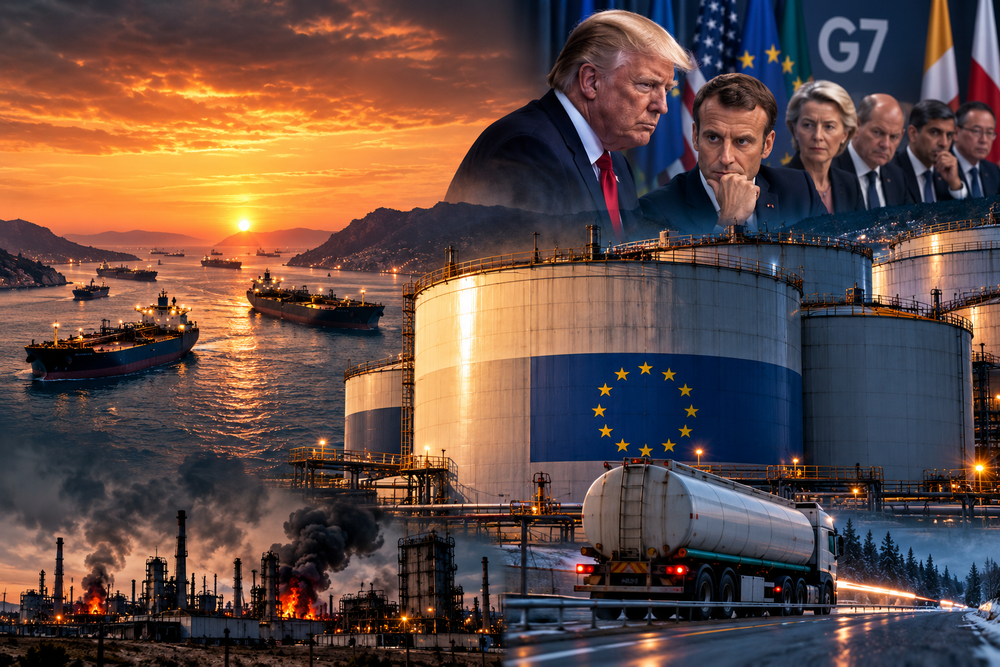
Treasury issued the alert as warning to shipping firms. Iran reads it as confirmation. The list of six payment methods names what the sanctions cannot reach.
Singapore, Saturday morning. A compliance officer at a commodity-trading desk opens the OFAC alert before the market opens. The document is meant as a warning. He reads it as confirmation. The six categories match the internal memo his firm circulated in March. He does not mark it as risk.
Treasury did not need to publish a list.
Closing loopholes does not require categories. A warning to shipping firms could read in two sentences. Do not pay Iran’s tolls. Sanctions risks apply. That would be sufficient as enforcement notice. It would not require an inventory.
On Friday, the Office of Foreign Assets Control issued one anyway. The alert was titled Sanctions Risks of Iranian Demands for Strait of Hormuz Passage. The financial press covered it as a warning to shipping companies. It is that. But to leave the reading there is to miss what the document actually contains.
The alert lists, in two short paragraphs, the methods Iran uses to receive payment for safe passage through the Strait. Not in the abstract. By name. By instrument. By recipient. By disguise.
Fiat currency. Digital assets. Offsets. Informal swaps. Other in-kind payments.
And then the part that made the financial-compliance lawyers sit up: nominally charitable donations made to the Iranian Red Crescent Society. Donations to Bonyad Mostazafan, the Iranian foundation tied to the Office of the Supreme Leader. Payments routed through Iranian embassy accounts in third countries.
The Treasury Department of the United States, in an official document carrying the seal of OFAC, named six categories of payment methods that exist outside the global banking system. It did not need to do this. It did it anyway. The reason matters.
Sixty-four days, and a sentence that does the work
It is sixty-four days since the air strikes of February 28, 2026. It is twenty days since the United States blockaded Iranian ports on April 13. President Trump claimed this week that the dual blockade is costing Iran 500 million dollars a day. The Department of Defense estimates Iran has lost 4.8 billion dollars in oil revenue by May 1.
Inside this arithmetic, Iran has built a toll system. Commercial vessels coordinate passage through the Strait by paying. The reports describe rates around two million dollars per supertanker, though the OFAC alert itself does not specify amounts. Insurance premiums for war-risk transit have moved from forty thousand dollars to between six hundred thousand and one point two million dollars per voyage.
These are not signals. They are price movements recorded by insurers who carry the risk. Insurers do not price hypotheticals.
Lloyd’s Joint War Committee redesignated the Strait. Seven of the twelve P&I insurance clubs cancelled coverage for the area within forty-eight hours of February 28.
These are facts that appear in trade-press reporting, in maritime underwriter notices, in shipping-firm advisories. They form the visible part of the architecture.
The OFAC alert names the invisible part. The part where the toll actually gets paid.
The evidentiary base is narrow but sufficient. The OFAC alert names the categories. Lloyd’s redesignated the Strait. War-risk premiums moved from forty thousand to over one million dollars per voyage. These are documented shifts, not interpretations. Everything beyond this point is analysis.
Read the list on its own terms
The conventional reading of the alert is: Treasury is closing loopholes. That reading is not wrong. It is shallow.
A regulator that wanted to close loopholes would warn against payment in general. Do not pay tolls. Sanctions risks apply. That would be sufficient as enforcement notice. It would not require an inventory of methods.
What does it mean, in regulatory language, to publish six categories of payment methods?
It means each category is documented enough internally for Treasury to name it. The Treasury Department does not list categories of evasion that are speculative. It lists categories where the agency has either intelligence reporting or pattern detection or vessel-level data sufficient to know that this method is being used.
The list is a redacted summary of what is already known.
Fiat currency. Cash, in physical form. Untraceable once it leaves the originator. Treasury naming it acknowledges that physical cash transit through third countries is occurring.
Digital assets. Cryptocurrency. Tether. Bitcoin. Stablecoins routed through unregulated exchanges in the Gulf. Treasury naming it confirms that Iran’s reported turn to crypto-rails is functional, not theoretical.
Offsets. Barter at sovereign scale. Iran provides oil. The buyer provides goods of equivalent declared value in another corridor. The books reconcile without dollar transit.
Informal swaps. Hawala. Money transfer based on trust networks that predate banking by centuries. A merchant in Dubai pays a merchant in Karachi who pays a merchant in Tehran. No SWIFT message is generated. No Treasury system can read it.
In-kind payments. Value delivered as goods or services. A shipping firm forgives a debt owed by an Iranian counterparty. An infrastructure contractor performs work without invoicing. The toll is paid in obligations rather than money.
Charitable donations to designated entities. And here the document becomes precise. The Iranian Red Crescent Society. Bonyad Mostazafan. Iranian embassy accounts. Three named institutions whose role in the toll architecture is now formally established by the United States Treasury.
What naming does
There is a distinction in regulatory practice between enforcing a sanction and naming the architecture that evades it.
Enforcement targets specific actors. Naming maps a system.
OFAC issues hundreds of enforcement notices a year. They identify a vessel, a company, a national, a transaction. The naming is narrow because the legal action is narrow. The May 2 alert does not work that way. It names categories of payment methods. It names institutions by full title. It does not target one vessel. It warns the entire global shipping industry.
For the Manifest reader who has followed this cluster since the February strikes, the catalog is not new information. The toll system has been described in trade reporting since March. The crypto-rail has been documented in Reuters and Bloomberg since the early Hormuz crisis. The hawala networks have been mapped by sanctions-research institutes for two decades.
What is new is that the United States Treasury has now compiled the list and published it.
The economics of the alert
There are two ways to spend regulatory attention.
A regulator that believed sanctions were working would not need this alert. Sanctions that worked would close payment channels at the bank-clearing level. SWIFT-disconnection would do the work. Correspondent-banking restrictions would do the work. The architecture of dollar-denominated trade would do the work, because no major shipping firm could afford to operate outside it.
The May 2 alert exists because none of those mechanisms is doing the work. Iran is collecting tolls. The tolls are being paid. The shipping industry is still moving cargo. The blockade is partial. The toll is also partial. The system finds equilibrium in the gap between the two.
The sequence is not abstract.
Blockade raises cost. Cost produces workaround. Workaround stabilizes flow. Regulator maps workaround. The system continues.
A regulator that wanted shipping firms simply not to pay would not list six payment methods. Listing them is functional. It tells shipping firms what to look for in their own books. It tells compliance officers what to flag. It tells lawyers what to advise.
But the same list, read sideways, tells everyone what is being paid, by whom, through which channels, to which institutions.
The ones who can read both ways
There is a small group of readers who do not need the alert to learn anything.
The compliance officers at the largest commodity-trading houses already know the six categories. They have known since 2018, since 2014, since 2012. They have written internal memoranda about each one. They have priced the risk into their hedging strategies. The May 2 alert tells them nothing they did not already know about how Iran-adjacent trade flows.
The reinsurance underwriters at Lloyd’s already know. The risk has been priced in the war-risk premium for years. The forty-thousand-to-one-point-two-million escalation in March was an instantaneous repricing of an already-known structural risk.
The Treasury Department itself already knows. The OFAC alert is a redacted summary of what its analysts and sanctions monitors have been tracking through SWIFT-screening, AIS-data, vessel-tracking, and counterparty-disclosure for years. The analysts would not be able to write the categories with this level of specificity if they were not already monitored.
The Iranian logistics apparatus already knows. It operates inside the architecture the alert describes.
The party for whom the alert is news is the same party for whom the toll system was news, the same party for whom the insurance pricing was news, the same party for whom the war itself was news. The public reader of mainstream media. The information has always been available. The channels through which it traveled have always been narrow.
The May 2 alert moves a piece of that information into the wider public domain. Treasury did not intend to do this. It intended to issue a compliance warning. But the document, once public, performs a different function for any reader who understands what it is naming.
What this does to the official narrative
The official frame of the Hormuz crisis is bilateral conflict. Iran versus the United States. Iran versus Israel. Iran versus the West. Tehran threatens shipping. Washington responds with blockade. Both sides escalate.
The OFAC alert sits awkwardly inside that frame. The frame says: this is two states in opposition. The alert says: there is a third architecture, one that crosses both states, that allows the conflict to continue without the predicted total collapse of either side.
The toll is paid. By whom? By shipping firms domiciled in third countries. Greek operators. Liberian flags. Indian charterers. Chinese state energy. The payments do not move along the bilateral axis of US-Iran confrontation. They move through a triangulated geography that the bilateral frame does not contain.
Iran receives revenue from a system the United States has officially declared closed.
The United States, by issuing the alert, formally acknowledges that the system is not closed.
This is not a contradiction within US policy. It is a feature of how sanctions architecture works at scale. Sanctions are designed to raise the cost of evasion, not to make it impossible. The premium increase from forty thousand to one point two million per voyage is the cost. The toll system is the response. The May 2 alert is the next iteration of cost-raising, not a proof that prior costs were too low.
But the same observation, framed differently, is a system-as-character moment. The system is not US-versus-Iran. The system is the dual-blockade-plus-toll-architecture. Both Tehran and Washington maintain their respective halves of it. The shipping industry routes through the gap. The financial mechanisms named in the OFAC alert are how the gap monetizes.
The frame that does not collapse
It would be tempting to read the May 2 alert as proof of a coordinated meta-elite directing both sides. That reading is not what the document supports.
What the document supports is something more precise and more durable than coordination from a single command. The document supports the proposition that, in modern sanctions environments, the financial architecture of evasion is functionally a public-private creation. Treasury does not invent the categories of evasion. It documents them. The shipping industry does not invent the toll demand. It routes through it. Iran does not invent the parallel rails. It inherits them from decades of post-1979 sanctions adaptation, from hawala networks centuries older than the dollar, from crypto-rails younger than the smartphone.
What you have is not a directing apex but a dense horizontal architecture in which costs migrate, payments find paths, and the system continues to function despite every official rupture and through every official rupture.
The OFAC alert is what that architecture looks like when one of the parties to it briefly publishes a description of how it works.
The question that the document leaves open
There is a passage near the end of the alert that is easy to miss. It is in standard Treasury language, the kind of formulation that lawyers read past on the way to the operative paragraphs. It reads, in substance, that these sanctions risks apply regardless of the payment method used.
Regardless of payment method. That is the whole document, distilled to four words.
In the architecture of conventional sanctions, payment method matters. Wire transfers are tracked. Cash is not. Charity donations have their own pathway. Cryptocurrency lives in a different regulatory category. Barter is harder to construct as a transaction at all.
The May 2 alert collapses the distinction. It says: regardless of which mechanism you use, the underlying transaction with Iran’s regime carries sanctions risk.
That is a statement Treasury can write. It is not a statement Treasury can enforce evenly. The enforcement infrastructure for cash flows is mature. The enforcement infrastructure for crypto is partial. The enforcement infrastructure for hawala is structurally limited. The enforcement infrastructure for in-kind payment recognition is functionally absent.
What the alert does, then, is impose a uniform legal posture on a non-uniform enforcement reality. It tells shippers: you cannot rely on the unevenness of enforcement to protect you. You must assume sanctions risk on all six categories.
This is rational regulatory practice. It is also an admission that the underlying architecture is, by physical and informational design, beyond uniform enforcement.
The alert is not the end of the toll system. The alert is what acknowledges that the toll system has matured to the point where it must be addressed at the level of categories, not at the level of individual transactions.
That is the part Treasury cannot say in the alert itself. The categories are too obvious to leave unmentioned. The acknowledgment they imply is too operationally inconvenient to be stated.
A regulator can list. A regulator cannot, in writing, concede.
The list does the conceding silently. The architecture, having been named, is now in the public record. What is in the public record can be referenced, cross-checked, and audited by anyone who reads the document carefully.
The warning may expire.
The methods will not.
Treasury named them.
That is what remains.
Sources: OFAC Alert “Sanctions Risks of Iranian Demands for Strait of Hormuz Passage,” May 2, 2026 (ofac.treasury.gov). Reuters, Al Jazeera, US News, Times of Israel coverage of the alert, May 1 to 3, 2026. Reporting on the toll system: trade press, March and April 2026. Insurance pricing data: Lloyd’s Joint War Committee redesignations, late February 2026.
Jerry writes The Manifest Archive. Forensic analysis of the institutional structures that shape geopolitics, history, and power. Published on Medium.
Related from The Manifest Archive