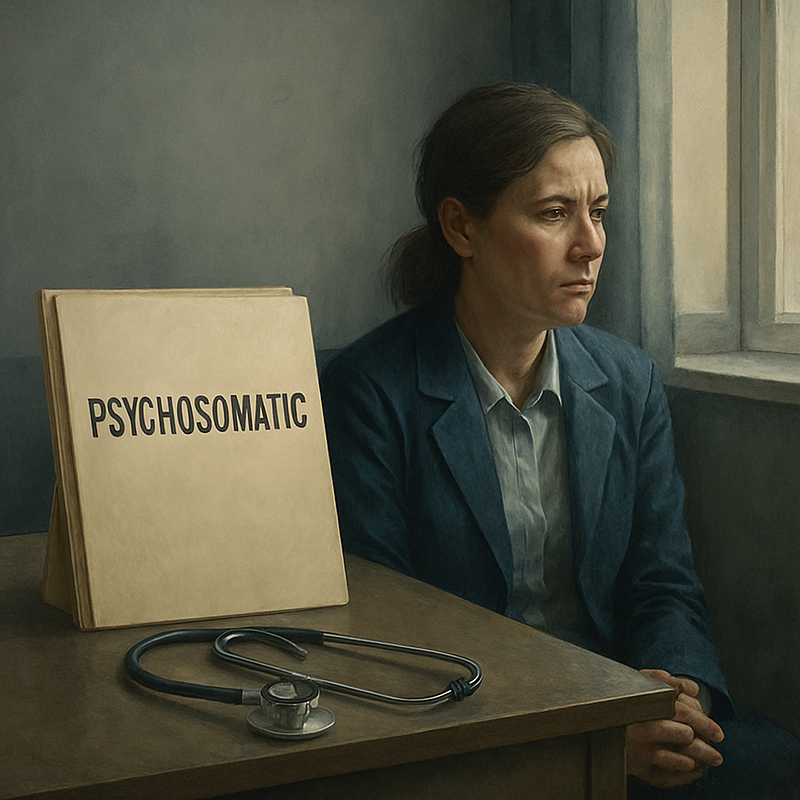
My sister was twenty-five when her life split into a before and an after. Before, she worked, she laughed, she trusted her body and lived inside a future that felt open. Then the symptoms began. Small at first. Strange sensations, pain that moved, a fatigue that made no sense. The kind of trouble a trained system is supposed to investigate.
She did everything right. She went to the specialists, endured the scans and the bloodwork, sat in the waiting rooms, and waited for an insight that never came. And then she sat in a cold examination room while a doctor closed her file with the finality of a door shutting, avoided her eyes, softened his voice, and said the sentence that ends more journeys than any disease ever has.
We think your symptoms are psychosomatic.
She was twenty-five, and her future dimmed in an instant. What followed was not care. It was a quiet, polite exile from medicine itself. This essay is about the word that exiled her, and about the thing that word actually does, which is not what most people, including most of the doctors who use it, believe it does.
The word is a verdict, not a finding
Begin with what the word claims to mean and what it does mean, because the gap between the two is the whole subject. Psychosomatic, in its careful clinical sense, names a real and documented thing: the mind and body are not separate, stress has physical effects, and there are genuine conditions in which distress expresses itself in the body. Medicine has a formal category for this, refined over a century, from Charcot's clinics through Freud's "conversion" to the modern diagnosis of functional neurological disorder. That category is not a fiction, and a clinician who uses it accurately is not failing at anything.
But that is rarely how the word arrives in the room. When my sister heard it, it was not the conclusion of a positive finding. No mechanism had been identified. No test had come back showing that distress was producing her symptoms. The word arrived at the end of a search that had failed, and it arrived as a substitute for the failure. It did not say "we have found the cause and it is psychological." It said "we have not found a cause, and we are going to stop looking." Those are opposite statements wearing the same word.
This is the move worth naming precisely, because it recurs far beyond medicine. A term that describes the state of the observer's knowledge gets heard as a description of the patient's body. "Medically unexplained" is a true and humble statement about the doctor: it means I cannot explain this. But it is delivered, and received, as a statement about the patient: there is nothing real to explain. The first is honest. The second does not follow from it, and the evidence does not support it. The whole tragedy lives in the slide from the first sentence to the second, a slide that happens so smoothly that neither party usually notices a claim has been swapped for its opposite.
It is worth seeing that this is one word in a family of words, because the family is the tell. Unexplained, in medicine. Unidentified, in the files on objects in the sky. Unverified, in the rules that govern what an encyclopedia will print. Each of these is, on its face, a confession about the observer: it means we have not explained, identified, or verified this yet. And each is routinely read, and acted on, as a fact about the thing itself, as though unexplained meant unreal, unidentified meant nonexistent, unverified meant false. The grammar is identical across domains that share no subject matter. A word that should describe the limit of the watcher gets quietly reassigned to describe the watched, and the reassignment is invisible precisely because the same word carries both meanings. Medicine is only the most intimate place this happens, because here the thing being reclassified as unreal is a person, sitting in the room, listening.
The word did not name what was wrong with her. It named what was missing in them.
The catch-all has a long memory
The label did not appear in the late twentieth century. It is the latest name for one of the oldest containers in medicine, and the history of that container is the first piece of forensic evidence, because it shows what the container has always been used to hold.
The word hysteria comes from the Greek hystera, the womb. For more than two thousand years it named a "wandering uterus" thought to cause unexplained symptoms in women, and it functioned as a catch-all, a single bin into which physicians swept whatever they could not otherwise account for. Into that bin, over the centuries, went epilepsy, multiple sclerosis, autoimmune disease, migraine, trauma responses, and ordinary anxiety, all filed together under one word, because the one thing they had in common was that the medicine of the day could not see their cause. In the late nineteenth century Jean-Martin Charcot, the father of French neurology, studied hysteria as a disorder of the nervous system rather than the womb, and his student Sigmund Freud reframed it as the body's conversion of buried distress into physical form. The name kept changing. The function did not.
In 1980, with the third edition of its diagnostic manual, American psychiatry formally retired the word hysteria. It did not retire the container. The contents were redistributed into "conversion disorder," and later into "functional neurological disorder" and the broader category of "medically unexplained symptoms," and most recently into the DSM-5's "somatic symptom disorder." Each revision is more careful, more humane, better evidenced than the last. But the underlying structure has survived every rename: there remains a recognized place to put the patient whose suffering the system cannot locate, and the act of placing them there still, too often, ends the search.
The most recent turn made the container larger, not smaller, and in a direction worth pausing on. When the DSM-5 introduced "somatic symptom disorder" in 2013, it removed the long-standing requirement that the symptoms be medically unexplained. The new diagnosis no longer needs the body to be a mystery. It needs only a clinician's judgment that the patient's thoughts, feelings, or behaviors about their symptoms are "excessive" or "disproportionate." Allen Frances, the psychiatrist who chaired the previous edition's task force, attacked the change as dangerously overinclusive, warning from the field-trial data that it would mislabel roughly one in six people with cancer or heart disease, and one in four with conditions like irritable bowel or fibromyalgia, as mentally disordered, alongside a fraction of people with no physical illness at all. Sit with what that means. The bin that once held only the unexplained can now, by a subjective judgment about a patient's worry, swallow people whose disease is fully confirmed. The container did not just survive its renaming. It grew an entrance on the side that faces the already-diagnosed, and the key to that entrance is a clinician's opinion that a sick person is too concerned about being sick.
And the bin has always tilted. For its entire history the label has fallen most heavily on women, whose pain has been disproportionately read as emotional, whose insistence has been disproportionately read as instability. This is not an accusation against individual doctors, most of whom are conscientious. It is a documented pattern in the structure, old enough to be encoded in the word's own etymology. The container that holds "what we cannot explain" has never been demographically neutral, because the judgment of what counts as a credible witness to one's own body has never been neutral either.
The graveyard of overturned dismissals
Here is the second and heaviest piece of evidence, and it is the one that turns a complaint into a forensic case. If "psychosomatic" were applied only where distress genuinely produced the symptoms, then conditions filed under it would stay filed. They do not. The history of medicine contains a long graveyard of illnesses that were confidently called psychosomatic and were later given a physical mechanism, and the pattern of those reversals is too consistent to be an accident.
The cleanest case is the stomach ulcer. Into the early 1980s, the peptic ulcer was a textbook psychosomatic disease, attributed to stress, personality, and the hard-driving modern life. Patients were sent for rest and counseling. Then, in 1982, two Australians, Robin Warren and Barry Marshall, found a bacterium, Helicobacter pylori, living in the inflamed stomach lining, and proposed that it, not stress, caused the ulcers. The profession resisted for years, until Marshall drank a culture of the bacterium, gave himself gastritis, and cured it with antibiotics. In 2005 the two received the Nobel Prize. Today H. pylori is understood to cause the great majority of peptic ulcers, which are no longer a chronic psychosomatic affliction but a short course of antibiotics. An entire disease walked out of the psychosomatic bin the moment someone found the mechanism that had been there all along.
Asthma tells the same story in a different organ. Through the heyday of psychosomatic medicine, from the 1930s into the 1950s, asthma was a textbook nervous disorder, "asthma nervosa," its attacks blamed on emotional disturbance and, in the fashionable theory of the day, on a damaged mother-child relationship. The recommended treatment was the relief of anxiety. Then, across the second half of the century, the inflammatory biology came into view, the genes and cells and cytokines of a real immune process, and the emotional theory was gradually displaced. The wheezing child had never been expressing a feeling. The medicine of the time simply could not yet see the inflammation, so it read the gap as psychology, exactly as it had read the ulcer as stress.
It is not an isolated case. Multiple sclerosis, before brain imaging could show the lesions, was for some patients, especially women, misread as hysterical paralysis. The visible disease was there; the instrument to see it was not, so the patient was blamed for the gap. More recently, myalgic encephalomyelitis, or chronic fatigue syndrome, spent the 1980s being mocked in the press as "yuppie flu," a fashionable hypochondria of the worried well. In 2015 the United States Institute of Medicine reviewed nearly nine thousand studies and concluded the opposite: that it is a serious, biologically based illness, and that the name "chronic fatigue syndrome" was itself stigmatizing. In 2021 Britain's national clinical guideline was rewritten to recognize the prejudice patients face and to withdraw the graded-exercise regimen that had been confidently prescribed for decades. Long COVID, in its first year, ran the identical cycle in fast motion: dismissed as anxiety, then slowly, grudgingly, recognized as real.
Notice the direction of the error. The dismissals do not fail randomly. They fail in one direction, the direction that let the institution stop looking, and they are corrected only when an outside instrument or an undeniable mass of patients forces the mechanism into view. A label whose mistakes all point the same way is not a neutral clinical tool. It is a structure with a bias, and the bias is toward closure.
The credibility gap
The bias has a second axis, and it is not organ but person. Who gets dismissed is not random either, and the pattern in who is disbelieved is as documented as the pattern in what is overturned.
Take endometriosis, a disease in which tissue like the uterine lining grows outside the uterus, affecting roughly one in ten women of reproductive age. It is not rare, not subtle in its consequences, and not new to medicine. Yet the average woman waits something on the order of seven years, by many studies between four and ten, from her first symptoms to a diagnosis, years during which severe pain is repeatedly read as ordinary, as exaggeration, as something psychological, or as simply "part of being a woman." The delay is not mainly a failure of tests. It is a failure of belief, and it is so well documented that researchers have given the underlying phenomenon a name, the gender pain gap, the repeated finding that the same reported pain is taken less seriously, investigated less aggressively, and attributed to emotion more readily when the patient is a woman. One of the bleaker findings in this literature is that a woman is more likely to be believed about her own body when a man is in the room with her.
This is the beschermen layer made concrete: not how a finding is suppressed, but how a claimant is disqualified before the claim is examined. A patient who can be coded as anxious, hysterical, or attention-seeking does not have to be refuted, because the coding does the work of refutation in advance. And the code, as the word's own history shows, has always been easier to attach to some bodies than others. The wandering womb never fully left medicine. It changed vocabulary and kept its aim.
And lest this seem like a problem at the margins, consider the scale. Symptoms that remain medically unexplained are not a rare anomaly at the edge of practice. By various estimates they account for somewhere between fifteen and thirty per cent of all primary-care consultations, with still higher rates in some specialist clinics. The unexplained patient is not the exception the system occasionally meets. The unexplained patient is a standing and substantial fraction of everyone who walks in, which means the pressure to do something with them, to file them somewhere, is constant, structural, and enormous. A label that resolves that pressure without resolving the illness is not a rare failure. It is a daily instrument.
What the label is honestly for, and where it goes wrong
This is the point where the argument must slow down and refuse the easy version of itself, because the easy version is false and would dishonor the careful clinicians who get this right.
It is not true that "psychosomatic" is always a mistake, or that every dismissed patient harbors an undiscovered H. pylori. Functional disorders are real. The mind genuinely shapes the body. Endless testing carries its own harms, and a good doctor who names a functional condition accurately, and stays with the patient, is practicing medicine at its most difficult and humane. The category is not the problem.
So run the honest test, the one that separates a forensic claim from a grievance. Faced with a patient the system cannot explain, there are four possibilities, and they must be told apart. The first is a genuine functional disorder, correctly identified. The second is ordinary diagnostic uncertainty, honestly stated as we do not yet know. The third is the label used as a closure device, the unproven leap from "no cause found" to "no cause exists." The fourth is institutional self-protection, the system preserving its own coherence by relocating its failure onto the patient. Only the first two are medicine working. The harm lives in the third and fourth, and the tell that distinguishes them is simple: whether the search continues. A functional diagnosis that keeps the door open is care. The same word used to close the file and end the relationship is something else, and it is the something else that this essay is about.
The determining variable, then, is not whether a given patient's illness is physical or functional. It is whether "we cannot find it" is allowed to masquerade as "there is nothing to find." That masquerade is not a medical judgment. It is an administrative one, and it serves the institution before it serves the patient.
Why the slide happens
No conspiracy is required to explain any of this, and assuming one would be its own kind of error. The slide from honest uncertainty to verdict is produced by the ordinary structure of the system, the way water finds the slope.
A modern medical system is built on explanatory authority. Its legitimacy rests on being able to account for what crosses its instruments. "I don't know" is therefore not a neutral phrase inside it; it is a small institutional wound, an admission that the machinery has a gap. And there is a documented structural reason the gap is so hard to close: the system is divided into specialties, each trained to read one slice of the body. The cardiologist finds nothing in the heart, the neurologist nothing in the brain, the endocrinologist nothing in the hormones, and each is correct about the territory he was trained to see. The patient who does not fit any single slice falls into the seam between them, and there is no specialty whose job is the seam. There is no desk, in any hospital, where the whole patient is meant to arrive. The fragments are each accurate. The person is missing from all of them.
And there is a reason the uncertainty travels toward the patient rather than staying with the system, a reason of pure structural physics. Of all the parties in the room, the patient is the only one with no institutional power to push back. A negative test result cannot be argued with; it is what it is. A specialty's boundaries cannot easily be redrawn; they are how the institution is built. The referral pathways, the appointment limits, the coding categories, all of these are fixed and defended. The patient, alone, can be reinterpreted at no cost to anyone but herself. So the gap in the system's knowledge flows, like water down the one open channel, to the one element that cannot resist being recategorized. This is not malice choosing a victim. It is a structure discharging its own tension along its single path of least resistance, and that path runs through the person least able to object.
A system like that cannot easily say "we failed to find it." So the uncertainty is moved. It travels, quietly, from the institution to the patient, from we could not see it to there is nothing to see, and from there to the trouble is in you. And once the uncertainty has been relocated onto the patient, a second mechanism takes over, and it is the cruelest one. The patient who insists that the pain is real becomes, by insisting, a problem. The insistence is read as a symptom. My sister discovered this trap, as nearly every dismissed patient does: the harder she fought to prove her symptoms were real, the more the fight itself was logged as evidence that they were not. There is no escape inside that logic, because the logic is designed, not by anyone, but by its own shape, to convert protest into proof.
This is the moment the stigma does the work that no doctor consciously intends. A label has been attached, and the label is discrediting. The patient is now the difficult one, the anxious one, the one with the thick file and no diagnosis. She is referred onward, out of the body and into the mind, to psychologists and therapists who are often skilled and kind but who cannot examine an organ, cannot read inflammation, cannot trace a hormonal cascade. The exit is dressed as a referral. It is experienced as care. It functions as removal.
The strongest case for the word
Honesty requires building the best version of the opposing argument, not the weakest, because the careful clinician has a real case and this essay collapses if it pretends otherwise.
Here it is at full strength. Functional disorders genuinely exist; the body really can express distress as physical symptoms, and functional neurological disorder is a diagnosis with positive signs a skilled neurologist can actually detect, not merely the absence of other findings. The mind-body link is not a metaphor. More than that, the endless search itself can harm. A patient sent for test after test accumulates radiation, false positives, incidental findings that trigger their own frightening and useless investigations, and the slow damage of a life organized entirely around a hunt for a diagnosis. There is a real condition, health anxiety, in which the search is the disease, and for that patient the most healing thing a doctor can do is to stop testing and say, with confidence, that the body is not hiding a catastrophe. Used well, by a clinician who stays in the room, "functional" is not an exile. It is an accurate diagnosis that spares a patient years of iatrogenic harm. The word, in the right hands, protects.
All of that is true, and none of it rescues the use this essay is about, because the difference is testable. The honest version keeps the relationship and keeps the door open; the harmful version closes the file and ends it. The honest version is offered as a positive finding, with its own signs and its own treatment; the harmful version is reached for when the search has merely failed. The honest version is held humbly, as a current best understanding open to revision; the harmful version hardens into a verdict the patient is then punished for questioning. The category is innocent. A particular use of it is not, and the use is identifiable by a single question: after the word was spoken, did anyone keep looking.
This also names exactly what would prove the essay wrong. If the conditions filed as psychosomatic were revalidated at no higher a rate than any random diagnosis, the talk of a closure bias would collapse into ordinary medical uncertainty. If patients labeled "unexplained" went on to do as well as those given a diagnosis, the harm would be imaginary. If the demographic skew in who gets dismissed disappeared under scrutiny, the credibility-gap claim would fail. The argument rests on those three patterns being real and pointing the same way. They are, and they do, which is why the ulcer and the "yuppie flu" and the seven-year wait belong in the same chapter. Remove them and there is no chapter, only a sad story about one family. They are present, so there is both.
The chemical silence
When a system cannot explain a pain, it has one more option short of admitting the gap. It can quiet the pain. My sister was given tramadol, in small doses at first, then more, then more again, until a dependency she never asked for had been added to the illness no one had named. This was not her failure. It was the institution's substitute for a diagnosis, a chemical silence laid over an institutional one. The pain did not go anywhere. It was buried under a second layer, and the second layer became a third problem, and the third problem was now, conveniently, hers.
There is a terrible economy in this. The unexplained patient is expensive, in time, in tests, in the discomfort of not knowing. The label plus the prescription resolves the expense without resolving the illness. It is efficient. It is, from the institution's side, almost reasonable. And that reasonableness, the fact that each step was defensible and no one did anything monstrous, is exactly what makes the outcome so hard to see and so hard to fight. The harm is the sum of a dozen sensible decisions, and a sum has no author to hold responsible.
For my sister
My sister is forty now. Fourteen years have passed since the system labeled her suffering imaginary. Fourteen years without work, without answers, without the simple thing she was owed, which was to be believed about her own body. The damage was not done by the illness alone. A large part of it was done by the dismissal, by years lived inside a body the system refused to read, pushed between departments like a puzzle nobody wanted to solve.
I am prouder of her than of anyone I know, in the way you are proud of someone who survived a war no one else could see. She endured what most people could not survive for a fortnight, and she did not disappear, though it came close, because she refused to. And I carry one question that will not stop burning, the same question that sits at the center of every story like hers. Why did no one simply say, I don't know? Those three honest words would have kept the door open. They would have left her a chance. Instead she was handed certainty where humility belonged, and she paid, for fourteen years, the price of someone else's fear of uncertainty.
She did not fail. The structure failed her, and it failed her in a way it has failed others for as long as there has been a word for the patients it cannot see.
What the word was hiding
So return to the cold room and the closing file, and read the sentence again with everything now visible behind it. We think your symptoms are psychosomatic. It sounded like a finding about her body. It was nothing of the kind. It was a statement about the edge of the institution's sight, dressed as a fact about her, and the dressing is the entire mechanism. The word converted a confession into an accusation. It turned we reached our limit into you are the limit.
This is why the label is so durable across every rename, from the wandering womb to functional somatic disorder. It performs a service no honest sentence can. It lets a system built on knowing absorb the unbearable fact that it does not know, by relocating the not-knowing into the one party who cannot defend against it, the patient, whose insistence has already been recoded as illness. The most effective form of control here is not a lie. It is a vocabulary, a single clinical word that ends the search while the body goes on telling the truth.
It is worth saying what the repair would actually be, because it is smaller and stranger than it sounds. The fix is not more tests; more testing is its own harm, and the steelman was right about that. The fix is not abolishing the category; the category is sometimes correct and sometimes kind. The fix is a single decoupling. Today "we cannot explain this" and "you are no longer fully credible" arrive welded together, so that the moment the search fails the patient is demoted. Pull those two apart and almost everything changes. A medicine that could say "we do not yet know what this is, and we believe you, and we will keep the door open" would lose nothing true and would spare the exile entirely. The honest sentence already exists in the language. It is the three words my sister was never offered. What stops a system from saying them is not ignorance, which is forgivable and universal, but the cost those words impose on an institution whose authority depends on knowing, and the discovery, made long ago and never unmade, that the cost can be transferred to the patient instead of borne by the system. The whole machinery is built to perform that transfer while sounding like care.
None of this means her doctors were cruel, and none of it means the category should be abolished, and none of it means the next dismissed patient is carrying an undiscovered disease. It means something narrower and more durable. When a knowledge system meets something it cannot explain, watch the verb. If it says we have not yet found this, it is still medicine. If it says this is not there, it has stopped doing medicine and started defending itself, and it has learned to do the second while sounding exactly like the first.
My sister deserved the first sentence. She was given the second. She deserved, more than anything, to be seen, and for fourteen years she was instead explained away. This chapter cannot give her back the years. It can do the one thing the room refused to do. It can keep the door open, and say plainly that the failure was never hers.
Evidence Map
Facts, interpretations, forecasts, and disconfirming signals.
Core claim. "Psychosomatic," and its successors "medically unexplained symptoms" and "functional disorder," are real clinical categories that are routinely misused as closure devices: the unproven slide from "no cause found" (a true statement about the observer) to "no cause exists" (a false statement about the patient). The determining variable is not whether a given illness is physical or functional but whether the search stays open. The label's documented track record of being overturned, always in the direction that let the institution stop looking, marks it as a structure with a bias toward closure, with the heaviest cost falling historically on women.
Evidence level. Facts (high, documented): the etymology and history of hysteria (Greek hystera; Charcot; Freud's conversion; removed from DSM-III in 1980; later conversion disorder, functional neurological disorder, DSM-5 somatic symptom disorder); peptic ulcer reclassified from psychosomatic to H. pylori (Warren and Marshall, 1982; Nobel 2005; now the majority of ulcers, antibiotic-curable); multiple sclerosis historically misread as hysterical paralysis before imaging; ME/CFS dismissed as "yuppie flu," reframed by the 2015 US Institute of Medicine review of ~9,000 studies as a biological illness, with the 2021 NICE guideline withdrawing graded exercise therapy and naming the stigma; long COVID's early dismissal and later validation. Interpretation (medium, marked): reading these as one structural pattern (a closure-biased label); the relocation of institutional uncertainty onto the patient; the recoding of insistence as symptom.
What would confirm this. Conditions labeled psychosomatic continuing to be disproportionately revalidated once a mechanism or instrument appears; the demographic skew of dismissal persisting; the "difficult patient" pattern recurring where no diagnosis is found.
What would disprove this. Evidence that conditions filed as psychosomatic are revalidated at no higher a rate than chance; that "unexplained" patients fare as well as diagnosed ones; that the label tracks genuine functional disorder rather than diagnostic convenience. Any of these would reduce the pattern to ordinary medical uncertainty rather than a structural bias.
Watchlist. How somatic symptom disorder is applied after DSM-5; whether long COVID hardens into a recognized mechanism or slides back toward dismissal; the gender gap in time-to-diagnosis; whether new biomarkers move today's "unexplained" conditions out of the bin, repeating the ulcer pattern.