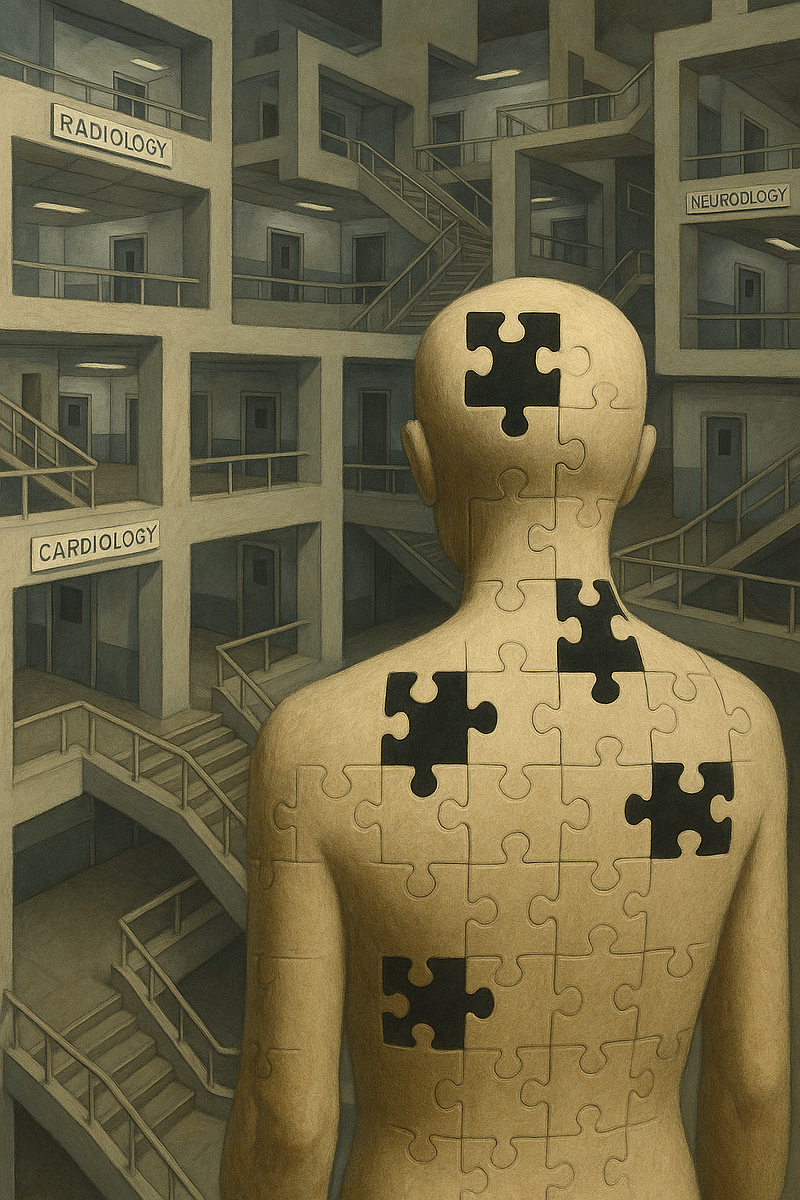
A woman lies in a hospital bed while three specialists take turns describing her. The cardiologist reads the numbers from the monitor and does not mention the tremor in her hands. The neurologist describes the electrical misfires in her brain and does not ask why she has not slept in weeks. The endocrinologist studies her cortisol curves and does not ask why she can no longer eat. Each is competent. Each is correct about the organ he was trained to see. Each holds a record that claims to describe her, and each record describes a fraction. When they have gone, the woman turns to her husband and asks the question that should haunt modern medicine: how can they treat me if none of them see the same person?
She has named, without the vocabulary for it, the most important fact about the system she is inside. It is not that her doctors are careless or unkind; they are neither. It is that the institution they work in is built to see her in pieces, and a person seen only in pieces is, in the way that matters most, not seen at all. The fragments are each accurate. The woman is missing from all of them.
This essay is about that disappearance, about how a system designed to heal the human body slowly stopped being able to see it whole, and about why the disappearance is not a failure the system is trying to fix but a condition the system depends on to function.
What the system is built to see
Begin with the thing almost no one questions, because it feels like simple progress: the modern doctor sees what can be recorded, and increasingly only that.
A century ago the dominant figure in medicine was the generalist, who knew families across seasons and encountered a disease as one event in a life. The diagnoses were often crude and the treatments often useless, but the physician saw a person. What replaced that figure was not a worse doctor but a different kind of seeing. As knowledge multiplied past what any mind could hold, medicine did the rational thing and divided the body into territories, one specialist to a system, and built around each an apparatus of instruments that could measure that territory with a precision no hand or ear could match. The cardiologist got the imaging and the troponin assay; the neurologist got the scan and the electrode; the endocrinologist got the assay panel. Each instrument extended the gaze inward, into the living body, in a way the old physician could only have dreamed of. This was real. A CT scanner sees what no palpation can; a blood test reveals what no amount of listening will.
But every instrument that lets you see one thing more clearly narrows what you are looking at, and the sum of all that narrowing is a gaze that has moved off the patient entirely and onto her representations. The philosopher Michel Foucault, writing in 1963 about the birth of modern clinical medicine, gave this a name, the medical gaze, and described how a particular way of seeing constitutes the patient as a particular kind of object. He was writing about the shift, around the turn of the nineteenth century, to examining the living body against the lesions found in the dead one, not about scanners and screens, so the extension is mine and not his. But the logic he traced runs straight to the present, because the gaze has shifted once more, off the body and onto its data, and the patient as modern medicine now constitutes her is not the person in the bed. She is the record.
The patient in the computer
The clearest measure of how far the gaze has moved is where the doctor's time and attention actually go, and the numbers are starker than most patients suspect.
A time-and-motion study published in the Annals of Internal Medicine in 2016 followed physicians through their working days and found that they spent, during office hours, about forty-nine percent of their time on the electronic health record and desk work, and about twenty-seven percent in direct face time with patients. For every hour spent with a patient, in other words, nearly two more were spent with the patient's record, and that was before the after-hours work, the documentation finished at home in the evening that clinicians wryly call pajama time. Later work found physicians spending on the order of sixteen minutes inside the record for every patient encounter. The person is in the room for a few minutes. Her representation occupies the rest of the day.
The Stanford physician Abraham Verghese gave this divided patient a name that has stuck: the iPatient, the version of the person that lives in the computer, assembled from test results and problem lists and coded fields, which receives, he observed, more of the medical team's attention than the flesh-and-blood patient in the bed. The iPatient is, in a sense, better cared for than the human one. Her labs are reviewed, her trends are charted, her record is meticulously maintained, and around it the team confers. Meanwhile the person it represents may go barely touched, barely looked at, her own account of her suffering compressed into the few fields the form provides. The record became more real than the patient, and the patient learned, in time, to make herself into a record. She arrives having rehearsed her symptoms into the categories she knows the system can accept, because she has learned that what cannot be entered cannot be seen.
The form that arrives before the patient speaks
Watch where a modern medical encounter actually begins, and you find that the fragmentation starts before the patient has said a word.
It begins with a form. A digital intake screen divides the body into fields before the doctor has looked up: a box for the chief complaint, a dropdown for its duration, a one-to-ten scale for the pain, a checklist of systems to review. Each of these is reasonable, and together they perform a quiet act of translation, taking the thing the patient actually has, which is a tangled, connected, hard-to-phrase experience of being unwell, and converting it into a set of discrete, codeable entries the system can process. What will not fit a field does not enter. The connection she feels between the insomnia and the gut pain has no box, so it is not recorded, and what is not recorded does not exist to the next person who reads the record, who sees only the boxes that were filled. The form does not describe her condition. It selects, in advance, which parts of her condition the system is permitted to perceive.
And once the form is filled, it acquires a strange authority over the person it represents. It travels ahead of her between departments; it is read by clinicians who never meet her; it persists, unchanged, through every disagreement, long after the encounter that produced it. A doctor can be argued with, can revise a judgment in the face of the patient in front of him. The record cannot be argued with in the same way, because it is already elsewhere, already the version of her that the rest of the system will act on. The living patient becomes, in effect, an appeal against a document that has already been filed and is winning. This is the deepest sense in which the record became more real than the patient: not that anyone believes the file over the person, but that the file is the thing the system is built to act on, and the person is merely the source it was generated from.
The hand that forgot how to look
As the gaze moved to the screen, a particular skill quietly died, and its death is documented.
The physical examination, the laying of hands and the act of looking that was for centuries the core of what a doctor did, has been receding for a generation, displaced by the scan that does the same job more reliably. In 2005 a physician named Herbert Fred gave the resulting deficit a name, hyposkillia, the loss of the basic clinical skills of taking a history and examining a body, and the loss is measurable. Studies of trainees find their ability to detect classic findings by ear and hand declining year over year; in one assessment, residents failed to hear diastolic heart murmurs in the majority of cases, sounds a competent physician of an earlier generation would have caught at the bedside. This is not laziness. It is substitution. Why train the ear to hear the murmur when the echocardiogram will show it, and show it better? The instrument is more accurate, so the skill atrophies, and each individual decision to trust the instrument over the hand is correct.
The trouble is that the hand and the eye were never only diagnostic instruments. They were the act through which the doctor encountered the patient as a body and not a file, and when they go, something beyond accuracy goes with them. Verghese, who has spent years arguing for the return of the bedside exam and built a program at Stanford to teach twenty-five of its lost techniques, gathered cases in which skipping the examination led directly to harm, diagnoses missed or delayed because no one performed the simple act of looking. These are collected vignettes, not a measured rate, and they prove a narrow thing rather than a broad one: that the exam still catches what the scan does not always think to look for, and that its omission has documented costs. But the narrow thing matters, because it shows that the gaze on the data is not simply a superset of the gaze on the body. It sees more of some things and less of others, and the things it sees less of are precisely the ones that announce themselves to a person paying attention rather than to a machine running a protocol.
The architecture that performs the misdiagnosis
Now the fragments and the screen can be seen as one structure, and the structure, not any doctor inside it, is what fails the woman in the bed.
A patient who arrives with palpitations, gut pain, insomnia, anxiety, fatigue, and a fog she cannot describe does not have six diseases. She most likely has one process moving through six systems, the kind of whole-body disturbance that does not respect the map medicine has drawn across the body. But the building she has entered is organized by that map. Cardiology takes the palpitations, gastroenterology the gut, psychiatry the fear, endocrinology the exhaustion, and each department, looking through its own instrument at its own territory, finds either a small abnormality it can name or nothing at all, and reports back, accurately, on its fragment. The cardiologist is right about the heart. The neurologist is right about the brain. The endocrinologist is right about the hormones. And none of them is right about the woman, because the woman is the relationship between the fragments, and the relationship is the one thing no single instrument is pointed at and no single form has a field for.
This is why the misdiagnosis here is not an error but an architecture. The patient is not confusing her doctors; the building is. Truth, in a case like hers, lives in the connections between the disciplines, and the disciplines have been walled off from one another by design, each with its own department and its own budget and its own record, so that the very place where her diagnosis lives is the place the structure has no room for. The system did not decide to miss her. It was built to see in pieces, for excellent reasons, and a thing built to see in pieces will miss whatever exists only as a whole, every time, no matter how skilled or caring the individuals operating it. The determining variable was never the competence of the doctors, nor even the gaze of medicine. It is recordability. What a system can record it can name, route, bill, and govern; what it cannot record it cannot act on, and what it cannot act on it treats, of necessity, as not quite there. Seen this way, every part of this story is one variable wearing different clothes: the intake form with no field for the connection between the symptoms, the code with no entry for the whole, the test with no marker for the suffering, the department with no budget for the person. The body was not lost to carelessness or to greed. It was lost to the brute fact that a system can act only on what it can record, and much of what makes a person a person is captured by no instrument at all.
When the test is normal and the person is not
The cruelest expression of this comes in a sentence millions of patients have heard, and it is worth taking apart because it contains the whole mechanism.
The sentence is your tests are normal, and the patient who hears it while still suffering is being told, without anyone intending the cruelty, that her reality has failed to register. A large share of what people bring to doctors falls into the category clinicians call medically unexplained symptoms, real and often disabling complaints for which the standard tests come back clean. The estimates of how large a share vary enormously with how the category is defined, ranging across studies from roughly fifteen to thirty percent of primary-care presentations and higher by some measures, and the category itself is unstable, heterogeneous, and contested, overlapping with conditions later given organic names once a test sharp enough to see them was finally run. But the instability of the label is itself the point. These are the patients who live in the gap between what is wrong with them and what the instruments can measure, and to a system whose gaze is the instruments, that gap reads as nothing.
Hear what your tests are normal actually says. It does not say you are well. It says nothing we are able to measure is abnormal, which is a true and modest statement that the patient, reasonably, hears as a verdict on her existence, because she has correctly understood that in this system to be unmeasured is to be, for practical purposes, unreal. Her suffering has not been judged and dismissed. It has simply fallen outside the field of vision, into the space the architecture cannot record, and what the architecture cannot record it cannot treat, and what it cannot treat it must, to keep functioning, regard as not quite there.
But unmeasured is not unreal, and the distinction is the whole of the matter. The gap between nothing we can measure is wrong and nothing is wrong is exactly the width of the instruments, and the instruments are not the world. A pain for which no test has yet been invented, a disorder real enough to dismantle a life and quiet enough to leave no mark any current machine can read, is not made less real by being unrecordable. It is only, to a system that can act on nothing else, invisible, and invisibility is not absence, though a system built only to measure has no way to tell the two apart. The woman in Room 312 and the woman told her tests are normal are the same person met at different doors of the same building, and both have run into the same wall, the edge of what the system is able to record.
The patient who learns to disassemble herself
The most quietly devastating part of this is not what the system does to the patient. It is what the patient learns to do to herself in order to be seen by it.
When she leaves the hospital, the fragmentation follows her home. She carries a folder of diagnoses like luggage, one for the sleep, one for the anxiety, one for the digestion, none of which explains why she no longer recognizes herself, and a calendar filling with follow-ups, each to a different specialist who will examine a different fragment. And slowly her language changes. She learns that the system does not respond to "I do not feel like myself," which fits no field, but does respond to a symptom with a location and a duration and a scale, so she learns to speak in symptoms, to present herself to each department in the vocabulary that department can process. She becomes fluent, with practice, in her own disassembly, able to hand each specialist the fragment he is equipped to receive, because she has understood that this is the price of being attended to at all.
There is a terrible competence in this, and it is the system's competence she has absorbed, not her own healing. She has been trained, without anyone meaning to train her, to convert her whole and connected suffering into the parcelled, codeable form the architecture requires, to make herself legible to a gaze that can only read fragments. When she calls to ask why nothing adds up, the answer is calm and accurate and final: each specialist did his part, each test was normal, each protocol was followed. There is no department for the feeling that the parts do not add up to her, no appeal process for coherence, no one whose job is the whole. So she stops asking why and starts asking how to manage, which is the moment the system has fully won, because she has stopped expecting it to see her and started adapting herself to the shape of its blindness.
It is not the doctors, and it is not the machines
Here the discipline matters, because the easy versions of this story all point at a culprit, and the culprits are mostly innocent.
It is tempting to blame the doctors, who seem to stare at screens and barely touch their patients, but the doctors did not design this and most of them feel its cost as acutely as anyone; they entered medicine to see people and find themselves entering data, and the exhaustion they report is in part the grief of a vocation narrowed to a workflow. It is tempting to blame the machines, the scanners and the records, but the scanner genuinely sees inside the living body and saves lives the old physician would have lost, and the record genuinely prevents some errors and coordinates care across a complexity no memory could hold. It is tempting to blame greed, and money is certainly in it, since integration cannot be billed and fragments can, but no executive sat down and decided that the human body should become unseeable. The fragmentation assembled itself, the way these things do, out of a long sequence of individually sensible decisions, each one a rational response to a real problem, the sum of them a structure no one chose and everyone maintains.
That is the unsettling shape of it, and it is the shape that the search for a villain always misses. There is no one to indict, which is precisely why nothing changes, because a harm with an author can be stopped by stopping the author, and a harm that is simply the emergent property of a million reasonable choices has no author to stop. The doctors are whole when they arrive and the system fragments them; the machines see truly and narrow the gaze; the money rewards the pieces and starves the whole. Each force is benign or neutral on its own. Together they produce a medicine that can examine a kidney to the molecule and cannot see the person the kidney belongs to, and they produce it without anyone having willed that result or being able, from inside their own fragment, to see that it is happening at all.
What the scanner sees that the hand cannot
The strongest objection has to be put now at full strength, because it is largely right, and an argument that pretended the old way was simply better would deserve to be ignored.
The instruments earned their place. For most of the serious conditions that kill people, imaging and laboratory tests are not merely more convenient than the hand and the ear; they are dramatically more accurate. Where a careful physical examination might detect a fluid collection around the lungs less than half the time, an ultrasound finds it almost always; where the examining hand is right about the cause of acute abdominal pain in roughly a third of cases, a scan is right in the great majority. A medicine that abandoned these tools to return to pure bedside intuition would kill people, not save them, and the nostalgia for the all-seeing old doctor conveniently forgets how often that doctor was confidently wrong. The diagnostic yield of much routine examination is genuinely low. The record, for all its burden, catches drug interactions and coordinates specialists and makes care legible across a system too large to hold in any head. And the worst of the screen problem, the documentation bloat, the billing-driven note, the badly designed interface that turns a doctor into a clerk, is plausibly a fixable problem of implementation rather than proof that measurement itself is the enemy.
All of that is true, and the honest form of this argument has to hold every word of it. The claim here was never that the stethoscope sees more than the scanner, because it does not, or that the system should unwind its instruments and go back, because it should not. The claim is narrower and survives the whole defense intact. It is that a gaze built entirely from instruments sees, with superb clarity, everything the instruments are pointed at, and is structurally blind to everything else, and that the everything else is not trivial. It is the connection between the fragments, the suffering with no biomarker yet, the whole of a person that exists in no single field of any record. The instruments did not make medicine worse. They made it see further into one kind of thing and, without anyone choosing it, stop seeing another kind of thing at all, and much of what makes a person a person is of the second kind.
The body made governable
Step back from the clinic to the institution, because there is a reason the fragmented body suited the modern hospital so well, and it is not only medical.
When medicine industrialized, when the solo physician gave way to the hospital and the university and the specialty, the body did not merely become better understood. It became, in the administrator's sense, governable. A whole person is impossible to manage: her suffering has no fixed boundary, her care no natural endpoint, her needs no unit you can count. But divide her into organs and the organs into departments and the departments into coded encounters, and suddenly the unmanageable becomes a flow of discrete, measurable, billable events that can be scheduled, costed, audited, and optimized. The same fragmentation that lost the person made the institution legible to itself. Care became modular, and once modular it became governable, and once governable it became the kind of thing a large organization could actually run.
This is why the fragmentation is so stubborn, and why it cannot be blamed on bad doctors or fixed by good intentions. It is not a distortion the system suffers; it is the form that makes the system administrable in the first place. The department exists because a department can have a budget. The code exists because a code can be reimbursed. The fifteen-minute encounter exists because an encounter can be counted and a relationship cannot. Every boundary that fragments the patient is also a boundary that lets the institution measure and manage what happens inside it, and an institution will not dissolve the boundaries that make it operable in order to see something, the whole person, that it has no way to process even if it saw her. The body was carved into pieces partly to be understood. It stayed carved into pieces because the pieces, and only the pieces, are the units a system of this kind can hold.
Why the system cannot afford to see
So return, at the end, to the woman whose doctors could not see the same person, and ask the question her husband could not: why does it stay this way, when so many inside it are unhappy with it?
The answer is the hardest part, and it is not that the problem is too difficult to solve. It is that seeing the whole is something the system cannot afford, in the most literal sense. To see a patient whole takes time without a defined outcome, the time to sit and listen and notice the thing that does not announce itself, and that time cannot be coded, cannot be billed, cannot be scaled across a population or justified on a dashboard. Integration has no reimbursement category. Wholeness fits in no field. The fragment, by contrast, is the unit the entire apparatus is built to process: it can be measured, coded, billed, routed to a department, and closed. A medicine organized around throughput does not fragment the body because it misunderstands the body. It fragments the body because the fragment is the only unit it can run on, and a system can only see what it is built to process.
This is why the reforms always stall, and why the problem runs deeper than any individual's failing. To make medicine see the human body whole would require it to act on the one thing it cannot record and to value the one thing it cannot bill, which runs against the grain of nearly everything that lets it function at scale. The woman in the bed was not failed by her doctors, who saw, each of them, exactly what they were trained and paid and built to see. She was unseen by an architecture that can act only on the recordable, and so, without anyone choosing it, attends to the recordable and lets the rest fall away.
And the pattern does not stop at the clinic. A system that can act only on what it can record is not a medical peculiarity. It is the common condition of the institutions that now run modern life, each of them able, in its own domain, to register and respond to the part of reality that fits its forms, and structurally blind to the rest. What medicine does to the suffering with no biomarker, the same logic does elsewhere to the citizen who exists only as a record, the property that exists only as a license, the country whose worth exists only as a credit rating. The deepest question this leaves is therefore not about medicine at all. It is what becomes of human beings when the systems that decide their fate can act only on representations of them, and no longer on them.
Evidence Map
Facts, interpretations, forecasts, and disconfirming signals.
Core claim. A system built to heal the human body has, through rational specialization and the shift of the medical gaze from the body to its representations (the scan, the lab value, the electronic record), become structurally unable to see the patient whole. The determining variable is not the competence of doctors or the quality of machines but RECORDABILITY: a system can act only on what it can record, name, code, bill, and govern, so it attends with great precision to whatever its instruments and forms are pointed at and is structurally blind to whatever exists only as a whole or cannot be measured (the connection between symptoms, the suffering with no biomarker, the person). "Unmeasured is not unreal": invisibility to the instruments is not absence. The medical case is one instance of a general pattern: institutions increasingly act on representations of people (the record, the license, the credit rating) rather than on people. This is emergent (no villain; doctors and machines are each benign or neutral) and self-perpetuating, because the fragment is the only unit a throughput-based system can process, and wholeness can be neither billed nor scaled.
Evidence level. Facts (high, documented): the 2016 Sinsky Annals of Internal Medicine time-motion study (~49% of physician office time on EHR/desk work vs ~27% direct patient face time; ~2 hours of EHR per 1 hour of patient contact; after-hours "pajama time"); the ~16 minutes of EHR per encounter (Overhage & McCallie, Annals of Internal Medicine, 2020); Abraham Verghese's "iPatient" (NEJM, 2008) and the Stanford Medicine 25 bedside initiative; "hyposkillia" (Herbert Fred, 2005) and documented decline in bedside auscultation skill; Verghese et al. (Am J Med, 2015) collected vignettes of harm from inadequate physical examination (documented CASES, not an incidence rate); Foucault's "medical gaze" (The Birth of the Clinic, 1963). Interpretation (medium, marked): the unifying determining-variable reading (the system sees only what it can record); the Foucault "gaze on the data" framing is an EXTENSION of Foucault, not his own claim (he wrote about the gaze on the body, not the screen), marked as such. Contested / attributed (marked): "medically unexplained symptoms" as a share of visits (~15-30%, varies widely by definition; the category is heterogeneous and unstable, and some cases later receive organic diagnoses). Steelman-grade facts (granted): imaging/labs far outperform the physical exam for serious conditions (e.g., pleural effusion exam sensitivity ~44% vs ultrasound ~98%; acute-abdomen exam accuracy ~31% vs CT).
What would confirm this. Continued displacement of attention from patient to record; persistence of the "your tests are normal" gap for measurable-only medicine; reforms toward "whole-person" care stalling on the inability to bill or scale integration.
What would disprove this. Evidence that the system can and does see and treat the whole patient at scale within its current incentive structure; that integration/whole-person care is routinely reimbursed and delivered; or that the unmeasured/unrecordable does not in fact fall out of care (that "your tests are normal" reliably leads to continued investigation rather than discharge).
Watchlist. Whether AI-assisted records reduce or deepen the gaze-on-data problem (a tool that could restore context or further displace the body); reimbursement experiments for time-based / whole-person care; the trajectory of bedside-examination training; how "medically unexplained" conditions are reclassified as measurement improves.
Related from The Manifest Archive
- Nothing Is Missing And That’s the Problem
- The Architecture of Dismissal
- Who Decides What a Democracy Can Afford?
- The Age of Engineered Life
Jerry van der Laan writes The Manifest Archive, daily forensic essays on power, language, and the systems that shape what we are allowed to see as reality. He traces the structures beneath them.