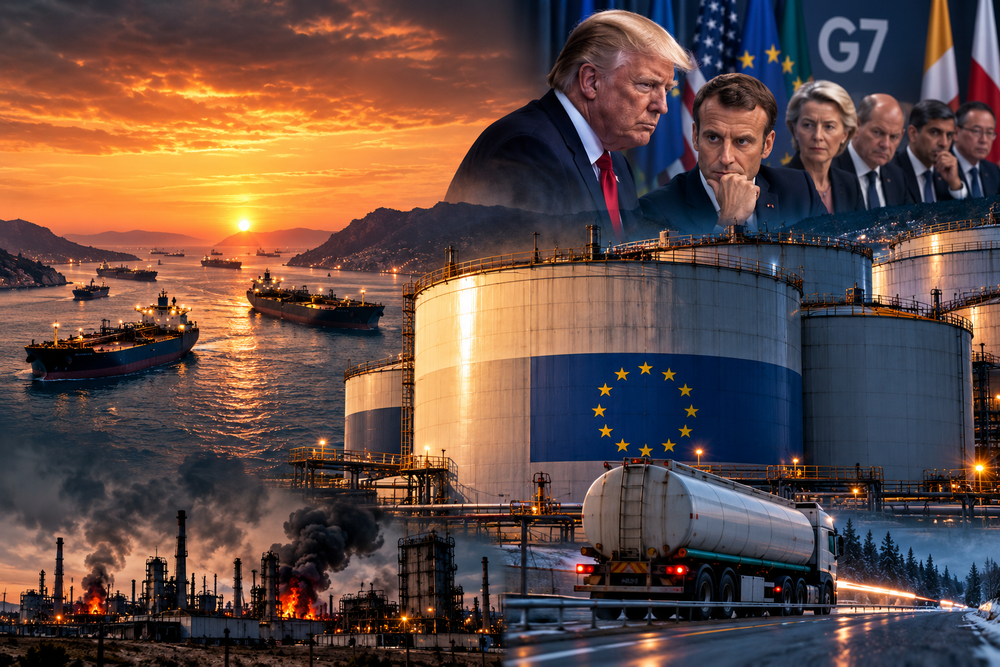
In the first hours after the strait reopened, the ships that moved were not the ones the world expected. A supertanker that had gone dark for weeks switched its transponder back on as it cleared the Gulf, and on its bridge the master held a course he had not chosen, down a lane the Iranian authority had designated, under an insurance document Tehran now required. Behind that ship came another, and then a procession, and almost all of them shared two traits. Their ownership traced back to China, or their hulls were already under sanction, or both. The great Western tanker fleets, the ones flagged to the open registries and insured in London and cleared through New York, mostly stayed where they were, waiting. The waterway that carries a fifth of the world's oil had been declared open. It had simply not been declared open for them.
That is the detail almost no one is examining, and it is the one that matters. The headline is that the crisis has passed. The interim agreement between Washington and Tehran has been signed, the United States has stopped enforcing its blockade, the tankers are crossing again, and the price of oil has come down from its spring peak. The relief is genuine and worth stating plainly. But relief is not resolution, and the question that decides the next decade is not whether the oil resumed flowing. It is who is now permitted to carry it, and in whose money it is paid. The strait did not simply reopen. It is reopening as something closer to a sorting mechanism, and the line it increasingly sorts along runs through the global financial system itself.
The variable everyone measures, and the one that decides
Every trading desk and every energy ministry is tracking the same figures: the price of Brent, the count of tankers clearing the strait, the level of the strategic reserves. Through the spring those were the right numbers, because the binding question really was physical. Would the oil arrive.
It is arriving. And precisely because the physical question has been answered, the world's attention is draining away at the exact moment the strait is being rebuilt into something it has never been. The determining variable is no longer supply. It is not even access in the simple sense of whether a ship can pass. It is the conditions of access: who sets them, what they cost, and which currency they are settled in. The Manifest has traced this shift across a dozen systems, and it always takes the same shape. The breakthrough gets the attention. The bottleneck decides the outcome. During the war the bottleneck was a blockade, visible to everyone and dramatized nightly. After the war the bottleneck is a clause, visible to almost no one and reported on no front page. The danger did not leave. It changed costume, from a warship into a document.
The blockade became a gate
Start with the fact that is hard and documented, the one a critic cannot dissolve. Iran's Persian Gulf Strait Authority, the body now asserting control over the waterway, had been registering vessel applications for weeks, with hundreds of shipping companies signed up before the memorandum of understanding took effect on June 18. Under its terms, every commercial ship transiting the Strait of Hormuz must hold a valid navigation permit issued by the authority and must carry authority-approved hull war voyage insurance. The maritime press, including Lloyd's List, the trade's paper of record, reported the requirement in detail. The coverage applies only to the transit segment, beginning at a designated entry point and ending at a designated exit. For now no fee is collected. But after the sixty day grace period the authority, in its own language, reserves the right to introduce insurance fees in the future.
Read that against what the United States did in the same week. American Central Command announced that all of its blockade enforcement had ceased, that its forces were no longer impeding vessels to or from Iranian ports. The two announcements are usually reported as a single piece of good news, two parties standing down. They are not the same kind of fact. One is the removal of a temporary military measure. The other is the installation of a permanent administrative one.
A blockade is a thing a navy does. It ends the moment the warships are ordered to stop, and when they stop, the water is free again. A permit regime is a thing a state does. It ends only when that state decides to end it, and until then every ship that wants to pass must ask. The United States lifted a blockade it controlled. Iran, in the same days, established a gate it controls. The strait that reopened is not the strait that closed. The old one was governed by the absence of force. The new one is governed by the presence of a license. Iran achieved with paper what it could never have held with mines: a standing, daily say over who uses the most important oil corridor on earth. It did not need to keep the strait shut. It needed to become the one who decides that it is open.
The gate is also a trap
Here the mechanism turns, and turns in a way that has almost no precedent. The authority issuing the permits is not an ordinary harbor administration. It is, under United States law, a sanctioned entity, linked to the Islamic Revolutionary Guard Corps. And that single fact converts the gate into a trap for the tankers that pass through it, the ships carrying more than a quarter of the world's seaborne oil and roughly a fifth of its liquefied natural gas.
The logic is brutal and specific. Any payment to a sanctioned, terrorist-designated entity is a prohibited transaction for anyone exposed to United States or European law, which means any owner, any protection and indemnity club, any war risk underwriter, and any bank with dollar clearing relationships. The compliance specialists reading the fine print have noticed something worse than the payment problem. Even accepting an Iranian guarantee of safe passage, with no money changing hands at all, can create sanctions exposure. A vessel that has paid the authority, or merely received its safe passage guarantee, cannot be insured by any Western war risk underwriter or P&I club. For the dollar fleet, the choice is not whether to pay a toll. It is whether to exist legally. They cannot meet Iran's condition without breaking Washington's law.
You can see the bind most plainly at a desk in London, where the war risk on the world's tankers is still priced. An underwriter there can read the Iranian permit, the approved insurance clause, the offer of a safe passage guarantee, and arrive at only one answer. To write the cover is to transact with a sanctioned entity and break the law. To decline is to leave the ship uninsurable, and an uninsurable tanker does not sail. The same person who could once clear a vessel through Hormuz with a signature can no longer sign at all, and the ship waits offshore, fully crewed and fully fuelled, for a permission that no one in the dollar world is legally able to give. The gate is not an abstraction. It is a clause on a screen that a single human being cannot initial.
There is a further reason the gate sits on contested ground. Under the law of the sea, ships enjoy a right of transit passage through international straits used for navigation, and Hormuz is the textbook case. A unilateral demand that every vessel buy a permit from the coastal state cuts against that right, which makes the regime not only a sanctions trap but a legal one, challengeable in principle and unenforceable in any neutral forum. That contested status is not a weakness in the analysis. It is the mechanism. The gate does not need to be lawful to function. It needs only to be the thing an underwriter checks before writing the cover, and a permit that no court has blessed can still decide which ships move, because the insurer, not the court, is the one who actually clears the passage.
And there is a clock on this, even if no date is stamped in the text. The memorandum guarantees toll free passage for sixty days, a window that closes in mid August. The authority has said only that passage is free for now, but the inference is hard to avoid: when the grace period ends and it is free to begin charging, normal Western commercial transit through the Strait of Hormuz could become categorically impossible without a sanctions waiver that does not yet exist. The world has been handed a countdown and has mostly treated it as a ceasefire.
The cost, and the missing cushion
The gate is not only a legal trap. It is an expensive one. War risk premiums for a Hormuz transit, which before the conflict ran at well under a tenth of one percent of a ship's value, surged during the crisis to between three and eight percent by industry estimates, enough to add several million dollars to the cost of moving a single large tanker. And the cushion that might have absorbed all of this is gone. To hold prices down while the strait was shut, the advanced economies drained their emergency reserves to levels not seen in decades. The American Strategic Petroleum Reserve fell to its lowest since 1983, after a release of around a hundred and seventy million barrels, and the combined government stocks of the rich world reached their lowest since 1990. The fire was put out with the last of the water in the tank. Whatever happens next happens to a system that has already spent its margin.
The strait begins to sort by currency
Now the deepest layer, the one the title points at and the one most of the coverage misses entirely. If the dollar fleet cannot legally pass, who can? The answer is everyone who had already left the dollar system behind.
The shadow fleet was built for exactly this. By industry count there are roughly four hundred and thirty tankers engaged in Iranian trade; somewhere around sixty percent fly false flags and close to ninety percent are already sanctioned. China takes an estimated ninety percent of Iran's crude exports and has paid Tehran tens of billions of dollars for oil while officially recording no Iranian imports at all since 2022. The legal owners of these tankers are registered in Chinese cities, the crews are often Chinese, and the payments increasingly settle in yuan, routed through intermediaries that sit outside American jurisdiction. For this fleet, the authority's insurance mandate is not a barrier. It is a formality inside a system already engineered around the dollar.
So the strait did not reopen for the world. It reopened most easily for the part of the world that no longer needs Washington's permission to move oil. Open for the yuan. Open for the dark fleet. Open for everyone who had already exited the currency that the gate is designed to exclude. The gate does not merely toll traffic. It has begun to sort it, and the line it increasingly draws is monetary. A waterway that for half a century was governed by the absence of force, then briefly by the presence of force, is now governed in part by the question of which financial system a ship belongs to. The gate is becoming a membrane between two monetary worlds, and the side that finds it easiest to pass is increasingly the side that has already left the dollar.
Stated with the discipline the claim deserves: Hormuz may be becoming the first major maritime chokepoint where the conditions of access increasingly correlate with monetary alignment rather than with a ship's flag or its destination. That is the claim, and it is a claim about a direction that is now visible, not a filter that has finished forming. The forensic point is not that the sorting is complete. It is that the sorting has begun, at the most important oil corridor on earth, and that nothing in the current structure reverses it.
Discipline requires stating the scale honestly, because this is where the analysis could overreach. The dollar is not finished. It still accounts for well over half of global reserves, and the overwhelming majority of oil worldwide is still priced and settled in it. The non dollar pool is a minority pool, and the bifurcation visible at Hormuz is a beginning, not a culmination. But beginnings are the only thing a forensic eye can catch in time, and the direction is unambiguous. Every month the Western fleet stays out, the parallel system deepens: the dark fleet grows, the yuan settlement entrenches, the workaround hardens into the norm. The reopening is quietly accelerating the precise thing American sanctions were built to prevent. The dollar once governed the oil. At this strait, the oil has begun to govern the dollar.
The underwriter is the real gatekeeper
There is a layer beneath even Iran's authority, and it is the one the Manifest has pointed to before: the strait is not truly governed by whoever issues the permits, but by whoever prices the risk. Iran can require insurance. It cannot manufacture it. Whether a ship genuinely passes depends on whether an underwriter will write the cover and at what price, and through the crisis it was the withdrawal of war risk cover, not any warship, that effectively closed the waterway. The deciding hand was actuarial before it was military.
That hand, for now, is largely Western. The marine insurance market still runs through London, through Lloyd's and the protection and indemnity clubs that sit inside the reach of British, European, and American law. Which means the insurance layer is itself a second chokepoint, and it is one the West controls. The actuarial blockade cuts both ways: Iran can deny passage to the uninsured, but the Western market can deny insurance to anyone who deals with Iran, and between those two denials the dollar fleet is crushed. The predictable response is already visible in outline. China is building its own protection and indemnity and reinsurance capacity, an eastern insurance layer to match the eastern fleet. The bifurcation does not stop at the waterline. It reaches into the underwriting itself, and the world ends with two insurance systems for two oil pools, each refusing to cover what the other carries.
The two pools, and who stands between them
The picture is cleaner as a binary than the world actually is, and the honesty of the analysis depends on the actors who blur it. India is the largest of them. It buys discounted Russian and Iranian crude with one hand while remaining firmly inside the dollar and Western orbit with the other, straddling both pools and refusing to choose, which is exactly why the split is a widening rather than a wall. Saudi Arabia straddles too, holding American security guarantees while signing currency swaps with Beijing and selling most of its oil to Asia. These are not minor exceptions. They are the proof that what is forming is not two sealed camps but two pools with very large swimmers crossing between them.
And beneath both pools, one asset is quietly being accumulated by the players on every side: gold. Central banks, led by China and Russia but not confined to them, have been buying gold at a record pace, and the reason is precisely the one this whole story illustrates. Gold is the only reserve that cannot be sanctioned, frozen, or switched off, the neutral money that both the dollar pool and the non dollar pool can hold without trusting each other. The return of gold to the center of central bank reserves is the clearest single signal that the actors themselves expect the monetary order to fracture. They are hedging against the very future this strait is opening.
This has happened before
The claim that a strait can decide the fate of a currency is not speculation. It is history, and it has run in both directions within living memory. A reserve currency has been broken at an oil passage, and a reserve currency has been built at one. The machinery now turning against the dollar is the same machinery that once made it.
Begin with the breaking. In the autumn of 1956, Britain, France, and Israel moved to seize the Suez Canal after Egypt nationalized it. Militarily the operation worked. Financially it was a catastrophe, and the catastrophe was the instrument. Sterling in the mid 1950s still made up close to half of the world's monetary reserves; the pound was not merely Britain's money, it was a large part of everyone's money, and that was its vulnerability. To stop the invasion, the United States did not fire a shot. It reached for the currency. Washington threatened to dump its holdings of sterling bonds, which would have collapsed the pound, and it blocked Britain's access to emergency credit, refusing to let the International Monetary Fund release a standby of around five hundred and sixty million dollars and barring a comparable line from the Export Import Bank, until London agreed to withdraw. The Bank of England burned through its dollar reserves defending the pound's fixed value. Within days, facing a run on its own currency, Britain capitulated.
The lesson of Suez was never about the canal. It was that an empire's power had migrated from its army to its money, and that whoever could close the wallet no longer needed to close the waterway. The British Empire did not end on a battlefield. It ended in the foreign exchange markets, at the moment it learned that the United States could break the pound at will. Suez is remembered as a military humiliation. It was a monetary one, and it marked the beginning of sterling's long retirement as the world's reserve currency. The chokepoint was the stage. The currency was the weapon. The dollar took the throne.
Now the building. The dollar that inherited that throne was, for a generation, backed by gold. In August 1971, under the strain of deficits and a draining gold stock, Richard Nixon ended that convertibility, and the dollar became a currency backed by nothing but the credibility of the government behind it. The anchor was gone, and the question of the early 1970s was what would replace it. The answer arrived through oil, and through a chokepoint crisis. In 1973 the Arab members of OPEC, responding to the Yom Kippur War, imposed an embargo that quadrupled the price of crude. Out of that shock came the arrangement that defined the next half century. In 1974 the United States and Saudi Arabia reached a broad agreement on security and economic cooperation, and at its center was a monetary mechanism: Saudi oil sales would be settled in dollars and the surplus recycled into United States Treasury securities, and in exchange Riyadh received American protection. The dollar had lost its backing in gold and regained it in oil. Every nation that needed energy now needed dollars, and the demand flowed back into American debt. The reserve currency had been re-founded, not on metal, but on the obligation to buy the world's most important commodity in a single currency. This is the system the word petrodollar names, and it too was born at an oil crisis.
Hold the two episodes together and the pattern is unmistakable. Reserve currency status is not decided only in central banks. At the hinge moments it is decided at the oil artery, by who controls access and by which money is required to pass. Suez showed that the power to settle and to lend could break a currency. The petrodollar showed that the power to price oil could make one. The petrodollar was born when oil was forced into the dollar. It ends, if it ends, when oil is allowed out of it. And the place that decides such things has always been a strait.
Why the hegemon cannot simply stop it
The obvious objection is that the United States sees all of this, so why does it allow it. The answer is that it does not allow it; it is trapped, and the trap is structural rather than a failure of will.
The dollar plays two roles that are quietly at war with each other. It is the world's reserve currency, which depends on being the neutral, indispensable layer that everyone trusts and uses. And it is the United States' favorite weapon, deployed through sanctions that depend on the dollar being something Washington can switch off. Every act of monetary warfare spends a little of the trust that the reserve role is built on. You cannot maximize the coercion and the universality at once. The American response to the shadow fleet is more sanctions, on Chinese refineries, on shipping firms, on tankers, and each new sanction pushes the target further into the parallel system. The cure is the disease. And Washington cannot easily stop, because relenting would mean legitimizing payment to an Iranian Guard linked authority, which is politically and legally close to impossible. It can neither enforce its way out nor stand down.
So it does the one thing a cornered hegemon has left. Where it cannot bind the oil by finance, it reaches instead for force. In January, by widely reported accounts, United States forces removed Venezuela's president and installed a government that agreed to direct the country's oil toward American refineries. Whatever else that was, it was the taking by force of a supply the dollar was losing the power to bind. The two are not separate stories. They are one mechanism in two registers, the financial weapon failing where it cannot reach and the physical weapon compensating where it can, and the line between them is simply distance. The reach of the dollar is contracting toward the reach of the carrier. It is a strong hand in the hemisphere Washington can still police, and a measure of how far that reach no longer extends everywhere else.
There is a deeper symmetry here that the chokepoint frame makes visible. The dollar clearing system itself, the network of correspondent banks and settlement rails through which most of world trade passes, is a chokepoint, and it is the one the United States controls. So this is not a story of one country gating the world. It is chokepoint against chokepoint: Iran's physical strait against America's financial strait, each side gating global flows with the lever it holds. And the symmetry runs further still, which is why no one in this story is comfortable. China may have slipped the dollar trap at Hormuz, but the overwhelming majority of China's own oil imports pass through the Strait of Malacca, which the United States Navy could close. Everyone in this system holds a gun, and everyone has one pointed at their own supply line. The new world is not one in which the chokepoints have been freed. It is one in which everyone has learned to build them.
Europe, the passenger
One major power appears in this story only as a passenger, and that is the warning inside it. Europe is the most exposed actor on the board and the one with the least control over its fate. It depends on the dollar system it does not run, on Gulf energy it does not produce, and on the freedom of navigation order it can no longer enforce, having neither the carriers to police the strait nor a currency that offers an alternative to anyone. Caught between American sanctions law and its own need for oil, Europe cannot follow China into the yuan and cannot follow America to the gunboat. It can only absorb the costs of a reordering decided by others.
The exposure is not abstract, because the gate falls hardest on European hulls. The world's merchant tankers are owned disproportionately in Europe, with Greek owners alone controlling one of the largest tanker fleets on earth, and those are precisely the vessels that clear through dollar banks, insure in London, and answer to European and American compliance law. They are the fleet the gate is built to exclude. The shadow tonnage that can ignore Iran's permit is largely not European; the fleet that cannot ignore it largely is. So the actor with the least say over the new regime is also the one whose ships are most directly locked out of it, which is the precise opposite of the position Europe occupied when these sea lanes were neutral and its merchant marine carried the world's oil without asking anyone's permission.
And Europe has been here before, one element over. The lesson it is now learning at sea it learned on land only recently, when the pipelines it had treated as plain infrastructure turned out to be a lever, and the gas it assumed would always flow became a weapon held by someone else. Russian gas taught Europe that an artery is never neutral once someone discovers it can be closed. Hormuz is the same lesson delivered by water instead of pipe. When the arteries of globalization become instruments of leverage, the actors who built their prosperity on those arteries being neutral are the ones with the most to lose, and Europe built more on that assumption than anyone. It is the passenger who pays the fare, chooses no route, and discovers only at the end that the ticket was never his to price.
The strongest case against this reading
Intellectual honesty requires the best version of the opposing view, because if it cannot be answered the analysis is unfinished.
The strongest counterargument is that the dollar is not sterling, and 2026 is not 1956. Sterling fell in days because a stronger currency stood ready to replace it. No such successor stands ready now. The yuan is not freely convertible, China's capital controls cut against the very role it would have to assume, and the depth of American debt markets and the network effects of the dollar have no rival. Venezuela, in this reading, is not a regression but an American win: a heavy crude supply pulled back into the dollar that partly offsets whatever is lost at Hormuz. The bifurcation is real but marginal, the optimist would say, and it could be reversed with a stroke of a pen, a general license that re-admits the Western fleet before the August deadline. And the United States is hardly the only power that weaponizes chokepoints; its own pressure on the Panama Canal shows that gating the world's passages is a universal temptation, not an American defeat.
That case is real, and parts of it may prove correct. The dollar will not collapse on a deadline, and this analysis does not predict that it will. The claim is narrower and harder to dismiss. It is that the mechanism which once forged the petrodollar is now, for the first time, running in reverse at the same kind of chokepoint, and that a direction has changed even if the distance has not yet been traveled. Suez did not end sterling overnight either. It marked the point after which the decline was only a matter of time. The reading offered here would weaken sharply if Washington issues a Hormuz transit waiver before the August window closes, if war risk premiums fall back toward their pre conflict level within a quarter, or if the share of Gulf oil settled outside the dollar stops rising. None of those has happened yet. The burden sits with the optimistic case to show the gate dismantled, not merely the panic passed.
What happens next
A mechanism understood is a mechanism that can be projected, so long as the projection is built as conditions rather than predictions. One variable governs the branches, and it is legal, not military: whether the United States issues a transit waiver before the August window closes, re-admitting the dollar fleet to a strait governed by a sanctioned authority. Watch the license, not the barrel.
If the waiver comes and the ceasefire holds, the strait drifts back toward something like normal. The mines are cleared over the weeks that minesweeping requires, premiums ease as underwriters regain confidence, the Western fleet returns, and the bifurcation softens. This is the path that vindicates the optimists, and it is the least likely, because it requires Washington to publicly sanction payment to a Revolutionary Guard linked entity, a step its own laws and politics make almost unthinkable.
If no waiver comes and the ceasefire holds, which is the path the mechanism runs toward on its own, the strait settles into a quiet bifurcation. After the window closes the Western fleet is locked out by its own compliance, the China led and shadow tonnage entrenches, the insurance fees arrive, the yuan share of settlement climbs, and the parallel system hardens from a workaround into the normal way the corridor operates. Nothing dramatic happens on any single day. The change is visible only in the slow drift of the numbers.
And if the ceasefire breaks, which remains a live possibility because the actor most able to break it, Israel, never signed it, the strait re-closes or narrows into a system that no longer has a buffer to cushion it, since the reserves that absorbed the first shock are spent. A second shock would land harder than the first, on an emptier world. Beneath even that sits the physical tail: a single mine strike or a damaged hull could close the strait regardless of any agreement, which leads to the vulnerability almost no one is pricing.
Beneath the oil, the water
The Gulf states draw the majority of their drinking water not from rivers but from desalination plants strung along the same coastline the tankers pass. Those plants are acutely vulnerable to exactly what this crisis has left in the water: roughly eighty uncleared mines, damaged hulls, and the ever present possibility of a spill or a strike in a shallow, enclosed sea. An oil slick or an attack that takes the desalination offline would not raise the price of energy. It would cut off the drinking water of millions, in Saudi Arabia, the Emirates, Qatar, and Bahrain, within days. This is the chokepoint beneath the chokepoint. The world is watching the strait as an oil corridor, and the strait is also, quietly, the artery of the region's water. The deepest revelation here is not about the dollar at all. It is that the same narrow stretch of sea now governs whether a currency rules and whether a population drinks, and almost no one is looking at the second question.
What the architecture accounts for
Return, at the end, to the worker who never appears in the energy reports. In Dubai, the hub whose entire promise is that it sits safely above the region's quarrels, hotel occupancy was projected to fall from around eighty percent before the war toward ten, tens of thousands of flights were cancelled, the Emirates' bourses shed something like a hundred and twenty billion dollars, and stray fragments of intercepted drones set fire to data center facilities in the Emirates. The people who felt that first were not the shipowners or the underwriters. They were the migrant laborers whose work vanished with the tourists, sending wages home to families who will never read a memorandum of understanding and whose lives nonetheless turn on its clauses. The master who could not choose his lane, the underwriter who could not sign, the laborer whose wage left with the tourists: each is a person held inside a mechanism that no single hand is running. The architecture assigns roles with remarkable consistency, and the only actor with no designed role is the one who pays for all of them without ever entering the room where the terms are set.
That is what the reopening hides. The oil is flowing, and that is true, and it matters. But the question that decided the last century of energy was where the oil is. The question that decides the next one is who holds the door, and in what money the passage is paid. At Hormuz, in the weeks when the world was relieved enough to look away, that question quietly received a new answer, and the answer was not the one printed in the headlines. The strait is open. It is simply no longer open for everyone, and the line it now draws runs straight through the center of the dollar's world.
Evidence Map
Facts, interpretations, forecasts, and disconfirming signals. Figures are a dated snapshot from mid-2026, and several are contested industry estimates that should be read as ranges.
Core claim. The Hormuz ceasefire restored the flow of oil but converted the strait from a temporary military blockade into a standing administrative access regime under a sanctioned Iranian authority. Because that authority is sanctioned, the gate excludes the dollar-and-compliance fleet while the China-led and shadow-fleet tonnage that already settles outside the dollar passes more easily. The marked hypothesis: Hormuz may be becoming the first major maritime chokepoint where the conditions of access increasingly correlate with monetary alignment rather than flag, the early form of a split into two currency pools. This is a claim about a visible direction, not a finished filter. The determining variable has shifted from supply to the conditions of access.
Evidence level. Facts (high): the Persian Gulf Strait Authority's mandatory navigation permit and approved hull war voyage insurance, effective June 18; the cessation of US blockade enforcement; the OFAC exposure attaching even to a safe-passage guarantee; the interim memorandum and sixty-day window; the strategic reserve drawdown and historic-low stock levels; the shadow-fleet scale and China's share of Iranian crude; the January seizure of Maduro and the redirection of Venezuelan crude to the US Gulf Coast; the Suez and petrodollar histories. Interpretation (medium, marked): that the access gate and the bifurcation are durable rather than transient; that Venezuela represents a regression to physical control. Forecast (speculative): that the petrodollar's grip is eroding gradually rather than that the dollar collapses.
What would confirm this. No US transit waiver before the August window closes; premiums and Western transit failing to normalize; the share of Gulf oil settled outside the dollar continuing to rise; tolls imposed after day 60.
What would disprove this. A Hormuz transit general license re-admitting the Western fleet; war-risk premiums returning toward pre-conflict levels within a quarter; the non-dollar settlement share stalling; reserves refilled on a published schedule without propping the price.
Watchlist. The hinge date in the second half of August, when the toll-free window closes. Plus: US carrier movements as the truest tell of whether Washington believes its own deal; the dark-fleet count; the yuan share of Gulf oil settlement; central-bank gold purchases; and any renewed Israeli strike on Iran, the veto that never signed.
Jerry van der Laan writes The Manifest Archive, forensic journalism on the systems beneath power, money, and history. He traces the structures beneath them.
Related from The Manifest Archive
- No Warship Closed Hormuz. An Insurance Committee in London Did.
- Strait of Hormuz: The Chokepoint That Could Break the World Economy
- China's Iran Leverage: The Exit No One Else Controls
- Who Owns the Federal Reserve? The Answer Is Stranger Than the Conspiracy
- Current Wars in the World, 2026: The Expanding Conflict Map