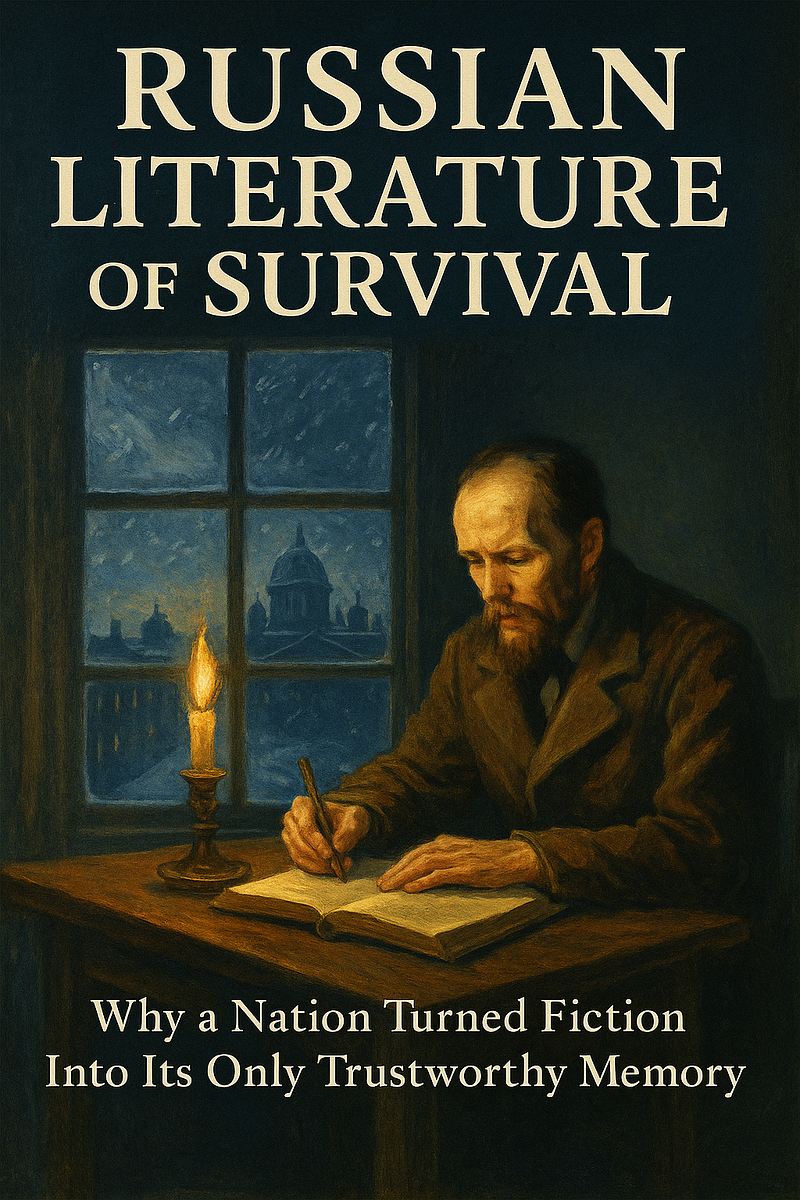
The Candle and the Page
The quiet inside the room is not gentle.
It is the quiet that settles after something irreversible has happened, the quiet that surrounds a world still pretending nothing has changed. Winter presses against the windows of Saint Petersburg. The candle on the desk flickers as if afraid to be overheard.
Dostoevsky sits with the posture of someone who has returned from a place where language becomes dangerous. Siberia has left marks on him that paper can barely hold. When he finally begins to write, it is with the understanding that the page is the last territory still free. The words do not come from confidence but from necessity.
Russian literature begins here, not as culture but as survival.
Not in salons or academies, but in rooms where truth must whisper to live.
“Every truth begins where the light fails.”
The origin is not aesthetic.
It is existential.
The Unintended Function of a National Art
In Western Europe, literature became a refinement of life.
In Russia, literature became a continuation of life when reality grew thin.
Institutions demanded obedience, so the novel became the place where the mind could remain uncolonized.
History was rewritten, so fiction became the underground archive.
Public life narrowed, so stories expanded the interior world until it could breathe again.
This was never a cultural choice.
It was a reflex of survival.
Russian readers learned to listen for meaning embedded beneath the surface. They treated the sentence the way a doctor treats a pulse. Russian writers learned to speak inside the margins of censorship, not by avoiding the truth but by expanding it inward.
A novel became a shelter for a truth that could not circulate openly.
A poem became a coded record of what the age tried to forget.
“Systems reveal themselves only when something breaks.”
Russian literature did not imitate reality.It stored the version of reality the state tried to erase.
When the Writer Becomes Dangerous
A Russian writer is dangerous because a Russian reader expects not entertainment but revelation. That expectation has terrified rulers for two centuries.
Under the tsars, manuscripts were scrutinized like military intelligence.
Under the Soviets, a metaphor could become evidence.
Under any system that fears the inner life, the writer becomes a liability.
The danger is not in the plot or the style.
It is in the moment of recognition the reader cannot unsee.
You feel it in Crime and Punishment when Raskolnikov realizes that the murder he rationalized as liberation has instead shackled him to the truth he wanted to escape. That moment is not political. It is human.
Which makes it more dangerous than any slogan.
You feel it in The Cherry Orchard when Gayev speaks about the estate with nostalgia while the ground beneath him shifts into a new century he cannot read.
The tragedy is not the orchard.
It is the blindness.
You feel it in One Day in the Life of Ivan Denisovich, where a spoon, a crust, a sliver of warmth become acts of resistance because they reaffirm the existence of a self the system has calculated away.
Russian literature reveals the one truth no regime can comfortably face.
The human interior is unconquerable unless it cooperates.
“The mask does not slip. It erodes.”
The Anatomy of Russian Literature
It is often said that Russian literature is heavy.
It is not heavy.
It is concentrated.
It studies the mind the way a court studies testimony.
It treats conscience as evidence.
It refuses to simplify because simplification is another form of control.
Dostoevsky dissects moral vertigo.
Tolstoy exposes the illusions through which society hides from itself.
Chekhov records the slow tragedies that unfold without villains.
Pasternak writes from inside the fracture between dignity and fear.
Solzhenitsyn performs an autopsy on the mechanics of dehumanization.
Sjalamov strips language down until only the bone of truth remains.
They do not write from the same philosophy.
They write from the same wound.
Each insists that the decisive battles of history occur not on the streets but in the human interior.
“Power hides not by secrecy, but by routine.”
The Human Being Inside the Machinery
Russian literature is not about Russia.
It is about the person trying to stay whole inside a system that encourages fracture.
It shows how pressure enters the mind.
How fear rearranges desire.
How exhaustion becomes obedience.
How silence becomes habit.
The Dostoevskian character breaks because they recognize themselves too clearly.
The Tolstoyan character suffers because moral clarity demands more courage than society supplies.
The Chekhovian character drifts because life requires more than waiting.
Russian literature exposes the choreography of internal collapse.
It shows that a system does not need force to break a person.
It only needs to persuade them that resistance is pointless.
Yet it also reveals the inverse.
A single act of honesty can destabilize the entire architecture of fear.
“A system does not break a person. It makes them break themselves.”
Why Russia Writes
Russian literature does not endure because it is tragic.
It endures because it protects meaning when meaning becomes fragile.
When public truth falters, fiction steadies it.
When facts are manipulated, narrative restores orientation.
When society becomes opaque, literature becomes transparent.
A Russian novel feels like overhearing the inner confession of a civilization.
A whispered truth accidentally left audible.
It does not promise triumph.
It promises recognition.
It does not demand faith.
It demands awareness.
It does not create escape.
It creates memory.
This is why Russian literature remains alive even as centuries change.
It was written to outlive the systems that tried to contain it.
“History does not repeat. It waits.”
The Mirror Turned Toward Us
Reading Russian literature now is unsettling because the pressures it describes no longer belong to Russia alone.
They belong to us.
Institutions strain.
Identities blur.
Reality fragments.
Information drowns meaning.
Narratives drift.
Memory becomes a battlefield.
A new and uncomfortable parallel emerges.
In a time when Europe begins to shake the way the Soviet Union shook in the years leading to its dissolution in 1991, when a continent discovered that collapse does not happen in a moment but in waves, the lessons of Russian literature return with renewed urgency.
The fractures that once moved silently across the USSR now echo across Western democracies.
Not as ideology but as exhaustion.
Not as repression but as drift.
Not as sudden collapse but as gradual unravelling.
Russian literature does not warn.
It reveals.
It makes visible the psychological prelude to political change.
It shows how truth erodes long before institutions fall.
It teaches that people sense instability long before leaders acknowledge it.
Russian literature is not prophecy.
It is diagnosis.
Why Russian Literature Matters Now
Our era is not defined by censorship but by velocity.
Not by tyranny but by distraction.
Not by propaganda but by saturation.
The crisis is not that truth is forbidden.
The crisis is that truth is blurred.
Russian literature becomes modern again because it insists on depth where the world insists on speed.
It asks the reader to think slowly in a time that punishes slowness.
It asks for attention in a culture of fragmentation.
It restores scale to a world flattened by noise.
It does not offer solutions.
It offers something more rare.
The ability to remain human.
The digital age breaks thought into fragments.
Russian literature assembles them back into coherence.
“Truth is not a destination. It is an exposure.”
Closing Reflection: The Echo That Remains
Russian literature survives because the human spirit survives.
It does not flatter.
It does not simplify.
It does not negotiate.
It reminds us that conscience cannot be outsourced.
That truth must be chosen.
That memory must be protected.
That the soul remains the final frontier no system can fully map.
Russian literature is not about Russia.
It is about the universal human struggle to stay whole inside worlds designed to fragment us.
And that struggle is ours now.
“Remember always where it truly began, and who set it in motion.”
Further Reading from The Manifest
Each piece uncovers another layer of the same structure.
Each one asks the same question in a different language.
Each one reminds us that survival, of a person, a memory, a culture, begins with the courage to see clearly.
Related from The Manifest Archive