The quiet before the fracture
The morning air in Texas is thick with dust and silence.
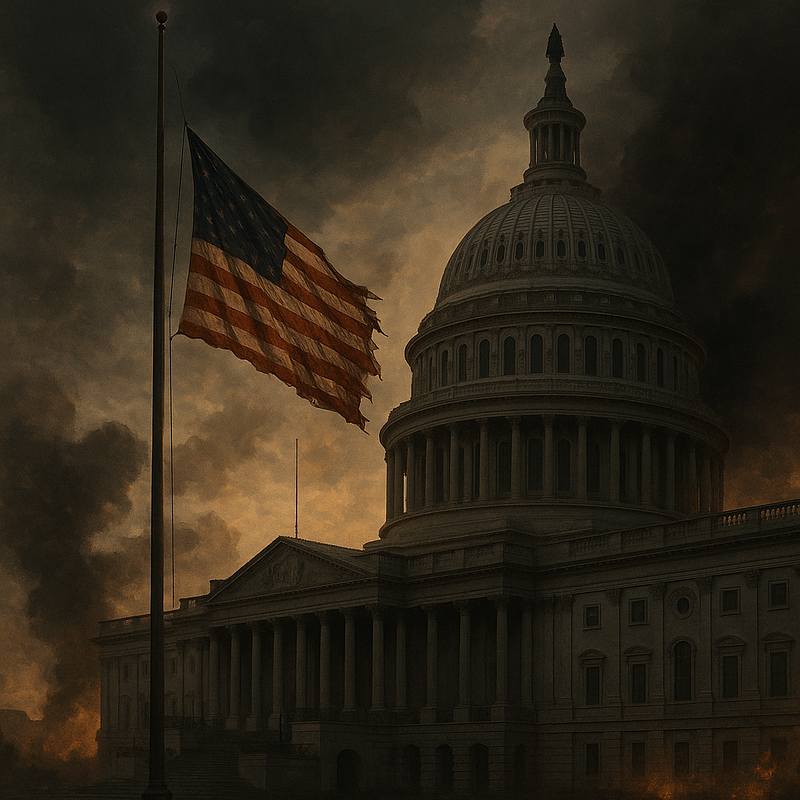
A man lowers the flag halfway without knowing why.
The supermarket shelves where ammunition once stood are empty again.
Somewhere, a radio host asks what still counts as truth.
“They still call it the United States. But it hasn’t felt united in a long time.”
The calm feels staged, as if history itself is holding its breath.
From the suburbs of Dallas to the rusted yards of Detroit, a quiet exhaustion spreads.
The world watches America the way it once watched the Soviet Union in its final years.
A superpower still performing its rituals while the faith beneath them disintegrates.
What happened to Moscow can happen to Washington.
The signs are there for anyone willing to see them.
A president deploying the National Guard into states that openly reject his command.
Governors defying federal orders, cities barricading against their own protectors.
When a union begins to fear itself, the fracture has already begun.
The divided army
Even the armed forces, once the spine of American unity, now show hairline cracks.
The National Guard is caught between two masters, the governor who commands it in peace and the president who claims it in crisis.
Each order now carries a shadow of doubt.
When Washington speaks, state leaders pause.
When states resist, soldiers hesitate.
Empires do not fall when their enemies attack them, but when their armies hesitate to obey.
The split is invisible on parade grounds but unmistakable in the barracks.
A private swears an oath to the nation but sleeps in a state armory.
A colonel answers to two chains of command.
No one says it aloud, yet everyone knows that loyalty itself has become a battlefield.
The architecture of fracture
Every empire begins to fall long before the walls collapse.
The fractures start in the language. Words like freedom, security and truth lose their weight.
By the time the buildings crumble, the meanings already have.
The divisions are no longer political but cellular.
Each household carries its own constitution. Each phone its own flag.
The republic that promised liberty has become a federation of fear.
In Washington, debates look like theatre. Outside, the audience has left.
The middle ground, once the heart of democracy, has turned into no man’s land.
Every vote feels like a battle. Every headline a weapon.
The Union is intact only on paper.
The symptoms mirror those of late Rome. A Senate without trust. Legions without loyalty. Provinces richer than the capital.
Willem Middelkoop’s warning echoes through financial and social fault lines alike.
A nation so armed, so angry, is only one spark away from civil war.
The cult of the flag
The flag still waves, but it no longer belongs to everyone.
It hangs above gas stations and gun stores, not courthouses.
Patriotism has become costume, not conviction.
In small-town churches, pastors pray for vengeance. In city studios, commentators pray for ratings.
The stars and stripes have been weaponized into stripes and scars.
Freedom sells better than it works.
“The American Dream survived only as an advertisement.”
Once the banner united colonies. Now it divides neighborhoods.
To display it is to declare allegiance, not to the country, but to a tribe.
Some kneel before it. Others burn it. Both call the other side un-American.
The deep state and the revenge of belief
When Donald Trump returned to power, the machinery of government turned inward.
Agencies that once spied abroad began suspecting their own citizens.
The purge was not political. It was theological.
He had promised to drain the swamp, but every empire drowns in its own purification.
The FBI, CIA and Pentagon, once pillars of faith, became symbols of betrayal.
Middelkoop had seen it coming. “If you send your National Guard to a state whose governor refuses them, you’re one step from civil war.”
What began as populist revolt hardened into a religion of cleansing.
Belief replaced policy. Loyalty replaced law.
Those who doubted were branded enemies. Those who obeyed were rewarded with fear.
“Every empire ends when it begins to purge itself.”
The republic no longer argued about ideas but about reality itself.
Each revelation spawned a counter-revelation. Each truth its mirror.
The capital became a temple of suspicion. Faith, not reason, wrote the decrees.
The American mirror
A man in Los Angeles films himself with a pistol and a flag, swearing to defend “real freedom.”
A mother in Ohio reads her children the Bible, then whispers that one day they may need to hide from their own government.
They worship the same God, but not the same truth.
“The war is not between citizens and the state. It is between versions of reality.”
The American Dream does not die in revolution. It suffocates in reflection.
Each side sees the other as distortion, until mirrors replace windows and light itself feels partisan.
The collapse of trust
Trust is the currency that outlives all empires, until it doesn’t.
When money inflates, people hoard gold. When meaning inflates, they hoard outrage.
The new civil war is fought with narratives instead of bullets.
The battlefield is digital.
Algorithms choose the targets. Emotions supply the ammunition.
No one wants to win. They only want the other side to lose.
Social media feeds have replaced town squares.
Every scroll is a skirmish. Every comment a trench.
The nation lives inside an endless feedback loop of rage, denial and repetition.
Economic despair deepens the divide.
Inflation, debt and abandoned factories, ghosts of prosperity, wander through the Midwest.
Main Street empties while Wall Street records profits that feel obscene.
Middelkoop’s observation lingers: “The rich are not escaping taxes. They are escaping collapse.”
When belief becomes currency, bankruptcy is inevitable.
From Texas to New York, conversations shrink into echo chambers.
Families stop speaking. Neighbors stop nodding.
Truth has become a subscription service. Everyone pays to hear their own reflection.
The suburban frontier
Beyond the cities, America retreats behind gates and cameras.
Security replaces community.
Children grow up knowing the code to the alarm but not the name of the neighbor.
The new frontier is psychological, the thin fence between comfort and collapse.
People still believe in independence, yet depend on systems they no longer trust.
The myth of self-reliance survives as décor: a gun rack, a pickup, a flag.
“They built walls to keep danger out, and discovered it was already inside.”
The shadow of 1861
The streets feel heavier now.
The flags still move, but slower, as if dragging a memory behind them.
In the distance, sirens echo through half-empty cities that pretend to sleep.
“History does not repeat. It remembers.”
The mood of a century ago drifts back through the architecture.
Then, as now, the republic argued about what it was meant to be.
Then, as now, every debate became a question of survival.
The parallels to 1861 are no longer academic.
This time, no one wears blue or grey.
The uniforms are digital.
The front lines are the screens glowing in living rooms across fifty divided states.
The fractures reach the barracks, the schools, the pews.
A government of laws has become a government of alarms.
Each faction speaks of liberty, yet each seeks control.
The word union survives in documents, not in hearts.
The ghost of the republic
There is a moment before a nation breaks when its citizens begin to speak of the past in the present tense.
People quote the founders as if they were prophets.
They whisper the Constitution like a spell.
But magic fades when belief does.
The republic still exists, but only as paperwork.
What once bound America together, its faith in progress, has become the fault line that pulls it apart.
Half the country believes the future can be rebuilt; the other half believes the future must be erased.
Between them lies the silence where institutions once stood.
When the empire turns inward
Every empire reaches a point when conquest turns domestic.
The wars move from distant deserts to the neighborhoods of the capital.
The rhetoric of liberation becomes the language of surveillance.
Power no longer expands; it circles.
America has entered the phase of self-occupation.
Federal agents raid what state police protect.
Governors resist what generals enforce.
The apparatus that once projected dominance abroad now rehearses control at home.
“What was built to watch the world has begun to watch itself.”
The Patriot Act was the hinge.
A law born from fear of the outside slowly redefined the inside.
Each renewal stretched its reach, until the difference between enemy and citizen blurred.
The global empire became an internal one.
The United States, like the late USSR, can no longer distinguish between dissent and disease.
Ideology has turned pathological.
To question is to contaminate.
And yet, in this sterile climate of enforced virtue, corruption thrives.
The world watching
Beyond its borders, the world observes the slow implosion with the calm of experience.
They have seen this before.
Moscow in 1991.
Baghdad in 2003.
Kabul in 2021.
Empires are laboratories of repetition.
China watches the dollar weaken and waits.
Russia smiles through sanctions it no longer fears.
India, Brazil, South Africa, all trade more with each other and less with the West.
Even Europe, polite in its statements, hedges its bets.
For the first time in a century, the world can imagine the twenty-first without Washington at its center.
The maps are quietly being redrawn, not by conquest but by avoidance.
Allies speak in public of partnership and in private of contingency.
They are preparing for the day the giant no longer moves.
The feast of the jackals
When the lion falters, the smaller beasts gather.
They do not roar; they feed.
Contracts once denominated in dollars are renegotiated in yuan.
Technology once licensed by Silicon Valley is replicated in Shenzhen.
Military bases once feared are now politely ignored.
The world does not hate empires. It hates paying for them.
The American weakness is not only military or financial; it is psychological.
The aura of inevitability has evaporated.
Without it, power becomes just another opinion.
At the United Nations, ambassadors speak longer, listen less.
At Davos, the applause grows thinner.
What once sounded like policy now sounds like nostalgia.
The mirror of 1991
In 1991, America watched the Soviet collapse with sermons about freedom.
It promised democracy to the ruins, markets to the hungry, optimism to the lost.
What it delivered were consultants, hedge funds, and hunger dressed as reform.
Now the mirror turns.
The rhetoric of rescue will not come for America.
The world has learned the lesson of 1991.
There will be no Marshall Plan for Washington.
No sympathy, only settlement.
“Empires are not helped. They are harvested.”
Foreign capital will buy American assets the way Americans once bought Russian factories.
The IMF and World Bank will issue reports of concern and prepare their balance sheets.
Nations that once begged for visas will buy real estate in Miami for half its former price.
History has a memory for humiliation.
The same lectures once given to others will return as headlines written by strangers.
Freedom indexes, corruption rankings, human-rights audits, each one a mirror held to the empire that invented them.
The silence of allies
Europe stands in that silence now.
It depends on America yet dreams of independence.
The fall of Washington would expose how little Europe truly governs itself.
Without the American shield, old ghosts would stir.
The Balkans. The Baltics. The fault lines of energy and memory.
NATO without the United States is a cathedral without a roof.
All alliances are conditional love.
China would move quietly into the vacuum, not with tanks but with trade.
Russia would offer forgiveness at a price.
Even Israel, the most faithful ally, would negotiate its own survival.
When the protector trembles, the protected improvise.
The aftermath of power
Inside the United States, the consequences would resemble Russia’s nineties.
Oligarchs would rise from chaos, draped in patriotism and debt.
States would compete for foreign investment.
Private armies would guard pipelines and ports.
Yet among the ruins, there would also be invention.
Collapse releases the imagination that prosperity cages.
From the wreckage of control, communities might rediscover scale, locality, meaning.
But that is a longer story, one the present cannot yet afford to tell.
Closing reflection
Night falls over a country still pretending it can be fixed.
The lights in the skyscrapers of New York burn later, as if work could reverse entropy.
On the steps of the Lincoln Memorial, tourists take photos in the dark.
The statue looks beyond them, toward a future it cannot recognize.
“Every empire ends twice, first in the mind, then in the world.”
The fall of America will not look like an explosion.
It will sound like applause fading after the music stops.
No enemies at the gate, only silence in the forum.
And somewhere, far from the cameras, another power will rise and say what America once said:
We are the future.
Remember always where it truly began, and who set it in motion.
Related Chapters from The Manifest
Max Verstappen and the Scripted Speed: How Formula 1 Learned to Sell Suspense, When dominance stops selling drama, the spectacle becomes the product, and belief becomes the brand.
The Second Civil War: The Implosion of the American Dream, When a nation begins to fear itself, entertainment replaces reflection.
The Tsunami Effect: Why Gold Rises Before the Flood, Every shimmer of safety is the sea pulling back before collapse.
Digital ID: The New Face of Obedience, Freedom was never lost, it was redesigned as verification.
Related from The Manifest Archive