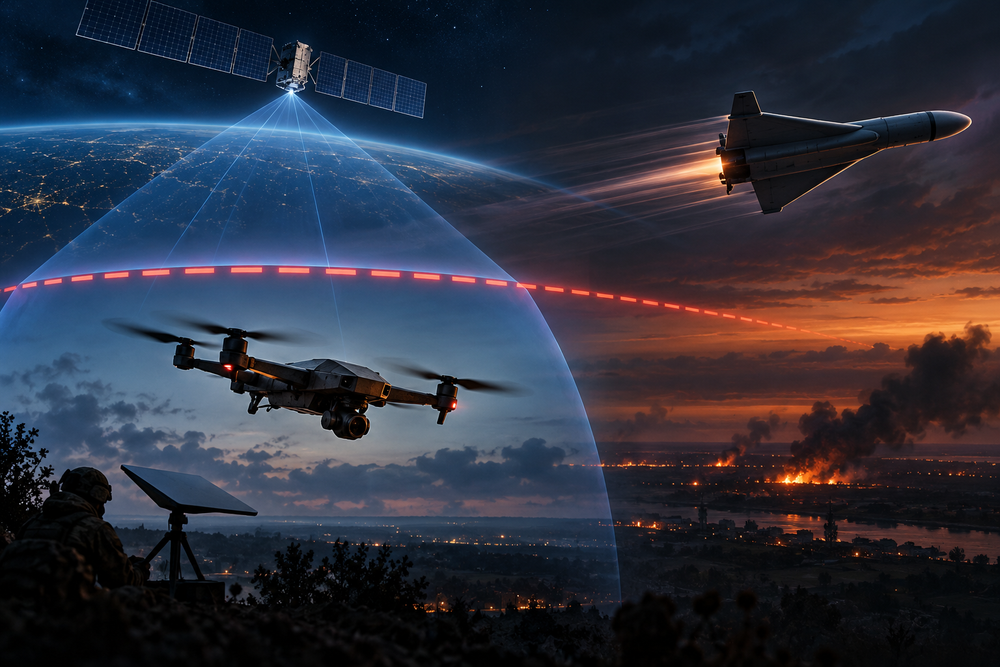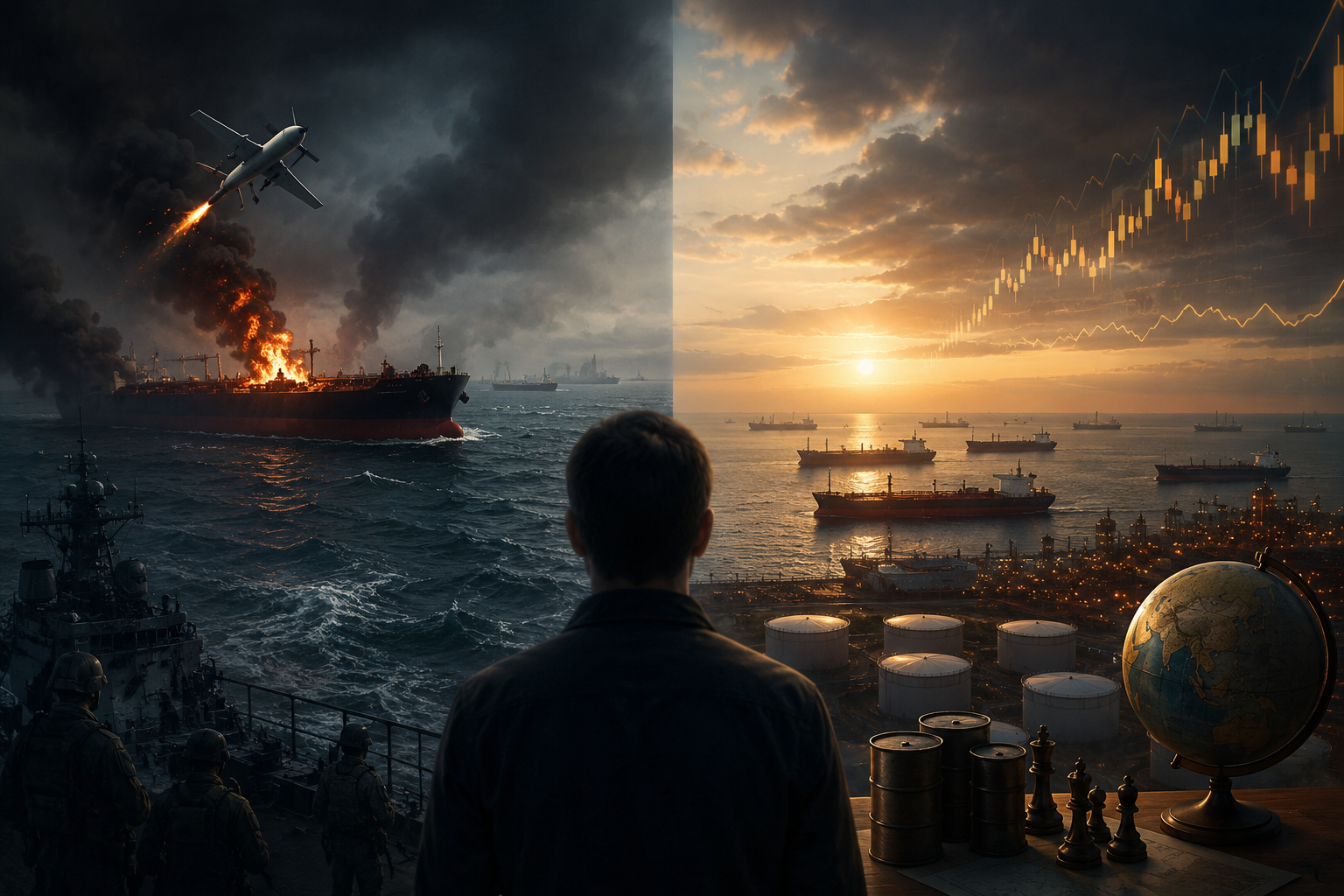
On Thursday, in the crowded shipping lane at the mouth of the Strait of Hormuz, a one-way attack drone came in low over the water and struck the upper deck of a cargo ship called the Ever Lovely. The vessel flew the flag of Singapore, a neutral commercial carrier in the most important oil corridor on earth, and it was hit anyway, one of at least four drones fired at shipping in the strait that day. A war that has run for four months, a cheap machine falling out of the sky onto a civilian deck, a fire on the water: this is the part of the picture that looks like a crisis, and it is real.
Now set the other half of the picture beside it. In the same week the price of Brent crude fell to around seventy-two dollars a barrel, the lowest since the last week of February, since before the war. Something close to twenty million barrels of oil left the strait in a single twenty-four-hour stretch, by the US energy secretary's count, about what passed through on an ordinary day before any of this began. A waterway that Iran had just declared closed was moving oil at close to its pre-war volume, and the market read the whole confrontation as an ending: a signed memorandum, a ceasefire framework, the danger sliding into the rear-view mirror. Two pictures, one strait, one week. One of them looks like a war. The other looks like peace breaking out.
Both are true, and the gap between them is the most important thing happening in the world economy right now. Either the crisis is genuinely passing, the drone notwithstanding, or the calm is being manufactured, paid for out of sight while the war goes on. It is worth being precise about which, because it is the difference between a danger that has passed and a danger that has only gone quiet.
The calm is being manufactured. Not in the sense of a conspiracy, but in the plainer sense that calm now has a cost, and someone is paying it. The low price and the record flow are not evidence that the danger is gone. They are evidence of how much is being spent to keep the danger from showing up in the price. To understand how long this can last, the question is not whether Iran reopens the strait or closes it again. The question is what is being drawn down to keep the oil moving while the war is still on, and how much of it is left.
This chapter was written while the strait looked calm and oil was cheap. The calm ran out exactly as the buffers here predicted: the ceasefire collapsed, tankers were struck in Omani waters, and the price jumped nearly nine percent within a day. Read this as the mechanics beneath the current phase, then continue with Nobody Is Watching the Sentence and Nobody Is Watching Your Fuel Bill. In this chapter: the spare barrel · the state as underwriter · the days in the tank · what empties first · the cascade at the pump.
The price is the last thing to move
Most people read an oil crisis through the price, because the price is the part that reaches them. It arrives at the pump, in the heating bill, in the cost of a flight. So when the price falls, the natural conclusion is that the crisis has eased.
This gets the order of events backwards. The price is not the leading edge of an energy shock. It is the trailing one. A price stays low as long as supply keeps arriving, and supply keeps arriving as long as the system has reserves to throw at the problem: spare barrels somewhere, ships willing to sail, insurers willing to cover them, tanks full enough to draw down. The price only moves when those reserves are gone. By the time the number on the screen jumps, the buffers that held it down have already been spent. The price is not the warning. It is the receipt.
This is why the falling price is the most misleading object in the entire crisis. Market analysts warned in May of misplaced euphoria, of markets sleepwalking toward a recession while congratulating themselves on cheap oil. The calm reading of the market and the alarmed reading of the supply chain are not two opinions about the same facts. They are two different layers of the same system, and the market is reading the top layer while the strain accumulates underneath. Underneath, four buffers are holding the world's most important oil route open. Each one is finite. Each one is being used right now. None of them is visible in the price.
The first buffer: the spare barrel that cannot move
When analysts reassure the public that an oil shock is survivable, they are almost always pointing, knowingly or not, at one number: spare capacity. It is the oil the world is not currently pumping but could, the slack that lets producers raise output if a supplier goes down. In the middle of 2026 that slack stands at roughly five million barrels a day, and it is concentrated almost entirely in two countries. Saudi Arabia holds about three million barrels of it. The United Arab Emirates holds about one million. Together they hold very nearly all the meaningful spare capacity on earth.
Here is the part that does not survive a second look. That spare capacity sits behind the Strait of Hormuz. The buffer the world would reach for in a Hormuz crisis is on the wrong side of the Hormuz crisis. The chief executive of Vitol, the largest independent oil trader in the world, said it without softening: all of the world's spare production capacity sits behind the strait today. The reserve tank and the broken valve are in the same locked room.
There are pipelines that route around the strait, and they matter, but they do not close the gap. Saudi Arabia can push crude west to the Red Sea through its East-West pipeline. The UAE can send a smaller volume to the port of Fujairah, outside the strait, through the Habshan line. Add them up and a meaningful share of Gulf oil has a way out that never touches Hormuz. But the spare capacity, the extra barrels that would have to be summoned precisely during a closure, exceeds what those pipelines can carry, and the surplus has only one road to the sea. The bypasses drain the bathtub at the normal rate. They were never built to drain it during a flood.
There is a second limit hidden inside the first, and it is in the definition itself. Spare capacity, as the energy agencies measure it, is not a bottomless reservoir. It is production that can be brought online within thirty days and sustained for at least ninety. The definition guarantees a season, not a year. Even in the best case, where the strait stays open and every spare barrel can reach the sea, that five million barrels a day is a cushion certified to bridge a disruption measured in months, not to replace a supplier indefinitely. The phrase that calms the market, the world has five million barrels of spare capacity, quietly contains a warranty period. It is a buffer with a guarantee, and the guarantee is short.
So the first buffer is real, and it is also a kind of illusion. It is five million barrels of insurance written against a fire, stored inside the burning building, and certified for only a season even if the door stays open. As long as the strait stays open, the spare capacity is genuine and the market is right to be calm. The moment the strait actually closes, most of that buffer converts from an asset into a hostage. It does not disappear gradually. It vanishes at once, on the day it is needed, which is the one day it was supposed to exist for.
The second buffer: when the government becomes the underwriter
The second buffer is the reason a single ship can still cross at all, and it is the one almost no reader has heard of, because it lives in a part of the system designed to be invisible.
A modern oil tanker does not sail on courage. It sails on insurance. Before a very large crude carrier enters a war zone, someone underwrites the hull, the cargo, and the liability, because no owner will risk a quarter-billion-dollar vessel and a hundred million dollars of oil on their own balance sheet. War-risk insurance is the quiet permission slip that the entire trade depends on, and it is priced by a small set of underwriters who meet, assess the danger, and set a rate.
When the war began, that permission was withdrawn. Within forty-eight hours of the airstrikes, premiums for the strait rose many times over, and major marine insurers cancelled existing cover outright and offered replacements at rates dozens of times higher than before. By late spring the cost to insure a single transit had climbed, by one widely cited industry estimate, to as much as four thousand times the pre-crisis price. At that point the market had effectively done what no navy could do. It had closed the strait without firing a shot, because a ship that cannot be insured cannot legally or commercially sail, whatever the captain's nerve.
Washington's answer was to offer a public one. The United States government, through its development finance arm, working with the Treasury and Central Command, stood up a reinsurance facility to backstop the trade, with the insurer Chubb as lead underwriter and capacity that grew to forty billion dollars. By mid-May the facility had not written a single policy, because it applied only to ships under US naval escort, and what brought tankers back in June was the ceasefire memorandum, with a Chubb-led private consortium adding cover. In plain terms, the American taxpayer now stands behind the strait as underwriter of last resort: a government has offered to absorb a risk the market had judged uninsurable.
That is a buffer, and it is the most fragile of the four, because it is not a physical quantity. It is a political decision that must be renewed. A barrel of spare capacity is a barrel whether or not anyone is paying attention. A government insurance facility exists only as long as the political will to fund it exists, and it can be capped, exhausted on a run of claims, or quietly withdrawn in a budget fight on the far side of the world. The risk has not been reduced. It has been moved, off the books of the people who price risk for a living and onto the books of a state that prices it for reasons of its own. Where the danger has been nationalised, that does not make it smaller. It makes it political, and a political risk waits, with great patience, for the politics that took it on to change their mind.
This has happened before, at the same strait, and the precedent is worth standing in for a moment because it shows, in a single image, what kind of move this is. In the late nineteen-eighties, during the tanker war that ran alongside the Iran-Iraq conflict, Iran was attacking the shipping that carried Gulf oil, and the commercial world began to back away from the danger exactly as it is doing now. Kuwait asked Washington for protection, and the United States agreed to do something legally remarkable: it re-registered Kuwaiti tankers under the American flag so that the US Navy could escort them, and launched the largest naval convoy operation since the Second World War.
Picture the morning it began, in July 1987. The first ship in the convoy is a Kuwaiti supertanker, freshly renamed and flying a brand-new United States flag that was stitched onto it for exactly this purpose, and around it steams a column of American warships, radar turning, guns crewed, the full weight of a superpower arranged to see a single tanker safely through. A few days into the passage the tanker hits a mine. The mine had cost perhaps a few thousand dollars and had been sitting silently under the water, waiting, indifferent to the flag. The ship was worth tens of millions, the warships around it billions, and not one of them could do a thing about a piece of iron they could not see and could not shoot. The most powerful navy on earth escorted its charge straight onto a weapon it had no answer to.
Hold that picture against the drone that hit the Ever Lovely this week and the through-line is plain. The point of the comparison is not that history repeats. It is that the instrument has changed while the logic has not, on both sides. The cheap threat is still cheap, a mine then, a drone now, and the expensive defence still cannot fully stop it. And the state's response is still to step between the danger and the cargo, except that the escort is now financial rather than naval. In 1987 the United States put a warship between the tanker and the threat. In 2026 it puts a balance sheet there. The destroyer has become an insurance facility, but it is the same decision: when the commercial world will no longer carry the risk of the strait, the state carries it, because the alternative is that the oil stops. And a state-borne risk, whether it floats on a warship or sits in a reinsurance ledger, lasts exactly as long as the government's willingness to bear it.
The third buffer: the days in the tank
The third buffer is the one the importing countries control, and it is the one being drawn down most quietly of all, because a falling reserve makes no sound.
Strategic petroleum reserves exist for exactly this moment. The standard, set by the International Energy Agency after the shocks of the nineteen-seventies, is that an importing economy should hold at least ninety days of net imports in store, a cushion to ride out a disruption without the price doing the rationing. When supply through Hormuz tightens, importers do not immediately bid up the global price. First they draw on the tank. The tank is what keeps the shortage off the market, and therefore out of the price, and therefore out of the headlines. Every barrel pulled from a reserve is a barrel of calm bought on credit.
It is worth pausing on where these defences came from, because it explains both their strength and their blind spot. Almost every buffer holding the strait open today is a child of the last great oil shock. The strategic reserves, the ninety-day rule, the agency that coordinates releases, even the habit of governments treating oil supply as a security matter rather than a commercial one, were all built in the nineteen-seventies in response to an embargo, an attempt to make sure the West could never again be squeezed at the pump by a producer's decision. The system now absorbing the Hormuz crisis is, in other words, a defence designed for the previous war: a sudden, deliberate cut-off by exporters. What it is meeting instead is a slow strangulation of a transit route, a shortage that arrives not as an embargo but as an insurance premium and a turned-back tanker. The buffers are real and they are working, but they were engineered to outlast a shock of a particular shape, and the shape has changed.
The cushions are wildly uneven, and the unevenness is the story. China holds the largest emergency stockpile in the world, on the order of a hundred and ten to a hundred and forty days of cover, built deliberately over a decade for precisely this scenario. Japan holds even more, well over two hundred days. These are the countries that can absorb a long disruption without flinching. Then there is the other end. India, which with China takes nearly half the oil that leaves the strait, holds only nine or ten days in its dedicated strategic reserve, with some additional cover in commercial tanks, and its own parliament has been pleading for years to build the ninety-day cushion it does not have. The countries of South Asia, India, Pakistan, Bangladesh, draw two-thirds of their imported gas through Hormuz and hold among the thinnest buffers against losing it.
And a reserve has a property the other buffers do not: it does not refill while the crisis is on. Spare capacity can in principle keep pumping; an insurance facility can be topped up by a government; but a strategic reserve, once drawn down, can only be rebuilt by buying oil back out of the same tight market that forced the draw in the first place, which no government does in the middle of a shortage. A reserve release is therefore a card that can be played once. The coordinated releases that the energy agencies organise among importing nations are real and they help, but they spend a stock that took years to accumulate, and they buy weeks. After that the cushion is thinner than before, and the next disruption meets a system with less behind it. The buffer that feels safest to use is the one that is hardest to replace.
So the third buffer is not one clock but many, running at different speeds. The world does not have a single deadline. It has a staggered sequence of them, and the first economies to feel a real shortage will not be the ones nearest the strait. They will be the ones with the shallowest tanks. A reserve draw is the most painless response available, which is exactly why it is dangerous: it is the buffer a government reaches for first and admits to last. The day a country announces it is releasing strategic stocks is not the beginning of its problem but the moment that problem grew too large to keep hidden any longer.
The fourth buffer: the clock
The fourth buffer is the ceasefire itself, and it is worth seeing clearly for what it is, because it is being read as the opposite of what it is.
The framework that calmed the markets is not a settlement. It is a sequence of conditional, reversible steps, with a clock attached: a ceasefire measured in weeks, during which the strait reopens with no tolls, Iran clears the mines it laid, the United States lifts its blockade, and Iran receives sanctions relief in return. Read the provisions as an engineer rather than a diplomat and what they describe is not peace but a suspension, each side performing a reversible act in exchange for the other's, the whole thing standing only as long as all of it stands. A ceasefire that reopens a strait can re-close it. A mine that was cleared can be relaid in a night. Sanctions relief that was granted can be revoked by the next press release.
This is why the framework functions as a buffer and not as a resolution. It is buying time, which is valuable, but time is the thing it buys, not safety. And the single most revealing clause in the entire arrangement is the smallest one: the strait reopens with no tolls. Hold that against the violence of the preceding months and the real subject of the war comes into focus. The fight was never only about whether the oil flows. It was about who sets the terms on which it flows, and a clause negotiated specifically to forbid a toll is the trace of a party that wanted to charge one. The ceasefire bought calm by deferring that question. It did not answer it. The clock is running on a disagreement that was paused, not closed, and when the clock runs out the disagreement is still there.
It is worth knowing exactly what the toll was, because the detail changes the size of the dispute. In the months before the framework, Iran was granting passage on a condition that had nothing to do with money in the usual sense. An Iranian official told CNN that Tehran was considering letting a limited number of tankers transit if their cargo was traded in Chinese renminbi rather than dollars, and Lloyd's List, the maritime industry's record of record, reported that at least two vessels paid a charge in yuan, outside the dollar-based network the world's oil has run on for half a century. Look at who was sailing and the arrangement makes sense: many of the ships Iran let through in those weeks were bound for China. The strait had become, briefly, a place where the price of passage was paid in the currency of the buyer and the counter-party to the dollar.
That is why a clause forbidding tolls was worth fighting for, and why it belongs in a story about buffers rather than a footnote about exchange rates. A toll collected in yuan at the world's most important oil chokepoint is not a fee. It is a precedent, a small repeated act of settling oil outside the dollar, performed at the one place the whole system has to pass through. The ceasefire did not only reopen a waterway. It suspended an experiment in pricing the world's oil in another currency, and suspended is not the same as ended. The clock counts down to the moment that experiment can resume.
What empties first
Put the four buffers side by side and the question everyone is really asking, how long before it really goes wrong, stops being a guess about a date and becomes a question about an order. These buffers do not drain at the same rate, and they do not drain independently. The honest forecast is not a number of days. It is a sequence, and a set of thresholds that would tell you which stage you are in.
The clock buffer is already failing as these words are written, which is the clearest possible demonstration of the point. Within ten days of the framework being signed, it was being violated. drones that Washington attributed to Iran were fired at vessels in the strait, one of them striking a Singapore-flagged cargo ship; the United States answered with strikes on Iranian missile, drone, and radar sites; Iran retaliated against American bases around the Gulf and again declared the strait closed, even as its own foreign ministry insisted shipping was operating normally. The status of passage is now contested hour by hour, one government calling the strait open and the other calling it shut. This is what it looks like when a buffer made of a promise runs out: not a dramatic closure, but a framework that frays back into the dispute it was meant to suspend, while the oil price, days behind the news, has barely begun to register it.
The most fragile buffer that remains is the political one, the government insurance facility, because it is the one that can be withdrawn by a decision rather than exhausted by use. Watch it first. If the reinsurance backstop is capped, drained by a major claim, or allowed to lapse, private insurers do not return at the old price, and the strait re-closes by balance sheet even if not a shot is fired. The second to watch is the ceasefire clock, because its expiry is literally scheduled; the strait's status on the day the framework lapses is the single most important date in the system. The third is the reserve sequence, where the leading indicator is not China or Japan but the thin-tanked importers, India first; the moment a major Asian economy announces a strategic release is the moment the shortage has outgrown the buffer that hid it. Only at the end of the chain sits the spare-capacity buffer, the five million barrels, and it is last not because it is strongest but because it only matters in the worst case, a genuine extended closure, the one event that turns that buffer from an asset into a hostage in a single day.
That is the structure of the danger, and it is also, deliberately, a set of claims that can be proven wrong. If the United States and its partners formalised the insurance backstop into a permanent, uncapped facility, if the importing economies quietly topped up their reserves during the lull instead of drawing them down, if the ceasefire converted into a durable settlement with the toll question actually resolved, then the buffers would be refilling faster than they empty, and the calm in the price would be earned rather than borrowed. The thesis here is not that catastrophe is coming. It is narrower and harder to dismiss: that the present calm is being financed out of reserves, and that nothing visible in the oil price tells you how much of that financing is left. The price will be the last instrument to warn you, because the price only moves when the buffers are already gone.
The cascade no one prices at the pump
There is a deeper reason the price of crude understates the danger, and it has nothing to do with crude. The strait does not only carry oil. It carries the inputs of the food supply, and that cascade reaches people through a channel the oil price never touches.
Roughly a fifth of the world's liquefied natural gas passes through Hormuz, almost all of it from Qatar and the UAE, and natural gas is not only fuel. It is the feedstock for nitrogen fertiliser. The same Gulf coast that ships the gas also runs some of the planet's largest ammonia and urea plants, and when those plants lost power and security in the opening days of the war, a large slice of the world's fertiliser supply went offline with them. By the reckoning of the World Bank and the United Nations Food and Agriculture Organization, which track these flows, the strait normally carries between a quarter and a third of the world's urea exports, and the price of urea climbed about eighty percent between February and April. The Gulf is also the world's largest exporter of sulphur, another link in the same chain, which gives this shock a reach the 2022 grain crisis did not have.
There is a cruelty in the geography of who absorbs this. The countries with the thinnest oil reserves, the South Asian importers drawing most of their fuel and gas through Hormuz with thin strategic cover, are largely the same countries that import their fertiliser and depend on the harvests it feeds. The oil shock and the fertiliser shock do not strike two different populations. They converge on one.
Put a face at the far end of that chain, because the chain ends at one. India draws about half of its imported nitrogen fertiliser from the Gulf, and as the Qatari gas that feeds the fertiliser plants stopped arriving, plants across India, Bangladesh, and Pakistan throttled back or shut down, and the price of urea climbed above eight hundred and fifty dollars a tonne in April, the highest in four years, in the run-up to the monsoon planting season that decides the year's rice. A smallholder reaching the depot in those weeks, for the sack of urea that decides whether the season is a harvest or a disappointment, finds it priced beyond what the land can pay back. So he buys half, or none, and spreads it thin. Months later that thinner harvest reaches the market as a higher price for the very food his own family eats, and the same household has paid twice for a waterway it will never see: once in the fertiliser it could not afford to spread, and again in the bread that costs more because it was not spread. The fuel bill arrives now, and is argued over on the news. The food bill arrives next season, larger and quieter, and is never traced back to a drone over a shipping lane on a Thursday in June.
Follow that forward and the destination is not the petrol station. It is the field, and then the loaf. A fertiliser shock does not arrive this quarter. It arrives next season, in lower yields and higher food prices, in the countries least able to absorb either. This is the part of the cascade that the falling oil price actively conceals, because the two move on different clocks. Crude can be calm in June while the fertiliser that will not be spread in autumn is already not moving through the strait in summer. The most consequential shortage in this crisis may turn out to be one that never shows up in the commodity everyone is watching. The world is pricing a fuel crisis. It is being handed a food one, on a delay, through a door it is not watching.
Why the smartest market on earth cannot see it
There is an obvious objection to all of this, and it deserves to be met head-on, because it is the question almost everyone arrives at. The global oil market is one of the most sophisticated information machines ever built, watched in real time by thousands of analysts paid very well to see exactly this kind of risk. If four buffers were quietly draining, how could that machine be pricing crude near a pre-war low? How could the whole world be falling for it?
The answer is not that the market is stupid. It is that the market is measuring the wrong thing, and measuring it almost perfectly. A price is set by the supply of today meeting the demand of today. As long as the oil reaches the port, the price is correct, by definition, because the price only knows about the barrels that exist, not about the reserves being spent to make them exist. The buffer is not on the instrument. The market reads the surface of the system with great precision and is structurally blind to the layer underneath it, the way a thermometer in a pleasant room tells you nothing about the fire moving inside the walls.
The blindness is deepened by how the watching is divided. No single eye sees all four buffers at once. The oil trader watches spare capacity. The marine insurer watches premiums. The central banker watches the strategic reserve. The foreign ministry watches the ceasefire. Each is an expert in one buffer and barely aware of the others, and there is no desk anywhere whose job is to add the four together. The danger lives precisely in the sum, and the sum is the one number nobody owns.
Even the analyst who does see the whole picture is paid not to act on it. A trader who prices in a catastrophe that has not yet happened underperforms every single day it continues not to happen, and is fired long before being proved right. The incentive is to read the calm, because the calm is almost always correct. The strait was threatened for forty years before this war without ever truly closing; the base rate says relax, and the base rate is usually right, until the one occasion it is not. This is the oldest trap in markets, the turkey that grows more confident of the farmer's goodwill with every meal, right up to the week of the holiday.
So the world is not being fooled by a trick. It is being failed by its own instruments, built to read the surface, divided so that no one sees the whole, and tuned by incentive to trust the quiet. The price is not lying. It is answering a different question from the one that matters, and answering it honestly. That is why the warning, when it comes, will land as a shock on people who were watching the screens the entire time.
The strongest case that this is fine
The honest counter-argument deserves to be put at full strength, because a good deal of it is right, and the analysis here only earns its keep if it can survive the best version of the opposing view.
The strongest case is this. Buffers exist precisely to be used. A spare-capacity cushion that is never drawn, an insurance facility that is never called, a strategic reserve that is never released, would be a waste; the entire point of these systems is to absorb exactly this kind of shock so that the price stays stable and ordinary life continues. The fact that they are working is not a hidden failure, it is a visible success. The system has held: after a spring in which exports through the strait fell below a tenth of normal, the oil is moving again. The ceasefire may well harden into something durable, as fragile frameworks sometimes do. And the price at seventy-two dollars may simply be correct, an efficient market pricing a genuine de-escalation, not a deluded one ignoring a hidden danger. On this reading, the buffers are not a countdown. They are the shock absorbers doing their job, and the smooth ride is the proof.
Most of that is correct, and it should be conceded without flinching. Buffers are meant to be spent, the system is working, and the ride, for now, is smooth.
What the counter cannot do is make the buffers infinite, or guarantee they refill before they empty. A shock absorber works until it bottoms out, and the smoothness of the ride tells you nothing about how much travel is left in it. The case for calm is really a bet that the war ends, or the buffers replenish, before the reserves run dry, and that is a reasonable bet, but it is a bet, and the falling price is being read as if it were the result. The deepest flaw in the optimistic reading is not that it is wrong about the buffers. It is that it points to the buffers being used as evidence that no danger exists, when the using is the danger, metered out slowly. A buffer spent is not a risk avoided. It is a risk postponed, and the postponement is being mistaken for a reprieve.
What the calm is really telling you
Go back to the strait, and the record day, and the price falling as if in relief. The strangeness resolves once you stop reading the surface as the system. The oil is flowing at a record not because the danger passed but because four reserves are being spent to push it through, and the bill is itemised in places the oil price does not show. The calm is real. It is also bought: the calm is purchased with the buffer, and the buffer is what the calm costs.
So the answer to how long before it really goes wrong is not a date, and anyone who gives you one is selling something. It is a sequence: the political buffer of the insurance backstop first, because it can be withdrawn by a decision; the ceasefire clock next, because its expiry is scheduled; the strategic reserves after that, the first announced release being the shortage admitting it has outgrown its hiding place; and the trapped spare barrels last, in the worst case of all. The oil price trails every one of them. The most dangerous thing about the Strait of Hormuz today is not that it might close. It is that, for now, it is open, and the world has mistaken the cost of keeping it open for the absence of a cost at all.
And the lesson does not stay at the strait, which is the reason to learn it here, where it is written large enough to see. Almost every stable system a modern life depends on is running on a buffer that is invisible until it is gone. A power grid holds its frequency on a reserve margin, and the lights stay on right up to the instant demand crosses it, and then they fail everywhere at once. A bank looks exactly as sound the day before a run as the day before none ever comes. A body in late middle age feels well on its organ reserve until the reserve is spent, and the first real symptom is also nearly the last warning. In every one of these the number everyone watches, the price, the voltage, the share price, the blood test, is the slowest part of the system, because that number is precisely what the buffer is being spent to hold still. Learn to watch the buffer instead of the indicator, and you are reading the system a year before it consents to tell you anything. The indicator is never the warning. It is the receipt.
Evidence Map
Facts, interpretations, forecasts, and disconfirming signals.
Core claim. The current calm at the Strait of Hormuz, record oil throughput and a crude price near its pre-war low, is not evidence that the crisis has eased but the visible result of four finite buffers being drawn down to keep oil moving while the war continues: OPEC spare capacity (almost all of it located behind the strait), a state-backed war-risk insurance facility, importers' strategic reserves, and a reversible ceasefire clock. The oil price is a trailing indicator and will move only after these buffers are exhausted.
Evidence level. Facts (high confidence, documented): roughly twenty million barrels left the strait in a single day by the US energy secretary's count and Brent fell to about seventy-two dollars in late June 2026; about a third of global crude trade and roughly a fifth of global LNG transit Hormuz; OPEC spare capacity is around five million barrels a day, concentrated in Saudi Arabia (~3 mb/d) and the UAE (~1 mb/d), and sits behind the strait; private war-risk cover was cancelled or repriced and a US government-backed reinsurance facility was set up (lead underwriter Chubb, capacity of $40 billion), though it had written no policies by mid-May; China holds ~110 to 140 days of reserve cover and Japan more than 200, while India holds roughly nine or ten days in its strategic reserve; Qatar/UAE LNG and Gulf ammonia disruption removed a large share of fertiliser supply and pushed urea up sharply. Interpretation (medium, marked): the framing of these four as a single depleting buffer-stack, and the claim that the price is being actively held down rather than reflecting genuine de-escalation. Forecast (speculative): the order in which the buffers fail.
What would confirm this. The ceasefire framework fraying with the toll and currency question unresolved (already visible: within ten days of signing, both sides exchanged strikes and Iran re-declared the strait closed); a cap, lapse, or large claim against the government insurance facility followed by a fall in transits; a strategic reserve release announced by a major Asian importer; fertiliser-driven food-price rises appearing on a lag while crude stays calm.
What would disprove this. The insurance backstop made permanent and uncapped; importers refilling rather than drawing down reserves during the lull; the ceasefire converting into a durable settlement that resolves the terms of passage; private war-risk insurers returning at near-normal rates without state support.
Watchlist (next 60 to 90 days). The status of the US reinsurance facility; the ceasefire expiry date; the first strategic-reserve release in South or East Asia; urea and ammonia prices as a leading edge of the food cascade.
Frequently Asked Questions
Is the Strait of Hormuz open or closed right now?
Both, in effect. Iran has declared the strait closed and is turning ships back, yet oil is moving through it at close to pre-war volume, by Washington's count, under a fragile ceasefire that has already been violated. Passage now depends on Iranian permission rather than free transit, so the strait is neither fully open nor fully shut.
How much of the world's oil and gas passes through the Strait of Hormuz?
About a third of globally traded crude oil and roughly a fifth of the world's liquefied natural gas transit the strait, almost all of it bound for Asia, with China, India, Japan and South Korea as the main destinations.
Why is the oil price low if the strait is in crisis?
Because the oil price is a trailing indicator, not a warning. It stays low while reserves are spent to keep oil flowing: OPEC spare capacity, a state-backed war-risk insurance facility, and importers' strategic stocks. The price only moves once those buffers are exhausted, by which point the danger is already advanced.
What would actually trigger a global economic shock from the Strait of Hormuz?
A sequence rather than a single event: the US-backed war-risk insurance facility being withdrawn, the ceasefire lapsing, a major Asian strategic-reserve release, and finally a real closure that traps OPEC's spare capacity behind the strait, the buffer designed for the crisis becoming inaccessible during it.
How does the Strait of Hormuz crisis affect food prices?
The strait also carries the natural gas and fertiliser that agriculture depends on. The disruption cut into a route that normally carries a quarter to a third of global urea exports and pushed urea prices up about eighty percent, which reaches households as higher food prices a season later, often in the countries with the thinnest reserves.