The Quiet Before the Change
The story is usually remembered as beginning in noise, airport balconies trembling under the pressure of screams, television studios buzzing beneath hot lights, guitars held like lightning rods for a generation that mistook volume for revelation.
But the real beginning lived elsewhere.
In silence.
In the narrow corridors of Abbey Road, the air felt heavier than the light allowed. Footsteps softened against old linoleum. Instruments were tuned with the slow patience of people waiting for something unnamed to announce itself. It was in that stillness that the first tremors of transformation began, long before the world had reason to suspect anything was shifting.
Studio Two was not grand.
It was simply honest.
High ceilings that gathered sound like breath held too long.
Soft light that revealed dust in slow suspension.
Walls that carried the memory of hundreds of takes, mistakes, revisions, and quiet breakthroughs.
And more than a physical space, it was a refuge the one place in their lives where expectation loosened its grip.
A temporary suspension of expectation.
A place where the world’s demands could not reach them, where ideas could arrive without being judged, named, or explained.
The only space in their lives that did not ask them to perform.
Inside that atmosphere, their earliest hints of restlessness took shape.
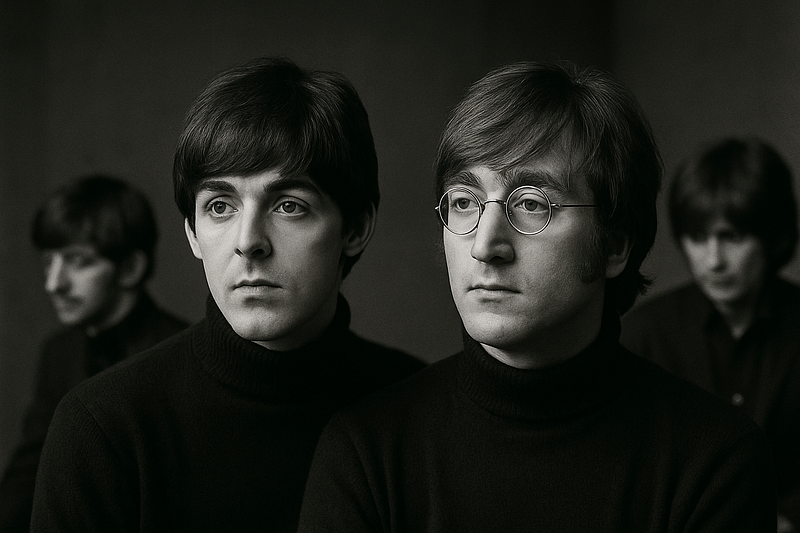
John hummed unfamiliar intervals without noticing he had crossed the threshold from habit into invention.
Paul tapped rhythms on the body of his bass, following the microseconds between impulses rather than the downbeat.
George searched for tonal color, listening for resonance that felt less like harmony and more like truth.
Ringo watched the room with the patience of someone who understood when the air itself had begun to shift.
None of them called it transformation.
Transformations never announce themselves.
They accumulate quietly.
The music was still bright, but the space around it had begun to contract.
Touring had become a loop, soundcheck, interview, performance, escape.
The repetition sharpened their showmanship but dulled their attention.
Crowds blurred.
Cities blurred.
Time blurred.
Yet exhaustion has a way of stripping away the unnecessary.
Under pressure, instinct refines itself.
They sensed when a chord was too tidy.
When a melody arrived too easily.
When harmony solved a problem that should have remained unsolved.
These micro-detections were the early signs.
“The tape remembers the turning long before the artist does.”
Something was shifting.
Quietly.
Relentlessly.
Out of view.
And even though they did not yet know where the shift would lead,
they had already begun to follow it.
The World Before the Shift
To understand the distance between “I Want to Hold Your Hand” and “Eleanor Rigby,” one must understand the world that existed between them, a world that was itself in motion. Popular music in the early sixties lived in small, predictable frames. Verse, chorus, bridge, repeat. Melodies that wrapped themselves easily around memory. Harmonies that resolved without hesitation. Emotional palettes limited to the primary colors.
The Beatles fit seamlessly into this architecture, at first.
Their early songs sparkled with immediacy, wide-open innocence, a kind of buoyancy the postwar decade craved.
But beneath that brightness lay restlessness.
Not dissatisfaction, but awareness.
They saw more than their songs could hold.
They lived at a pace that revealed the world not as audiences experienced it, but as it appeared through windows, backstage doors, and hotel rooms that blurred into a kind of emotional abstraction.
Britain itself was shifting.
Not abruptly, but perceptibly.
American soul drifted in like weather.
Jazz re-entered mainstream consciousness.
Early electronic textures flickered at the edges of academia.
Indian classical music arrived through whispers and curiosity.
Folk music, once nostalgic, became introspective.
The cultural grid loosened.
And in those loosenings, space appeared.
Space for ambiguity.
Space for complexity.
Space for music that did not owe clarity to anyone.
“Creativity begins in the moment repetition becomes unbearable.”
Their early songs were not false, they were simply early.
But the vocabulary of the world changed, and artists either changed with it or became artifacts of the moment that birthed them.
The Beatles were not artifacts.
They were antennae.
By the time they returned to the studio, something inside them had already shifted.
The world that had embraced them was no longer the world in which they were writing.
And they felt it, even if they had no language for it yet.
Abbey Road and the Threshold of Reinvention
When the relentless pace of touring finally broke open, the band returned to Abbey Road with the kind of exhaustion that sharpens attention rather than dulls it.
They were too tired to perform, too emptied out to pretend, too stripped down to follow old patterns.
They arrived without a plan, and that was the point.
Studio Two greeted them with its usual patience.
It did not demand a hit.
It did not demand charm.
It demanded nothing.
And in that nothing, they found room.
Room to hear themselves.
Room to contradict themselves.
Room to surprise themselves.
Tape machines offered reversals, layers, manipulations.
Microphones revealed subtleties previously lost to the roar of performance.
George Martin provided structure without confinement.
Engineers brought precision without ego.
Ideas floated into the air as fragments.
The band let them stay fragmented.
John allowed melodies to bend into emotional shapes rather than predictable arcs.
Paul followed harmonic logic into places where simplicity gave way to depth.
George gravitated toward exotic scales not as decoration but as inquiry.
Ringo held the center with a rhythmic sensitivity that kept the exploration grounded.
“Reinvention is not a choice.
It is a condition you eventually stop resisting.”
And slowly, quietly, the band stopped resisting.
They stopped writing for the world and started writing for the room.
That was the turning point.
The space itself became a collaborator a quiet partner that asked nothing and revealed everything.
And that partner changed them.
By the time Rubber Soul emerged, the transformation was already underway.
Rubber Soul and the Turning of the Lens
Rubber Soul arrived not as a rupture but as a reorientation, a new lens held gently but decisively against the world. The songs felt warmer, but the warmth was introspective rather than inviting.
This wasn’t pop reshaping itself.
This was consciousness widening.
“Norwegian Wood” hovered in ambiguity.
“Michelle” whispered intimacy.
“Girl” oscillated between revelation and restraint.
Even the brighter moments carried weight beneath their shine.
Rubber Soul was not the leap.
It was the realization that the leap was possible.
The band listened differently, to each other, to the room, to the silence between decisions.
Their conversations grew quieter.
Their instincts more deliberate.
Their choices more architectural.
“Rubber Soul didn’t reinvent The Beatles.
It clarified what they had already become.”
And the world, still dazzled by their brightness, did not yet sense how far the light was beginning to bend.
Revolver and the Expansion of Sound
When Revolver appeared, the world felt the shift.
Even those who couldn’t articulate it sensed it.
The songs didn’t grow louder or stranger.
They grew deeper.
“Taxman” arrived with surgical precision.
“Here, There and Everywhere” floated in near-weightlessness.
“I’m Only Sleeping” bent time into loops.
“She Said She Said” fractured memory into rhythm.
And “Eleanor Rigby” stood at the center like an unmoving, unblinking truth.
Revolver didn’t expand their sound.
It expanded what their sound could hold.
George Martin guided.
The band surrendered.
The studio transformed.
“Revolver was the moment intention overtook expectation.”
And from that moment forward, nothing would be the same.
The Creation of “Eleanor Rigby”
“Eleanor Rigby” did not enter the room with the force of revelation.
It arrived quietly, the way significant things often do, through a melody Paul carried without explanation. It was unadorned, almost fragile, but its weight was immediate. Not heavy like sadness, but heavy like truth.
He played it softly, almost as a question, and the others answered not with commentary but with stillness. The room, usually indifferent, seemed to shift its posture. Something in the air understood what none of them had yet said aloud: this song was not like the others.
Paul tried it with guitar.
Too warm.
He tried it faster.
Too bright.
He adjusted the phrasing.
Too resolved.
The resistance was the signal.
The song had its own rules.
George Martin sensed it immediately.
He suggested strings, not lush, not cinematic, but sharp, almost percussive, recorded close enough that the breath of the bow became part of the emotional terrain.
The arrangement did not soften the song.
It revealed its skeleton.
Dry.
Elegant.
Unforgiving.
Paul sang with a calmness that felt almost clinical, as though he were placing emotional fragments on a table and letting the listener decide what they meant. John and George added harmonies that flickered briefly, offering presence without consolation.
Ringo remained silent.
Silence, here, was a form of respect.
“Eleanor Rigby is not a story.
It is a stillness held long enough to become audible.”
The people in the song were not characters.
They were conditions.
Loneliness rendered without sentiment.
Isolation without melodrama.
Ordinary lives shown without disguise.
In two minutes, the band captured an emotional truth the decade had been circling but had not yet articulated:
that the world was full of unseen people, moving through unseen days, carrying unremarked burdens.
It was not evolution.
It was emergence.
The leap had become visible.
Why the Leap Feels Impossible
Viewed from a distance, the leap from early Beatles to Revolver seems superhuman, an eight-year transformation more drastic than most artists achieve in a lifetime. Critics have offered explanations: their chemistry, their ambition, their influences, their intelligence. These factors matter, but they miss the essential point.
The leap feels impossible because it was not linear.
It was atmospheric.
The Beatles changed because everything around them changed, and they were awake enough to notice.
Touring sharpened their instincts but narrowed their lives.
Studio work slowed their bodies but accelerated their curiosity.
Fame expanded their exposure but compressed their privacy.
Exhaustion removed superficial aim and left only what mattered.
Transformation is rarely a decision.
It is often the accumulation of contradictions.
“Change does not begin in the moment of discovery.
It begins in the moment of discomfort.”
And the band had become uncomfortable with repetition.
They were too curious to remain simple,
too observant to remain shallow,
too attentive to remain static.
Their leap was not the product of brilliance.
It was the product of alignment.
Timing, temperament, technology, and the rare privilege of vanishing into a room long enough for instinct to reorganize itself.
The Studio as a Laboratory of Reinvention
Most artists create within the constraints of identity.
The Beatles created within the constraints of possibility.
Abbey Road was not a recording space.
It was an environment.
Tape machines became tools for time manipulation.
Microphones captured emotional detail rather than mere sound.
Engineers understood texture as narrative.
George Martin translated intuition into architecture.
Inside this ecosystem, the band discovered that music could be built, not just performed.
John explored emotional contour, bending phrases toward vulnerability rather than clarity.
Paul treated harmony like scaffolding, shaping larger structures from small melodic seeds.
George treated tone as thesis, allowing color to guide composition.
Ringo sensed the gravitational pull of each moment and anchored it without restricting movement.
The studio gave them something the stage never could:
silence.
Silence to experiment.
Silence to fail.
Silence to hear the emotional resonance of a sound before the mind tried to explain it.
“When artists stop performing and begin listening, the world changes shape.”
And once the shape changed, the leap became inevitable.
They were no longer writing for an audience.
They were writing for the silence that surrounded them the quiet allowance that let instinct speak before expectation did.
The Cultural Weather That Made It Possible
The sixties were unstable in the most productive way.
It was a decade that questioned everything, authority, morality, consciousness, identity.
That questioning seeped into every discipline.
Academia flirted with early electronic experimentation.
Jazz musicians pushed into modal frontiers.
Indian classical philosophy drifted into Western awareness.
Film expanded narrative form.
Poetry embraced ambiguity.
Psychology challenged interiority.
The Beatles stood in the crosswind of these movements, not as scholars, but as receptive participants.
They absorbed shifts in culture the same way they absorbed shifts in harmony: instinctively, almost unconsciously.
Influence, for them, was not imitation.
It was atmosphere.
They evolved because their era asked them to.
“Some decades ask artists to entertain.
Others ask them to illuminate.”
The 1960s demanded illumination.
The band answered.
The Leap That Cannot Happen Today
To understand why the Beatles’ leap feels unrepeatable, one must examine not their talent but the conditions that shaped them.
Artists today are observed before they are understood.
Documented before they are developed.
Judged before they are ready.
Drafts are public.
Mistakes are permanent.
Expectations precede identity.
The Beatles had none of these pressures.
They changed in private.
They failed without witnesses.
They experimented without commentary.
They contradicted themselves without backlash.
The world did not watch them evolve.
And that made evolution possible.
Attention today is too fast.
Visibility too constant.
Feedback too immediate.
Art now bends to reaction.
In the sixties, reaction bent to art.
“Evolution requires room.
Room is what the modern world no longer gives.”
The leap feels impossible now not because musicians lack genius,
but because genius requires time unobserved,
and time unobserved has become extinct.
The Years of Expansion
Between 1964 and 1967, the band entered a period of accelerated internal movement.
Not frantic.
Not chaotic.
But sustained.
Every session widened their understanding of what a song could hold.
Every new texture expanded their emotional vocabulary.
Every misstep redirected their instinct.
This was not linear growth.
It was dimensional.
“Tomorrow Never Knows” broke time.
“Love You To” broke genre.
“She Said She Said” broke narrative form.
“Eleanor Rigby” broke the emotional architecture of pop itself.
The leap was not outward.
It was inward.
The band moved deeper into themselves until the world around them expanded in response.
“They did not enlarge their sound.
They enlarged the space in which sound could mean something.”
Once expanded, that space never shrank.
The Anatomy of an Impossible Leap
What made the transformation possible was not singular genius,
but a rare combination of three forms of intelligence evolving simultaneously:
Musical Intelligence
Their melodic instincts became sharper.
Their harmonic systems more inventive.
Their rhythmic structures more atmospheric.
Emotional Intelligence
They sensed the weight beneath ordinary moments.
They recognized the truth in unresolved feelings.
They learned how to narrate without explaining.
Cultural Intelligence
They felt the decade turning before the decade knew it was turning.
They absorbed its anxieties, its restlessness, its awakening.
It was the convergence of these three intelligences that made the leap seem like magic.
“When timing, temperament, and environment converge, evolution looks like destiny.”
Destiny is simply alignment in disguise.
The Era That Allowed Genius to Breathe
The more one examines the Beatles’ evolution, the more apparent it becomes that their leap was not merely a triumph of talent, it was a triumph of conditions.
They grew in a decade that granted artists the rarest form of permission: the freedom to become unreadable before they became understood.
The sixties allowed ambiguity.
It allowed contradiction.
It allowed incompleteness.
It allowed a song to arrive strange and remain strange long enough for the world to meet it halfway.
In today’s climate, the strange is explained before it can be felt.
The Beatles had space for their uncertainty.
Most artists never receive that luxury.
They evolved because the world had not yet learned to punish evolution.
“The decade itself shifted.
Not in sound, but in scale.”
Music was no longer entertainment.
It became inquiry, an instrument for sensing the edges of consciousness.
The Beatles stepped into that shift with a kind of instinctive courage.
They were not trying to lead the world.
They were simply attentive to it.
And attention, more than talent or innovation, was their real gift.
The Emotional Weather of Abbey Road
Inside Abbey Road, the emotional climate carried its own quiet gravity.
Some sessions felt playful.
Some tense.
Some nearly silent.
But beneath every moment was a shared truth:
the work mattered more than the explanation.
This absence of explanation created freedom.
John began treating vulnerability as a sonic texture.
Paul treated beauty as an architectural challenge.
George treated every new scale as a philosophy.
Ringo treated rhythm as a form of empathy.
They were not chasing the next hit.
They were chasing a feeling the world had not yet named.
The studio became a sanctuary for unspoken intention.
It allowed them to contradict their earlier selves, abandon their formulas, alter their instincts, follow discomfort instead of applause.
“Great art begins the moment the artist stops trying to impress and starts trying to understand.”
And that shift, from impressing to understanding, was the true threshold of their genius.
The Moment the World Understood What Had Happened
When Revolver arrived, listeners felt the change before they could describe it.
The album sounded familiar yet foreign, grounded yet weightless, structured yet quietly rebellious.
But Eleanor Rigby that two-minute, string-driven meditation, was the first moment the world truly understood that something unprecedented had occurred.
Pop music had never held stillness with such authority.
No drum kit.
No swagger.
No smile.
Just a portrait of loneliness rendered with surgical clarity.
The song did not ask for sympathy.
It asked for recognition.
Recognition of the unseen.
Recognition of the unremarked.
Recognition of the human cost of invisibility.
“Some songs do not enter culture.
They rearrange it.”
And rearrange it, this one did.
The emotional vocabulary of the decade widened because one band allowed silence to speak.
Why the Leap Still Feels Uncomfortable
The Beatles’ transformation unsettles people for the same reason all profound change unsettles:
it challenges our sense of what human development should look like.
Eight years feels too short for so much depth.
We prefer evolution that moves at a pace we can rationalize.
But the Beatles did not evolve rationally.
They evolved experientially.
They were immersed in a decade in upheaval, a culture in expansion, a technology in transition, an art form discovering its own intelligence.
Their leap wasn’t improvement.
It was emergence.
The discomfort comes from confronting the idea that humans can change faster than narratives allow.
“The extraordinary always appears impossible until you understand the layers that made it inevitable.”
And the layers, in their case, were countless.
The Echo Beyond the Leap
Even after the rooftop performance faded, even after the dissolution, even after the myth solidified into memory, the leap continued to reverberate through the architecture of modern music.
Artists no longer treated albums as collections.
They treated them as worlds.
They no longer treated the studio as a recorder.
They treated it as an instrument.
They no longer treated melody as pleasure.
They treated it as meaning.
This wasn’t because the Beatles broke the rules.
It was because they revealed that rules were simply habits.
“What changed after them was not the sound of the world.
It was the size of it.”
Music became larger, capable of holding complexity, contradiction, philosophy, memory, grief, ecstasy, and quiet revelation.
This expansion has never fully receded.
The Leap as a Mirror of the Decade
Their transformation mirrored the sixties not in style but in structure.
The decade moved through three phases of consciousness:
awakening, questioning, dissolving.
So did the band.
Awakening in their early pop radiance.
Questioning through Rubber Soul.
Dissolving through Revolver.
Their leap was not separate from the era.
It was the era, compressed into melody and form.
The band was not reacting to the world.
They were absorbing it.
And the world, through them, heard its own transformation.
Why the Leap Still Matters
Their evolution matters because it represents a moment when art operated without fear without the demand to be perfect, predictable, or profitable. It captures a rare historical window in which attention was slow enough, deep enough, and patient enough to allow complexity to flourish.
The Beatles remind us of something essential:
Art needs room.
Room to fail.
Room to shift.
Room to contradict itself.
Room to deepen.
The modern world collapses that room under the weight of instant reaction.
But their music remains a memory of what creative expansion felt like when time was not yet a threat.
“They remind us not of what was achieved, but of what was possible.”
And possibility is the engine of culture.
Closing Reflection, The Distance Between Two Songs
In the end, the distance between “I Want to Hold Your Hand” and “Eleanor Rigby” is not the story of a band.
It is the story of attention.
Attention widening.
Attention deepening.
Attention maturing.
The early songs brightened the world.
The later songs revealed it.
The leap did not break them.
It unveiled them.
“The real transformation happens before history begins to notice.”
And somewhere between those two songs,
between brightness and architecture, innocence and introspection,
between noise and truth,
a world turned.
Four musicians turned with it.
The music became the evidence.
And the evidence endures
because attention, once awakened, never fully closes again.
Further Reading from The Manifest
Related from The Manifest Archive