The Moment the Air Changes
It happens in the car, or in a supermarket, or in the middle of a crowded train. A song from decades ago slips into the background, a guitar line you haven’t heard in years, a voice from a world that breathed differently, and everything around you shifts. The air thickens. The spine lengthens. Your breath drops into a deeper place without asking permission.
You are not remembering the past.
You are recognizing life.
“The body understands music long before the mind does.”
Even before meaning forms, the nervous system identifies the signature of a human presence. It recognizes the curve of the sound, the warmth of natural frequencies, the small imperfections that act like fingerprints left on air. Something in the chest loosens because something in the sound is alive.
Modern pop rarely reaches that place.
It entertains, but it does not enter.
We live surrounded by songs, yet moved by almost none. Music is louder than ever, cleaner than ever, brighter, sharper, more compressed, more optimized, and somehow emptier. It fills space without filling us. It stimulates without settling. It arrives everywhere and stays nowhere.
Something shifted in the culture.
But the body felt it first.
What the Nervous System Remembers
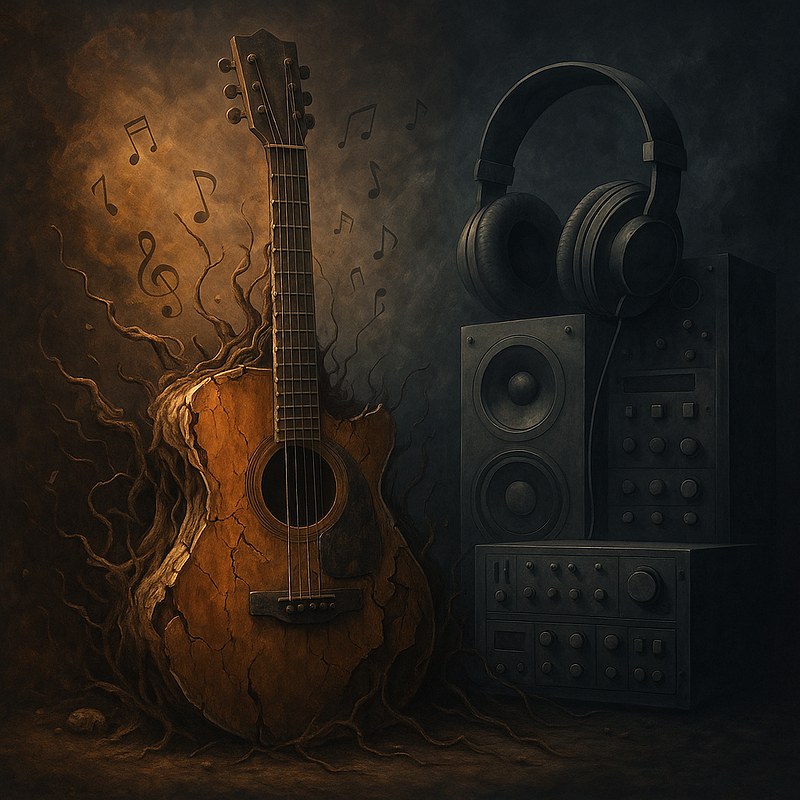
There was a time when music moved with the physics of emotion. It rose and fell like breath. It held silence like a heartbeat holds rest. It carried imperfections that communicated more than lyrics ever could. These irregularities lived below language, yet the nervous system depended on them.
Play Whitney Houston and feel the spine respond before memory awakens. Play Prince stretching Purple Rain into a prayer. Play Tracy Chapman and let the silence between her words speak with its own gravity. Play Sade and notice how her voice settles over you like warm light. Play Marley and feel the pulse align with your own heartbeat. Play the Eagles and sense the room expanding around their guitar tones. Play Let It Be and watch a single piano chord widen the emotional field of the self. Play Nirvana’s Something in the Way and feel the entire atmosphere settle into its tempo.
These songs regulate the nervous system not because they belong to another time,
but because they belong to human physiology.
Bold truth:
The body does not respond to decades.
It responds to dynamics.
Modern pop cannot access this.
It lost the architecture of breath.
The Age When Sound Was Flattened
At the turn of the millennium, music shifted, not through evolution, but through engineering. Sound became product. Melody became metric. Rhythm became data shaped by prediction engines. In the pursuit of efficiency, the industry removed precisely what the body needs.
Compression collapsed dynamic range.
Auto-tune erased the tremble where truth lives.
Quantization locked rhythm into mechanical perfection.
Digital mastering shaved off the soft edges where emotion forms.
Algorithms rearranged structure toward attention, not resonance.
“Music didn’t evolve. It conformed.”
Yet the nervous system did not.
The autonomic system regulates through contrast. Quiet against loud. Breath against force. Tension against release. These shifts are neurological instructions. Without them, the body cannot exhale. When sound stops breathing, so do we.
Music that cannot vary cannot heal.
Music that cannot rest cannot stay.
Music that cannot wobble cannot reach the emotional brain.
And then,
when nobody expected anything,
the world was reminded of what real sound could do.
The Night the Machinery Fell Away
The Room That Remembered How to Listen
It happened in a small New York studio built for television, not revelation. A stage surrounded by candles, a crowd close enough to feel the musicians exhale, and a format that was never meant to last. MTV Unplugged was designed as a novelty, a detour from spectacle, a marketing experiment.
But when you remove the machinery from music, you also remove the illusion.
What remains, if anything remains, is truth.
Nirvana walked onto that stage without distortion, without walls of volume, without the armor that had become their public identity. They sat down with wooden instruments, dim light, and the kind of silence that feels like a collective held breath. And for the first time, the world heard the part of Kurt Cobain’s voice that technology never preserved: its fragility.
Not its weakness.
Its life.
You could hear the catch in his throat.
The swallow.
The soft scrape of fingers against the strings.
The tremble of a note that might break but doesn’t.
These micro-movements, inaudible to algorithms, are the very signals the nervous system responds to.
When he sang Something in the Way, the entire room shifted into a slower rhythm, and the world shifted with it. You could feel it through the screen. The moment became heavier, denser, almost holy.
No choreography.
No studio trickery.
Just resonance.
“It was the quietest performance they ever gave,
and the loudest truth they ever spoke.”
The applause didn’t erupt, it exhaled.
As if the audience had been waiting years for someone to crack the surface.
Where Fragility Becomes Frequency
This is the part few people articulate:
Unplugged worked because it returned music to the frequencies the human organism evolved to resonate with.
Wooden instruments vibrating in real air.
Human breath shaping every line.
Rhythm that bends and stretches the way emotion bends and stretches.
A voice trembling in the exact place where meaning lives.
Nothing compressed enough to neutralize the tremor.
Nothing polished enough to sterilize the truth.
Nothing engineered enough to flatten the contour of feeling.
“To hear a voice that might break
is to remember you have one.”
Eric Clapton discovered the same gravitational pull. The electric version of Layla exploded outward, but the acoustic version folded inward, revealing a tenderness buried beneath its own mythology. For many, the Unplugged version became the definitive one. Not because it was simpler, but because it felt closer to the shape of human experience.
And when Lauryn Hill stepped onto her Unplugged stage, the world wasn’t watching a performance, it was witnessing a confession. Every crack in her voice carried meaning. Every imperfection was a doorway. The guitar buzzed. The words trembled. The room listened with the kind of attention usually reserved for prayer.
These sessions did not succeed because they were acoustic.
They succeeded because they were alive.
The Body That Still Knows
After Unplugged, something else began happening, quietly, like a reflex the culture didn’t realize it still had. Classic rock stations surged in popularity. Vinyl returned. Slow songs from the seventies and nineties began charting again. People started seeking out older recordings with a hunger that felt almost biological.
Because it is biological.
When people tune into classic rock at night, they are not chasing nostalgia. They are stabilizing their nervous system.
A Led Zeppelin riff that breathes.
A Fleetwood Mac harmony built on actual air, not digital simulation.
A Pink Floyd guitar line that stretches time rather than compresses it.
A Springsteen vocal that cracks in the exact place where truth sits.
These songs were built in an era when music still assumed an audience with patience enough for tension, curiosity enough for buildup, and emotional landscapes shaped by contrast rather than constant stimulation.
“Old songs do not push.
They open.”
People turn to classic rock because it offers regulation in a world built on overload. It gives the body what modern sound stripped away: breath, contour, warmth, space.
When a song from 1975 comes on unexpectedly and your breath deepens, your heart rate slows, and your chest opens, that is not nostalgia.
That is physiology.
The body is whispering:
“I remember this.
I know how to live inside this.”
The Algorithm That Cannot Feel
Modern pop exists in a different ecosystem, not a human one, but an economic one.
Algorithms were not designed to understand music.
They were designed to maximize time-on-platform.
So the industry adapted.
Hooks moved to the first seconds.
Intros disappeared.
Silence became an error.
Breathing room became a risk.
Dynamics became a liability.
And imperfection became incompatible with the logic of retention.
Songs were no longer shaped by musicians.
They were shaped by metrics.
“Music didn’t become shallow by accident.
It became shallow because depth is unprofitable.”
What algorithms reward is not resonance, but repetition.
Not emotion, but engagement.
Not presence, but predictability.
So modern pop speaks to the machine, not the body.
But the human organism has not changed.
It still needs contour.
It still needs breath.
It still needs imperfection as a form of truth.
Old recordings contain micro-signals that digital perfection cannot reproduce:tiny timing shifts, the faint sound of breath, a harmonic overtone that only wood can create.
The brain interprets these as signs of life.
Signs of presence.
Signs of humanity.
That is why a song from another era can feel like oxygen.
It doesn’t remind you who you were.
It reminds you who you are
The Medicine We Forgot
The Nervous System’s Oldest Instrument
Long before humans built cities, wrote language or created nations, we built rhythm. Long before we named emotion, we mapped it through sound. Rhythm synchronized groups. Melody processed grief. Harmony regulated fear. The human body is older than culture, older than industry, older even than music itself, but it recognizes music as a tool for survival.
When sound breathes, the body breathes.
When sound settles, the body settles.
When sound trembles, the emotional mind awakens.
There is a reason lullabies slow the pulse of children who cannot yet speak.
There is a reason chanting synchronizes the breath of strangers.
There is a reason a single cello note can feel like someone placing a hand on your back.
“The nervous system responds to music because music once served the nervous system.”
But modern pop is not built for regulation.
It is built for engagement.
And so it stimulates without soothing, distracts without grounding, excites without resolving, the opposite of what the body is wired to need.
Quiet no longer leads to breath.
Breath no longer leads to calm.
Calm no longer leads to clarity.
We wonder why anxiety rises in a world with more music than ever.
But we rarely ask what kind of music we are feeding the emotional brain.
Why Old Music Heals
When a song carries real dynamic range, when it softens, swells, retreats, exhales, the parasympathetic system activates. When a voice cracks, the limbic system fires in recognition. When timing shifts slightly, mirror neurons engage. When instruments resonate through air, not software, the auditory cortex processes depth rather than flatness.
Old songs feel healing because they behave like the world used to behave:
with patience, with contrast, with breath.
This is why people listen to seventies tracks during panic attacks.
Why nineties ballads calm inner storms.
Why unplugged sessions still circulate like secret medicine.
These recordings contain emotional oxygen.
Modern music, in contrast, often hyperventilates.
It stays loud.
It stays bright.
It stays optimized.
It stays perfect.
But no organism thrives in perfection.
Life requires variation.
Emotion requires space.
Healing requires imperfection.
You cannot soothe a nervous system with music that was never designed to soothe.
What Algorithms Can Never Create
An algorithm can mimic rhythm.
It can predict chord changes.
It can replicate structure.
It can generate “hooks.”
It can even simulate voices.
But it cannot replicate presence.
It cannot replicate risk.
It cannot replicate human breath.
It cannot replicate the possibility of failure, which is where authenticity lives.
The machine can imitate music.
But only a human can mean it.
Meaning comes from the places machines cannot reach, the tremor, the hesitation, the slight wobble in pitch that reveals the shape of a feeling. Meaning comes from intention. From vulnerability. From someone daring to leave a trace inside the sound.
“You can automate a song.
You cannot automate a soul.”
And that is why old music still feels like shelter.
It was not built to capture attention.
It was built to carry emotion.
The Hidden Promise of Sound
If we let it, music could become medicine again.
We know enough about the nervous system now to understand what people always felt intuitively:
warmth regulates, breath regulates, space regulates, imperfection regulates.
We know that dynamic range helps trauma settle.
We know that human rhythm stabilizes.
We know that living voices calm the emotional brain faster than synthetic ones.
We know that sound is not entertainment, it is architecture for the inner world.
Music is not backdrop.
Music is biology.
And when the world feels overwhelming, the body reaches not for noise, but for resonance.
Up to now, the industry has treated sound as product.
But sound is not product.
Sound is memory.
Sound is medicine.
Sound is heritage older than language.
And it is still waiting for us.
What We Lost, and What We Can Still Find
Modern pop is not broken by accident.
It is broken by design.
Because the machine rewards whatever keeps you scrolling, not whatever keeps you whole.
Because silence earns nothing.
Because breath cannot be monetized.
Because nuance does not scale.
But music is older than the machine.
And so is the human body.
That is why, in the middle of the noise, a single voice from decades ago can still feel like sanctuary.
Why a crack in a note can feel like truth.
Why a soft guitar from 1975 can feel like the first deep breath of the day.
Why an old ballad can feel like home.
Because the body remembers what the industry forgot.
And it always will.
“Real music does not ask for attention.
It restores the parts of you that attention has taken.”
Music was never meant to be efficient.
It was meant to be human.
And the moment we let it breathe again,
the world will too.
Related from The Manifest Archive