The screen does not go black.
That is the first thing people get wrong about the word blackout. They imagine darkness, silence, the sudden absence of signal, a switch pulled too hard, a decision too visible to deny. That is not how modern power operates, because that version of the blackout is crude, dramatic, and self-defeating, and the people who manage these systems learned long ago to do something quieter.
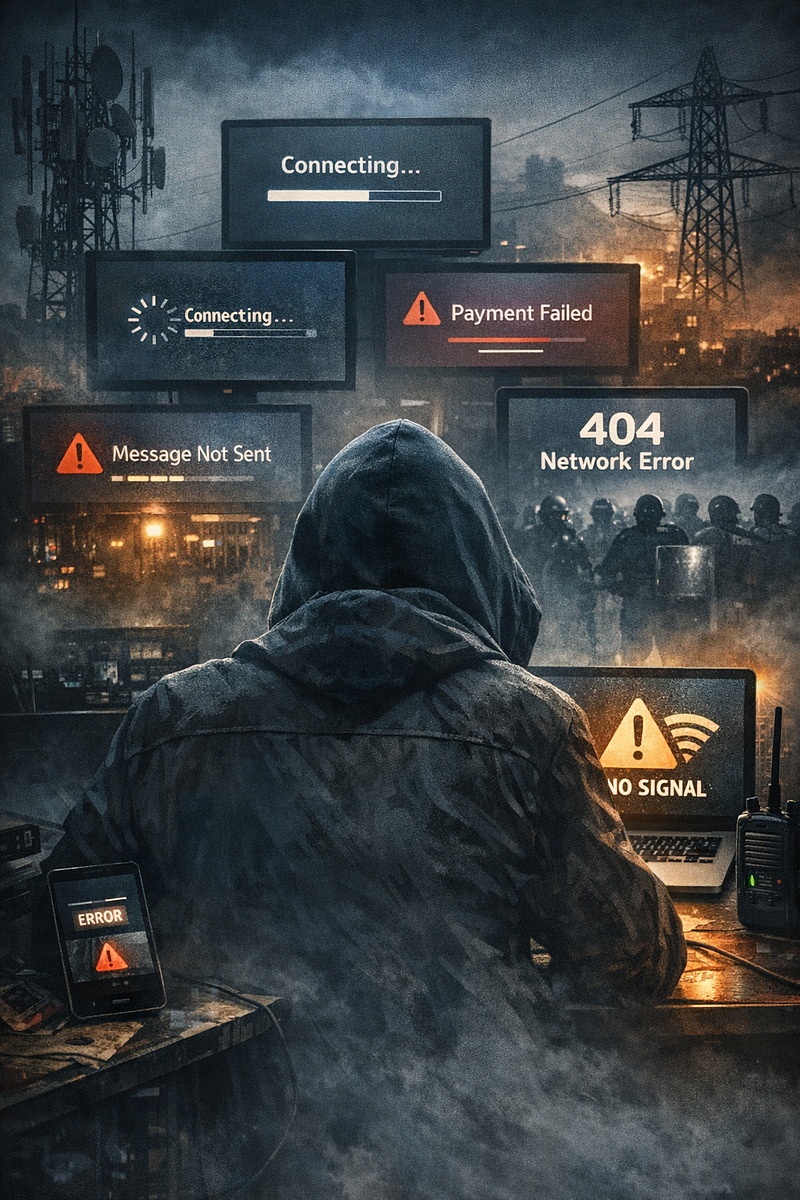
The screen stays on. The bars stay full. The app opens. It just stops working at the moment it matters. A message takes longer to send. A payment fails once, then twice. A video uploads after the moment it would have mattered has passed. The group chat goes quiet, not because anyone left, but because coordination dissolved into delay. Nothing was forbidden. Something was simply made unreliable, and unreliability, it turns out, is a more durable form of control than prohibition, because there is no single order to leak, no law to challenge, no dramatic instant to film.
This is the determining variable of the modern internet shutdown, and it is worth stating before the cases, because the cases only make sense once you see it. The word shutdown still conjures the total blackout, the whole country pulled offline, but the most effective version is the opposite of total: a connection left on and quietly degraded. The lever of control has moved from forbidding action to degrading it. The most effective contemporary repression does not stop you from speaking or even from gathering. It prevents you from coordinating at scale, and it does so by introducing friction precisely where coordination happens. This is not censorship. It is infrastructure management, and the difference is the whole subject. Censorship removes a message and leaves a gap you can see. Infrastructure management removes the reliability of the channel and leaves nothing to see at all, which is why the second has quietly replaced the first as the preferred instrument of the age.
When protest moved, power followed
For most of history, dissent was physical. Bodies gathered, streets filled, squares became symbols, and power responded with force, and force produced images, and images created memory, and memory created legitimacy problems for whoever had ordered the force. That cycle, the engine of a century of revolutions, depended on one thing: that the gathering and the coordinating happened in the same visible place, where suppressing them produced a picture.
Then protest migrated. Organisation moved into messaging apps. Logistics moved into digital payments. Visibility moved onto platforms. What once required bodies in a square now required bandwidth, uptime, and synchronisation, and the moment it did, the target of control quietly changed. The question for a state facing unrest was no longer how to stop people from being angry, or even how to stop them from assembling. Anger is not dangerous, and an unsynchronised crowd disperses on its own. The question became how to prevent coordination without appearing to intervene, because appearing to intervene is what produces the image that creates the legitimacy problem. The answer was not repression in the old sense. It was latency, and the genius of latency is that it has no face.
Iran, November 2019: the blackout that hid the killing
The clearest demonstration came on the evening of 16 November 2019. Protests had erupted the day before over a sudden rise in fuel prices, and Iran's authorities began ordering internet service providers offline until international connectivity had dropped to near zero. Officially it was temporary network management for security reasons. In practice the country was sealed for roughly a week.
What is most revealing is what stayed on. Domestic banking remained partially operational. Government channels kept functioning. The selective nature of the shutdown was the point: it was not an absence of connectivity but a curation of it, designed to keep the machinery of the state running while the machinery of coordination among its citizens went dark. By the time connectivity returned, Amnesty International had documented at least 304 people killed, with 16 November the single deadliest day. The blackout was not a side effect of the crackdown. It was the condition that made the crackdown possible, because a killing that cannot be filmed, shared, and assembled into a collective record is a killing that, for the purposes of accountability, very nearly did not happen. Iran did not invent this method. It demonstrated, at the cost of hundreds of lives, exactly how well it works.
That abstraction, near-zero connectivity, hides a human reality, and at least one piece of it is documented down to a name. Pouya Bakhtiari was twenty-seven years old. On 16 November 2019, the deadliest day of the protests, he was in the streets of Karaj with his phone, filming, doing the ordinary reflex of his generation: recording what was happening so that it could be seen. He was shot in the head and killed. And here is the detail that belongs to this story above all others. The videos Bakhtiari filmed that day did not reach the world while it could have mattered. They surfaced only later, after the blackout lifted and the country was reconnected, by which time he was dead and buried and the protests already broken. He had filmed his own last hours; the footage existed the entire time; it simply could not be sent, because the state had arranged that it could not. For the week that decided everything, his death, like hundreds of others, occurred inside a silence the government had manufactured on purpose. When his family later tried to hold a public memorial, several of them were arrested. Even the mourning had to wait for permission.
That gap, between recording and transmitting, between everyone having a camera and no one being able to send the footage, is the precise space the modern shutdown occupies. The screen showed full bars. The app was open. The upload simply would not complete, and a man who had documented his own killing died, for the purposes of the watching world, unseen, until the architecture that hid him was switched back on.
Kazakhstan, January 2022: the full shutdown, and its cost
Two years later Kazakhstan ran the cruder version. As protests over energy prices spread, the monitoring service NetBlocks, which tracks connectivity disruptions in real time, recorded the network collapsing from the evening of 4 January into a nation-scale blackout the following afternoon. Payment systems failed. ATMs stopped. Businesses closed. Protesters could not communicate, journalists could not report, and international media lost real-time visibility into a country in upheaval. The blackout ran for days, and when the internet returned the protests were over. Western governments issued statements of concern; no consequences followed; the lesson was absorbed in silence.
But the total shutdown carries a price the precision version does not, and Kazakhstan paid it: the blackout is estimated to have cost the economy around $410 million, because in a wired economy turning off the internet means turning off commerce, banking, and logistics along with dissent. A full shutdown works, but it is a sledgehammer, visible to everyone, expensive to the state that orders it, and impossible to deny. The sophisticated operators learned to stop reaching for the sledgehammer, and the reason they learned it has a date.
Egypt, 2011: the mistake that taught the lesson
In late January 2011 the Mubarak government attempted one of the first modern total shutdowns, ordering the country's providers offline until Egypt had simply disappeared from the global network. The intended effect was control. The actual effect was the opposite. Stripped of digital coordination, people did the oldest thing: they went into the street to find out what was happening, because the street was the only remaining source of information. Word of mouth replaced the platforms. Tahrir Square filled. The regime fell.
Every government watching learned the lesson that year, and it was not "shutdowns do not work." It was "never turn everything off." A total blackout removes the very tool people have been trained to depend on, and a population suddenly deprived of its phones falls back on the one form of coordination that predates and survives the network: physical presence. The trick, the operators realised, was not to remove the tool but to make it just unreliable enough that people keep using it, keep refreshing, keep waiting for the message to send, and never quite reach the threshold of frustration that sends them into the square instead.
The precision of partial darkness
So the modern blackout is not a blackout at all. It is surgical. Bandwidth throttling makes livestreams impossible without blocking access, so video, the thing that produces the dangerous image, fails while text limps through. Selective interference degrades the specific platforms used for organising while leaving the rest of the internet apparently normal. Manipulation of the systems that route traffic introduces delay that looks indistinguishable from ordinary congestion. Mobile networks fail in a protest district while fixed lines elsewhere stay up.
Everything technically works. Nothing works well enough. And because everything technically works, there is nothing to point at. No order leaks, because the order is a throttling parameter, not a decree. No law is broken, because degrading service is not the same as denying it. No dramatic moment is captured, because the moment never arrives as a moment; it arrives as a series of failed refreshes spread across an afternoon, each one individually trivial, collectively decisive. Control is most stable when it cannot be located, and partial darkness is control that has dissolved into the texture of normal technical life. People refresh, retry, wait. Momentum dies quietly, which is the only way momentum can be killed without creating a martyr.
The deniability is not a happy accident; it is engineered, and it is engineered into the very layer where the manipulation happens. The systems that route the internet, that translate a name like a messaging app into the address of a server, that carry traffic between networks, were all built for a world of accidents, of congestion, of links that fail and packets that drop. Degrading them deliberately produces an effect indistinguishable, to the user and very nearly to the expert, from the ordinary bad luck of a strained network on a busy day. A throttled connection looks exactly like a congested one. A manipulated name-lookup looks exactly like a glitch. That is the perfection of the method: it hides not behind secrecy, which can be breached, but behind plausibility, which cannot, because there is genuinely nothing to find. The investigator who goes looking for the smoking gun discovers that the gun and the absence of a gun produce the same forensic trace, and a weapon that is indistinguishable from no weapon is the only weapon that can be fired in broad daylight.
India, Kashmir, 2019: the longest darkness in a democracy
The method is not the property of dictatorships, and the most important evidence for that is the case that lasted longest. In August 2019, after revoking the constitutional autonomy of Jammu and Kashmir, the government of India, the world's largest democracy, cut communications across the territory: landlines, fixed internet, and mobile networks, the full stack, to prevent the population from organising a response to a constitutional change imposed from outside. The shutdown in the Kashmir valley ran, in various forms, for 552 days, the longest internet shutdown ever imposed by a democracy.
Picture what 552 days means to a single life inside it. A trader in Srinagar who ran his business on a messaging app and online orders watched, for a year and a half, the orders simply stop, not because his customers vanished but because the channel between them had been switched off; a shop that had been viable in July was, by the following spring, a room full of stock no one could reach him to buy. Multiply that by a valley of seven million people, by every student cut off from an online course, every patient unable to reach a distant doctor, every family unable to confirm that a relative across the country was alive, and the abstraction "longest shutdown in a democracy" resolves into eighteen months of a society held, deliberately, just below the threshold of functioning. No one was imprisoned for it. Everyone was confined by it.
This case matters more than any of the others, because it forecloses the comfortable reading that this is something authoritarian regimes do to their people. A democracy ran the longest version of it, openly, with courts and a free press elsewhere in the country, and absorbed the modest reputational cost as the price of an objective achieved. India also runs more internet shutdowns per year than any other country on earth, most of them local, brief, and barely reported: an exam to be protected from cheating, a communal tension to be contained, a protest to be pre-empted. The shutdown has become, in the largest democracy in the world, an ordinary instrument of administration, reached for the way an earlier state might have reached for a curfew. That normalisation, not any single dramatic blackout, is the real measure of how far the method has travelled.
The scale, and the price
It would be a mistake to read these as a handful of dramatic episodes. They are the visible peaks of something that has become routine. The digital-rights organisation Access Now, through its Keep It On coalition, has documented the pattern year after year, and the numbers are precise. In 2023 the coalition recorded 283 deliberate shutdowns across 39 countries, the highest annual count since its monitoring began in 2016, the overwhelming majority timed to protests, elections, exams, or unrest. Of those 283, fully 116 were imposed by India, the country that has led the world in shutdowns for years running. The shutdown is no longer an emergency measure reached for in extremis. It is a standard administrative tool, used quietly and constantly, most instances too local and too brief to make the international news at all.
The cost is staggering and, revealingly, is borne in two currencies at once. The economic toll is now counted precisely: the analysts at Top10VPN put the global cost of government shutdowns at $9.13 billion in 2023 and $7.69 billion in 2024, because in a wired economy switching off connectivity switches off commerce, banking, logistics, and work along with dissent, which is exactly why the crude total shutdown is being replaced by the surgical version. Kazakhstan's days-long blackout alone is estimated to have cost its economy $410 million; India's shutdowns cost it roughly $585 million in 2023 by the same accounting. But the economic cost, large as it is, is the lesser one. The greater cost is the one that does not appear on any ledger: the protests that did not cohere, the reports that were never filed, the killings that were never recorded, the coordination that dissolved into delay. A state that is willing to pay hundreds of millions of dollars to keep a population from organising for a week is a state that has made a very clear calculation about what that organising is worth to it, and the size of the price it will pay is itself a measure of the power it is buying.
The financial frontier: Canada, 2022
The newest and arguably most significant extension of the playbook is not about information at all. It is about money, and it was demonstrated not by an autocracy but by a liberal democracy. On 14 February 2022 the Canadian government invoked the Emergencies Act for the first time in the law's history to end the trucker-convoy occupation of Ottawa, and the financial measures that came into force the next day did something the old toolkit never could. Banks were directed to freeze accounts associated with the protest, and they did: roughly two hundred and ten accounts, holding close to eight million dollars, were frozen without a criminal charge, without an individual court order, on the basis of association. Payment processors cooperated. Donations were intercepted.
The question here is not whether the convoy was justified. It is whether a financial infrastructure can be used as a coordination-control mechanism once the precedent exists, because a precedent does not ask the politics of the next people it is applied to. Within days the protest collapsed, not under police batons but under financial interruption, and that is the watershed. A blackout degrades your ability to coordinate. An account freeze degrades your ability to exist economically, to buy fuel, pay a driver, book a room, feed a family, and it does so with the same properties that make the partial internet blackout so effective: no violence, no image, no martyr, just a card that stops working. Canada demonstrated, in full view, that financial infrastructure is now a political instrument as fine-grained and as deniable as bandwidth, and that a democracy will use it. The lesson, once again, was absorbed quietly by every government that was watching, which was all of them.
Why it converges: democracies and autocracies reach for the same tools
Here is the observation that ties the cases together, and it is the one most likely to be resisted. The blackout playbook is not an ideology. It is an efficiency, and efficiencies are adopted by everyone who can use them regardless of their politics. Iran and Kazakhstan reached for it; so did India and Canada. The systems converge not because they share values but because they face the same problem, coordination they wish to prevent, and the same tools solve it better than the alternatives. Force produces martyrs and images. Friction produces neither. A regime that beats protesters in a square creates a memory that outlives it. A regime that throttles their bandwidth creates an inconvenience that no one can quite remember being done to them.
This is why calling the method authoritarian misses the point, and the missing of the point is itself part of how the method survives. It is not authoritarian. It is architectural. Democratic and authoritarian states arrive at the same instruments because the instruments are the path of least resistance to the same end, and the comforting belief that "it cannot happen here, this is a democracy" is precisely the belief that lets it happen here, because it directs scrutiny at the wrong thing. The question is never whether a state is democratic. It is whether it has the infrastructure, and whether it has discovered, as all of them now have, that the infrastructure can be turned into an instrument without ever being announced as one.
An old impulse, a new precision
None of this is new in its impulse. Controlling the channel through which a society talks to itself is one of the oldest reflexes of power. In wartime, states have always seized the telegraph office, cut the undersea cables of the enemy, censored the post, and jammed each other's radio broadcasts; the British cutting of Germany's transatlantic cables at the outbreak of the First World War was a deliberate act of communications control that shaped the whole information war that followed. The impulse to sever the wire is ancient.
What has changed is two things, and they are what make the modern version categorically different rather than merely larger. The first is granularity. The old methods were blunt: you held the telegraph office or you did not, you jammed the frequency or you did not, and everyone knew it had been done. The new methods are surgical to the level of a single platform, a single district, a single afternoon, and they can throttle rather than cut, degrade rather than deny. The second is deniability. Cutting a cable is an unmistakable act with an unmistakable author. Throttling a network is an act that looks like weather and has no author at all. The state seizing the telegraph office in 1914 was exercising power visibly and owning it. The state degrading a province's bandwidth in our decade is exercising more precise power while owning nothing, and that combination, more reach with less accountability, is the genuinely new thing. The wire has not stopped being cut. The cutting has simply learned to look like a bad signal.
The corporate layer: a blackout with no author
None of this is executed by the state alone, and the division of labour is what makes it deniable. The telecoms throttle. The platforms comply with takedown and downranking requests. The payment processors freeze the accounts. The cloud services adjust who can reach what. They do this not out of ideology but out of obligation: licences to protect, regulations to satisfy, contracts to honour, jurisdictions to stay on the right side of. Repression no longer requires a dictator when it can be distributed across a supply chain of compliance, each link performing a small, defensible, technical act that it would be unreasonable to refuse, and none of which, on its own, looks like repression.
The result is a blackout with no author. When historians look for the order, they will find instead a throttling parameter set by an engineer following a lawful instruction, a takedown executed by a moderation team applying a policy, an account frozen by a compliance officer reading a directive. Each acted within the rules. The aggregate suppressed a protest. There is no one to hold responsible, because responsibility was dissolved into the ordinary operation of a dozen private systems doing what their licences required, and a harm with no author is a harm that the machinery of accountability, built to find an author, cannot process.
You do not notice until you need it
It is tempting, up to this point, to read all this as something that happens to other people in other countries. That reading does not survive the next thought.
You assume your bank works, your phone works, your apps work, because they always have, and you only test that assumption at the moment you actually need them: the urgent transfer that is delayed, the account flagged for review, the message that never arrives, the donation that does not go through. There is no announcement and no explanation, only inconvenience, and inconvenience is invisible precisely because it is indistinguishable from the ordinary friction of systems that sometimes fail. The system does not tell you no. It teaches you, gently and without ever putting it in writing, that yes will not work reliably enough to act on, and a population that has quietly learned that lesson does not need to be repressed. It has been trained to expect that effective coordinated action is technically difficult, and a population that expects that will rarely attempt it.
That is the deepest layer of the mechanism, and the most uncomfortable. The blackout playbook does not only defeat the protests that happen. It pre-empts the ones that never start, by teaching everyone, through a thousand small frictions, that the tools they would need cannot quite be relied upon when it counts.
And this clarifies what the system actually fears, which is not what most people assume. It does not fear anger; anger is abundant, harmless on its own, and even useful, because a population venting into a feed is a population that feels it is acting while changing nothing. It does not fear speech; speech is permitted, encouraged, endless. What it fears, and the only thing it fears, is synchronisation: the moment when scattered anger becomes a coordinated act, when a hundred thousand individual grievances align into a single movement at a single time. The entire playbook is built around that one distinction. Let people speak; deny them the ability to synchronise. Let the square fill with noise; make sure the noise never resolves into a chord. This is why the measures target coordination infrastructure, the messaging apps, the payment rails, the live streams, rather than expression as such, and it is why the system can afford to look so tolerant. Tolerance of speech is cheap when you control the conditions under which speech becomes action. The old censor feared what people would say. The new architecture does not care what they say, only whether they can act on it together, and it has quietly removed the second while leaving the first untouched, which is why it can call itself free while functioning as the opposite.
The strongest case for the defence
The objection to all of this is serious and must be put at full strength, because in its best form it is not a defence of repression but a description of real and difficult problems. Internet shutdowns, the argument runs, are sometimes genuinely defensive: they are used to stop the spread of incitement during live communal riots that have killed people, to prevent the coordination of actual violence, to halt the viral spread of lynching rumours that have, in India and elsewhere, gotten people murdered. Account freezes target the financing of activities a court would likely find unlawful. States have a real and legitimate interest in public order, the disruption caused by an occupation or a riot is real, and a government that did nothing while a capital was paralysed or a mob assembled would be failing its most basic duty. To describe every such measure as a sinister blackout playbook is to flatten a genuinely hard balance between order and liberty into a one-sided story of control.
This objection is strong, and parts of it are simply true. Some shutdowns do interrupt real violence; some account freezes do target genuine unlawful financing; the interest in public order is legitimate, and the disruptions are not imaginary. If the claim here were that every such measure is illegitimate, the objection would defeat it. But the claim is narrower and survives at a precise point: it is about the structure of the tool, not the justification for any single use. A measure that can be deployed without a charge, without an individual court order, without an announcement, and without an image, against coordination rather than against a proven crime, is a measure whose safeguards have been removed, and a tool with its safeguards removed will, over time, be used for more than its original justification, because nothing structural stops it. The test is not whether the first use was defensible. It is whether the same instrument, having been normalised on the defensible case, then becomes available for the indefensible one, with the same deniability and the same absence of an author. India's defensible riot-shutdowns and its 552-day Kashmir shutdown run on the identical infrastructure. Canada's freeze of genuinely unlawful financing and the precedent that a democracy will freeze accounts on association are the same act. The danger is never the justified use. It is that the justified use installs the capability, and the capability does not remember what it was installed for.
There is a second, more optimistic objection that deserves its own answer, because it is the one technologists reach for. People route around it, the argument goes. VPNs punch through throttling; circumvention tools and satellite links restore access; mesh networks let phones talk directly when the towers fail; cryptocurrencies evade the frozen account. The cat-and-mouse always favours the mouse in the end, because the open architecture of the internet is fundamentally hard to control, and every shutdown is met with a wave of ingenuity that defeats it. The blackout, on this view, is a losing rearguard action, not a stable form of power.
This is the most hopeful objection and it contains real truth: circumvention is real, the determined and the technical do route around these measures, and the existence of the workarounds is itself why the crude total shutdown is dying. But it mistakes the exception for the rule, and it mistakes friction for prohibition. The blackout playbook was never designed to be airtight. It was designed to be effective on the median person under time pressure, and on that target it works precisely because circumvention costs effort, knowledge, and nerve that most people, in the decisive hours, do not have. The activist with a VPN gets through; the hundred thousand people who would have needed to coordinate in the same window do not, because they are refreshing a stalled app, not configuring a tunnel. A measure that can be beaten by a skilled minority but not by the unorganised majority is not a failed measure. It is a perfectly calibrated one, because mass coordination is precisely a majority phenomenon, and a tool that defeats the majority while leaving a heroic minority a way through has achieved exactly what it set out to achieve, with the bonus that the surviving minority's success makes the system look freer than it is. The mouse gets through. The herd does not, and the herd was the target.
What would falsify this reading? If these measures were hedged with the safeguards that govern other coercive state power, requiring a specific legal finding, an individual order, a public record, a named official who can be held responsible, and were used only against proven unlawful conduct rather than against the general capacity to coordinate, then the claim that they constitute a deniable architecture of control would collapse, and the public-order account would stand. The mechanism predicts the opposite: that the measures will keep their deniability, keep targeting coordination, and keep migrating from the emergency that justified them into ordinary administration. Watch the safeguards. The thesis lives or dies on whether they are present.
The end of the square
The public square once symbolised reversal: the place where bodies could overwhelm power, where the ruled could become, briefly and visibly, more numerous than the rulers. That symbol depended on a technology, the spontaneous physical gathering, and that technology has been quietly outflanked. Today the square fills only when the networks allow it, when the payments flow and the platforms amplify and the messages send, which is to say it fills only when the infrastructure that could prevent it chooses not to. Spontaneous mass protest at scale is no longer the default capacity of a free population. It has become a permitted exception, available when the architecture does not object, and a freedom that exists only when the infrastructure permits it is a freedom that has changed its nature without changing its name.
When historians study this era, they will not find the mass crackdowns that defined earlier repressions. They will find logs. Traffic reports. Network adjustments. Compliance notices. Account-freeze directives. The great suppression of dissent in the early digital century will be remembered not as violence but as inconvenience, not as a wall but as a delay, and that is exactly why it has been so effective and so little resisted. You can build a monument to a massacre. You cannot build one to a message that took too long to send. The screen never went dark. It just, at the moments that mattered, stopped responding, and a population can be governed very thoroughly indeed by a screen that stays bright and simply will not do the one thing you need it to do when you need it most.
The only defence against a power that works this way is to recognise it for what it is before you need it, because by the time you need it the recognition comes too late, arriving as it does through the very channels being degraded. The friction is not bad luck. The delay is not congestion. The frozen account is not a glitch in the bank's system. When the tool fails at exactly the moment it would have mattered, that timing is not coincidence; it is the signature. Naming it does not restore the connection, and it does not unfreeze the account. But it converts an inconvenience back into what it actually is, an exercise of power, and a power that has been named as power can at least be argued with, legislated against, hedged with the safeguards it has so far escaped. Left unnamed, it remains the perfect form of control: the one that never has to admit it is control at all, because it presents itself, every time, as nothing more than a bad day on the network.
Pouya Bakhtiari filmed his own death and the footage could not be sent. That is the whole of it, compressed into one man's last afternoon. The camera worked. The phone worked. The network, at the one moment it mattered, did not, and a killing that the entire world would later see was, while it was happening, made invisible by nothing more dramatic than an upload that would not complete. When the connection returned, so did the evidence, too late to change anything except the historical record. A power that can do that does not need to break down doors or burn the negatives. It only needs to decide, quietly and without ever signing its name, that for a little while the message will not go through. The screen never went dark. Pouya did.
Evidence Map
Facts, interpretations, forecasts, and disconfirming signals.
Core claim. The modern instrument of control over dissent is not the total blackout but precision friction, throttling, selective platform interference, and financial-rail freezes, applied to coordination rather than to expression. It is deniable (no order, no image, no author), it converges across democracies and autocracies because it is efficient, and it migrates from emergency justification into ordinary administration. The claim concerns the structure of the tool, not the legitimacy of any single use.
Evidence level. Facts (high): Iran's near-total shutdown from 16 November 2019 and Amnesty's documented toll of at least 304 killed; the documented case of Pouya Bakhtiari, 27, shot dead in Karaj on 16 November 2019, whose protest videos circulated only after the blackout lifted, and whose family were arrested attempting a memorial; Kazakhstan's January 2022 nation-scale blackout (NetBlocks) at an estimated cost near $410 million; Egypt's failed total shutdown of January 2011; India's 552-day Kashmir shutdown from August 2019, the longest in a democracy, and India's status as the most frequent shutdown user; Canada's invocation of the Emergencies Act on 14 February 2022 and the freezing of roughly 210 accounts holding about $7.8 million without charge or individual court order; Access Now's Keep It On coalition recording 283 shutdowns across 39 countries in 2023 (116 of them in India), the highest since monitoring began in 2016; Top10VPN's accounting of the global economic cost at $9.13 billion in 2023 and $7.69 billion in 2024, and India's at roughly $585 million in 2023; the post-9/11 surveillance-and-compliance architecture as the template. Interpretation (medium, marked): the synthesis into a single deniable "architecture of friction," and the convergence and migration claims, are analytical conclusions, not documented intentions.
What would confirm this. Continued use of partial/throttling shutdowns and financial freezes against coordination, without charge, order, or named author; continued migration of these tools from emergencies into routine administration.
What would disprove this. These measures being hedged with the safeguards governing other coercive power, specific legal findings, individual orders, public records, named officials, and used only against proven unlawful conduct rather than the capacity to coordinate. Robust safeguards would defeat the architecture-of-control reading.
Watchlist. Whether financial-freeze powers spread to other democracies post-Canada; the safeguard regime around shutdown orders; the frequency and deniability of throttling events during protests.
Jerry van der Laan writes The Manifest Archive, where he traces the structures beneath the headlines. He traces the structures beneath them.