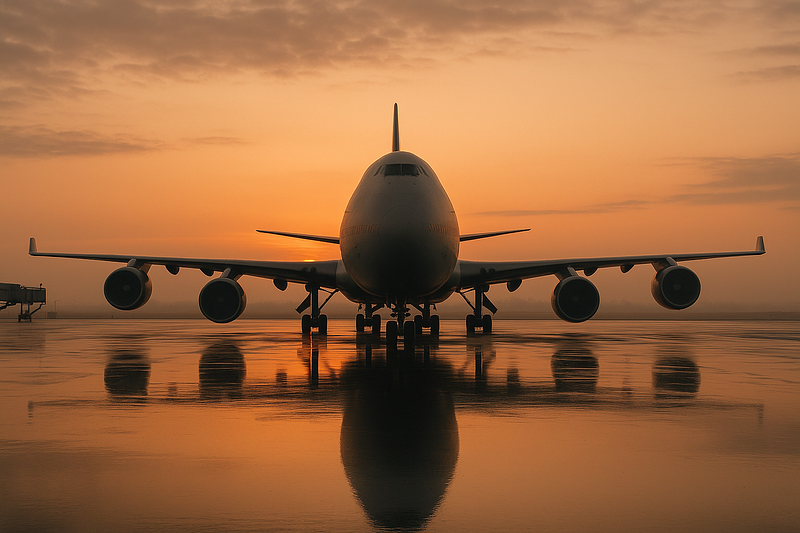
Everyone assumes flight kept getting faster. It is the rare technology that went backward, and the reason was never physics.
The Boeing 707 entered airline service in 1958 cruising at about eighty percent of the speed of sound. The jet you will board this year cruises at roughly the same speed, and on many routes a little slower. Sit with that for a moment, because it contradicts almost everything the last seventy years have taught about technology. In the same span that took computing from room-sized machines to the phone in your pocket, that sequenced the genome and landed robots on Mars, the speed of commercial flight did not improve. It plateaued in the Eisenhower administration and has stayed there ever since. Aviation is the great exception to the story of acceleration, the one major technology that reached a peak, turned around, and settled for less.
It did more than plateau. For a quarter of a century it could fly its passengers at twice the speed of sound, and then it stopped doing that too. Concorde began scheduled service in January 1976, crossing the Atlantic at Mach 2, and it was retired in October 2003. Which means the plain, strange truth is that we fly slower today than we did in 1976, that the fastest a paying passenger could cross the ocean was achieved half a century ago and then deliberately abandoned. The usual explanation is that supersonic flight simply failed, that it was a beautiful dead end the market sensibly rejected. That explanation is incomplete in a way that hides the real mechanism. The speed was not beaten by physics or even, in the end, by economics alone. It was bounded by a regulation and a price, and once you see which two, the whole frozen sky comes into focus. Aviation did not stop advancing because it ran out of capability. It stopped because the thing that determined the outcome was never the engineering.
We could, we did, we stopped
Begin with what is not in doubt: supersonic passenger flight was not a fantasy that proved impossible. It was a working technology that flew for twenty-seven years. Concorde was real, profitable on its best routes, and beloved, and it carried passengers from London and Paris to New York in under four hours for a generation. The United States had its own, larger and faster supersonic transport on the drawing board, the Boeing 2707, designed to fly at nearly three times the speed of sound and carry far more passengers than Concorde. The capability existed on two continents at once. We could build it, and we did. We could fly it, and we did, for twenty-seven years. We could keep it, and we chose not to. The question the frozen sky poses is therefore not why we could not build fast aircraft. We built them. It is why we chose, repeatedly and deliberately, to stop flying them and to build slow ones instead.
The American supersonic dream was, for a while, a national project. In 1963 President Kennedy committed the federal government to a supersonic transport program, framing it as a race the United States could not afford to lose to a state-backed European aircraft, and Boeing won the design competition with the 2707, a swing-wing giant meant to carry close to three hundred passengers. It was to be bigger, faster, and more American than anything Europe could field. But the project ran into trouble that was only partly technical. The swing-wing mechanism proved so heavy that the design had to be reworked, and around it grew something new in American life: an organized environmental opposition. A Harvard physicist, William Shurcliff, founded the Citizens League Against the Sonic Boom, and the campaign broadened from noise to fears about the ozone layer and the cost to the taxpayer. The fast aircraft acquired enemies before it had passengers.
The reckoning arrived in Washington in 1971, before most of these aircraft had carried a single fare. The 2707 depended on continued federal funding, and in March 1971 Congress cut it off. The votes were extraordinarily close, the House killing further money by 215 to 204 and the Senate by 49 to 48, and the reasons given were cost, environmental concern, noise, and the absence of an obvious market. By a margin of a few votes, the United States decided not to enter the supersonic age, and no American supersonic transport has flown since. The most powerful aerospace nation on earth chose subsonic, and the choice was made not in a wind tunnel but on a floor of Congress.
The boom
The deeper constraint, the one that doomed the economics of supersonic flight everywhere, was a single physical fact turned into a single regulation. A plane flying faster than sound drags a continuous shock wave behind it, and where that wave reaches the ground it is heard as a sonic boom, a sharp double crack loud enough to rattle windows and startle anyone beneath. Through the late 1960s the American public was exposed to military supersonic flights overhead, and the government made the mistake of testing public tolerance directly. In an exercise known as Operation Bongo II, the Federal Aviation Agency arranged for Oklahoma City to be overflown at supersonic speed eight times a day for six months in 1964, a deliberate study of whether a population would accept routine booms. It would not. The test generated roughly nine and a half thousand complaints of building damage, about four and a half thousand formal damage claims for cracked plaster and broken glass (the great majority of which were rejected), and a class-action lawsuit, and it was cut short. A city that had volunteered for the experiment became the proof of why the technology could not live over land.
In 1973 the Federal Aviation Administration drew the conclusion into law, with a rule that still governs the sky: civil aircraft may not exceed the speed of sound over United States land. Supersonic flight was banished to the oceans. The same physics produced the same overland bans in other countries, so the wall was effectively global. The fast aircraft could exist. It was simply forbidden to be fast anywhere people lived, and the map on which it was allowed to be itself shrank to the empty water between continents.
That regulation, more than any engineering limit, is what strangled the supersonic future. An aircraft that can only break the sound barrier over water can serve a handful of transoceanic routes and nothing else. It cannot fly fast from New York to Los Angeles, or across Europe, or anywhere over a populated continent, which removes most of the routes that would make a fast fleet economic. Concorde survived on the few ocean crossings where it was allowed to be itself, and even there it was a luxury exception rather than a system. The boom did not make supersonic flight impossible. It made it illegal over land, and illegal over land meant uneconomic everywhere, and uneconomic everywhere meant that the technology, fully developed and flight-proven, was quietly parked. The determining variable in the speed of human flight turned out to be a noise complaint, codified.
The price of speed
Then came the second pressure, and it pushed in the same direction. In October 1973, months after the overland ban took effect, the oil embargo sent jet fuel prices soaring, and the economics of the entire industry inverted overnight. For an airline burning enormous quantities of suddenly expensive kerosene, the most valuable improvement was no longer speed but efficiency, the number of seats moved per gallon, and the engineering effort of a generation turned to chase it.
The instrument of that turn was the high-bypass turbofan. An early jet engine pushed almost all of its air through the hot core; the high-bypass design wraps a huge fan around the core and sends most of the air around it, producing thrust far more efficiently and far more quietly at the cruise speed of about Mach 0.8. The engine that powered the Boeing 747, the Pratt and Whitney JT9D, was the breakthrough example, and the bypass ratios climbed across the following decades from roughly one-to-one toward ten-to-one and beyond. NASA launched an Aircraft Energy Efficiency program in 1976 to push the gains further. Over the three decades that followed, fuel efficiency improved by roughly one percent a year, a steady and genuine achievement that compounds into a near halving of fuel burn per seat, and every bit of it was spent on burning less rather than flying faster. The whole creative force of the industry had been redirected from the question how fast to the question how cheaply.
The airline deregulation that followed in the United States in 1978 finished the logic. Once airlines competed openly on price, the passenger revealed what the passenger had always wanted, which was a cheap seat far more than a fast one. Speed became a premium product for a tiny market, and efficiency became the entire game. The industry did not freeze out of laziness or conspiracy. It responded rationally to a fuel price and a regulation, and the rational response was to abandon speed and perfect cost. This is the part that makes the frozen sky a Manifest story rather than an aviation footnote. Nothing was suppressed and no one decided that flight should stop improving. The system simply optimized, hard and for decades, along the one axis it was rewarded for, and the axis it was rewarded for was not the one we instinctively call progress.
Three aircraft, and what happened to the other two
For all its beauty, Concorde was always a narrow thing. It was the product of a 1962 treaty between Britain and France, built at roughly six times its original budget with the cost absorbed by two governments. Only twenty were ever built, and only fourteen entered commercial service, flown by just two airlines, British Airways and Air France, on the handful of ocean routes the regulation allowed. The airlines of the world had once held options on more than a hundred Concordes; after the 1973 oil shock and the overland ban, every one of those options outside the two national carriers was cancelled. It never came close to recovering its development cost. It was a magnificent exception the system tolerated rather than a model the system adopted, and exceptions are fragile.
There was a third supersonic transport, and its fate is the most forgotten and the most instructive. The Soviet Union built the Tupolev Tu-144, so similar in shape that the West nicknamed it Concordski, and it beat Concorde into the air, flying first on the last day of 1968 and becoming the first commercial transport to exceed Mach 2. It also crashed spectacularly at the 1973 Paris Air Show, and after a brief and troubled passenger service with Aeroflot in the late 1970s it was withdrawn. Three nations built supersonic airliners. One never flew commercially because its own legislature defunded it, one served two routes for a generation as a tolerated luxury, and one was abandoned after a few dozen flights. Three programs, three different deaths, and not one of them killed by an inability to build the aircraft. In every case the machine worked and the system around it did not want it.
Concorde's own end came in stages. On 25 July 2000, an Air France Concorde ran over a strip of debris on the runway as it took off from Paris, blew a tyre that ruptured a fuel tank, caught fire, and crashed within minutes, killing all 109 people aboard and four more on the ground. The fleet was grounded, modified, and returned to service, but it returned into a changed world. The collapse in air travel after the September 2001 attacks gutted the premium transatlantic market that was Concorde's only viable home, the maintenance bills on an ageing and tiny fleet kept climbing, and in 2003 both airlines retired the aircraft, British Airways flying the last commercial service that October.
What makes the retirement a landmark rather than a footnote is what followed it, which was nothing. No successor was built. For the first time in the history of powered flight, a major transport technology was withdrawn and not replaced by something better, or even by something equivalent, and the fastest way for a member of the public to cross the Atlantic became, and has remained, slower than it was in 1976. The plane could outrun the rules, but the rules outlasted the plane, and when the plane was gone the rules stayed exactly where they had been set thirty years before.
Certified, and therefore frozen
The boom and the oil price froze the sky. A third mechanism, slower and quieter, is what keeps it frozen long after those first two causes have faded. An airliner is one of the most heavily certified objects on earth, and certification runs on precedent. Every new component, material, or piece of avionics must be proven safe to a standard that overwhelmingly trusts what has already been proven safe, which means the familiar starts every race a lap ahead of the better. This is why airliners still fly with avionics architectures designed decades ago, why proven but old systems persist in cockpits long after superior alternatives exist, and why an improvement that is obviously sensible can sit unused for years because the cost and risk of recertifying the aircraft around it exceed the benefit to any single operator.
The clearest emblem of this inertia is the aircraft that has carried more people than any other. The Boeing 737 first flew in 1967, the year before the 707's cruising speed had already become the permanent standard, and it is still in production today, nearly six decades later, the latest versions stretched and re-engined and re-equipped on top of what remains a 1960s airframe. The industry keeps the lineage alive not because nothing better could be drawn but because a clean-sheet airliner now costs many billions of dollars and most of a decade to certify, while stretching a design the regulator already trusts is faster, cheaper, and far easier to approve. The familiar wins again, not on merit but on permission.
That preference has a documented cost, and it is not abstract. When Boeing needed to hang larger, more efficient engines on the 737 to compete, the engines sat further forward and changed how the aircraft handled, so rather than redesign the airframe and trigger a full recertification, the company added a software system, MCAS, to push the nose down automatically and preserve the handling of the older model, partly so that pilots would need no expensive retraining and the type could be sold as the same familiar 737. The system relied on a single sensor, and when that sensor fed it bad data it forced two aircraft into the ground: Lion Air Flight 610 in October 2018 and Ethiopian Airlines Flight 302 in March 2019, killing 346 people in total. The fleet was grounded worldwide for some twenty months. The engineers were not villains. The entire chain of decisions, the stretching of an old airframe, the software patch over a hardware change, the dodging of a clean sheet, flowed from one structural fact: the familiar is cheaper to certify than the better. Permission is not a neutral brake. Stretch the trusted far enough and you reach the edge of what it can safely absorb. Two planeloads of people found that edge. The same force that keeps the sky slow had, at its extreme, a body count.
This is also why the coming supersonic revival will be slower than the engineering alone would allow, and why permission will remain the binding layer even after the noise rule changes. A new fast airliner does not only need an aerodynamic shape that defeats the boom and a rule that lets it fly. It needs a full type certification, the same precedent-bound, multi-year, multi-billion-dollar process that favors the familiar, applied to an aircraft that is by definition unfamiliar in almost every respect: a new airframe shape, a new engine built from scratch because the established makers walked away, new materials, new flight characteristics at speeds no current certification basis covers. The boom was the first wall. The certification machine is the next one, waiting behind it. The constraint does not disappear when the rule is rewritten; it migrates to the next permitted-but-hard layer, exactly as it has every time before. Watching where it lands next is the surest way to see that permission, not capability, has been steering all along.
In aviation, progress is measured less in innovation than in permission. The physics of a lighter window, a more efficient engine, a smarter control system are usually settled long before the paperwork that would let them fly. The constraint migrates, over time, from the laboratory to the regulator and the balance sheet, and the determining question stops being can it be built and becomes will it be allowed, and is it worth the certification. A technology governed this way does not advance at the speed of what is possible. It advances at the speed of what is permitted, and permission moves slowly by design, because its entire purpose is caution. None of that is sinister. It is the documented texture of a mature, safety-bound industry, and it is also exactly why the sky stopped evolving while the screen in your hand did not.
The one wall that is not permission
Honesty about the thesis requires naming where it does not apply, because there is one constraint on aviation that is not a rule and not a price but physics itself, and it is worth marking clearly so the argument does not overreach. The reason airliners still burn kerosene, and the reason no battery-electric airliner crosses oceans, is energy density. Jet fuel carries something on the order of forty times more usable energy per kilogram than the best current lithium batteries. An aircraft is the one machine where the weight of its energy is everything, because it must lift that weight off the ground and carry it the whole way, and at that ratio a battery-powered airliner cannot hold enough energy to fly a long route without weighing far too much to take off. This is not a regulation waiting to be rewritten or an economic preference waiting to flip. It is a hard physical floor, and it is the genuine reason the efficiency gains have been incremental rather than revolutionary and why the propulsion of a 2026 airliner is recognizably the same kind of machine as a 1970 one.
Naming this sharpens rather than weakens the argument. The efficiency axis is bounded by physics, which is why progress along it slowed to roughly one percent a year. The speed axis was bounded by permission, which is a different kind of wall entirely, the kind that can be moved by a vote or an executive order. Confusing the two is the error the conventional story makes, treating the frozen speed as if it were the same kind of inevitability as the energy-density floor. It is not. One wall is built of jet fuel chemistry and will not move for anyone. The other was built of a noise complaint in 1973 and is being dismantled right now.
The energy-density floor also explains the shape of aviation's actual decarbonization plan, which quietly confirms the point. The industry is not betting on batteries to cross oceans, because it cannot; it is betting on sustainable aviation fuel, a drop-in liquid that behaves chemically like kerosene and can be poured into the same engines and the same airframes. Even the green future of flight is being built around the energy density of a liquid hydrocarbon, because nothing lighter can do the job. That is what a real physical constraint looks like: it does not get repealed, it gets engineered around within the same fundamental envelope. The speed limit never had that character, which is exactly why it is falling now.
Efficiency is not the same as progress
It would be wrong to say aviation did not improve. It improved enormously, but on a single axis. A modern jet is dramatically more fuel-efficient, quieter, safer, and cheaper per seat than its ancestors, and those gains are real and have democratized flight for billions of people. The point is narrower and more unsettling. The industry advanced on the axis it was rewarded for, cost, and regressed on the axis it was not, speed, and because cost is the axis the passenger feels at the ticket counter, we experienced the whole thing as progress and never noticed the regression.
The cost of that regression is measured in the most concrete currency there is, time. Concorde crossed from London to New York in under three and a half hours. The subsonic jets that replaced it take about seven. Every passenger on that route now spends roughly twice as long in the air as a passenger did in 1976, and almost none of them know that the slower journey is the newer one. The preference for cost over speed runs so deep that airlines now fly even their subsonic jets slower than those jets are capable of going. The practice has a name in the trade, cost-index flying, and it means selecting a cruise speed that minimizes the combined cost of fuel and time rather than the speed the aircraft could hold, so that when fuel prices spiked after 2008 many carriers simply throttled back and added minutes to every flight. The aircraft can fly faster. The economics instruct it not to. Even within the frozen ceiling, the industry chooses the slow end of what it is allowed. We told ourselves a story of advance while quietly going backward on the one measure, time in the air, that the supersonic age had actually conquered.
There is a civilizational shape to this worth naming. Cheap mass flight did something genuinely democratic: it took an experience that had belonged to the rich and gave it to almost everyone. But it did so by making the slow journey universal and the fast one extinct, and the trade was offered to no one explicitly. The market did not let the wealthy keep their three-hour crossing while everyone else took the cheap seat. It abolished the three-hour crossing for everyone, the billionaire and the backpacker alike, because the fast option could not survive without the mass market the cheap seat had captured. The democratization of flight and the disappearance of speed were the same event. That is the quiet bargain of a system that optimizes a single variable: it does not distribute the trade-off, it removes the alternative.
Aviation is not even the only mode of travel that ran this way. American passenger rail tells a parallel story in a different key: the streamliners of the 1930s ran at speeds the fastest American intercity trains barely match today, while Japan, France, and China built networks that move people at twice that pace. The American constraint there was not physics either; it was a sustained choice not to invest, a permission and priority problem rather than an engineering one. Two of the three great ways a person can cross a continent, by air and by rail, froze or regressed in the same country across the same decades, and in neither case because the capability ran out. The pattern is not unique to the sky. It is what happens wherever a system stops being rewarded for the thing we call progress.
This is the same shape the Manifest keeps finding in different clothes. A system optimized relentlessly for one variable will let every other variable atrophy, and it will not feel like loss because the variable being optimized is the one that shows. In semiconductors the optimized variable was efficiency and the atrophied one was resilience. In aviation the optimized variable was cost per seat and the atrophied one was speed. In both cases the system did exactly what it was rewarded to do, and in both cases what it was rewarded to do was not the same as getting better. The frozen sky is not a failure of engineering. It is a monument to the difference between optimization and progress, and to how easily the first is mistaken for the second.
The boom was the variable all along
The strongest evidence that the constraint was always the regulation and not the physics is arriving right now, in real time, and it takes the form of the constraint being removed. For half a century the binding problem was the boom, the noise that triggered the 1973 ban, and engineers have finally learned to defeat it. The aerodynamic trick is to shape the aircraft so that its shock waves never coalesce into a single sharp crack at ground level, producing either a soft thump or, under the right conditions, no audible boom on the ground at all.
In January 2025 a demonstrator built by the startup Boom Supersonic broke the sound barrier over the Mojave, and did it without a boom reaching the ground, exploiting a long-known atmospheric effect called Mach cutoff in which a boom generated high enough simply bends away in the warmer air below before it can reach the surface. The company is developing a full airliner, the Overture, designed to carry sixty to eighty passengers at Mach 1.7, and major carriers including United and American Airlines have already placed orders and options for it, a commercial bet that the market for speed, dormant since Concorde, is about to reopen. Because the established engine makers declined to build a new supersonic powerplant, Boom is developing its own, a sign of how completely the industry had abandoned the speed axis: the capability had to be rebuilt almost from scratch.
It is worth being honest about what reopening the speed axis would and would not deliver, because the strongest objection to this whole reading is that supersonic flight failed on economics, not permission, and that lifting the ban will simply prove it. That objection deserves a real answer. Speed will return first as a premium product, sold to the business traveler for whom three hours saved across an ocean is worth a steep fare, and it may never again be the universal standard that subsonic cruise became. If the new supersonics end up as a small luxury fleet, the skeptic will say the market spoke. But notice what that argument concedes. A luxury fleet that can fly fast over land is still something that was flatly illegal the day before the rule changed, and impossible for fifty years before that. The question was never whether everyone would fly supersonic tomorrow. It was whether the ceiling on speed was set by what could be built or by what was allowed, and a fleet taking off the moment the rule moves answers it. The economics will decide how big the fast sky becomes. The permission decided whether it could exist at all.
NASA built the other half of the proof. Its purpose-built low-boom aircraft, the X-59, made its first flight in October 2025 and flew supersonic for the first time on 5 June 2026, reaching about Mach 1.1 over Edwards Air Force Base in California. The X-59 exists for a single regulatory purpose: to prove that a supersonic aircraft can be shaped to produce no disruptive boom at ground level, and to hand regulators the measurements they need to rewrite the rule. Through the rest of 2026 it will fly over selected American communities so their reactions to its soft thump can be recorded and given to regulators. That is the quiet revolution. The 1973 ban prohibits speed. The replacement now being drafted would prohibit noise, allowing any aircraft to fly faster than sound over land so long as no boom reaches the people below. The distinction sounds technical and is in fact the entire argument, because it relocates the rule from where it has sat for fifty years, on the speed itself, to where the actual public objection always lived, on the sound.
And the regulation is moving to meet the technology. In June 2025 an executive order directed the Federal Aviation Administration to repeal the standing prohibition on overland civil supersonic flight, to begin that process within 180 days, and to propose a new standard based on whether a boom actually reaches the ground within eighteen months, while legislation to the same effect advanced through Congress. Read the sequence carefully, because it closes the argument. The moment the boom became solvable, the fifty-year wall began to come down. If the obstacle had ever truly been the engineering or the economics, solving the noise would have changed nothing. Instead, solving the noise is changing everything, which proves that the noise, encoded as a regulation, was the determining variable the entire time.
The sky did not stop evolving because flight had reached its limit. It stopped because of a rule written in 1973, and it is starting to move again now, for the first time in two generations, because that rule is finally being rewritten. The Concorde that flew in 1976 remains, by the only measure that counts, faster than anything a passenger can board today, and it took an act of Congress, a noise regulation, and an oil embargo declared half a world away, not a single one of them an engineering verdict, to make that the permanent condition of the sky. The breakthrough was achieved sixty years ago. The outcome waited on a permission slip.
Evidence Map
Facts, interpretations, forecasts, and disconfirming signals.
Core claim. A mature technology advances at the speed of what is permitted, not what is possible; commercial aviation's speed froze because the binding constraint was a rule, the overland sonic-boom ban, not a physical limit, and the rule's removal is now letting speed return.
Evidence level. Facts (high): the Boeing 707's 1958 cruise speed as the still-current standard; the Boeing 2707 cancellation by close congressional votes in 1971; the 1973 FAA overland supersonic ban; the 1973 oil embargo and the high-bypass turbofan turn; Concorde service 1976-2003 and its 2000 crash; the Tu-144's history; the Boeing 737's 1967 origin and the MCAS-linked crashes of 2018-2019; Boom Supersonic's XB-1 supersonic flight without a ground boom in January 2025; NASA's X-59 first flight (October 2025) and first supersonic flight (5 June 2026); the June 2025 executive order directing repeal of the overland ban. Interpretation (medium, marked): permission rather than capability as the binding constraint on speed; a system optimizing cost while quietly regressing on speed; the democratization-of-flight and disappearance-of-speed as one event. Physical floor (high, and a deliberate scope limit): jet-fuel energy density as the genuine non-regulatory constraint on the efficiency axis.
What would confirm this. The repeal of the overland boom rule being followed by renewed commercial supersonic development rather than continued stagnation; the binding constraint then migrating to the next permitted-but-hard layer (engine certification, airport noise, fuel); subsonic cruise speeds staying flat.
What would disprove this. The overland ban being lifted and supersonic flight still failing to return, which would indicate economics or physics was the real constraint all along; or low-boom flight proving unachievable at scale, restoring noise as a genuine physical limit rather than a solvable engineering problem.
Watchlist. Live and fast-moving: the X-59 community-response data through 2026, the FAA's drafting of a noise-based standard, and the first commercial supersonic certification attempts.
Jerry van der Laan writes The Manifest Archive, a continuous investigation into how institutions, language, and systems shape what people are permitted to see as reality. He does not report events. He traces the structures beneath them.