Introduction, the measure of power
Trump’s provocation
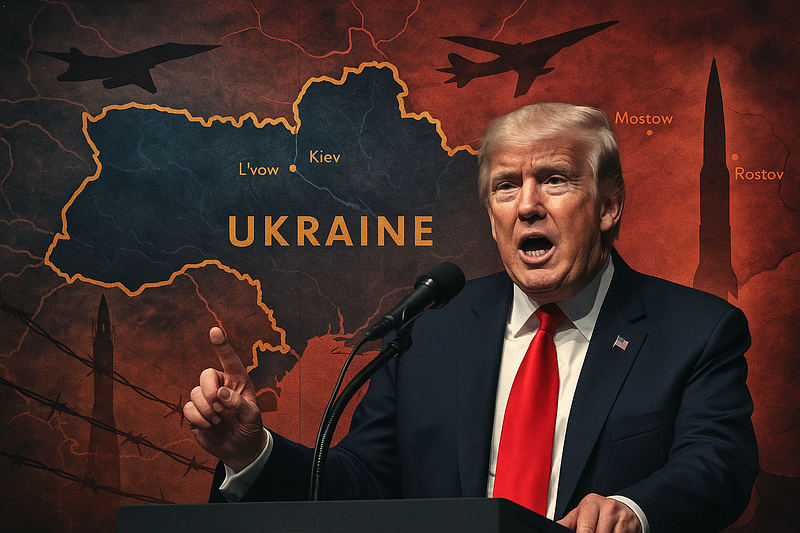
On a September morning, U.S. President Donald Trump declared that if Russia were truly a superpower, it would have won the war in Ukraine in a single week. He mocked Moscow for fighting “aimlessly” in a war that a “real military power” would have ended “in less than a week.” Russia, he said, was nothing but a paper tiger.
The words lingered. They were meant as humiliation for Russia. Yet they carried an unintended echo. If this is the measure of power, what does it say about America? What does it say about NATO, and about Washington’s proxy war in Ukraine?
“Trump wanted to expose Russian weakness. Instead, his words made America vulnerable.”
The illusion of invincibility
For more than seventy years, the United States has defined itself as the ultimate superpower. The arsenal was unmatched, the alliances vast, the rhetoric absolute. But the record tells another story. Korea ended in stalemate. Vietnam ended in helicopters lifting from rooftops. Iraq collapsed into endless insurgency. Afghanistan became the longest war in American history.
Trump’s insult toward Russia revealed something deeper: the fragility of the word superpower itself.
The first tests of a superpower
Korea, the war that froze
If Trump defines a superpower by swift victory, then Korea delivers a troubling mirror. In 1950, U.S. troops entered a conflict they believed would be quick. The world’s richest nation, armed with nuclear weapons, faced a divided peninsula still shattered by World War II. General Douglas MacArthur even promised his soldiers they would be “home by Christmas.”
Christmas came and went. The war did not end the next year either. After three years of brutal fighting, the front line froze roughly where it had begun, near the 38th parallel. Nearly 40,000 Americans were dead, millions of Koreans displaced, and the so-called superpower had failed to impose its will on a small, war-torn state.
The war concluded not with victory but with an armistice. The Korean Peninsula remains divided to this day.
“If a superpower cannot finish a war in three years, what does that word really mean?”
Vietnam, the war America could not escape
Then came Vietnam. What began as a handful of U.S. “advisers” in the 1950s swelled to over half a million American troops by the late 1960s. The Pentagon spoke of body counts and pacification. Presidents promised progress. But the images told another story: napalm tearing through jungles, villages burned, young soldiers trudging through terrain they could not hold.
America had unmatched aircraft carriers, bombers, nuclear missiles. But against a determined insurgency, all that power became a burden. After two decades of fighting, the world’s self-declared superpower left Saigon in 1975. Helicopters lifted from rooftops, evacuating personnel and desperate civilians. The fall of Saigon became an enduring symbol of humiliation.
Vietnam did not redefine America’s power. It exposed its limits.
“If victory within a week defines a superpower, then what was Korea? What was Vietnam?”
Iraq and Afghanistan the endless wars
Iraq, the war that never ended
If Vietnam proved that overwhelming firepower cannot guarantee victory, Iraq showed how quickly triumph can curdle into failure. In 2003, Washington launched its invasion under the banner of shock and awe. Baghdad fell within weeks. President George W. Bush stood beneath a “Mission Accomplished” banner barely a month into the war.
But the war never truly ended. The Iraqi state collapsed. A violent insurgency emerged that summer, catching occupation forces off guard. Sectarian violence exploded, Sunnis and Shiites tearing the country apart. Roadside bombs replaced pitched battles, and American troops found themselves trapped in a war without front lines.
What was promised as a quick liberation became a grinding occupation.
By the time U.S. forces withdrew, nearly two decades later, Iraq remained fractured and unstable. Tens of thousands of civilians were dead. Over four thousand American and allied soldiers had been killed. The banner that once declared victory became, in hindsight, a symbol of profound miscalculation.
“Mission Accomplished became Mission Unending.”
Afghanistan, the longest war
Afghanistan lasted even longer. It began in late 2001 with vows to crush al-Qaeda and defeat the Taliban. The invasion was swift; Kabul fell within weeks. Washington quickly declared success. But the Taliban never disappeared. They melted into rural strongholds, crossed borders, waited.
What was meant to be a short intervention stretched across four presidencies. Trillions were spent, thousands of lives lost, yet a lasting victory never arrived. In August 2021, the United States ended its war in Afghanistan with a frantic evacuation from Kabul. Helicopters whisked diplomats from rooftops, echoing Saigon in 1975.
After two decades, the Taliban were back in power. The American-led project of nation-building had collapsed.
“If a superpower cannot defeat insurgents in Iraq or the Taliban in Afghanistan, what does the word even mean?”
Ukraine and the limits of power
The proxy war unmasked
When Trump declared that Russia could not be a superpower because it had failed to win in Ukraine within a week, he invited a comparison that rebounded on America itself. For if speed defines strength, then what do Korea, Vietnam, Iraq, and Afghanistan reveal about the United States?
The war in Ukraine is not simply a clash between two nations. It has become a proxy war. NATO, bankrolled and armed largely by Washington, confronts Moscow by another name. Each shipment of missiles, each sanctions package, each intelligence briefing makes clear that the United States is not a distant observer but a central participant.
The U.S. frames itself as broker. In reality, it is a belligerent.
“By mocking Russia’s failures, America exposed the memory of its own.”
The stalemate revealed
Despite billions in Western aid and the backing of the world’s strongest alliance, the war has not been won. What was supposed to be a short, decisive campaign has stretched into years. Frontlines shift, towns are reduced to rubble, offensives stall. Even Ukraine’s own commanders now describe the conflict as stalemate.
Trump portrays Russia as weak, exhausted, a paper tiger. European leaders echo the line, eager to show sanctions biting and Western unity prevailing. Yet the contradiction remains: if Russia is no superpower because it failed to win quickly, then what does it say about America and NATO that, with all their might, they too have not achieved victory?
Ukraine is not the exception to superpower struggles. It is the latest chapter in their illusion.
The fragility of the superpower myth
The illusion of quick victories
Trump’s words turned the spotlight on Russia, but they illuminated something larger: the fragility of the very term superpower. If supremacy is measured by lightning conquests, then perhaps no state qualifies. Not Russia. Not China. Not even the United States.
Modern wars rarely end in weeks. They sprawl across years, leaving nations drained rather than triumphant. The myth of superpowers rests not on victories, but on the stories told about them.
“Every time America points to another nation’s weakness, it reveals the memory of its own.”
China power claimed, limits exposed
China is often framed as the rising challenger, the future superpower. Its economy rivals America’s. Its navy now boasts more ships than the U.S. fleet. Its leaders speak the language of inevitability. Yet on the battlefield, China’s record offers caution.
In 1979, Beijing invaded Vietnam expecting a swift punishment. Weeks later, Chinese forces withdrew bloodied, having failed to impose their will. Border clashes with India in the Himalayas have yielded stalemate, not supremacy. Despite its arsenal, China has not demonstrated the decisive victories that Trump claims define power.
Like America and Russia, China projects invincibility but encounters limits.
Propaganda as armor
What sustains the illusion is not battlefield success but narrative. America insists every intervention was progress. Russia frames every setback as temporary. China speaks of destiny. Each uses propaganda as armor against the reality of limits.
The illusion matters more than the result. Citizens are told their nation is strong. Textbooks highlight victories and blur defeats. Leaders recite the language of greatness, even as helicopters lift from rooftops in Kabul, or troops stumble in the mountains of Vietnam.
Superpowers endure not because they always win, but because they refuse to admit when they lose.
Closing reflection, the illusion that survives
The scars of decades
Superpowers are not measured in weeks. They are measured in scars. Korea froze in stalemate. Vietnam ended in helicopters over Saigon. Iraq collapsed into insurgency. Afghanistan dissolved into retreat. Each war began with declarations of strength and righteous purpose. Each ended in ambiguity, in silence, in humiliation where victory was promised.
Ukraine has joined that continuum. Washington frames it as a noble struggle for freedom, NATO as a test of unity, Europe as a defense of order. Yet the facts remain: a war many hoped would decisively punish Moscow drags into its third year, with neither victory nor peace in sight.
“The myth of superpowers lasts longer than their victories.”
The theater of power
Trump sought to expose Russia’s weakness. In doing so, he revealed the fragility of the very word he invoked. If lightning conquest defines a superpower, then none remain. America, Russia, China, each can start wars. None can end them on their own terms.
In theory, a superpower is omnipotent, able to impose order and depart in triumph. In practice, the stage is theater. Leaders proclaim greatness. Citizens are asked to believe. But on the ground, the outcomes are fractured states, collapsed governments, displaced populations.
The illusion survives. The victories do not.
Related from The Manifest Archive