Introduction | the vault that holds the world
At the heart of Rome stands a door that almost no one may open. It is not the bronze portal of St. Peter’s, nor the marble gate of a palace, but a slab of steel hidden in a quiet courtyard. Tourists stream past without knowing. Pilgrims kneel above without suspecting. Behind it stretches not a chapel, not a hall, but a city of paper.
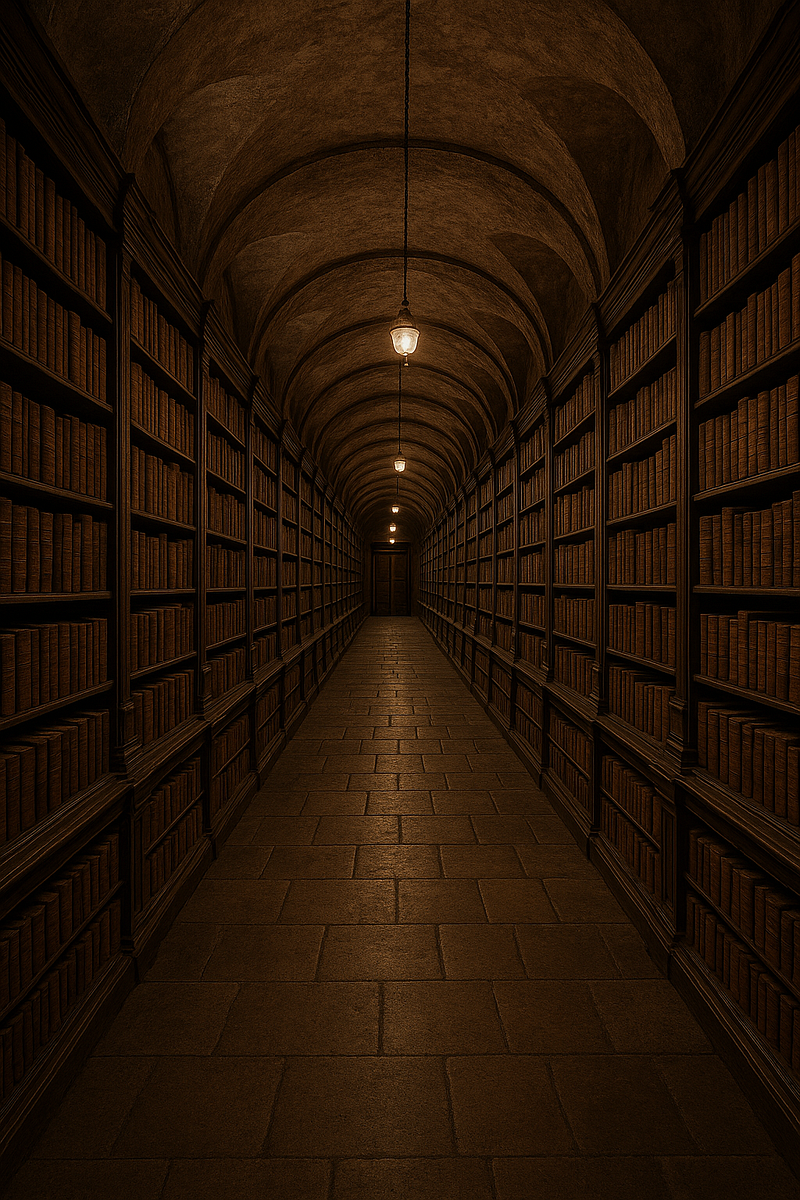
Eighty kilometres of shelves lie in darkness beneath the stone city. Parchment, maps, secret letters, ledgers, treaties, trial records, everything that emperors proclaimed, everything missionaries observed, everything popes judged. What armies conquered in noise, the Vatican preserved in silence.
This is not a library. It is a vault. And it holds not only books but history itself.
For centuries it was called the Archivum Secretum Vaticanum, the Secret Archive. The name was softened in 2019 to the Apostolic Archive, as if to suggest transparency. But nothing essential changed. Secret was always the truer word. For secrecy here does not mean denial. It means control.
“Empires fall with noise. The archive endures in silence.”
The Vatican does not destroy knowledge. It hoards it, seals it, edits it. By deciding what is revealed and what is withheld, Rome does not simply preserve memory, it governs it. Galileo’s trial, Bruno’s heresy, the dispatches of missionaries, the escape routes of war criminals, the ledgers of banks and the relics of saints: all are here, not to enlighten the world but to bind it.
To step into this archive, if one is permitted, is not to enter a library. It is to enter the nervous system of empire.
The gate to the unspoken
The approach is deceptively ordinary: a corridor of marble under fluorescent light. The air is dry, conditioned to preserve parchment for centuries. Yet the silence here is not ordinary silence. It presses on the chest. It warns before it welcomes.
At the end stand the doors. Steel, massive, immovable. They do not invite; they forbid. They are less an entrance than a declaration: beyond this line begins the unspoken. Whoever steps through does not enter a neutral archive. He steps into power itself.
Behind the doors, the shelves unfold in endless ranks. Imagine a second Rome beneath the first: a subterranean city of paper mirroring the city of stone above. Every box a house. Every shelf a street. Every corridor a history.
Once, the archive carried its name openly. Secretum. In 2019 the word was softened. Apostolic, they said. The change was cosmetic. It remains secret not because it denies existence, but because it denies access.
“Silence in Rome is not absence. It is presence, carefully constructed and maintained.”
This is Rome’s fortress more than any wall of the Vatican. Pilgrims marvel at basilicas. Scholars petition for access. Kings and presidents know better. The real power lies not in the dome of St. Peter’s but in the locked shelves below.
The birth of the archive, 1612
Rome did not invent its archive in an instant. For centuries popes had gathered manuscripts, codices and chronicles. In 1451, Nicholas V formalised them as the Vatican Library, a treasury of books, coins, manuscripts and images, a mirror of the Church’s ambition to be custodian of universal culture.
But a library is not yet an archive of power. A library preserves to be read. An archive preserves to be controlled.
That transformation came in 1612, when Pope Paul V decreed that the scattered records of the Curia, the correspondence of nuncios, the proceedings of inquisitions and the reports of missionaries be centralised into one guarded organism: the Archivium Apostolicum Vaticanum.
The timing was deliberate. The Council of Trent had ended only decades earlier. The Counter-Reformation was in full force. Protestant presses flooded Europe with tracts. Rome’s answer was not mass publication but custody. It would not outprint its rivals. It would outlast them.
In the same century Francis Bacon wrote his maxim: knowledge is power. Rome agreed, but inverted the meaning. For Protestants, knowledge meant diffusion, pamphlets, presses, debate. For the papacy, knowledge meant custody. Power did not come from spreading knowledge. It came from sealing it.
From 1612 onward, papal letters, treaties, inquisitorial verdicts, diplomatic exchanges and ethnographic notes flowed into Rome. Even the Donation of Constantine, long exposed as forgery, was preserved. To destroy it would be to concede too much. Michelangelo’s complaints about fees for St. Peter’s were filed. Reports from missionaries in the Americas, Africa and Asia were boxed and shelved.
“From the moment Paul V locked the steel doors, memory itself became a tool of governance.”
Rome had built not a neutral repository but a fortress of memory. The Vatican Library had gathered treasures of knowledge. The Apostolic Archive gathered the instruments of power.
Galileo and the silence of centuries
The trial that became ritual
In 1633 Galileo Galilei stood before the Inquisition. The trial was staged like theatre. Questions were posed, answers transcribed, admonitions read. The verdict was foreseen long before the proceedings. Galileo was condemned to house arrest for the rest of his life.
But what endures is not only the sentence. It is the paperwork. Every exchange, every hesitation, every whispered admission was transcribed by scribes and sealed into the archive.
The irony is stark. Galileo had once been celebrated by Rome, welcomed by Pope Urban VIII himself. But his Dialogo mocked authority by putting the pope’s view into the mouth of a fool. That act of satire, more than heliocentrism, was his real crime. Authority had been made ridiculous.
Galileo’s condemnation was less about astronomy than about control. The archive absorbed not only his words but the ritual of submission: the abjuration he signed, the silence he swore.
Silence as editor
For centuries, those files lay unopened. Only in the nineteenth century, when Europe had embraced science, did the Vatican release fragments. By then the silence had already shaped memory. Galileo was remembered as the man silenced by the Church, but the nuances remained hidden.
Rome did not erase his trial. It preserved it in silence, deciding when the world would see. The delay was itself an editorial choice. By the time fragments emerged, the legend was fixed: Galileo as martyr of science, Rome as his jailer.
“The archive does not destroy. It delays. And delay shapes memory as powerfully as fire.”
Bruno and the missing pages
The infinite worlds
Giordano Bruno met his fate in 1600, burned alive at Campo de’ Fiori. His crime was not error but imagination unchained. He declared the stars to be suns with their own worlds, each perhaps with life. He envisioned an infinite cosmos too vast for scripture to contain.
Rome could not allow it. The Inquisition charged him not only with heresy but with dissolving the very architecture of heaven. To say the universe was infinite was to make salvation provincial. To call each star a sun was to dethrone Christ from the centre of creation.
The fragments that remain
The record of his trial exists, but in fragments. The folios break mid-argument. Pages are missing. Entire exchanges are absent. What remains is enough to condemn, but not enough to understand.
Perhaps the lost pages contained speculations so radical Rome found them intolerable. Perhaps they held procedural details that would humanise his judges. What is certain is that the silences make Bruno more mystery than man.
And mystery, too, is control. The fire in the square made him a martyr for free thought. The gaps in the shelves made him a captive of secrecy. Rome controls Bruno not by preserving him whole, but by preserving him incomplete.
The double death
Bruno was killed twice. Once in the flames. And once in the archive, where absence became its own verdict. For centuries he was remembered only in whispers, the missing pages heavier than the ones that remain.
“The fire made him ash in the streets. The archive made him myth in the shelves.”
Missionaries as a global network of memory
Crucifixes and notebooks
From the sixteenth century onward, missionaries spread across the earth. Jesuits in China, Franciscans in Mexico, Dominicans in Lapland, priests in the Congo. They carried crucifixes in one hand and notebooks in the other.
They mapped lands with meticulous precision. They listed languages, sketching alphabets never before written. They described rituals, rites, and cosmologies. They catalogued plants and stars, noting remedies, drawing constellations, charting winds and currents.
These observations were not for locals. They were for Rome. Reports flowed to the Congregation of Propaganda Fide, founded in 1622, which gathered them, copied them, filed them. Some were published for European scholars. Most were sealed, dispatched into the arteries of the Vatican’s memory.
A global ethnography
The effect was immense. Rome became custodian of a planetary ethnography. Cultures that conquest silenced survived on parchment. Tribes extinguished by disease were preserved in ink. Cosmologies dismantled by missionaries endured in sketches.
A drawer in Rome could open into a miniature world: an Andean ritual described in Quechua, a Chinese star chart annotated in Latin, a West African pharmacopoeia listing herbs unknown to Europe. The archive was not only theology. It was anthropology before the word existed.
“Missionaries preached the Gospel, but they also archived the world.”
Preservation as power
Rome rarely destroyed. It preserved. But preservation without access is another form of control. By choosing which reports to publish and which to keep sealed, the Vatican decided which cultures would survive in memory and which would dissolve into silence.
For European audiences, missionary reports framed peoples as noble savages or as heathens in need of salvation. For the archive, they became leverage. Rome possessed what others forgot.
Vanished worlds
Maps that disappeared
Early modern maps carried names that have since evaporated. Tartaria stretched across Eurasia, its borders vague but vast. Mercator drew the North Pole as four rivers converging around a magnetic mountain. Chroniclers wrote of Hyperborea, a land of eternal spring beyond the winds. These were not marginal fantasies. They were part of mainstream geography.
By the eighteenth century, they began to vanish. Encyclopedias omitted them. Atlases erased them. By the nineteenth, they were myths.
The mechanics of forgetting
Where did they go? Some fragments remain in European libraries. Others almost certainly rest in Rome. The Jesuit polymath Athanasius Kircher, whose books filled shelves of the Vatican Library, speculated on subterranean channels, lost continents, and ancient cataclysms. His works were once central to learned discourse. Later they were recast as curiosities.
The pattern is consistent. What the world forgets often still exists, but renamed, recatalogued, removed from circulation. The Vatican does not need to burn. It simply withholds. A map placed in a box ceases to exist for the public.
“The archive is not a cemetery of paper. It is an editor that decides which worlds endure as fact and which dissolve into legend.”
Myths as files
Atlantis, Tartaria, Hyperborea: today they are myths, dismissed as fantasy. Yet once they were coordinates in scholarly maps, debated in academies. To us they are stories. To Rome they are files. Somewhere in the shelves may lie Jesuit field reports describing lands that no longer bear the same names, or missionary notes on rituals connected to vanished geographies.
Silence works here as everywhere else. By erasing from public memory what it still preserves in secret, the Vatican transforms myth into leverage. What is ridiculed outside is recorded within.
the cultural archive
from polyphony to permanence
Rome has always understood that music and art move hearts as powerfully as sermons. In the sixteenth century, the polyphony of Palestrina was debated as a question of salvation itself. His manuscripts were bound and stored in Rome, as if the harmonies themselves required papal custody.
The instinct continued across centuries. Mozart’s letters to patrons, Beethoven’s Missa Solemnis, Verdi’s Requiem, all became part of the archive. Even Bach, who never set foot in Rome, entered through copies and reviews that found their way into Vatican collections. What vanished in air was captured in paper.
Rome did not treat music as ephemeral art. It treated it as record, evidence of cultural power, and evidence was meant to be preserved.
the age of spectacle
As centuries passed, the archive expanded beyond classical scores. The Beatles met Paul VI in 1965, and Lennon’s remark that they were “more popular than Jesus” became dossier. Dylan sang before John Paul II, Bono placed sunglasses on a pope, Madonna provoked, Michael Jackson was rebuked, Bocelli praised, Franklin mourned.
Each became paper. Rome clipped, catalogued, stored. LPs, cassettes, VHS tapes, CDs, digital files, all entered shelves. The archive followed not only theology but spectacle.
Even the ephemeral became permanent once Rome touched it.
beats in the basilica
The instinct carried into the twenty-first century. A papal message was remixed by a Dutch DJ. Armin van Buuren’s name appeared in Catholic media as the “voice of youth.” Tiësto and Calvin Harris entered files not as artists but as entries.
The method was constant. A concert becomes a clipping. A scandal becomes a file. A performance becomes a reference number.
“Sound disappears. In Rome it becomes a shelf mark.”
Rome collected not only kings and councils, but also chords and choruses. Its archive of culture was not decoration. It was strategy. To preserve is to control.
Ratlines and the bookkeeping of silence
The escape routes
When the Second World War ended, Europe was rubble. Millions wandered without homes or documents. Within that chaos, men who should have faced justice vanished into new lives. Their escape routes became known as ratlines.
The trail often led through Rome. Italy was devastated, borders porous, and the Vatican occupied a unique position: sovereign, neutral, endowed with global networks. Monasteries offered shelter, priests provided false baptisms, Catholic charity offices acted as nodes of passage.
The International Committee of the Red Cross, overwhelmed by displaced persons, issued tens of thousands of temporary passports. With papal blessing those papers carried weight. A man could be Adolf Eichmann in Germany and Ricardo Klement in Buenos Aires. Josef Mengele passed through Genoa. Klaus Barbie vanished through Bolzano.
Concealment as record
Each passport bore a number. Each recommendation carried a seal. Each diplomatic pouch contained a log. Rome did not only conceal fugitives. It documented concealment.
The Nuremberg Trials became spectacles of revelation, stenographers recording every word. Headlines declared justice. Yet in Rome a different record grew: the archive of silence. Files filled not with verdicts but with departures, not with confessions but with new identities.
Historians have glimpsed fragments, the interventions of Bishop Alois Hudal, rector of the German College in Rome, who openly aided SS men; the role of Catholic charities whose paperwork doubled as cover. But the bulk remains sealed. Somewhere in the shelves lie the passports, routes, and names that remade criminals into ghosts.
Silence as leverage
This was not an exception but a revelation of logic. Destruction erases. Preservation without access creates leverage. Rome knew. To keep records of escape was to hold power over the escaped, over their protectors, over the governments who later discovered them.
And the mechanism endures. In the twenty-first century, elites move through diplomatic passports, shell companies, and discreet humanitarian corridors. Exiled rulers appear in safe havens. Billionaires shift fortunes across borders with a signature. The public sees disappearance. Rome sees paperwork.
“Even concealment became a dossier. Even silence bore a number.”
Diplomacy in silence
The empire of pouches
Diplomacy is usually imagined as theatre: speeches in gilded halls, treaties signed beneath chandeliers, press releases read to attentive reporters. Yet in Rome, diplomacy was never about what was spoken. It was about what was filed.
From the Renaissance onwards, papal envoys carried satchels sealed with leaden bulls. Their letters passed through frontiers unopened, protected by the immunity of the Church. In the seventeenth century, the newly established Apostolic Archive became the destination for all these dispatches. Reports from Madrid, Vienna, Paris, Warsaw, Constantinople, all returned to Rome.
Immunity produced an ocean of paper that no king could intercept.
Once delivered, nothing left again. A denunciation of a heretic, a secret promise from a Habsburg prince, a financial pledge by a Venetian doge, all became files. Their power lay not in publication but in custody.
The living organism
The practice endures. The Holy See today maintains diplomatic relations with more than 180 states and permanent observer status at the United Nations. Every nuncio, every papal ambassador, sends constant reports. Conversations with presidents, generals, and prime ministers are reduced to memoranda. Every audience becomes a note. Every gesture becomes an entry.
The result is daily growth. Couriers deliver pouches from Washington, Beijing, Kinshasa, Buenos Aires. Each pouch is absorbed into the bloodstream of the archive. This is not a relic of the seventeenth century. It is a living organism.
“Diplomacy speaks in words. Rome speaks in silence.”
Treaties expire. Regimes collapse. The documents remain. A box on a Vatican shelf can outlast the dynasty it records. To know that such a box exists is itself a form of power.
The bookkeeping of god
Ledgers as theology
Not every file in Rome is parchment. Many are ledgers. Where theologians wrote of grace, accountants filled columns with numbers. In the Vatican, numbers were never just arithmetic. They were instruments of governance.
For centuries Rome received money: tithes from parishes, indulgence payments, inheritances from kings. But in the twentieth century this financial flow crystallised in a new form. In 1942 the Istituto per le Opere di Religione, the Vatican Bank, was officially founded. Shielded by sovereignty, it became a discreet channel through which funds could move beyond ordinary scrutiny.
Banco Ambrosiano and the river underground
The most notorious chapter came with Banco Ambrosiano. In the late 1970s and early 1980s, this Milanese bank, entangled with the IOR, created a labyrinth of offshore companies from Luxembourg to Peru. Billions of dollars moved invisibly through its veins.
Mafia organisations laundered profits. The secretive Masonic lodge Propaganda Due, known as P2, used the flows for political designs. And when the house of cards collapsed in 1982, its chairman Roberto Calvi was found hanging under Blackfriars Bridge in London, his pockets filled with bricks. The tabloids called him God’s banker.
What the world saw was scandal. What Rome possesses is record. Every correspondence between Ambrosiano and the IOR, every contract initialled by Vatican officials, every transaction filed through papal accounts is now boxed, numbered, and shelved.
Silence as currency
The logic is consistent. To destroy such records would be to erase evidence. To preserve them in secrecy is to create leverage. Somewhere in those shelves lie the ledgers that reveal who profited, who was protected, and who was sacrificed.
The Vatican Bank still exists today, reformed in name, paraded with audits, but sovereign in essence. Compliance officers present transparency for cameras. Behind the show, the archive grows. New agreements, new accounts, new audits, all filed.
“Rome never built factories, but it built ledgers. Wealth is not only gold. It is the file that tracks its flow.”
Finance here is not separate from faith. It is faith translated into credit, belief transcribed into numbers. In Rome, a balance sheet is as sacred as a bull.
The order of malta and the red cross
Neutrality as paperwork
Some institutions seem older and nobler than states. The Sovereign Military Order of Malta, born in the age of Crusades, still issues its own passports, maintains diplomatic corps, and operates hospitals from Africa to the Middle East. To the public it is charity. To Rome it is continuity.
Behind the image of knights in white tunics lies bureaucracy. Every patient list, every supply register, every meeting with heads of state generates paper. These records flow, directly or indirectly, into Vatican custody. Mercy in the streets becomes memory in the shelves.
The same pattern applies to the Red Cross. Founded in the nineteenth century as a humanitarian shield, it presented itself as neutral, above ideology. But neutrality requires administration. Administration requires documents.
In the aftermath of the Second World War, the Red Cross printed tens of thousands of temporary passports for displaced persons. Intended for mercy, they also became instruments of escape. Without papal blessing, those papers would have been worthless. With papal blessing, they opened borders. Eichmann walked free with a Red Cross passport. So did many others.
The gravity of records
Every humanitarian gesture leaves a trace: signatures, seals, numbers. These are not destroyed. They are preserved. The world remembers relief as acts of compassion. Rome remembers them as entries.
“Humanitarian relief is mercy in the streets. In the archive it is paperwork, another layer of silence.”
This is not conspiracy but gravity. Institutions produce documents. Documents require custody. Custody gravitates to Rome.
The treasury of relics
The archive made flesh
If the archive is the fortress of words, the treasury is the fortress of matter. Rome does not only preserve what was written or spoken. It preserves what was touched, worn, carried, worshipped. To stand before these collections is to see history condensed into fragments of bone, cloth, and stone.
At its centre are Christianity’s relics: splinters of the True Cross in jeweled reliquaries, the Holy Lance said to have pierced Christ’s side, the Veil of Veronica with the face of Christ, the Mandylion of Edessa, the Shroud of Turin, the bones of Peter beneath the basilica, the chains of Paul in golden shrines.
Each relic anchors memory in matter. For the faithful it is contact with the sacred. For Rome it is evidence, preserved and controlled. Relics here are not only objects of devotion but legal documents of sanctity.
Gifts of kings, trophies of conquest
Around the saints’ bones and martyr’s blood lie treasures sent by emperors and kings: crowns, scepters, Byzantine triptychs, golden chalices. To send such gifts was not only homage. It was submission. Each became an entry, a symbol of Rome’s role as custodian of meaning.
Missionaries expanded the treasury into something planetary. Jesuits in China brought silk and jade. Franciscans in Mexico sent feathered headdresses, ritual masks, and Aztec objects. From Africa came carved totems, from Oceania wooden idols, from Japan lacquerware, from Peru silver vessels. Sacred to their origins, they were catalogued as trophies of conversion.
Modernity added its own reliquaries: the blood-stained garments of John Paul II after the assassination attempt, the personal effects of newly canonised saints, even the clothing of martyrs in civil wars.
The scale of secrecy
Only a fraction of this treasury is visible. Scholars estimate that behind locked doors lie collections so vast no catalogue could encompass them. The fragments of the True Cross alone, scattered across reliquaries, could fill a ship. Yet Rome never discards. Authenticity is secondary. Belief is primary.
“To see the treasury is to see the archive made flesh.”
Rome’s archival instinct is total. It seeks not only texts and treaties but the very matter of faith, power, and empire. To control relics is to control memory embodied in matter.
Closing reflection | the archive as power
The continuity that governs
Empires fall with noise. Armies dissolve, thrones collapse, flags are torn down. But archives endure. Rome has always known this. The Vatican does not rule by legions. It rules by custody.
From Galileo’s sealed folios to Bruno’s missing pages, from missionaries’ notebooks to maps erased from public memory, from dossiers of musicians to ratline ledgers, from diplomatic pouches to Ambrosiano’s balance sheets, from humanitarian passports to reliquaries of bone, all belong to one fabric. The fabric of Rome’s editorial power.
The principle is simple. Shared knowledge is influence. Withheld knowledge is sovereignty.
Rome gathers, seals, withholds. It turns forgetting into strategy, silence into leverage. Its archive is not a passive vault but an active factory of memory.
“Archives are not cemeteries of paper. They are instruments of rule.”
The lesson of silence
Every day the archive grows. Couriers deliver reports from nuncios in Washington and Beijing. Bankers initial agreements. Missionaries note the use of a herb in the Amazon. A pop star performs for a pope, and the clipping becomes an entry. A relic is authenticated and boxed. The organism of silence expands.
The lesson is unsettling. What disappears from public view may still exist. What humanity forgets may still be preserved. Our forgetting is curated. And the curator sits in Rome.
The future of Rome is not written only in doctrine. It is bound in files.
Rome does not need to control armies when it controls memory. Its archive is not the shadow of empire. It is empire itself, transmuted into silence.
Further Reading from The Manifest
This article is part of The Manifest, a continuous exploration of the forces that shape history long before they are named in public.
For the wider structure behind Rome, silence, and the preservation of power, continue here:
- The Hidden Throne: The Vatican’s Absolute Power
- Why Rome Never Really Fell
- Beyond Earth: The Vanished Civilizations That Walked to the Stars
- NATO: The Façade of Peace and the Architecture of Power
Follow The Manifest if you want to see the structure before the world is told how to name it.
Related from The Manifest Archive