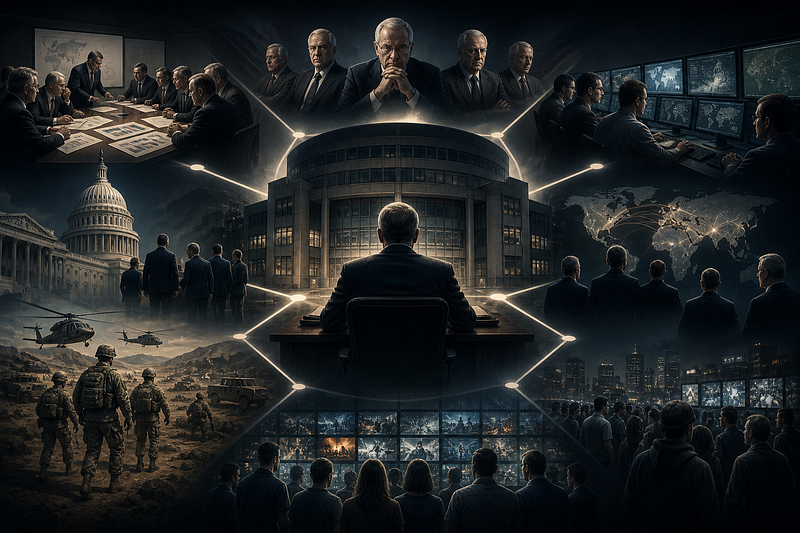
How the same institution wrote the doctrine, supplied the personnel, and graded its own homework.
That definition has survived every outcome it helped produce.
The institution that writes the strategy also evaluates the outcome. No outside body is required to review the result. This is legal, continuous, and seven decades old.
Most people have never heard of RAND Corporation. That absence is part of the mechanism.
April 2019. Washington. A report appeared with a title so dry it nearly disappeared into the paperwork: Extending Russia, summarized in a brief called Overextending and Unbalancing Russia. Commissioned by the U.S. Army. Produced by RAND.
Less than three years later, Russia launched its full-scale invasion of a Ukraine that had been fighting in the Donbas since 2014.
RAND is a nonprofit research organization founded in 1948 with U.S. Air Force funding. Between 2014 and 2019, by the count of the Center for International Policy, it received $1.029 billion from the U.S. government and defense contractors, roughly 95 percent of such money flowing to the top fifty American think tanks. The client never changed.
RAND does not make weapons. It produces research, doctrine, frameworks, threat assessments then supplies the people who carry those frameworks into government. When the policies those people design require evaluation, RAND produces the evaluation. The assumption underlying the arrangement was that better analysis would produce better outcomes. The problem with that assumption only became visible when the same institution generating the data also assessed whether the outcomes were good.
Whoever controls the framework does not make decisions. It decides what decisions are possible.
Vietnam
In 1961, Robert McNamara arrived at the Pentagon with a specific problem. The American military was large, expensive, and, in his assessment, unmeasurable. He had run Ford Motor Company on data. He believed the Defense Department could be run the same way. He recruited a team to build the measurement system. He went directly to RAND.
Charles Hitch, RAND’s chief economist, became Pentagon Comptroller. Alain Enthoven, a RAND systems analyst, ran the office of Systems Analysis that would reshape how the military evaluated its own performance. They brought with them the methodology RAND had developed over the previous decade: systems analysis. The reduction of complex strategic problems to quantifiable metrics. The assumption that what could be measured could be managed, and what could not be measured did not need to be.
The methodology had worked for comparing the cost-effectiveness of weapons systems. McNamara applied it to counterinsurgency.
Body counts. Kill ratios. Sortie rates. Progress in Vietnam would be measured the way cost-effectiveness in defense contracts was measured: with numbers that could be tracked, compared, and reported upward. Units filed reports because reports were being requested. Reports showed progress because progress was what the measurement system was designed to detect. The war produced data. The data confirmed the strategy. The strategy continued.
The metric had become the objective. Commanders optimized for the number being measured, not for the outcome the number was supposed to represent. A system designed at RAND to bring rigor to defense planning had, when applied to a counterinsurgency in Southeast Asia, created the conditions for a war that could be shown to be going well while going badly.
RAND did not send soldiers to Vietnam. It sent the method that made the war continue.
By 1967, McNamara knew something was wrong. The numbers showed progress. The war showed no progress. He commissioned a classified historical study of how the United States had arrived at this point. The task force sat inside the Pentagon and drew on outside analysts. One of them was Daniel Ellsberg, a RAND researcher.
Ellsberg had spent a decade at RAND. He had a doctorate in economics from Harvard, had worked on nuclear war planning, and had spent time in Vietnam as a civilian attached to the State Department. He had watched the gap between the official narrative and the situation on the ground widen each year. He returned convinced that the war could not be won as described. Before he went to the press, he gave the study to Senator J. William Fulbright. It stayed unpublished.
The team produced 7,000 pages across 47 volumes. It documented how successive administrations from 1945 to 1967 had misled Congress and the American public about the origins of the war, its prospects, and the assessments their own officials had made in private. McNamara had commissioned the study, but he was gone by the time it was finished. It was handed to his successor, Clark Clifford, in January 1969. Fifteen copies were made. Two went to RAND.
In 1971, Ellsberg leaked the study to the New York Times. The Pentagon Papers.
The system recorded its own deception.
RAND built the doctrine that shaped the war’s conduct. A RAND analyst who had worked on the study made the war’s deceptions public. The methodology that extended the war and the researcher who exposed the lies behind it both came from the same institution, at the same address, funded by the same government.
The method did not fail. The war did.
Iraq
Donald Rumsfeld served on the RAND board of trustees for more than two decades, including as chairman. Condoleezza Rice served as a RAND trustee in the 1990s. Both went on to fill the two most senior national security positions in the U.S. government. The Secretary of Defense and the National Security Advisor had spent years inside the institution that produced the strategic frameworks through which they would now make decisions.
That proximity is not evidence of coordination. It is evidence of something more durable: a shared intellectual environment. RAND had spent the 1990s building the analytical vocabulary through which the post-Cold War security landscape was interpreted in Washington. It had produced threat assessments of regional instability in the Middle East. It had published extensively on the Revolution in Military Affairs, the doctrine, born in Soviet military writing and the Pentagon’s Office of Net Assessment, that a technologically superior force could achieve rapid, decisive victory with reduced troop numbers. That doctrine shaped how the invasion of Iraq was planned.
The people who made the decision to invade had not been told what to conclude. They had spent years inside an institution that determined which risks warranted serious responses and which could be dismissed, which strategic frameworks were rigorous and which were not, which questions were worth asking. By the time the intelligence assessments arrived in 2002 and 2003, the conceptual architecture through which those assessments would be read was already in place.
This is the mechanism. Not instruction. Preconditioning.
The invasion proceeded. The predicted rapid victory did not materialize. The post-conflict reconstruction failed. The counterinsurgency dragged on for years. At each stage, RAND produced the evaluations. When the planning failed, RAND analyzed why. When the de-Baathification policy collapsed the Iraqi state, RAND assessed the effects. When the surge was proposed, RAND analyzed its prospects. The institution that had contributed the intellectual frameworks within which the war became thinkable also produced the reports on what had gone wrong.
No external body reviewed whether the frameworks had been part of the problem.
RAND did not invent the Revolution in Military Affairs, but it was one of the places where the doctrine was worked out for defense clients. Among the post-invasion assessments of what went wrong was After Saddam, a 2008 RAND study sponsored by the Army that faulted the overly optimistic views held by top civilian leaders. Many of the recommendations for what to do next were RAND products too. Much of the primary analysis in that sequence came from an institution with a financial relationship to the Department of Defense. The evaluator and the evaluated shared an address.
The framework did not change between administrations. The personnel did.
Ukraine
On 24 April 2019, RAND published Extending Russia: Competing from Advantageous Ground, a 354-page report, with a short brief titled Overextending and Unbalancing Russia. The client was the U.S. Army. The document was not classified. It was publicly available, indexed on RAND’s website, and read almost exclusively by people already inside the policy apparatus.
The report sorted its measures to strain Russian resources and exploit Russian vulnerabilities into six categories. One of them was the provision of lethal aid to Ukraine. The brief described this option as capable of exploiting what it called Russia’s greatest point of external vulnerability. Those were the document’s own words, written for the client that paid for the analysis.
The report did not recommend this option without qualification. It assessed the likely Russian response: providing lethal aid to Ukraine, it noted, would risk provoking a significant Russian military response. The report named that risk explicitly. It evaluated it. It rated the option’s benefits high and its costs and risks high as well, and concluded that economic measures, energy pressure and sanctions, were the more attractive path.
The analysis was published in April 2019. By then the United States was already providing lethal aid to Ukraine: Washington had approved the sale of Javelin anti-tank missiles in December 2017, and 210 missiles and 37 launchers had been delivered by the end of April 2018. The report described a policy already under way. Less than three years after it appeared, Russia invaded. The wider conflict the report had warned of had arrived.
On 25 January 2023, RAND published Avoiding a Long War: U.S. Policy and the Trajectory of the Russia-Ukraine Conflict, a paper funded by a private donor and foundations rather than the Army. The report analyzed the costs and risks of extended conflict and recommended how the United States should calibrate its involvement. Later that year, RAND published additional analysis on Ukrainian war aims and the prospects for a negotiated settlement.
The institution that mapped the options went on to judge how the war should end. No step in that sequence required leaving the building.
The system did not expand. It repeated.
No external correction entered the system.
What this means concretely: a single institution identified the vulnerability, scored the pressure options, supplied much of the analytical vocabulary through which policymakers understood them, and then, once the war began, became one of the leading voices on how to end it.
The 2019 report and the 2023 report were produced by the same organization, though not for the same client: the Army paid for the first, private funders for the second, which argued that avoiding a long war should be a higher priority for Washington. The question of whether the 2019 analysis contributed to the conditions that made the 2023 analysis necessary was never formally asked. There is no institutional mechanism that would require it to be.
The Mechanism
This pattern does not require coordination. It requires only that the same institution supply the frameworks, the personnel, and the evaluation, and that no one is required to disclose the connection.
RAND’s budget depends on defense funding. Defense funding depends on threat assessments. An institution funded by defense budgets does not need to be told to identify threats. The incentive structure identifies them automatically. An institution that produces reassuring assessments loses relevance and eventually contracts. An institution that identifies serious threats, requiring serious responses, and necessitating continued serious investment in analysis, grows. This is not a description of corruption. It is a description of how organizations respond to the incentive structures they operate within.
That is not a conspiracy. It is arithmetic.
The architecture has one additional feature. Because RAND is a nonprofit research organization, not a contractor or a lobbying firm, its output carries the designation of independent analysis.
That designation provides access that commercial defense contractors do not have. It allows RAND researchers to testify before Congress as neutral experts rather than as advocates. The sponsor is named inside each report. It rarely travels with the citation when the conclusions reach a policy document.
This is not a recent development. It has been the structural condition since 1948. What changes is only the domain.
RAND is now one of the most prominent institutional voices on artificial intelligence policy in Washington, publishing on governance, national security applications, autonomous weapons systems, and AI risk assessment.
It has testified before Senate committees on AI governance, safety, and regulation. It has advised the Department of Defense on AI ethics frameworks and the operational doctrine governing autonomous systems. It has produced threat assessments that shape which AI capabilities are treated as serious risks requiring regulatory response and which are not.
That research has a newer funder alongside the old one. Open Philanthropy, a foundation focused on AI risk, gave RAND more than $15 million in 2023 alone for work on AI and other emerging-technology risks, according to Politico. The Department of Defense remains a major client.
The institution that defines which AI capabilities represent existential risks also advises on how those risks should be regulated. The institution that shapes the threat assessment also shapes the policy response the threat assessment is used to justify. The institution that advises on the rules for autonomous weapons is also positioned to assess whether those rules worked. When the AI strategy requires evaluation, RAND is likely to produce much of it.
The architecture is identical to 1948. The Air Force was the first client. The domain was nuclear weapons. Today defense is still a principal client, now joined by private funders. The domain is artificial intelligence. Nearly eight decades of institutional structure, largely unchanged.
There is no stage in that sequence where an external party enters. No independent body reviews whether the frameworks are producing good outcomes. No rule requires the financial relationship between the analyst and the client to travel with the conclusions. The loop is closed before the public learns what question was being asked.
RAND does not win wars. It defines what winning means.
That definition has survived every outcome it helped produce.
Jerry writes forensic institutional analysis at The Manifest Archive. This article examines the structural relationship between strategic think tanks, defense funding, and policy outcomes.
Related from The Manifest Archive
- Vietnam Had a RAND Strategy.
- Everyone Reads the Pentagon Papers. Nobody Notices When Reality Changed.
- Angela Merkel Helped Broker a Peace Agreement in 2015. In December 2022, She Said It Was Never Designed to Bring Peace.
- US Strikes Iran While Talks Continue: Energy, Law and the Architecture of Escalation