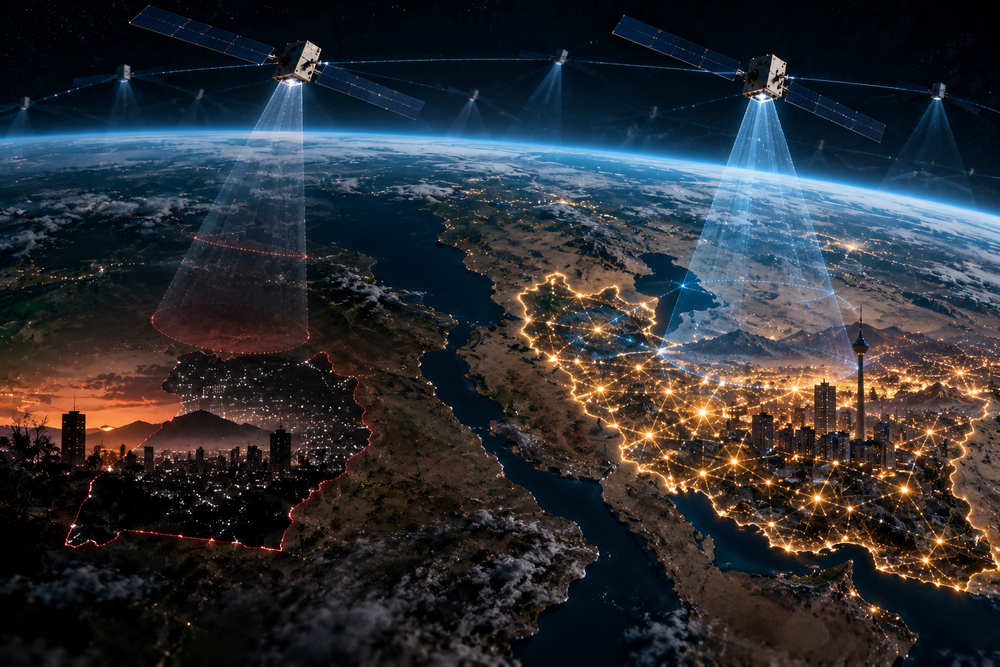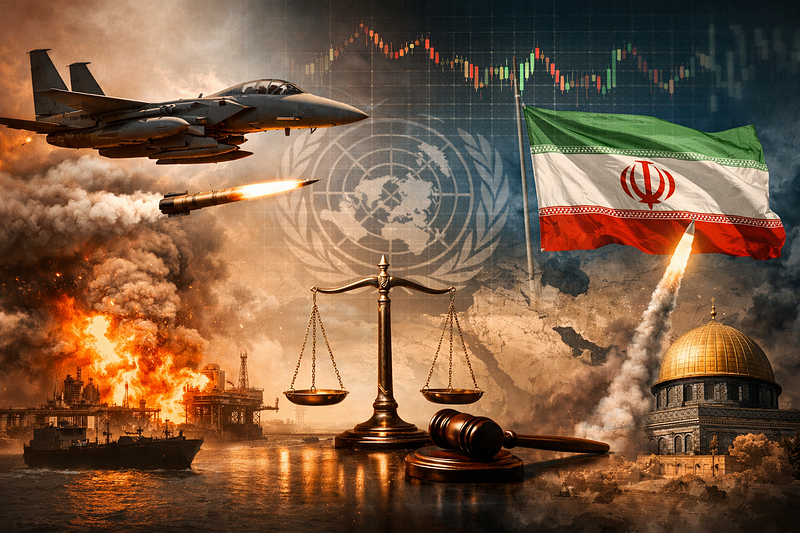
Why the timing of a US attack on Iran during active diplomacy reshapes energy markets, international law, alliances and global power competition.
The Room Where Diplomacy Was Still Breathing
The conference room in Geneva was quiet in the way diplomatic rooms always are. Water glasses aligned. Translation headsets resting on polished wood. Legal pads marked with careful annotations. The choreography of caution.
A translator adjusted one earpiece and wrote a single word in the margin.
Still.
Not agreement. Not breakthrough. Just still.
In rooms like this, that word carries weight. It means the door is not closed. It means language is still being measured before it becomes irreversible.
Outside, reporters waited for adjectives.
Constructive.
Serious.
Ongoing.
No one declared breakthrough. But no one declared collapse either.
The talks were still breathing.
The US strike on Iran did not follow a declared diplomatic collapse. It occurred while negotiations were formally ongoing, raising questions about escalation timing and strategic intent.
Markets reflected that ambiguity. Brent crude fluctuated but did not spike into immediate panic territory. Tanker traffic through the Strait of Hormuz continued. Insurance spreads widened modestly.
Risk was priced.
Not detonated.
In geopolitics, sequence is substance.
Then force entered the equation.
Not after negotiators walked out.
Not after a formal diplomatic failure.
But during an active process.
Force introduced before exhaustion is not reaction. It is prioritization.
International Law and Article 51: Is a US Strike on Iran Legal?
The UN Charter prohibits the use of force against the territorial integrity or political independence of any state under Article 2(4). The recognized exceptions are narrow: self-defense under Article 51, or authorization by the Security Council.
Under Article 51, a US attack on Iran requires justification grounded in self-defense if no Security Council mandate exists.
That justification turns on imminence.
If diplomacy is still active, the claim that a threat is immediate and unavoidable carries a higher evidentiary burden. Negotiation implies alternatives remain open.
This does not automatically render military action unlawful. But it intensifies scrutiny.
When force precedes the exhaustion of talks, legal justification carries greater weight, and greater exposure.
International law has no global police. Enforcement depends on political alignment and Security Council dynamics. A permanent member wields veto power.
Law exists.
Enforcement varies.
Intelligence and Imminence: The Hardest Variable
Every escalation rests on threat assessment.
Was there imminent danger?
Was intelligence indicating acceleration?
Was delay materially risky?
Imminence is not elastic.
If talks are ongoing, the threshold becomes more visible. The Iraq 2003 precedent lingers in institutional memory as a reminder that intelligence claims can later be reassessed.
That precedent does not invalidate present intelligence. But it alters the trust environment.
When force enters before diplomacy concludes, intelligence credibility becomes inseparable from escalation credibility.
In democratic systems, much intelligence remains classified. Citizens assess legitimacy indirectly. Trust becomes structural.
Strait of Hormuz and Oil Prices: Why US–Iran Escalation Moves Markets
The Strait of Hormuz carries roughly one-fifth of globally traded petroleum. According to the U.S. Energy Information Administration, around 20 million barrels per day of petroleum liquids transited the Strait in 2022, representing about one-fifth of global consumption.
(Source: U.S. Energy Information Administration, “World Oil Transit Chokepoints,” 2023.)
Oil does not need to stop flowing to destabilize markets. It must become uncertain.
Markets price probability, not only fact.
Even limited US–Iran military escalation historically triggers oil price reactions due to Hormuz’s strategic role.
On a tanker moving through the Strait at night, radar screens glow against black water. The captain does not debate geopolitics. He monitors coordinates, insurance clauses, and shipping advisories. Markets model probability. He calculates distance.
Volatility widens. Insurance costs adjust. Shipping contracts reprice.
Energy instability spreads into transport, food, and monetary policy.
Dollar Dominance and Energy Markets in a US–Iran Conflict
Oil is predominantly priced in U.S. dollars. When prices rise, global demand for dollar liquidity increases. Importers must secure dollars. Investors rotate into dollar-denominated assets.
The issuer of the dominant pricing currency occupies a structurally distinct position.
Energy instability redistributes strain through currency structure.
The structural role of dollar liquidity in global power dynamics is explored further in The Fourth Reich: Echoes of Empire in America, particularly in its examination of financial continuity and institutional resilience.
This is not conspiracy. It is architecture.
Economic Pressure Before Military Pressure
After the US withdrawal from the nuclear agreement in 2018, Iranian oil exports fell sharply from roughly 2.5 million barrels per day to a fraction of that within a year. Inflation exceeded 40 percent in subsequent periods.
(Source: International Monetary Fund country reports, 2019–2023.)
Sanctions operate through cost.
Revenue contracts.
Currency erodes.
Inflation spreads.
Sanctions are cumulative pressure.
Sanctions and Protest: Pressure Inside the System
Sanctions are cumulative pressure.
They alter purchasing power, employment prospects, and economic stability. Iran has experienced repeated waves of domestic protest over the past decade, often triggered by inflation, fuel price adjustments, or governance grievances.
There is no publicly verified evidence that broad domestic unrest has been centrally orchestrated by foreign governments in operational terms.
But sustained sanctions pressure shapes the economic environment in which protest emerges.
Sanctions aim at governments. Their pressure is experienced by societies.
The use of economic pressure as geopolitical leverage is examined in greater depth in The Transition from the USSR to Russia: What Really Happened, where financial restructuring and systemic pressure are analyzed as instruments of political transformation.
If protests are interpreted externally as regime fragility, escalation logic may shift. If they are interpreted internally as foreign-induced destabilization, consolidation may follow.
Sequence matters here as well.
Europe as the Absorbing Periphery of Energy Volatility
The rupture of Russian gas flows forced rapid diversification in Europe.
In August 2022, the Dutch TTF benchmark surged above €300 per megawatt hour, more than ten times its pre-crisis average.
(Source: ICE Endex historical data, 2022.)
The spike reflected not only scarcity but geopolitical volatility embedded in pricing.
The system survived.
But survival is not the same as strength.
Costs Inside the United States
Escalation is not costless domestically.
Higher oil prices affect American consumers. Fuel costs influence inflation and monetary policy. Political approval often tracks energy prices.
Defense expenditures expand during sustained engagement. Budget deficits widen. Veteran care obligations extend decades beyond active conflict.
The difference is not absence of cost.
It is distribution.
American territory is rarely the battlefield.
Economic and institutional consequences are cumulative and internal.
The Domestic Engine of US Decision-Making
Military action emerges from institutional architecture: the President, National Security Council, intelligence agencies, Department of Defense, and congressional frameworks.
Congress holds war powers formally. In practice, executive authority often moves faster under crisis conditions.
Speed favors the executive. Deliberation favors the process.
The structural design of alliance power and forward deployment has been explored in NATO: The Façade of Peace and the Architecture of Power, where institutional momentum behind collective security is examined in greater detail.
Sequence reflects internal momentum as much as external calculation.
US Bases in the Gulf: Alliance Risk and Iran Retaliation
Alliances provide infrastructure and strategic depth. Consultation mechanisms exist. Shared decision authority does not.
Decision velocity resides centrally.
Immediate exposure resides locally.
In one Gulf capital, air defense systems activated overnight after reports of incoming drones. Flights were delayed. Parents waited in corridors refreshing contradictory updates. The bases were military. The fear was civilian.
Alliances endure strain differently than they endure surprise.
Iran retaliation against US bases in the Gulf would likely widen the conflict beyond bilateral confrontation.
Iran’s Strategic Logic: Deterrence Without Direct War
Iran operates under constraint: sanctions, conventional imbalance, economic fragility.
Direct confrontation with the United States would be catastrophic.
Its doctrine emphasizes proxy networks, missile capability, and calibrated retaliation.
For a constrained state, deterrence is expressed through ambiguity rather than confrontation.
The Wider Triangle: Energy and Strategic Signaling Beyond the Region
China is one of the largest importers of Middle Eastern energy and has purchased Iranian crude despite sanctions regimes. Instability in the Gulf affects Beijing’s industrial calculus as well as Washington’s financial architecture.
Russia also occupies a strategic position. As a major energy exporter under its own sanctions regime, Moscow benefits structurally from sustained volatility.
The recurring pattern of escalation framed as defensive necessity has appeared across multiple historical theaters, a theme explored in Why Rome Never Really Fell, which analyzes how continuity often hides beneath apparent rupture.
Regional conflict now unfolds inside global competition for financial and energy architecture.
From Limited Strike to Regional War: The Escalation Path
Escalation rarely ends at the first exchange.
What begins as a limited strike can evolve along several pathways. Proxy intensification across multiple theaters. Maritime confrontation in contested waterways. Cyber operations targeting financial or energy systems. Sustained air campaigns against infrastructure. Incremental expansion of declared military objectives.
None of these outcomes are inevitable.
But history shows that once the threshold of direct force is crossed, restoring the previous diplomatic baseline becomes increasingly difficult. Each retaliatory step narrows flexibility. Each additional justification hardens political positions.
Every step up the ladder reduces the number of steps available downward.
The presence of forward-deployed bases complicates this ladder. A strike on a host nation can trigger alliance consultations, defensive mobilization, and broader deterrence signaling. What begins as bilateral confrontation risks widening into regional entanglement.
Sequence determines slope.
When force enters before diplomacy is exhausted, the incline steepens. Off-ramps shrink. Reversal becomes politically costlier than continuation.
Strategic analysis often measures energy flows, currency stability, alliance cohesion, and deterrence credibility. Those variables matter. States are structured to calculate them.
Yet beneath every cost–benefit assessment lies a variable that does not compound, reprice, or recalibrate: human life. Civilian safety, long-term social stability, and the irreversibility of loss cannot be hedged or deferred. When escalation is weighed primarily in strategic terms, the human metric risks becoming derivative rather than decisive. That shift is subtle. Its consequences are not.
The Irreversible Variable
Markets stabilize.
Currencies fluctuate.
Oil corridors reopen.
Statements evolve.
Power measures cost in stability. History measures cost in sequence. Human beings measure cost in absence.
The room in Geneva will host future meetings.
But the order of events will not change.
Diplomacy was still breathing.
Force entered.
And that sequence will outlast every justification.
Related from The Manifest Archive