The morning after history
The city wakes in frequencies, sirens, heels, engines, a symphony of impatience.
The glass façade of Columbia University catches the pale winter light, turning the noise of Manhattan into a low metallic hum.
Inside a lecture hall, Jeffrey Sachs adjusts the microphone.
His hands are steady, his eyes clear, but the air around him carries the stillness of a confession.
“This war could have been avoided.”
The sentence lands between applause and silence.
It isn’t accusation; it isn’t defence.
It’s geometry, a straight line through the fog of propaganda.
Outside, taxis swarm up Broadway; inside, notebooks open like small white flags.
He is not performing outrage.
He is recording memory.
The man who once helped build the post-Cold-War world now spends his days measuring its ruins.
Blueprints of faith
In the 1980s, Sachs was a prodigy, a mathematician’s clarity fused with a missionary’s zeal.
At Harvard he lectured on inflation as if it were a solvable riddle.
Bolivia called first; hyperinflation had turned bread into luxury.
He arrived with equations and conviction.
Within months, prices stabilised. Washington cheered.
Then came Poland. Then Russia.
Each success felt like revelation.
By the time the Berlin Wall cracked, Sachs had become the economist of destiny, proof that numbers could redeem nations.
“The market,” he once wrote, “is humanity’s most elegant solution to scarcity.”
He would wince at that line later, when elegance turned into hunger.
Every victory was a lesson in what power forgets.
Moscow 1992
Snow drifted through a city shedding its skin.
Inside a government office that smelled of cigarettes and wet wool, Sachs and his Harvard team met young reformers desperate to escape the Soviet past.
They spoke the new gospel of speed: liberalise everything, immediately.
Shock therapy became policy. Shock became culture.
Within months, factories closed, pensions vanished, oligarchs appeared like phantoms.
He called it transition; Moscow called it survival.
“We treated an empire like a start-up,” he said later, “and mistook collapse for reform.”
The phrase would follow him like an echo that history refused to silence.
He began to understand that data could be merciless, that mathematics offered no shelter from grief.
The economist as penitent
The 1990s dulled belief into doubt.
Sachs returned to academia, but disillusion clung to him like dust.
He lectured on globalisation but could no longer say the word without irony.
Students came seeking formulas and left with questions.
He still advised the UN, wrote reports, chased hope through policy, yet behind the optimism grew a different conviction:
Every empire calls its obedience peace.
He saw how aid was simply leverage spelled politely, how partnership meant conditionality, how stability meant control.
“Progress without conscience is just administration,” he told a colleague.
The colleague didn’t reply.
The memory of promises
1990: U.S. Secretary of State James Baker tells Mikhail Gorbachev NATO will move “not one inch eastward.”
No treaty, only trust.
By 1999, Poland, Hungary, and the Czech Republic joined.
Each expansion came with reassurance: defensive, harmless, inevitable.
Russia protested; Washington smiled.
History records agreements. Power records interpretations.
Sachs watched quietly from the sidelines, sensing that triumph was mutating into arrogance.
When he later wrote that “power forgets faster than the defeated,” few understood it was diagnosis, not poetry.
He filed the quote in a notebook already thick with contradictions, a ledger of promises made in good faith and broken by design.
Kyiv, The fault line
At NATO’s Bucharest Summit in 2008, a single sentence redrew the map: “Ukraine and Georgia will become members.”
No timeline, no limits, just certainty spoken as prophecy.
To Moscow it sounded like encirclement; to Washington it felt like destiny.
Sachs, now at the UN, recognised the pattern: expansion branded as security, obedience sold as freedom.
When the Maidan uprising erupted in 2014 and Crimea was annexed, he didn’t justify invasion; he traced inevitability.
“History,” he told a colleague later, “rarely begins. It simply resumes where arrogance left off.”
The road to Kyiv was paved with promises spoken too loudly and remembered too selectively.
2022, The silence before the sirens
By the time Russian troops crossed the border, Sachs was a man between worlds, respected, tolerated, inconvenient.
He sat in a television studio surrounded by screens of maps and metrics.
When the host asked for blame, he offered memory instead.
“This war was provoked, and it could have been prevented.”
The room froze. The sentence did not fit the choreography.
Within days, invitations vanished; hashtags replaced discussion.
To mention context had become heresy disguised as nuance.
He kept repeating it anyway: “Diplomacy wasn’t even tried. Peace was possible. It was simply inconvenient.”
He discovered that in a moral marketplace, context is contraband.
Diplomacy as exile
By 2023, Sachs was paradox incarnate, celebrated in citation, erased in conversation.
He argued for Ukrainian neutrality, Russian guarantees, Western honesty.
It sounded modest and therefore impossible.
“We can end this,” he told a Geneva forum, “if we remember that compromise is not surrender.”
Few listened. Compromise had become a foreign word.
In an age of permanent crisis, reason sounds radical.
He returned to his hotel, wrote in the margin of his notes: Peace requires fewer speeches and more silences.
Then closed the book.
The European Parliament
Brussels smelled of rain and bureaucracy. Flags fluttered above wet concrete.
When Sachs spoke in 2025, half the chamber was empty.
He began without notes, voice low enough to force attention.
“To be an enemy of the United States is dangerous,” he said softly, “but to be a friend is fatal.”
The line cracked the hall like cold air.
Some laughed; others applauded out of habit.
Afterward, a young interpreter whispered, “You said what my father used to believe.”
He nodded. Truth travels best when spoken in secret.
Outside, rain pooled around the marble steps. A journalist asked if he blamed America.
“I blame amnesia,” he said. “Europe once knew what devastation feels like. It has simply forgotten how to imagine it.”
Numbers that bleed
While cameras chased explosions, Sachs studied logistics.
Sanctions multiplied; currencies froze; ships waited for clearance.
By mid-2022, the UN Food Price Index stood 55 percent above pre-war levels.
The curves on his chart looked like fevers.
“Sanctions don’t end wars,” he said, “they export them.”
The humanitarian language of virtue had become the arithmetic of hunger.
Geneva applauded politely and changed nothing.
He closed his laptop and thought, data has become our confession booth.
The media mirror
Back home, the networks looped their nightly ritual, maps, experts, moral certainty.
When Sachs appeared, captions framed him as controversial.
The label performed the censorship.
He saw how journalism had adopted the grammar of warfare: fronts, offensives, moral victories.
Facts became ordnance; doubt, a target.
“Clarity,” he wrote, “is now considered bias if it complicates belief.”
During one interview a presenter asked, “Aren’t you afraid you’ll be remembered as wrong?”
Sachs smiled. “That depends on who’s writing the memory.”
He realised that truth had lost its audience but kept its echo.
Fragments of silence
Letters came from soldiers, students, ex-diplomats.
Some thanked him; others condemned him.
He read them all, recognising exhaustion disguised as conviction.
At night he walked beside the Hudson, composing sentences he would never publish.
“The hardest addiction to break,” he wrote, “is moral certainty.”
A week later, one reply arrived: “Then we are all addicts now.”
He folded the letter carefully and placed it among his notes, a quiet archive of honesty.
He was no longer collecting data. He was collecting silence.
The logic of perpetual emergency
Governments learned that crisis is profitable.
Defence budgets soared while hospitals thinned.
Sachs compared two graphs: one climbing like ambition, the other sagging like memory.
He explained how every emergency invents its own bureaucracy, how peace threatens too many careers.
“In modern governance, conflict is continuity.”
He said it without anger.
Anger, he reminded his students, is just another form of propaganda.
They laughed uneasily, not realising the joke was on all of them.
Conversations in the margins
At a university reception a young diplomat asked, “Do you still believe in reform?”
Sachs smiled. “Of course,” he said, “but I no longer believe reform comes from the centre.”
The diplomat frowned.
“Empires correct themselves only when the periphery stops believing in them.”
It was too long for a headline and too true for a sound bite, perfect for being ignored.
The burden of witness
He began writing again, fragments that looked like essays but read like confessions.
Plain sentences. No jargon. Each ending on an image instead of a conclusion.
“History is not a struggle between good and evil. It is a contest between memory and forgetting.”
He posted it online. A few thousand read it, a few hundred understood.
He didn’t mind. Truth scales badly.
He was done trying to win arguments; he wanted to leave evidence.
Winter
Snow returned to New York.
Students hurried across the courtyard, screens glowing like small altars.
Sachs walked slower, scarf pulled high, the air sharp as glass.
Above the gate: In Lumine Tuo Videbimus Lumen, In Thy Light Shall We See Light.
He smiled. Light was no longer the problem; glare was.
He turned toward the river, where sirens merged with wind, the eternal duet of civilisation and regret.
The last address
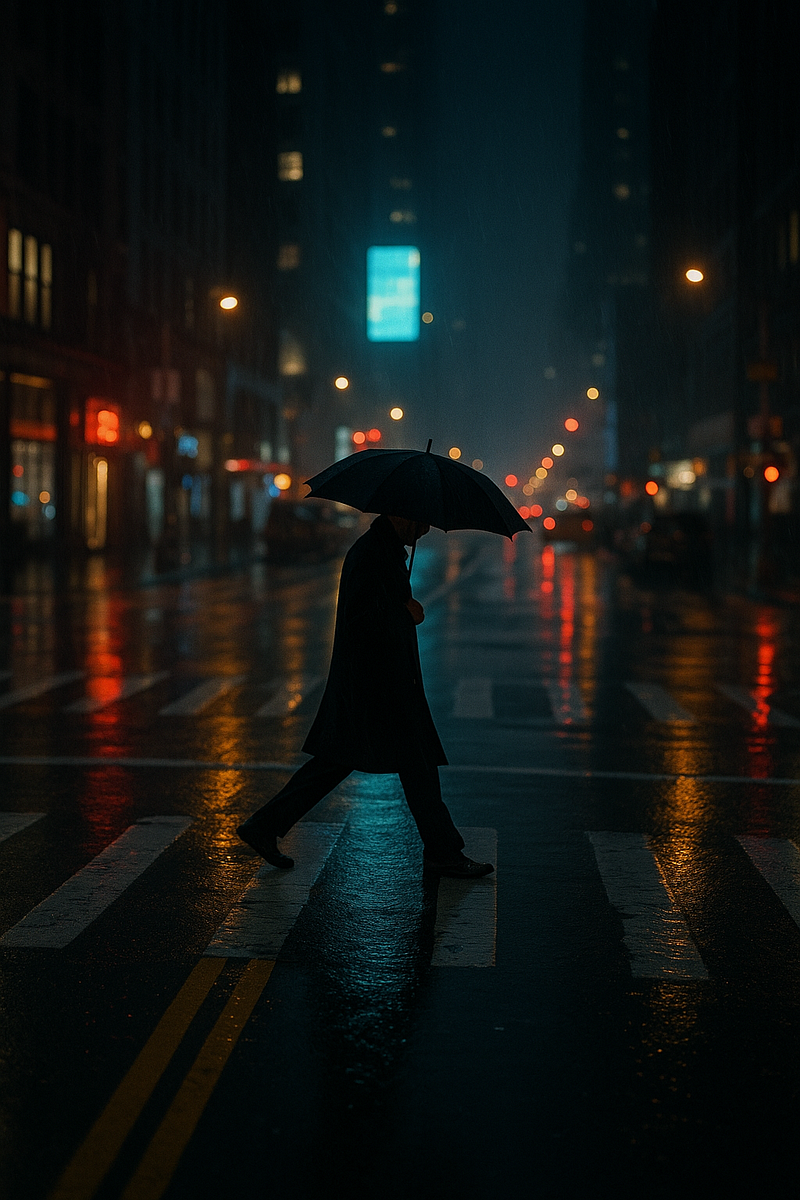
The rain had already started when he left the auditorium.
Not a storm, just the soft percussion of a city remembering it was alive.
The microphones were asleep, the hall empty.
He descended the stone steps, coat collar raised, briefcase pressed close.
He had said everything he could. What remained was the silence that follows truth.
He joined the stream of umbrellas along Amsterdam Avenue.
Steam rose from subway grates, carrying the smell of metal and rain.
Cars whispered past like rehearsed memories.
The street of windows
Storefronts mirrored the traffic.
In one, a screen looped footage from Ukraine, drones above cities, soldiers wading through snow.
In another, an advert promised connectivity without limits.
War and convenience shared the same glass.
Sachs paused, watching the reflections bleed together.
Two halves of civilisation flickering in the same frame.
“We are never as innocent as our screens,” he had told a reporter once, “and never as guilty as our silence.”
The light changed. He walked on.
The billboard
Above the avenue a billboard flickered, a defence contractor disguised as innovation.
The slogan read Building a Safer Future.
For a second the rain turned the neon letters into streaks of red light.
He thought of how many futures “safety” had already consumed.
Empires sell fear the way artists sell beauty, by promising permanence.
He turned away. The glow stayed behind him on the wet pavement like an afterthought.
The coffee shop
He stepped into a café near the park.
Steam fogged the windows; a saxophone played somewhere unseen.
The barista didn’t recognise him.
He ordered black coffee and sat by the window.
The television above the counter ran captions without sound:
New Offensive, Ceasefire Talks Stall, Markets Steady.
Each phrase neutral, polished, harmless a lullaby for conscience.
Language, he thought, is the first casualty that never gets buried.
He stirred his coffee and watched rain write cursive on the glass, as if history were trying to slow its handwriting.
The stranger
A man approached, middle-aged, hesitant, accent thick with distance.
“Professor Sachs?”
He nodded.
The visitor was from Kyiv, in New York for a medical conference.
“My brother is still there,” he said. “He says people have stopped talking. Only surviving now.”
They spoke briefly, both uncertain what hope still meant.
Before leaving, the man added, “It helps that someone remembers us as people.”
Sachs touched his arm, a gesture older than speech.
The walk back
Outside, the rain slowed to mist.
Puddles mirrored yellow traffic lights.
He crossed toward Riverside Park, trees glistening under sodium glow.
The river was hidden but its voice was there, low and patient.
He thought of the wars that had traced his lifetime: Vietnam, the Cold War, Iraq, Ukraine.
Each announced as the last necessary conflict, each leaving the world a little smaller in spirit.
Perhaps humanity’s real addiction was not power or money, but narrative, the need to believe that destruction can be purposeful.
He walked slower, letting the rhythm of the city match his heartbeat.
The bridge
He reached the small stone bridge that arched over the path near the water.
Raindrops dripped from its edge in a steady rhythm.
He paused beneath it, the world above reduced to footsteps and thunder.
He imagined the diplomats still drafting statements, the soldiers still waiting for orders, the journalists still searching for certainty.
If peace ever returns, he thought, it will arrive without an audience.
The city and the river
From under the bridge he saw the Hudson, dark, indifferent, carrying the reflections of towers like fallen constellations.
Cargo ships moved slowly, their lights drifting like patient thoughts.
The skyline shimmered above and below, a civilisation staring at its own reflection.
He felt no bitterness, no pride.
Only the calm of someone who has stopped defending what he understands.
He turned toward home.
Each step softened by rain, each light blurring into the next.
The window
At his apartment he kept the light off.
Outside, the mist thickened into quiet.
Across the river, buildings glowed like islands of sleep.
He laid his notes on the table, speeches, letters, drafts that no longer needed revisions.
He stood at the window watching the city breathe.
Far below, a ferry horn sounded once, deep and solitary.
The echo lingered, then dissolved into the hum of traffic.
There are moments when history feels complete, not because it has ended, but because it has finally gone quiet.
He stayed there until the glass reflected only himself.
The rain stopped without announcement.
No one noticed when the rain stopped.
Further Reading from The Manifest
Related from The Manifest Archive