Moscow, 1991, The Ritual of Conversion
In November 1991, Yegor Gaidar asked the deputy finance ministers of the G7 to let Russia stop servicing the old Soviet debt for a while.
By Sachs’s own account, the request was refused outright, with a threat attached: miss a single payment and the emergency food aid already at sea would be sent back to its home ports.
Jeffrey Sachs, thirty-seven, Harvard economist, the West’s golden prodigy, met an ashen-faced Gaidar immediately afterwards.
He still believed numbers could heal history.
They called it therapy.
It was closer to ritual, an act of exorcism through numbers.
And in that ritual lies the story of our age:
how the West learned to disguise power as medicine,
and how the man who wrote its gospel began to doubt his own faith.
The First Gospel of the Market
Before Moscow, there was Bolivia.
La Paz was drowning in hyperinflation; prices could double within weeks.
Sachs arrived with formulas and faith, convinced that speed could cure anything.
He had received tenure at Harvard in 1983, at twenty-eight.
At thirty, he already advised governments, IMF teams, entire nations.
His voice carried the authority of a world that believed equations could erase pain.
Overnight, subsidies vanished. Fuel rose roughly sevenfold in price.
Shops went dark. Trucks stopped in mid-journey.
Within months, inflation fell from five digits to double digits; by 1987 it stood near 11 percent.
Economists called it the Bolivian miracle.
Washington applauded.
The cure worked. The people starved slower.
Freedom became his metric.
Pain, his proof.
He was convinced that history rewarded the bold.
Warsaw, The Faith Spreads
Poland, 1989.
The Berlin Wall was cracking; ideology itself seemed obsolete.
Sachs arrived in Warsaw as if summoned by history.
With David Lipton he advised the team behind what would be known as the Balcerowicz Plan, shock therapy for a nation stepping out of communism’s shadow.
Price controls abolished overnight, the złoty made convertible and anchored by a $1 billion stabilization fund.
Factories closed. Unemployment soared.
But foreign creditors smiled.
The pain was renamed transition.
Every empire loves a man who can turn chaos into prophecy.
By the time he reached Moscow, he no longer questioned the faith, he preached it.
The Laboratory of Collapse
Russia was different.
It wasn’t a patient to be cured but a civilization to be rewired.
The Soviet heart was still beating, weakly, under mountains of debt and steel.
Sachs arrived as an unpaid adviser to Boris Yeltsin’s economic team,
with a few colleagues at his side.
Their brief, as they understood it: turn command into capitalism.
He worked alongside Yegor Gaidar, the young finance minister.
Together they worked through what would become the blueprint of post-Soviet reform.
Prices freed. Subsidies cut. Trade opened.
On 2 January 1992 prices more than doubled in a day, and over the year they rose more than 2,500 percent.
Over the decade, the economy roughly halved.
But in Washington, the numbers looked clean.
They called it reform. It was demolition by data.
Street Level, The Human Equation
Outside the ministries, Moscow was a market of memory.
Old women sold Soviet medals for bread.
Men bartered watches for vodka.
Televisions showed new commercials teaching citizens how to smile for capitalism.
He was both architect and witness.
The models said progress; the streets whispered loss.
By 1994, life expectancy for Russian men had fallen by about six years.
Oligarchs rose overnight, their Mercedes flashing through empty streets.
The market had become a faith with no afterlife.
The Shock That Never Ended
“Shock therapy” was meant to be temporary, pain before recovery.
But the shock never ended.
It migrated.
From Latin America to Asia, then home to the West.
What began as policy became reflex.
Every crisis an opportunity to restructure obedience.
In Russia, it birthed oligarchy.
In America, financialization.
Debt replaced discipline.
Consumption replaced citizenship.
Sachs watched it happen from inside the machine.
He still believed in data, but data now behaved like myth, self-creating, self-forgiving.
Factories silent. Miners unpaid.
Doctors selling cigarettes outside hospitals.
And still the graphs rose.
They called it the free market. It looked like looting.
He realized his formula didn’t stabilize, it transferred.
From public to private.
From citizen to creditor.
From memory to metric.
He had written a new economics of faith.
Now he was living its gospel of doubt.
Transition, The Silence Before Confession
By the mid-1990s the experiment was complete.
Russia had been converted, but not saved.
The West moved on, congratulating itself on the victory of markets.
Sachs had already resigned as adviser, in December 1993 by his own account, announced publicly in January 1994.
He no longer spoke with missionary confidence.
He spoke like a man translating between two languages that no longer believed each other.
He started listening for silence.
And in that silence, something shifted.
He began to sense what he had built, and what it had built in him.
That awareness would soon become confession.
The Confession of a Technocrat
By the late 1990s, the missionary had grown tired of miracles.
He left the spreadsheets for speeches, the equations for empathy.
For the first time in years, he began to question the arithmetic of salvation.
At the United Nations, he reinvented himself as a global conscience.
He spoke of ending poverty in our lifetime, of shared responsibility and sustainable development.
The phrasing was clean, the optimism contagious.
He became an adviser to Kofi Annan, standing beside Bono and Bill Gates on stages where ideals echoed louder than facts.
Under the lights, Sachs looked reborn, the prodigy transformed into prophet.
The air in those rooms always smelled of air-conditioning and applause.
For a brief moment, it felt like redemption, as if the same ambition that once fractured nations could now heal them.
But redemption built on memory is fragile.
And his critics began to point at the same hidden architecture in every project, every plan:
funders at the top, metrics below, dependence at the base.
The formulas had changed vocabulary, not structure.
Aid had become empire in softer tones.
They changed the altar.
Not the god.
The Benevolence Industry
He visited clinics in Malawi, schools in Ethiopia, villages in Ghana.
Everywhere he went, there were banners with logos, the flags of donors, the faces of sponsors.
Aid workers moved like diplomats, polite and temporary.
Critics such as William Easterly argued that poverty had become an industry, that progress was measured in spreadsheets, not stomachs.
Money left New York, touched Africa, and returned home with interest.
Sachs answered the other way. In The End of Poverty (2005) and the Millennium Villages, he argued for more aid, better coordinated, not less.
The sharpest verdict came from Nina Munk, whose book The Idealist (2013) documented how far the villages fell short of what the project had promised.
Sachs kept defending the plan. His break with Washington would come over something else.
He had started to outgrow the empire, not in rebellion, but in recognition.
He wasn’t losing faith.
He was learning what it cost to have one.
The Heretic of the New Cold War
Two decades later, the world returned to its old reflex: division.
Sachs, older now, stood before microphones again, but his tone was different.
The brightness of the UN years had faded into something slower, colder, more precise.
He spoke of NATO, of Ukraine, of a West addicted to moral certainty.
He said the alliance had forgotten its purpose, that diplomacy had become theater, and that power no longer required victory, only permanence.
In February 2023 he briefed the UN Security Council at Russia’s invitation, and in essays and interviews he kept returning to NATO’s eastward expansion as the broken promise behind the war.
The reaction was feral.
His critics turned him into a caricature: a pro-Kremlin economist, a useful idiot, a fallen guru.
Yet his words were less provocation than diagnosis.
He was no longer defending Moscow.
He was describing Washington.
A correction for readers who came here looking for Sachs and religion: an earlier version of this piece quoted him calling NATO a religion. No such statement could be found in his published essays, interviews or speeches, and the quote has been removed. His documented tie to religion is institutional: in October 2021 Pope Francis appointed him to the Pontifical Academy of Social Sciences.
Read this way, the empire had replaced theology with technology, the same impulse for order, now automated.
Sanctions became sacraments.
Algorithms became apostles.
And faith returned, rebranded as governance.
He stopped preaching markets.
He started preaching memory.
The Language of Protection
In essays on Iraq, Libya and Syria, Sachs began to map a pattern.
Every act of control arrived dressed as care.
Every intervention claimed moral necessity.
From humanitarian wars to regime-change programs, virtue had become the new currency of empire.
He saw the pattern: all systems justify themselves by pretending to protect.
He was no longer economist, nor activist, nor prophet.
He had become something rarer, a heretic of certainty.
And in the quiet logic of his dissent, power heard its own reflection.
The Paradox of Repentance
What does redemption look like for a man who once engineered collapse?
Sachs’ later years read like secular repentance.
He still teaches.
Still writes.
Still appears on panels that used to applaud him.
But the applause now sounds nervous, the sound of people unsure whether they are being blessed or judged.
He no longer tries to defend or condemn the past.
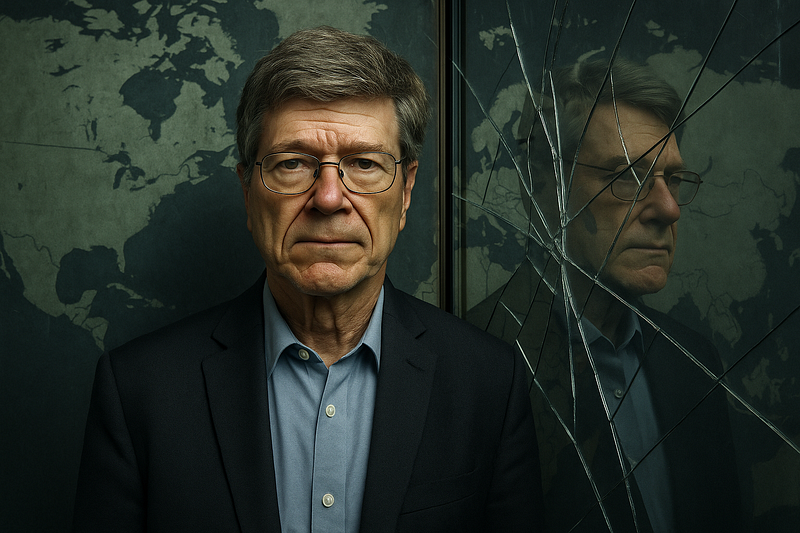
He uses it as mirror.
He outgrew the empire.
But the empire never stopped growing through him.
He stands, in effect, in a doorway,
the way a man stands in the threshold of a house he once built but no longer owns.
The Anatomy of Forgetting
History doesn’t repeat because people forget.
It repeats because institutions remember selectively.
Call it the algorithmic conscience,
the way modern systems automate belief.
The same logic that priced bread in Moscow now prices attention online.
The same idea of “efficiency” that collapsed nations now measures our emotions in clicks.
Humanity is being optimized out of itself.
Empire, on this reading, no longer needs armies or ideology.
It only needs metrics.
In this lies the arc of his transformation:
the economist becomes the philosopher of cause and consequence,
a witness to the moral mechanics of progress.
The Weight of Clarity
There is a moment in every conversion when truth stops hurting and starts illuminating.
For Sachs, that moment came quietly.
He began to speak of peace not as a treaty but as a temperament.
He speaks now with Orwell’s discipline: short, honest, without decoration.
Every sentence is a window.
Every pause, a confession.
He no longer wants to save the world.
He wants it to remember itself.
The Echo and the Mirror
The arc closes where it opened, with a refusal.
Only now the economist is older, slower, more deliberate.
He is part scholar, part witness now.
He no longer believes in redemption through reform.
He believes in remembrance through honesty.
“Remember always where it truly began, and who set it in motion.”
It is both confession and warning,
the echo that ends every Manifest.
The empire listens,
but only to itself.
Related from The Manifest Archive