Introduction | The sound no one owned
Los Angeles, 1965.
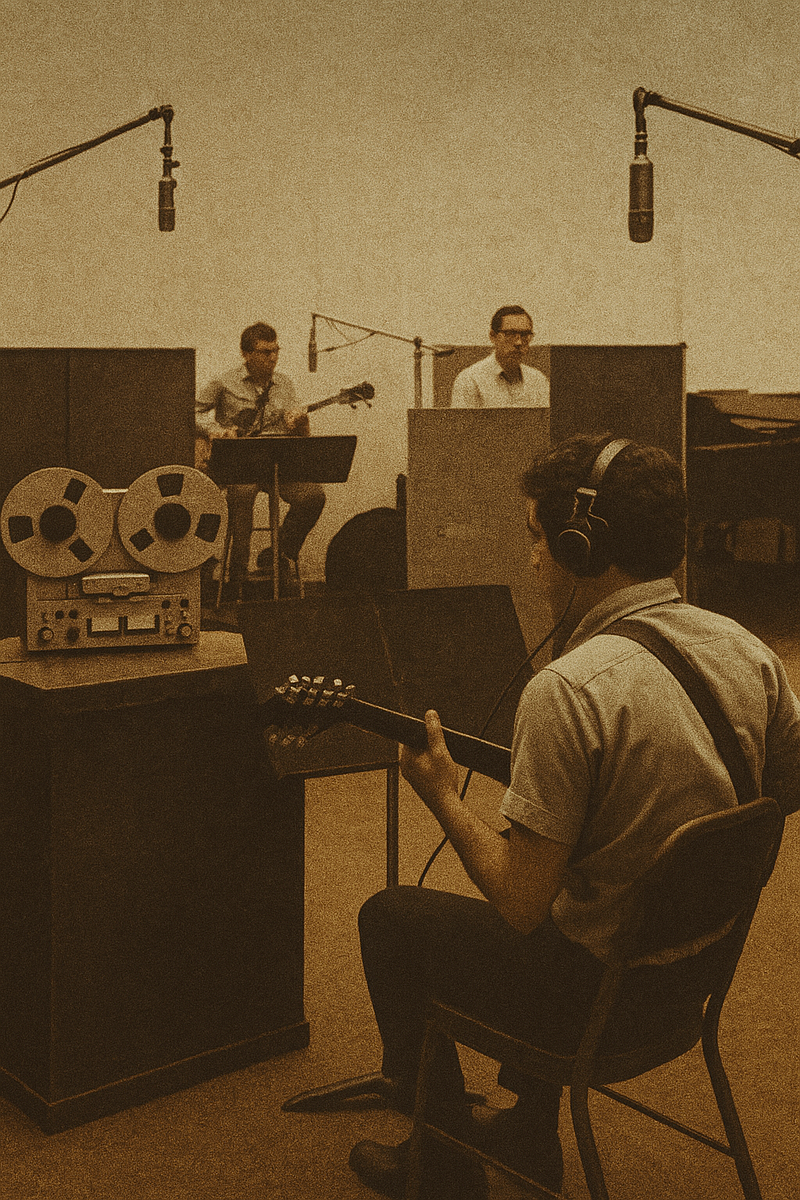
The air inside Gold Star Studios was heavy with dust and electricity. A single red light glowed above the control-room door. Cigarette smoke curled around the lamps. The musicians tuned in silence, eyes half-closed, waiting for the click track to start.
A young producer entered with a fresh lyric sheet and a promise of fame. He wouldn’t play a note; he didn’t need to. The people in that room would turn his idea into something the world would remember.
For a decade, this secret collective, later known as The Wrecking Crew, performed on more than 40,000 recordings.
They were the invisible architects behind The Beach Boys, The Byrds, The Monkees, The Righteous Brothers, The Mamas and the Papas, Nancy Sinatra, Frank Sinatra, Simon & Garfunkel, Elvis Presley, Sonny & Cher, The Fifth Dimension, and even early tracks by Frank Zappa and The Doors.
Their hands built the rhythm of California Dreamin’, the pulse of Good Vibrations, the swing of Strangers in the Night, the echo of Mrs. Robinson, the swagger of These Boots Are Made for Walkin’, and the ache of You’ve Lost That Lovin’ Feelin’.
They didn’t just play songs, they engineered the emotional DNA of American pop.
The record sleeves named the stars, but the stars rarely played.
Behind every chorus, every shimmering guitar line, stood the same quiet few.
Even the singers themselves often didn’t know who had made their music sound immortal.
When the tape rolled, Hal Blaine’s snare hit like a clock striking truth. Carol Kaye’s bass breathed between the notes. Glen Campbell’s guitar shimmered through the haze. Larry Knechtel shaped harmonies that would outlive their names.
In less than four minutes they built California Dreamin’, a sound that would circle the planet and define a decade.
Then they left the studio, cashed their fifty-dollar checks, and disappeared into the city’s heat. Their names never touched the label.
They played the sound of America, but America never knew their names.
They didn’t choose their name, the insult chose them.
Older studio musicians, men in suits and ties, used to complain that this new generation of players would wreck the business with their loud amplifiers and restless style.
The joke stuck. The Crew embraced it.
The Wrecking Crew became a badge of rebellion in a world that demanded obedience.
They were accused of destroying the craft.
In truth, they rebuilt it in their own image.
The machinery of pop
The sixties are remembered as the age of freedom, of guitars and revolutions, of long hair and longer ideals.
But the truth of pop music was far more engineered.
At the heart of that countercultural dream stood a handful of uncredited professionals who worked twelve-hour days creating the illusion of spontaneity.
Record executives learned early that chaos doesn’t sell, precision does.
They built empires around control: of rhythm, of harmony, of image.
The Wrecking Crew were their secret weapon, the human metronomes behind the myth of youth.
Every label had its saints of sound. Motown had The Funk Brothers in Detroit, Nashville had The A-Team, and Los Angeles had The Crew.
Their studios, Gold Star, Western Recorders, Capitol became cathedrals of invisible devotion.
Within their walls, individuality dissolved into harmony.
Phil Spector called it the Wall of Sound.
Layer upon layer until the human ear could no longer separate the parts.
It was both art and architecture, the acoustic equivalent of stained glass.
Authenticity was no longer the goal; recognizability was.
The industry had found the formula for emotion.
Every drumbeat was calibrated for radio compression, every vocal mix designed to survive the static of car speakers on Route 66.
It was the first algorithm of feeling, long before computers learned to imitate the heart.
The session that built a myth
One afternoon in 1966, Brian Wilson of The Beach Boys walked into Western Studio 3 with an unfinished melody in his head.
He handed out fragments of sheet music and tried to explain a sound he could barely articulate, part surf, part prayer.
The musicians listened in silence.
Hal Blaine counted them in.
A low bass note from Carol Kaye filled the room like warm air; Tommy Tedesco added a fragile guitar tremor; a theremin whined above it all.
Wilson nodded, and for the next six hours they constructed Good Vibrations bar by bar, rewinding the tape until the emotion felt symmetrical.
No one in that room could have predicted that those three minutes would become one of the most expensive recordings in history.
What mattered wasn’t money, but memory.
They were chasing the exact frequency where joy meets melancholy, the invisible point where sound becomes belief.
That pursuit was their religion.
They never spoke of art, only of takes.
Theirs was the liturgy of repetition, the prayer of perfect timing.
The system behind the music
By the mid-sixties, session work had become the backbone of the industry.
Anonymity was written into every contract.
The label owned the sound; the players owned nothing but their skill.
They began each morning not knowing which genre they’d inhabit: surf at nine, soul by noon, country at three, psychedelic pop before dinner.
The same hands that played for Sinatra’s orchestra laid down the grooves for The Monkees.
The paradox was total.
Pop, sold as rebellion, had become the most standardized art form on earth.
Freedom had a click track.
Hal Blaine, the Crew’s drummer, played on 150 top-ten hits.
He called the studio “a church without a congregation.”
Inside, they built cathedrals of sound; outside, the world danced without knowing who to thank.
They weren’t chasing fame. They were building the architecture of emotion.
Carol Kaye and the invisible pulse
Among them sat Carol Kaye, the only woman in the room.
Her Precision Bass rested across her knees, her eyes never leaving the sheet music.
She played on Feelin’ Alright, The Beat Goes On, Homeward Bound, and Good Vibrations.
Every note she touched became part of someone else’s legend.
When asked how it felt to be left off the records she built, she smiled softly.
“We were paid to create magic, not to own it.”
In that single sentence lay the secret philosophy of twentieth-century music.
Art was work.
Work was invisible.
And invisibility was the price of perfection.
She was the pulse beneath the illusion, the heartbeat of other people’s dreams.
The business of illusion
Producers discovered that invisibility was profitable.
Audiences believed they were witnessing authenticity; in truth, they were buying a brand.
Each singer became a logo, each sound a reproducible asset.
The Crew’s precision allowed record labels to manufacture consistency.
If a hit worked on Monday, they could clone it by Friday.
A system built for art became the earliest prototype of industrial creativity.
Even the artists were replaced by themselves.
Touring bands mimed to studio tracks recorded by strangers.
Television performances were pantomimes of spontaneity.
The Wrecking Crew proved that art could be mass-produced without anyone noticing.
The lesson would echo through every future industry that sold emotion, film, advertising, politics, technology.
The new wrecking crew
Sixty years later, the names have changed, but the logic remains.
Today’s Crew is scattered across continents: ghost producers in Berlin, sound designers in Mumbai, AI composition tools in Los Angeles.
The modern hit is no longer written in a room; it is assembled in code.
Spotify and TikTok have replaced radio.
Algorithms predict emotion, tempo, and replay value.
Human intuition is still present, but hidden behind interfaces.
The session musicians of the sixties built the illusion of talent.
The machines of today perfect it.
Even authenticity has become a genre.
The trembling voice, the raw guitar, the imperfect take, all crafted to sound like truth.
The illusion has become so refined that it no longer needs a performer.
The machine learned to imitate the soul, and the audience applauded.
From tape to algorithm
The thread from Gold Star Studios to Silicon Valley is unbroken.
Where engineers once aligned magnetic tape, coders now align neural networks.
Each seeks the same outcome: predict the listener’s desire before they feel it.
Producers like Max Martin and Jack Antonoff inherited the Crew’s discipline, not their visibility.
Their fingerprints are everywhere and nowhere, from Taylor Swift to The Weeknd, from BTS to Billie Eilish.
They too are architects of emotion, designing sound to trigger dopamine rather than memory.
AI systems such as Jukebox and Suno now learn from millions of tracks, teaching themselves to generate what humans once played.
The ghost in the machine no longer needs hands.
What began with Carol Kaye’s bass and Hal Blaine’s snare now hums inside a server farm.
The heart of pop still beats, but it beats in code.
Echoes in the machine
If you listen closely, you can still hear them, that same pulse beneath the noise.
The structure of modern hits mirrors the patterns The Crew discovered: rise, release, return.
Every chorus still lands on the coordinates they mapped half a century ago.
The industry learned a simple equation: familiarity equals profit.
Innovation is tolerated only when it can be domesticated.
Even rebellion is choreographed.
A distorted guitar in 1966 meant danger.
In 2025, it means nostalgia.
The revolution repeats on schedule.
The human pulse
Close your eyes and listen to the silence between songs.
That faint echo, that residue of rhythm, that’s them.
The Crew may have vanished, but their logic endures: build emotion, hide the builder.
Carol Kaye once said that music was a conversation between time and truth.
The tragedy is that truth no longer speaks first.
The church of sound
In every age, power hides behind harmony.
The Church had its choirs, empires had their marches, corporations have their playlists.
Music is obedience disguised as beauty.
When a song repeats enough times, it becomes belief.
When belief is amplified, it becomes identity.
And identity is the most efficient form of control.
Streaming is not free listening, it is ritual.
Billions repeat the same chorus each morning without realizing they are participating in a mass liturgy of data.
The algorithm is today’s conductor, and we move to its baton.
The Wrecking Crew built the altar; the algorithm keeps the faith.
The last note
Music may be the most beautiful gift ever given to us.
A language without borders, a voice without a master, a memory of what we were before words began to lie.
But even this gift has not remained untouched.
The scale became a market, the rhythm a product, the silence an algorithm.
And yet, somewhere within every melody, something untamable still survives, a tone that refuses obedience.
As long as one chord doesn’t fit the measure, as long as one voice refuses to whisper what is expected, the possibility of freedom remains.
They can own the stage, the studio, the stream, but never the song that rises uninvited.
Music reminds us that beauty cannot be made, only found.
That is why power will always try to possess it, and why it never will.
Further Reading from The Manifest
Related from The Manifest Archive