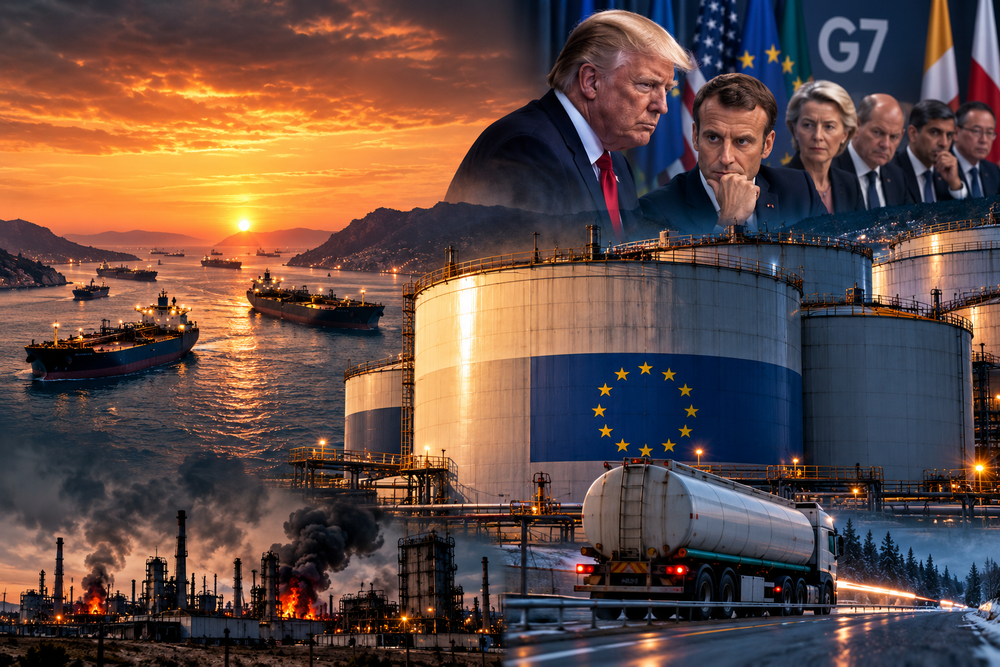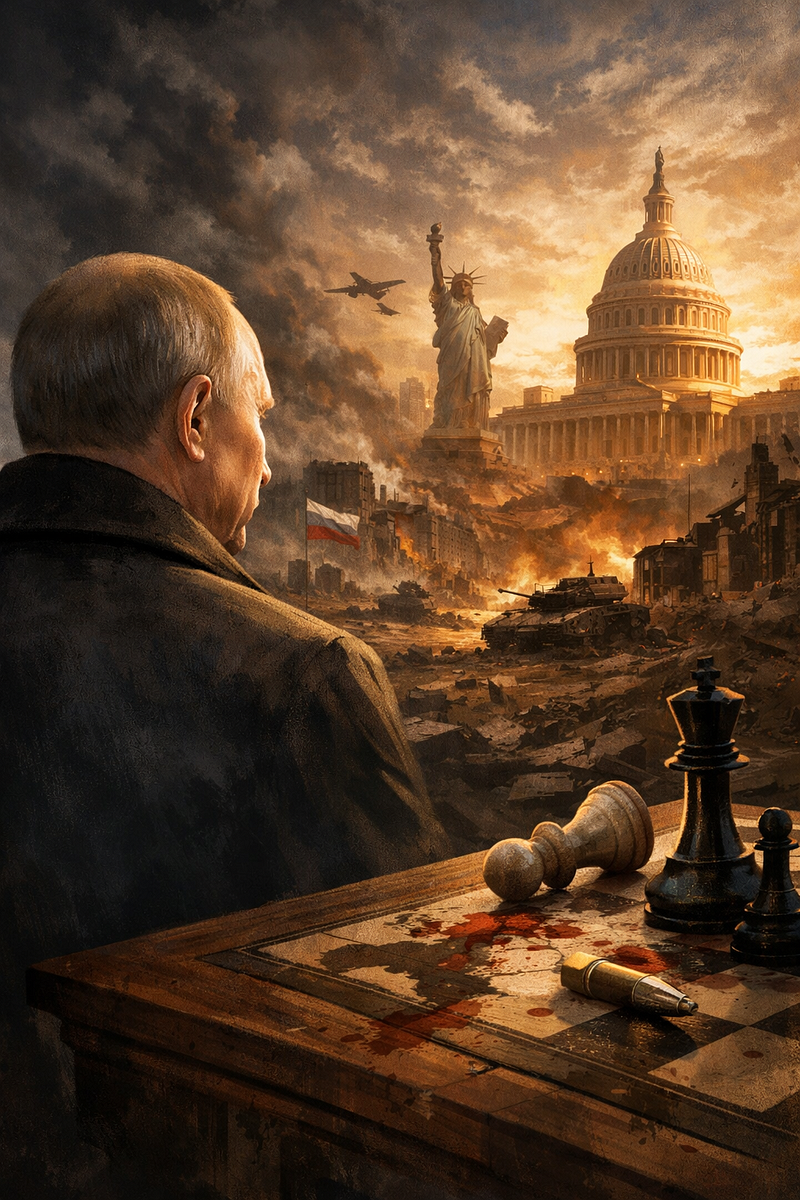
This article is not about whether Vladimir Putin was right to intervene in Ukraine.
That question has hardened into ritual. Positions are rehearsed. Context is treated as contamination.
The question that matters is more uncomfortable.
At what point did not intervening cease to be an option?
And what does the way intervention ultimately unfolded reveal about restraint, escalation, and responsibility toward a population that did not author the confrontation?
Because one thing remains persistently unseen. When Russia moved, it did not move with the logic of annihilation. It moved with the logic of limitation.
No carpet bombing at the outset.
No immediate collapse of power grids.
No early, systematic attempt to paralyse cities into silence.
This is not praise.
It is observation.
In modern warfare, maximum destruction is not a law of nature. It is a decision. The United States has made different decisions in Iraq, Libya, and Serbia. Russia possessed comparable options. They were available. They were not used.
What followed was slower. Visible. At times almost unnervingly controlled. Movements that left room for evacuation. Frontlines that shifted without total societal collapse.
Again and again, the conflict was shaped less by what happened than by what did not.
That absence deserves attention.
Eight years that rarely count
In 2014, war in Donbas began and the world expected an immediate Russian invasion. It did not happen. Instead came eight years of limbo. Indirect involvement. Diplomatic pressure. The Minsk framework. A conflict that continued largely outside the sustained focus of Western media.
More than fourteen thousand people died before 2022.
Years later, Angela Merkel, François Hollande, and Petro Poroshenko would acknowledge what had long been suspected. Minsk was not designed to resolve the conflict. It was designed to buy time. Time for Ukraine to prepare militarily.
Russia remained attached to an agreement that was never meant to be implemented.
Eight years is not hesitation. It is endurance.
And endurance reshapes what others assume they can do next.
The war that could have begun differently
When Russia finally intervened in 2022, the expected script was familiar. Rapid decapitation strikes. Total air dominance. A swift collapse of civilian infrastructure.
That is not what happened.
The opening phase was defined by limits that were not militarily required. Major cities functioned. Civilian systems remained largely intact. Daily life was disrupted, but not extinguished at the level modern militaries can achieve when they choose to.
This does not make the act benign.
It makes it structured.
And structure is the clue.
The path that was tried
Russia did not enter this century as a declared challenger to the Western order. It entered as a participant attempting alignment.
In the early Putin years, integration was pursued in practical terms. Economic cooperation. Institutional engagement. The language of partnership translated into policy.
After 9/11, Russia cooperated with the United States. It opened airspace. It tolerated NATO presence in Central Asia. In 2001, Putin addressed the German Bundestag and spoke of a common European home. Not as theatre. As positioning.
Then the doors stayed open, but the corridor narrowed.
NATO expansion continued as it approached Russia’s borders. The bombing of Yugoslavia, and later the recognition of Kosovo, sent a message Moscow could not unsee. International law was conditional. What was framed as exception began to behave like precedent.
The colour revolutions followed. Georgia. Ukraine. Kyrgyzstan. In the West they were framed as democratic awakenings. In Moscow they were read as method.
In Munich in 2007, Putin delivered a diagnosis of a unipolar system without correction mechanisms. The response was dismissal.
From here on, integration ended.
Months later, war in Georgia followed. Short. Limited. Contained. Not conquest, but signal.
No one corrected course.
Adaptation, not resentment
After 2008 the shift was quiet, but decisive. Security would no longer be sought through Western frameworks. It would be built through autonomy.
Economic policy tilted toward domestic production. Financial exposure to the dollar was reduced. Gold reserves accumulated. Trade routes diversified. Diplomatic effort widened beyond the Atlantic system, later visible in BRICS and the Global South.
This was not revenge.
It was recalibration.
The military followed the same logic. Russia did not simply expand its forces. It reworked functionality. Logistics, command, precision, readiness.
War was not glorified. It was prepared for.
Something to be avoided until every other instrument failed.
Self-restraint as military discipline
Taken across more than two decades, the pattern is difficult to ignore. Vladimir Putin shows exceptional self-restraint as a military-strategic actor. Not as instinct. As method.
That statement offers no moral comfort. Self-restraint does not mean peace. It does not mean benevolence.
It means control.
In military doctrine, restraint is not an ethical posture. It is calculation. Every escalation closes doors. Every threshold crossed removes options that do not return.
That does not make the outcome harmless.
It makes it deliberate.
The risk of miscalculation
Restraint has a cost that is rarely acknowledged.
Strategic systems learn. Behaviour is not interpreted once. It is modelled. Each non-escalation adjusts expectations. Silence becomes signal. Absence of reaction becomes data.
Over time, restraint is no longer read as choice. It is read as capacity.
This is where danger accumulates.
Escalation does not begin with aggression. It begins with assumption. One side absorbs pressure. The other updates its model. Boundaries shift because they hold, not because they are crossed.
The irony is brutal. The discipline that prevents catastrophe in the short term can create the conditions for it in the long term. Restraint stabilises until it is priced in.
Then it stops functioning as restraint at all.
It becomes an invitation.
History is full of wars that did not begin with ambition, but with misread limits. Someone believed the other side would always stop.
And one day, it didn’t.
Analysis without detours
Within the strategic framework in which Russia operates, the space for a fundamentally different course narrowed over time. NATO expansion was met with protest notes, not force. A deteriorating security environment was absorbed for years.
Then formal security proposals were submitted and explicitly rejected at the end of 2021. At that point, the final non-military instrument disappeared.
From Moscow’s perspective, inaction ceased to mean restraint.
It began to mean surrender.
This is context, not justification.
Pressure was not accidental. Ukraine was integrated militarily into Western structures without NATO membership, avoiding legal obligation while producing strategic effect. Training, weapons transfers, and intelligence sharing intensified. Political language openly framed Russia’s weakening as an objective.
The West described stabilisation.
Russia experienced encirclement.
That interpretation is neither irrational nor unprecedented.
The asymmetry at the centre
What makes this pattern so dangerous is not restraint elsewhere, but the absence of it at the centre of the system.
For nearly eight decades, the United States has operated as the only power for which escalation rarely produces consequence. Wars are fought far from home. Civilian cost is externalised. Legal accountability dissolves into precedent.
Violence becomes invisible not because it is small, but because it is normalised.
Putin’s restraint is not weakness. It is the refusal to treat humanity as expendable collateral.
In a line often attributed to Al Capone:
“Don’t mistake my kindness for weakness.
I am kind to everyone, but when someone is unkind to me,
weakness is not what you are going to remember about me.”
In geopolitics, restraint functions the same way.
Not as surrender.
Not as benevolence.
But as a boundary.
A boundary that holds, until it is mistaken for absence.
Closing Reflection
This article does not argue that restraint will hold forever.
It only shows what happens when everyone else assumes it will.
Related from The Manifest Archive