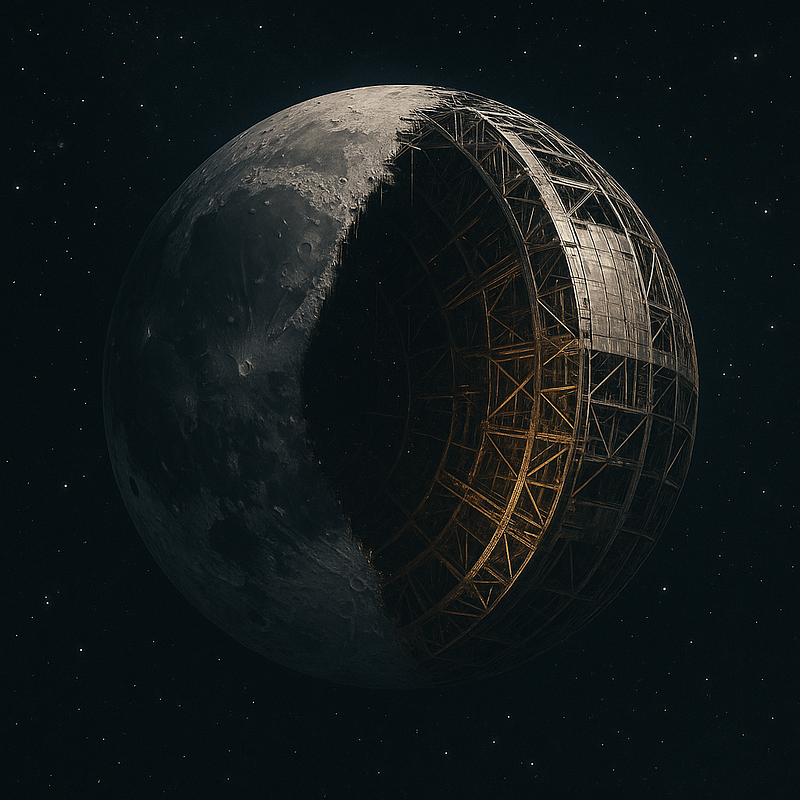
In November 1969, the crew of Apollo 12 did something deliberate and strange. On their way home they sent the empty ascent stage of their lunar module crashing back into the Moon at roughly six thousand kilometres an hour. It struck the surface and gouged a crater about nine metres wide. A seismometer the astronauts had left in the dust began to register a tremor. The tremor did not snap and fade the way a struck rock fades on Earth. It built slowly, peaked minutes later, and took close to an hour to die away.
The instrument had been left there precisely to do this. The impact was a calibrated source, a known hammer-blow struck near a microphone so that geologists could read how the shock travelled through the body of the Moon. The result surprised them anyway. And in the surprise, a single sentence was born that would outlive every paper written to explain it.
The Moon rang like a bell.
That sentence has since fathered a thousand videos, books, and late-night certainties. The Moon is hollow. The Moon is a shell. The Moon is an artificial station, towed into orbit and parked above us by intelligences who left it ringing like the instrument it secretly is. The strange part is not that people believe this. The strange part is where it begins. It begins with a fact that is entirely true. The seismometer really did record an hour of vibration. The reading is in the archive. You can find it.
This piece is about the distance between those two things. Between a documented anomaly and the story we drape over it. That distance is where almost all of the difference between revelation and delusion lives, and learning to measure it is, in the end, the only skill that matters.
The thing we were never meant to see is not on the Moon
The title is a promise the fringe makes constantly. Somewhere there is a thing you were never meant to see, and they will show it to you. A hidden interior, a sealed record, a photograph that was pulled from the press kit. The promise works because it flatters. It turns the reader into one of the few who looks past the curtain.
The honest version of the promise points somewhere else entirely. What we were never meant to see is not behind a curtain. It is the seam itself, the join between an anomaly that is real and the meaning we attach to it before the boring explanations have been defeated. The fringe theorist and the bored official both walk straight past that seam, in opposite directions. One drapes intention over everything. The other drains wonder out of everything. Both skip the only step that produces knowledge.
The step is a discipline, and it can be stated plainly. Before you are allowed to reach for intention, you must defeat the explanations that require none. An effect that looks designed has to survive a gauntlet first. Is it physics. Is it ordinary institutional behaviour, the reflex of any large body to file, soften, and move on. Is it the cost of complexity, the simple fact that hard things get abandoned when they stop paying. Is it inertia, the momentum of a system doing on Tuesday what it did on Monday. Only when an effect has walked through that gauntlet and come out the other side still unexplained are you permitted to ask whether someone meant it.
This is not scepticism for its own sake. It is the opposite of dismissal. The gauntlet is what lets you keep the real anomalies, because it strips away the ones that were never anomalies at all and leaves you holding only what genuinely resists explanation. The fringe never runs the gauntlet, which is why it drowns in false positives. The bored official runs only the first step and stops, which is why the genuine residue gets filed away with everything else. Run it completely, on the Moon, and watch what happens to each marvel in turn.
The bell that was a metaphor
Start with the ringing, because it is the strongest case and the one that built the whole mythology.
The fact is solid. After the Apollo 12 ascent stage hit, the seismic signal lasted nearly fifty-five minutes. Later impacts, including spent rocket stages dropped on purpose, produced the same long reverberation. On Earth a tremor of that kind would die in under a minute. The Moon held the energy and let it ring out. Scientists reaching for words said it behaved like a bell, like a gong, like a struck instrument. The metaphors were vivid, and the vividness is exactly where the trouble started.
The seductive reading is immediate. A bell is hollow. A gong is a shell. If the Moon rings, the Moon must be hollow, and a hollow Moon is a made Moon. The logic feels airtight because the metaphor did the reasoning before the reader noticed. This is worth naming precisely, because it is a move that recurs everywhere, far beyond the Moon. A word chosen to describe a thing quietly imports a whole theory of the thing. Bell imports hollowness. The reader inherits a conclusion disguised as a description.
Now the gauntlet. Why does the Moon hold seismic energy when the Earth does not. Because the Earth is wet, layered, and hot. Water, magma, sediment, and a fractured plastic interior all absorb and scatter a shock quickly. The Moon is none of those things near the surface. It is dry, cold, and shattered into a deep layer of broken rubble, the megaregolith, with no water to damp the waves and no sharp internal boundaries to swallow them. A shock entering that dry, scattering medium does not dissipate. It bounces, scatters, and reverberates, a little like a sound in a long stone corridor. The long ringing is not evidence of a shell. It is evidence of dryness. It is, if anything, the signature of a body with no oceans and no living interior, which is to say a very ordinary dead world.
The bell survived the first sentence of the gauntlet and died on the second. And notice what actually fooled people. Not the data. The data was correct and remains correct. The metaphor fooled them. A measurement says forty-five minutes of reverberation in a dry scattering medium. A metaphor says the Moon is an instrument. They are not the same statement, and the gap between them is the whole con.
Where the hollow Moon was born
The hollow-Moon idea is not internet folklore without parentage. It has a precise birth date and named authors, and tracing it shows the metaphor doing its work in real time. In 1970, two Soviet writers, Mikhail Vasin and Alexander Shcherbakov, published an article in the popular-science magazine Sputnik under a title that asked the question outright: is the Moon the creation of alien intelligence. They gathered exactly the anomalies above, the long reverberation, the depth ceiling of the craters, the improbable neatness of an orbit that steadies Earth's tilt and tides, and proposed that the simplest way to fit them together was to assume the Moon was not natural at all, but a hollowed, armoured body deliberately parked overhead.
It is worth being fair to them, because the gauntlet is not a way of feeling superior. They were not lazy thinkers. They had noticed real things, and they had noticed something else that was also real: that the official explanations arrived piecemeal, one anomaly at a time, never assembled into a single satisfying account. That observation is not stupid. It is the same instinct that drives good investigation, the suspicion that a pile of separate small explanations may be concealing a missing large one.
Their error is the exact one the gauntlet exists to catch. Faced with several anomalies that each already had a dull, separate, sufficient cause, they reached past all of them for one dramatic cause that would explain everything at once. A theory that explains everything is seductive precisely because it spares you the labour of explaining each thing on its own terms. But the dry crust, the gravity ceiling, and the levitating dust do not need a single author. They are different ordinary facts about a dead, dry world that happen to lie near one another. The unifying author was not discovered in the data. It was imported by the same bell that started everything, and once imported it made every later anomaly look like one more rivet in a hull.
The craters that obey gravity, not armour
The second marvel is the craters, and it follows the same arc.
The observation is real and was confirmed by precise modern mapping from the Lunar Reconnaissance Orbiter. Across the Moon, as craters grow wider they stop growing proportionally deeper. Past a certain size the floor flattens, the walls slump into terraces, and a peak often rises in the centre. The depth seems to hit a ceiling it will not cross.
The seductive reading writes itself. Something down there is stopping the holes. A buried shell. Armour. Plating beneath the dust that the impacts cannot punch through. Each crater ends where it should not, as though it struck a floor that was put there.
The gauntlet again. There is a floor, and it has a name, but it is not metal. It is gravity. On any rocky world, small impacts leave simple bowl-shaped pits, but above a transition size the rock can no longer hold a deep bowl open against the pull of the planet itself. The walls collapse inward, the floor rebounds upward into a central peak, and the crater spreads wide and shallow instead of deep. The size at which this switch happens depends on the world's gravity, and on the Moon it falls somewhere around fifteen to twenty kilometres across. Smaller bodies switch at larger sizes, larger bodies at smaller ones, in a clean relationship to surface gravity that holds across the Solar System. The Moon's craters stop deepening for the same reason a sandcastle cannot be built past a certain height. The material gives way under its own weight.
So the armour is gravity, and the giveaway is universality. A buried shell would be a property of the Moon. The depth ceiling is a property of every cratered world, scaled exactly to its gravity. An explanation that has to be invented separately for the Moon loses to one that was already explaining Mercury, Mars, and the asteroids before anyone looked up. The pattern that felt like intention was the most ordinary physics there is, made to look sinister only by describing it as armour.
The lights that are still half a mystery, and why that is allowed
The third marvel is the one the gauntlet does not fully clear, and it is the most instructive of the three.
The Moon flickers. Observers have reported brief glows, reddish patches, hazes, and star-like flashes on its surface for centuries. In 1968, NASA gathered these reports into a single document, Technical Report R-277, the Chronological Catalog of Reported Lunar Events. It collected about five hundred and seventy sightings stretching back to the year 1500, and the British astronomer Patrick Moore, one of its authors, gave the phenomenon its enduring name, Transient Lunar Phenomena. The reports were not made by cranks alone. Trained astronomers logged them. The crew of Apollo 11, asked from the ground to look at the crater Aristarchus on their way to the Moon, radioed back that the region seemed noticeably more illuminated than its surroundings.
The seductive reading is the most dangerous of the three, because lights happen in the present tense. A crater is ancient. A reverberation is mechanical. But a flash is now, and now implies activity, and activity implies something doing the flashing. Life. Machines. Signals. A world that was supposed to be dead, blinking.
Run the gauntlet. Most Transient Lunar Phenomena have ordinary candidate explanations. Some are almost certainly effects in our own atmosphere or in the telescope, not on the Moon at all. Some are likely outgassing, small releases of gas from below that briefly disturb the dust. Some may be sunlight catching electrostatically levitated dust at the terminator, the line between lunar day and night. Some are observer error, or the eye inventing structure at the limit of resolution. The candidates are mundane and they cover most of the catalogue.
But not all of it. A residue of well-attested sightings remains without a settled explanation. And here is the part that the fringe cannot tolerate and the bored official will not say aloud. That residue is allowed to exist. Unexplained is a legitimate, stable, scientific category. It is not a waiting room for a preferred answer. The fringe treats every open question as a door, and behind the door is always the same thing it wanted to find. The discipline treats an open question as a destination, a place you are permitted to stand without rushing through it. The lights are partly explained, partly not, and the honest sentence is exactly that long. Adding aliens does not shorten the mystery. It abandons it.
This is the rule that separates analysis from belief, and it is worth stating in its own right. Absence of an explanation is not evidence for your explanation. The gap is not a clue pointing at your suspect. It is just a gap, and the work is to leave it open and accurately sized rather than to fill it with the most exciting available tenant.
There is a bitter irony folded into that residue, and it is the first hint of where this piece is really going. The unexplained sightings are the part of the catalogue most worth studying, the only part that might still teach us something new about the surface of the Moon. They are also the part that has become almost impossible to study, because the topic has been so thoroughly colonised by the hollow-Moon crowd that a working astronomer who proposed a serious programme on Transient Lunar Phenomena would have to spend half the proposal explaining that no, this is not about aliens. The genuine question and the fantastic one have been welded together in the public mind, and the weld is load-bearing. It keeps the real question too embarrassing to fund. Hold that thought, because it is the mechanism the rest of this piece is about.
After the gauntlet, the better question
So the marvels fall, two of three completely and the third into its honest, half-lit shape. The hollow Moon is dead. The armour is gravity. The lights are mostly dust and air and partly an open question. A confident debunker would stop here, brush off his hands, and file the whole subject under nonsense.
That is the second mistake, and it is the more interesting one, because it throws away something real.
The fringe was wrong about what is hidden. It was not wrong that something is off. Go back to how each of these facts actually reached the public. The fifty-five minute reverberation went into a technical seismology report. The depth ceiling went into crater morphometry tables. The five hundred and seventy lights went into R-277 and then into the archive. In every case the anomaly was recorded with care and then, in the public-facing story, quietly drained of its strangeness. The press releases spoke of a conquered Moon, a measured Moon, a Moon reduced at last to fact. The wonder was real, the data was real, and the wonder was managed out of the data on the way to the public.
This is the seam. Not suppression. Softening. The records were never sealed. They were left fully open and made boring, which works better than locking them away ever could.
And that reframes the entire subject. The thing worth investigating was never the interior of the Moon. It is the machinery that decides which parts of a public record get to keep their wonder, and which get filed where curiosity will not follow. The Moon is the easy half of the story. The hard half is us.
How a public record stays unread
Notice what is doing the hiding here, because it is not a vault.
Everything is downloadable. The seismograms are archived. R-277 sits on a public server. Artemis flies on a budget argued over in open hearings. There is no lock anywhere in this story. And yet the anomalies function, for most people, exactly as if they were secret. They are invisible not because they are concealed but because they are uninteresting in the form they were left in, and because asking about them carries a social cost.
That cost is the real mechanism, and it deserves to be named exactly. The most effective way to bury a true anomaly is not to classify it. It is to make curiosity about it socially expensive. Attach the question to a discredited identity, the hollow-Moon believer, the man with the laser pointer and the YouTube channel, and no serious person will go near it. The stigma does the filing that the censor never had to do. A scientist who wants to study the unexplained residue of Transient Lunar Phenomena has to first climb over a mountain of nonsense that has colonised the topic, and risk being mistaken for part of it.
Here is the quiet collaboration that almost no one notices. The fringe and the gatekeeper need each other. The wilder the hollow-Moon claim becomes, the easier it is to wave away the seismograph along with it. Every overreaching video about an artificial Moon makes the genuine, modest anomaly a little more untouchable. The extravagant lie is not the enemy of the dull dismissal. It is its partner. Between them they guarantee that the real, half-lit question in the middle, the one that is neither a hoax nor a revelation, never gets the patient attention it would actually reward.
This is the layer the fringe sensed and misnamed. It felt the management and called it a cover-up, because a cover-up is a shape the mind can hold. A villain sealing a vault is a story. The truth has no villain and no vault, which is precisely why it is harder to see and harder to fight. There is only a record nobody reads, an anomaly nobody finishes, and a reflex, shared by institutions and audiences alike, that treats settled-sounding as the same thing as understood.
It is worth slowing down on how a visible fact becomes an invisible one, because the conversion is so smooth that it leaves no trace. A finding is published. A press release summarises it in the register of solved problems, the Moon measured, the mission a success. The summary travels, the finding does not. A year later the finding is old, and old is filed, and filed is forgotten, and forgotten is indistinguishable, from the outside, from never having existed. At no point did anyone hide anything. Each step was ordinary and defensible on its own. The result is concealment without a concealer, produced entirely by the normal metabolism of attention. Familiarity is the most powerful redaction tool ever built, and it requires no authority to operate it. You cannot file a freedom-of-information request against the assumption that a thing is boring.
And once you have seen the move on the Moon, you cannot stop seeing it. The same metabolism processes far larger and far more consequential things than lunar seismograms. The most stable structures of public life are not the secret ones. They are the ones so completely visible that they have stopped being questions at all, the institutions and arrangements that everyone can see and almost no one examines, precisely because their visibility reads as a kind of proof. We will return to that. For now, hold the smaller version: the Moon's anomalies are not hidden. They have simply been made too familiar to look at, which works better than hiding ever could.
Three generations of the same question
It helps to see why this is a different kind of question rather than a softer version of the old one.
The first thing the Moon stories ask is what happened. The Moon rang. The craters flatten. The lights flickered. That is the level of the event, and it is where most curiosity begins and ends.
The second thing asks what mechanism produced it. A dry scattering crust. Gravity and the strength of rock. Outgassing, dust, and the limits of a telescope. This is the level the gauntlet operates on, and clearing it is real work that most accounts never do.
The third thing is the new one, and it only becomes available once the first two are settled. It asks why the gap between the data and the public story felt normal to everyone living inside it. Why a fifty-five minute reverberation could sit in a public archive for half a century, factually available and practically invisible. Why the people who noticed were so easy to dismiss, and who, exactly, gets to decide which curiosity is respectable and which is embarrassing.
That third question is the most powerful, and it is also the most dangerous, which is why it comes last and not first. It is dangerous because it can be reached too early, as a shortcut, by skipping the work. A piece that asks only why people found something normal, without first establishing what happened and which mechanism caused it, is not analysis. It is mood. The ladder is a sequence, not a substitution. The third rung holds weight only because the first two are standing under it. Take them away and the whole thing is just suspicion with better vocabulary.
But put them in order, and the third question opens a door the first two never could. Because most of what governs a society is not hidden at all.
What is visible is what goes unexamined
This is the rule the Moon teaches, and it is far larger than the Moon.
The fringe spends its life hunting for the concealed. The sealed file, the buried base, the redacted page. And the hunt is not crazy. Concealed things exist. But the supply of genuinely hidden things is finite, and most of what shapes our world was never hidden in the first place. It is sitting in the open, fully visible, and therefore never made into an object of study. We do not examine it because we long ago stopped seeing it as a thing that could be examined. It has become furniture.
The Apollo seismic archive is furniture. It is right there, and almost no one has ever opened it, because the press release told us the Moon was a solved problem and we believed the framing rather than the data. The framing, not the data, is what we were never meant to inspect. The most reliable concealment in the modern world is not the lock. It is the label that says nothing here is worth your time, applied to something that is sitting in plain view.
And that is a vastly larger field of investigation than every classified programme combined. The black vault holds a finite number of secrets. The open record holds an almost unlimited number of unexamined assumptions, each one made invisible not by a guard but by familiarity. The deepest thing we were never meant to see is rarely a hidden object. It is the visible thing we were trained to look past.
This is a lens, and it has to be held with discipline, or it becomes the very thing it warns against. Pointed carelessly, the move from hidden to visible-but-unexamined can be used to manufacture suspicion about anything at all, since everything visible can be described as suspiciously unexamined. That is the trap, and the gauntlet is the way out of it. The visible thing is only worth examining once you can name a specific anomaly inside it that survives the boring explanations, the way the seismic residue survives them. No documented anomaly, no investigation, just a vague unease dressed as insight. The discipline that protected us from the hollow Moon is the same discipline that protects this larger claim from collapsing into paranoia. You earn the right to ask why something visible goes unexamined only after you have found, in the open record, a specific thing that does not fit and cannot be waved away. The Moon earned it. Most conspiracy theories never do, which is exactly why they reach for the hidden vault instead. The vault excuses them from finding the anomaly first.
The fifty-year silence, run through the gauntlet
Test the discipline one last time, on the fact the original telling treated as the most sinister of all.
No human had set foot on the Moon since December 1972. For more than fifty years, the story went, we simply stopped, and the stopping must mean something. We can photograph galaxies at the edge of time and send probes past the rim of the Solar System, yet we abandoned the one world close enough to touch. Surely we were warned off. Surely we found something.
Run the gauntlet. Apollo was not an exploration programme. It was a Cold War demonstration, built to beat the Soviet Union to the surface, and once that was done the most expensive part lost its reason to exist. Each later landing cost a fortune and returned diminishing political value. The programme was cancelled not by a warning but by a budget committee, which is a far more powerful force than any warning. Nobody went back because no goal survived contact with the cost. And the silence has now, quietly, ended in exactly the shape this explanation predicts. In April 2026, Artemis II carried four astronauts around the Moon and home again, the first crewed return to lunar space in over half a century. It landed no one. It was a flyby, a careful, costly first step, fought for line by line in public.
The fifty-year gap is real, and its explanation is mundane, and the mundane explanation is the more unsettling one if you sit with it. We did not stop because we were forbidden. We stopped because wonder is expensive and lost its budget line. No villain closed the Moon. We simply stopped paying attention, and called the silence a conclusion. That is not a story about what was hidden from us. It is a story about what we declined to keep looking at, which is the same lesson the bell and the craters and the lights have been teaching all along.
What would have to be true for the fringe to be right
Honesty requires building the strongest version of the case against this reading, not the weakest.
Here is the steelman. You have conceded a great deal. You admit the anomalies are real. You admit a residue of the lights remains genuinely unexplained. You admit the records were softened on the way to the public, and that stigma keeps real questions untouchable. At what point, a sharp critic asks, does managed wonder become indistinguishable from suppression. If the effect is the same, the public never engages with the data, why insist on the gentler word.
The answer is that the difference is not rhetorical. It is testable, and it points to specific facts that would flip the conclusion. Suppression hides the data. Management leaves it in full public view and lets familiarity and stigma do the rest. The test sits in the open record. The seismograms are archived and downloadable. R-277 is published and has never been withdrawn. The Aristarchus transcript exists and can be read. Artemis flew on a published budget. Nothing in this story is locked, and that is not a small detail. It is the whole load-bearing distinction.
Which means the reading is falsifiable, and it is worth saying exactly how. If the Apollo seismic archive turned out to be classified, if R-277 had been quietly pulled from circulation, if the Aristarchus exchange were missing from the transcript, if independent re-analysis made the long reverberation vanish, then this would no longer be a story about managed wonder. It would be suppression, or the anomaly itself would dissolve, and either way the analysis here would have to be torn up. The argument lives or dies on the records staying open and the anomalies staying real. They are, and they do. That is what keeps this forensics rather than faith.
What we were never meant to see
So return to the title, which turns out to be a trap the piece springs on itself.
The fringe reads it one way. We were never meant to see the secret inside the Moon, the shell, the maker's mark. That reading is false, and proving it false took only the gauntlet, run patiently three times.
The truer reading is duller and far larger. We were never meant to see that there is no secret to see. That the marvel was a metaphor, the armour was gravity, the lights were mostly dust, and the silence was a budget. And that beneath all of it sits the thing actually worth our attention, which was never on the Moon at all. It is the machinery of attention itself, the reflex that catalogues a wonder and then files it where no one will look, the stigma that punishes anyone who lingers, the quiet agreement between the fabulist and the gatekeeper that keeps the modest, real, half-answered question forever out of reach.
What looks hidden was left in the open. What was left in the open is what stays hidden. The Moon was never the thing we were not meant to see. The thing we were not meant to see is how we decide what is worth seeing, and that decision is made every day, in full view, by no one in particular, which is exactly why it works.
The Moon is not waiting for us to discover its secret. It is waiting, as it has for half a century, for us to read what we already wrote down.
Evidence Map
Facts, interpretations, forecasts, and disconfirming signals.
Core claim. The Moon's famous anomalies are real but mundane once tested against ordinary physics and institutional behaviour. What was genuinely "never meant to be seen" is not a hidden Moon but the machinery that catalogues a public anomaly and then lets familiarity and stigma file it where curiosity will not follow. The deepest concealment is a visible record made too boring, and too embarrassing, to read.
Evidence level. Facts (high): the Apollo 12 ascent-stage impact and roughly fifty-five minutes of seismic reverberation; the simple-to-complex crater transition near fifteen to twenty kilometres under lunar gravity; NASA Technical Report R-277 (1968) cataloguing about five hundred and seventy reported lunar events from 1500 to 1967; Artemis II's crewed lunar flyby, with no landing, in April 2026. Interpretation (medium, marked): the dry-crust, gravity, and outgassing explanations are correct, with a residue of Transient Lunar Phenomena still genuinely open. Interpretation (medium, marked): the gap between data and public story is produced by managed attention and social stigma, not by suppression.
What would confirm this. Continued public availability of the Apollo seismic archive and R-277; serious anomaly research remaining rare while the data stays open; the unexplained residue of lunar lights shrinking under ordinary mechanisms as instruments improve.
What would disprove this. Classification or withdrawal of the seismic archive or R-277; a missing Aristarchus transcript; independent re-analysis dissolving the long reverberation; or a lunar anomaly that survives the full gauntlet and resists every non-design explanation. Any of these would move the story from managed wonder back toward either suppression or genuine mystery.
Watchlist. Future Artemis missions and any crewed landing (the first crewed landing is currently slated for Artemis IV in 2028, after a 2026 rescheduling); new Transient Lunar Phenomena studies and whether stigma keeps them unfunded; how the public record of old anomalies is curated, surfaced, or buried as archives move online.