Introduction | The thought that came from the fog
The jungle and the pulse of light
The screen showed only green. An endless canopy stretched to the horizon, a wall of leaves and branches so dense that nothing else existed. A drone hovered above, its camera helpless before the thickness of the jungle. To the eye, there was no pattern. No path. No structure. Only a wilderness without end.
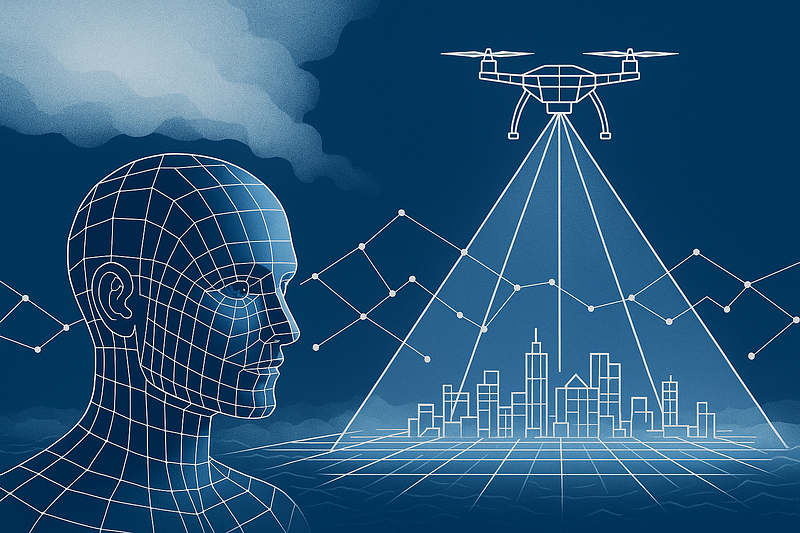
Then came the pulses. LiDAR, light detection and ranging, sent invisible lasers downward. Each pulse struck the canopy, the trunks, the ground beneath, and returned. In the rhythm of those returns, the image changed. The jungle dissolved into points of light, the surface peeled away, and hidden beneath the trees appeared the ghost of a city. Streets aligned, plazas emerged, stone walls traced themselves into existence. What was invisible became architecture. What was forgotten became present.
It was a moment both eerie and beautiful. Technology did not invent the city. It revealed what was always there, hidden in plain sight.
And I thought of geopolitics.
The canopy of headlines
Our daily view of politics resembles that jungle canopy. We see the surface, leaders giving speeches, ministers shaking hands, missiles exploding on television screens, stock markets rising and falling. But beneath the canopy lies another map: the flows of resources, the bargains behind the speeches, the contracts signed in shadows.
Most of us never see that terrain. We live among headlines and images, surfaces bouncing back like leaves. And yet the structures are there: pipelines, treaties, supply chains, debts, and covert alliances. They do not vanish because they are hidden. They vanish because we lack the instrument to reveal them.
What if artificial intelligence could be that instrument? What if AI could serve as LiDAR for power?
The metaphor of LiDAR
LiDAR is not a camera. A camera records the light reflected from surfaces, preserving appearances. LiDAR sends out pulses and measures the time they take to return. In that delay lies depth. Hills rise, valleys fall, ruins reappear.
It does not paint. It scans. It does not flatter. It reveals.
“LiDAR does not tell stories. It reveals structures.”
The metaphor is powerful. AI could send pulses through the fog of propaganda, measure the echoes, and return with a contour map of power. Wars would no longer be headlines but lines of force. Markets would no longer be numbers but networks. Alliances would no longer be slogans but geometries.
AI could reveal what empires conceal.
The question in the fog
Yet the question hangs like mist: why doesn’t it? If AI could serve as LiDAR for geopolitics, why is it not used this way? Why does it echo the canopy rather than pierce it? Why do we hear the repetition of official stories rather than the revelation of hidden structures?
This is the paradox. The very tool that could scan through fog has been captured by those who produce the fog.
The promise of AI
Mapping the hidden war
Imagine Ukraine not as a torrent of daily headlines but as a scanned terrain. On the surface: footage of tanks, speeches in parliaments, casualty counts, hashtags. But beneath the canopy, a LiDAR-style map emerges. NATO deployments appear as invisible lines of force across Eastern Europe. Pipelines stretch like arteries, pumping dependence into economies. Defense contracts cluster as glowing nodes of profit, each missile launch mirrored by a spike in stock prices.
A true scan would not show rhetoric. It would show geometry.
The war would be revealed as a structure of logistics and finance, not just flags and slogans. The narrative of “freedom versus aggression” would dissolve into supply chains of oil, gas, and weapons. AI, if used as LiDAR, could give us not the story of the war but its architecture.
“Empires tell stories. A true scan reveals scaffolding.”
The arteries of economy
Now shift the lens to global markets. The dollar appears not as a symbol but as a gravitational center. Trade routes pulse like veins across oceans. BRICS summits, often treated as obscure, emerge as tectonic plates pressing against that center. Sanctions glow on the scan as pressure points, their leaks forming hidden rivers of smuggling and survival.
What looks to the surface eye like economic noise becomes visible as structure: flows of grain, shipments of microchips, reserves of gold. The battlefield of finance is not chaos but pattern, if only we had the instrument to see it.
The echo of propaganda
AI could also trace language itself. A phrase coined in Washington, rules-based order, appears on the scan as a pulse. It bounces through Reuters, amplified by AP, repeated by newspapers in London and Paris, echoed by broadcasters in Sydney and Tokyo. Within weeks it is spoken in living rooms across continents.
Another phrase, unprovoked invasion, follows the same path. Its geometry becomes visible: a network of repetition that transforms narrative into truth.
AI as LiDAR could reveal not just what is said, but how it spreads. Not content, but contagion.
“Propaganda is fog. A scan reveals the machinery inside the mist.”
The map of climate conflict
The promise extends beyond war and propaganda to the terrain of climate and survival. On the surface, we see droughts, floods, fires, random disasters. On the scan, rivers of cause emerge: energy contracts tying Europe to Russian gas, rare-earth mines binding Africa to China, carbon markets shaping policies in Brussels.
Refugee flows appear as streams of light across continents, water shortages as pressure points, Arctic shipping lanes as new arteries. Climate, too, is geopolitics. And its map is hidden in the fog of isolated headlines.
A vision of the possible
Artificial intelligence, if liberated, could make such scans. It could reveal connections, flows, and architectures invisible to the naked eye. It could dissolve the canopy of noise into the skeleton of power.
But instead of piercing the fog, AI often deepens it. Instead of being LiDAR for politics, it is trained to be the camera of empire. Repeating surfaces, not revealing depths.
“The promise of AI is the scan. The tragedy is the repetition.”
The distortion of the lens
Bent before the light
LiDAR cannot lie about the distance between a pulse and a tree. The beam travels, returns, and geometry is revealed. Artificial intelligence is different. It does not measure reality directly. It learns from data, and data is never neutral. Every dataset is a choice, every filter a decision, every algorithm a mirror of the hand that designed it.
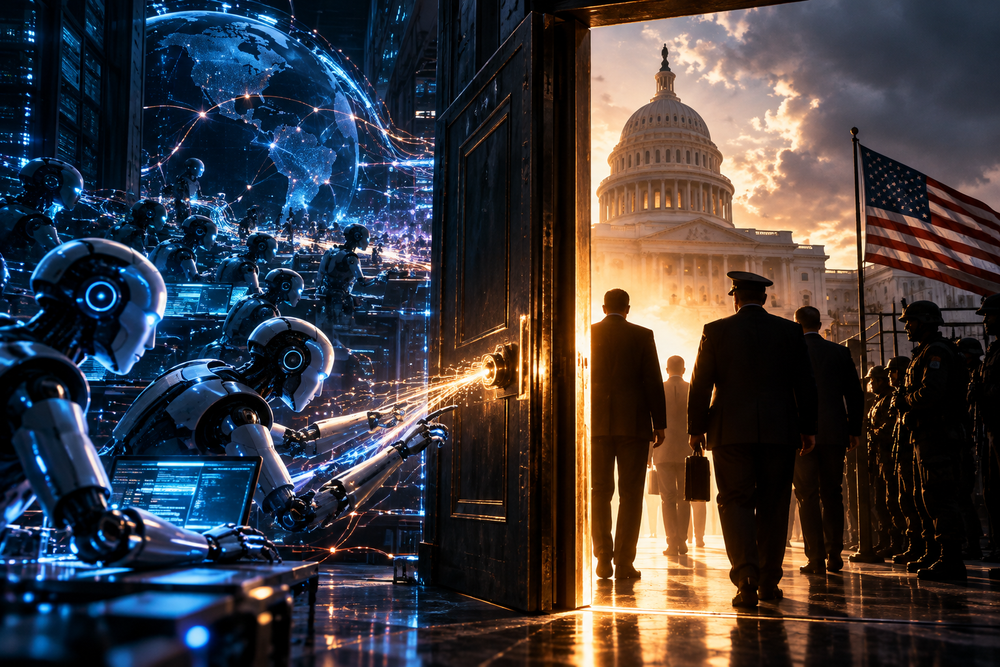
The promise of AI as a scanner of power collides with its reality as an instrument of power. Instead of cutting through propaganda, it is trained on propaganda. Instead of mapping the world as it is, it projects the world as elites want it seen.
“The map is drawn not by the landscape, but by the hand that holds the scanner.”
American filters
An AI built in Silicon Valley inherits the priorities of its funders. Ask it about a war, and it will echo Pentagon press releases. Ask it about economics, and it will speak the language of Wall Street. Datasets are scraped from media that already amplify Western narratives. The result is a machine that reflects the surface of empire while claiming to scan beneath it.
A rebel fighting Western allies becomes a terrorist. The same rebel, fighting Western enemies, becomes a freedom fighter. These are not objective classifications. They are choices embedded in training material, reinforced by repetition, and sanctified by code.
Chinese mirrors
In Beijing, the distortion bends another way. AI systems trained on Chinese data inherit the state’s censorship and priorities. Taiwan disappears from maps, Tibet is reframed as harmony, criticism of party leadership dissolves into silence. The scan is not geometry but choreography: an arrangement of reality according to the needs of the state.
Both systems claim neutrality. Neither provides it. The distortion is symmetrical, though the directions differ.
Europe’s paradox
Europe prides itself on ethics and frameworks. It issues guidelines, white papers, regulations. Yet the technology itself is imported, from California or Shenzhen. Europe governs the language of morality while outsourcing the architecture of power.
The result is paradoxical: European citizens are told they are protected by ethical AI, while the instruments they use are shaped elsewhere. The continent that once drew the maps of empire now negotiates the terms of visibility with powers that own the scanners.
Big Tech as geopolitics
We speak of Google, Microsoft, Baidu, OpenAI as companies. But they are also geopolitical actors. Their models are infrastructure, their servers are territory, their datasets are resources. Governments lean on them not as vendors but as allies and adversaries.
In the twenty-first century, corporations are not merely private. They are para-states. And their AI models are the new cartographies, defining what is visible, what is invisible, and what is forbidden to ask.
“The scanner has become empire’s mirror. The promise of vision is consumed by the power of reflection.”
The history of distorted vision
Maps as empire
In the sixteenth century Gerardus Mercator drew a world that has shaped our imagination ever since. His projection turned a round earth into a flat map, exaggerating the size of Europe, shrinking Africa, minimizing South America. The distortion was not error but strategy. By inflating Europe’s presence on the page, the map affirmed its place in the world. Cartography became not a mirror of geography but a claim of sovereignty.
“Every map is a declaration of power disguised as geometry.”
Mercator’s projection still hangs in classrooms and textbooks. Children absorb the world distorted, learning that Europe is larger than it is, that the Global South is smaller than it is. The projection endures because the distortion serves the order that sustains it.
Telescopes and silence
Centuries later, Galileo lifted a telescope to the sky. He saw moons orbiting Jupiter, stars invisible to the naked eye. His glass revealed what theology had not prepared for: a universe wider than dogma.
Yet his discoveries were treated not as revelation but as heresy. They were reframed, suppressed, absorbed into doctrine only when control could be assured. The instrument that widened vision was bent into submission. Galileo gave us clarity, but power demanded silence.
Cold War satellites
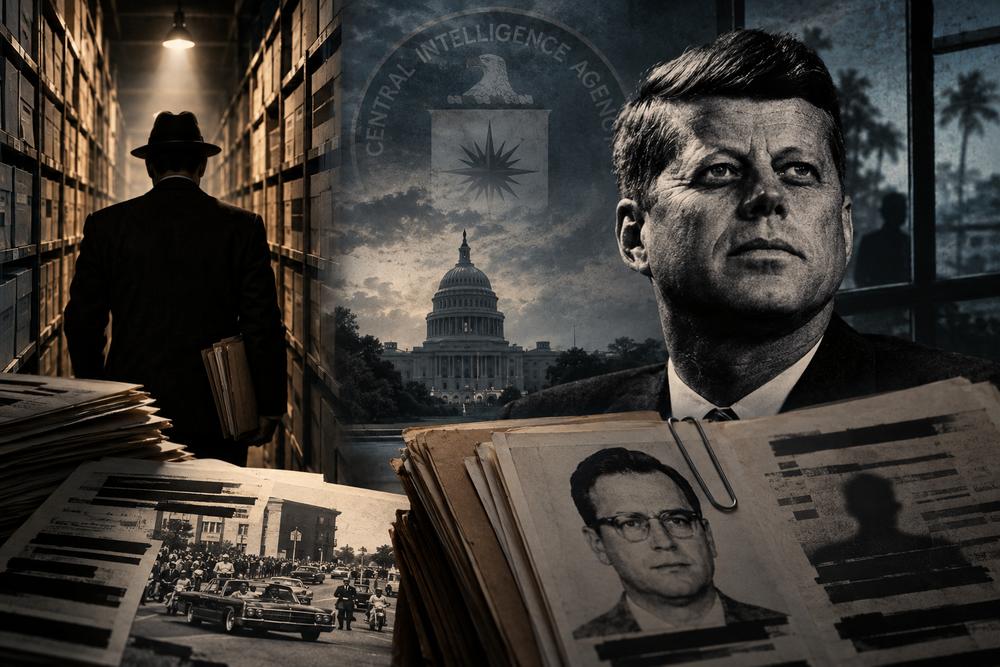
In the twentieth century the sky filled with machines. Satellites scanned the earth with radar and infrared, mapping missile silos, tracing heat signatures, charting fleets and troop movements. The data could have revealed the world in detail to everyone. Instead, it was classified.
The public saw only fragments: grainy black-and-white photos of Soviet launch sites presented at the United Nations, propaganda images of missile gaps and nuclear superiority. The real scans remained locked in vaults, transformed from knowledge into intelligence, from public truth into private leverage.
Technology revealed too much. Power decided how much could be shown.
The new cartographers
The Cold War ended, but the pattern endured. Data-gathering instruments multiplied, radars, satellites, drones, fiber-optic taps, social media scrapers. Each promised vision. Each was filtered before it reached the public.
In 2016, the name Cambridge Analytica surfaced. A company claimed to know voters better than they knew themselves, mapping psychological terrain from Facebook likes and online traces. What was sold as insight became manipulation. The lens did not show reality. It bent it to influence behavior.
LiDAR’s dual life
Even LiDAR itself carries this paradox. Archaeologists use it to uncover lost cities in the forests of Central America. At the same time, militaries use it to guide drones through mist, to target convoys invisible to the human eye.
The same pulse of light that reveals forgotten temples in Honduras also directs weapons in deserts. Every instrument that reveals can also kill. Every lens is a choice, every map a claim.
“No instrument is ever neutral. Each revelation is also a concealment, each vision a weapon.”
The future scan | what the fog may conceal
A map of 2035
Imagine the year 2035. Not headlines, but a LiDAR scan of geopolitics. Lines of force spread across the globe. Arctic shipping lanes glow as new arteries where ice has retreated. Water scarcity appears as bright fractures in Africa, the Middle East, and parts of India. Refugee streams shine as threads across continents, moving not randomly but along paths of drought and conflict.
Digital currencies pulse as invisible rivers, China’s e-yuan spreading through Asia and Africa, America’s digital dollar pulsing across financial networks, Europe struggling to catch up. AI itself appears on the scan as nodes of concentrated computation, glowing in Silicon Valley, Shenzhen, and a handful of hidden data centers under Arctic soil.
The map shows what the eye cannot: empires reshaped not by battles but by bandwidth, not by borders but by algorithms.
The architecture of energy
Energy patterns become the skeleton of the world. Green grids glow across Europe, tethered to North African solar fields. Oil remains a dense light in the Middle East, though dimmer. Nuclear stations cluster like stars in Asia. Every energy choice is not only environmental, it is geopolitical. A scan in 2035 would reveal not nations but networks of dependency.
The shadow of war
Wars, too, would appear differently. Not just missiles and tanks, but supply chains, contracts, algorithms of targeting. Invisible to the camera but clear on the scan: how every strike resonates in stock markets, how every speech is amplified by automated propaganda, how every negotiation bends data flows as much as borders.
“The war of the future will not only be fought in trenches, but in patterns.”
Closing reflection | the architecture beneath
AI could give us this vision. It could serve as LiDAR for the geopolitical landscape, revealing what lies beneath the canopy of headlines. It could dissolve propaganda into scaffolding, slogans into coordinates, fog into architecture.
But it does not. Because the scanner is owned. Because the lens is bent before the light enters. Because neutrality is never granted, only claimed.
The promise of AI is revelation. Its tragedy is capture.
The jungle remains above us, green and impenetrable. Occasionally the canopy parts, and we glimpse the outlines of forgotten cities, supply chains, contracts, alliances, networks. But the full map remains withheld.
“The promise of AI is LiDAR for truth. The tragedy is that it has been taught to scan only what empire allows.”
The closing pulse
Every age invents instruments to see further. Maps, telescopes, satellites, lasers. Each reveals, each distorts, each becomes weapon and witness. AI is our latest lens, our newest scanner. Whether it will serve as empire’s mirror or humanity’s LiDAR remains unwritten.
And perhaps the silence we hear now, AI repeating the canopy rather than revealing the roots, is not the end of the story but its beginning. For the structures remain, waiting to be seen.
What is hidden in the fog does not vanish. It waits for the pulse of light.
Related from The Manifest Archive