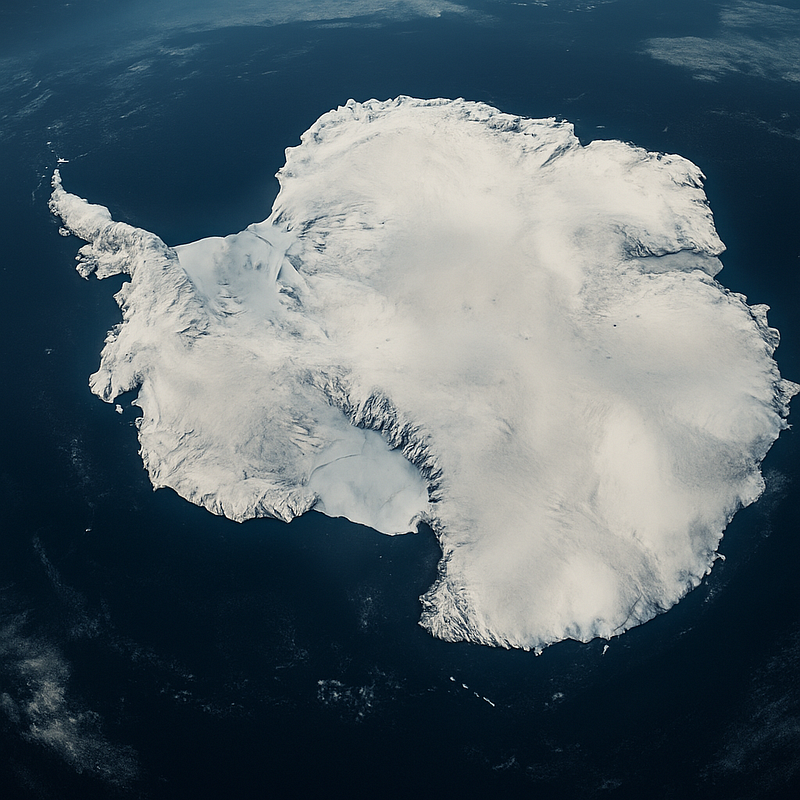
Seven nations have planted flags in Antarctica, three of them in the same wedge of ice, on territory each insists is its own and the other two refuse to recognize. Beneath the ice, by the estimates that circulate, lie minerals and hydrocarbons. Above it, through the second half of the twentieth century, two superpowers conducted a global rivalry that turned almost every other empty space on the planet into a contested frontier, from the deep ocean to the surface of the moon. And on this one continent, the size of the United States and Mexico combined, with overlapping claims and rumored riches and every reason for conflict, nobody has fired a shot. The most heavily claimed unclaimed land on earth is also the most peaceful.
This is usually explained by appeal to human virtue. Antarctica, the schoolbook version runs, is a triumph of cooperation, a place set aside for science and penguins by the better angels of our nature, proof that nations can choose peace when they try. It is a lovely story and it explains nothing, because the same nations that kept the peace in Antarctica were, in the very same years, arming for mutual annihilation everywhere else. Virtue that switches on for one continent and off for all the others is not virtue. It is structure. Something about the specific arrangement governing Antarctica produces peace that the character of its signatories plainly does not, and the interesting question is what that something is.
The answer is a single, strange, and underappreciated move written into the treaty that governs the place. The nations did not agree on who owns Antarctica. They agreed not to decide. They took the question of ownership, the question that turns every other valuable territory into a prize worth fighting for, and they suspended it, indefinitely, by mutual consent. And a prize whose ownership has been permanently deferred is not a prize anyone can win, which means it is not a prize anyone needs to fight for. The peace of Antarctica is not the absence of greed. It is the engineered absence of the thing greed attaches to.
The Thing They Agreed Not to Decide
The mechanism sits in the fourth article of the Antarctic Treaty, signed in Washington in 1959 and in force since 1961, and it is one of the most elegant pieces of diplomatic engineering of the century precisely because it solves a problem by refusing to solve it.
By the late 1950s seven countries had asserted formal territorial claims to slices of Antarctica, and the claims of three of them, Argentina, Chile, and the United Kingdom, overlapped on the Antarctic Peninsula, each rejecting the others. Two more powers, the United States and the Soviet Union, asserted no claim but reserved the right to make one and recognized nobody else's. Any attempt to settle this tangle by deciding whose claims were valid would have meant picking winners and losers among rival great and regional powers at the height of the Cold War, which is to say it would have meant conflict. So the treaty did not try. Its fourth article performs a careful triple suspension: it requires no party to give up the claims it has already made, it leaves every party free to keep recognizing or refusing others' claims as before, and it forbids any new or enlarged claim for as long as the treaty lasts. Nothing done on the continent thereafter can strengthen or weaken anyone's case.
Read that again, because the genius is easy to miss. The claims are not resolved. They are not abolished. They are frozen exactly where they stood, with the whole question of who is right placed in suspension and left there. Argentina still says the Peninsula is Argentine. Britain still says it is British. And under the treaty neither statement matters, because no act either country takes can advance its claim and no recognition is required of anyone. The dispute is preserved intact, like a fly in amber, and rendered completely inert. The parties did not decide who owns Antarctica. They decided not to decide, and to make the not-deciding permanent, and that decision is the whole foundation of the peace.
What Made the Continent a Prize
To see why suspending the question worked, you have to see that the question was live, because Antarctica in the 1940s and 1950s was not the serene scientific reserve of the schoolbooks. It was a frontier being scrambled for.
The seven claims had been staked over the preceding decades, and the great powers were circling. In the years just after the Second World War the United States sent its largest-ever expedition south, a naval task force of some thirteen ships and over four thousand men, the kind of force that is not dispatched to a place no one cares about. The Soviet Union, for its part, made clear it would accept no settlement that excluded it. The ingredients of a serious territorial conflict were all present: overlapping claims, rival superpowers, suspected resources, and the general post-war instinct to fix the ownership of every unclaimed space before someone else did.
What changed was an accident of timing and science. The International Geophysical Year of 1957 and 1958 brought the nations to Antarctica together to do research, and the cooperation it required, stations side by side, data shared, logistics intertwined, created both the habit and the opening for a different settlement. The treaty caught the continent at the one moment when the powers were already working together and the stakes were not yet high enough to make any of them walk away. A few years earlier the claims might have hardened into conflict; a few decades later, with the resource question more pressing, the bargain might have been impossible. The suspension was struck in the narrow window when it still could be.
How You Manufacture Peace
The freeze on claims is the heart of the treaty, but it works because two other suspensions surround it, and together the three form a machine for removing not only the prize but the means of fighting over it.
The first article of the treaty restricts Antarctica to peaceful purposes alone. It prohibits military bases, fortifications, manoeuvres, and the testing of any weapons; military personnel and equipment are permitted only in the service of science. A separate article bans nuclear explosions and the dumping of radioactive waste anywhere on the continent. So alongside the suspension of ownership runs a suspension of force: even a nation that wished to press its claim is denied the instruments with which territory is normally seized and held. And the whole arrangement is administered by consensus among the consultative parties, the states with active research programs that hold the decision-making vote, which today number twenty-nine within a wider membership of fifty-eight. Consensus means that no single party can force a change, and equally that the system moves only when all the empowered members agree, which in practice means it mostly does not move at all.
Look at the structure as a whole and it is a study in subtraction. The object of contention, ownership, is removed by being suspended. The means of contention, military force, is removed by being banned. And the mechanism of change, decision-making, is slowed to the pace of unanimity. What remains, once the prize and the weapons and the capacity for unilateral action have all been taken away, is a continent on which there is genuinely very little to fight about and almost no way to fight about it. The peace is not painted onto the place by good intentions. It is what is left after the structures that produce conflict have been systematically subtracted, one article at a time. This is the negative space of diplomacy: a peace defined not by what was built but by what was deliberately removed.
The Commons That Works
There is a name for what Antarctica became, and it belongs to a body of thought that the usual framing of the continent never reaches. The political economist Elinor Ostrom spent her career on a question most people assume has only two answers: when a valuable resource is shared, must it be owned by a single authority, a state or an empire, or thrown open to a free-for-all in which everyone grabs what they can until it is ruined? Ostrom's work showed that there is a third option, the governed commons, in which the users of a shared resource manage it collectively through agreed rules, and that under the right conditions this third option is not a utopian fantasy but a durable, observable reality.
Antarctica is one of the largest governed commons on earth. It is not owned by anyone, the first option having been suspended, and it is not a free-for-all, the second having been banned. It is administered collectively, by consensus, under a shared set of rules, by the states that use it for science. And the arrangement has held for more than sixty years, through the end of the Cold War and into a new era of great-power rivalry, which by the standards of international agreements is a remarkable run. In 1991 the parties deepened the commons further, signing a protocol in Madrid that designated the entire continent a natural reserve devoted to peace and science and prohibited any activity related to mineral resources except scientific research. The mining ban closed the most obvious future route to conflict, the scramble for what lies under the ice, by taking extraction off the table along with ownership and force.
Ostrom also identified the conditions under which a commons holds, and Antarctica has nearly all of them in unusually pure form. There is no resident population to displace or to make competing claims of right. The boundary of the resource is absolute, an entire continent ringed by ocean. The users are a defined and limited set of states. The rules are clear and the monitoring, through the shared scientific presence, is mutual. And, crucially, the arrangement was constituted before the resource became worth fighting over, which is the condition that makes all the others possible. It is far easier to agree to share something when no one yet has a pressing reason to want it all. The commons was built in the cold, in both senses, and the cold is part of why it has lasted.
The Other Pole, and the Counterexample
It sharpens the argument to look at the place where the same logic was tried on a different problem and worked, and at the place where the opposite approach is failing, because the contrast shows that the Antarctic peace is a structural achievement and not a happy accident of geography.
The same continent supplies its own confirming case in the management of its surrounding ocean. Where the treaty froze the land, a later convention was built to govern the Southern Ocean's living resources, chiefly the krill that anchor the entire food web, and it was built on the same principle of consensus among the using states. When that machinery has worked, it has worked for the same structural reason the land treaty does: shared rules agreed before the resource was fully exploited. And the contrast that proves the point is the Arctic, the other pole, where almost none of the Antarctic conditions hold. The Arctic is an ocean ringed by powerful coastal states, not a continent ringed by ocean; it has resident populations and ancient national territories reaching into it; its resources are already accessible and being extracted; and crucially its sovereignty was never suspended, because the surrounding nations had long-established claims they had no interest in freezing. The result is precisely what the Antarctic model was built to avoid: a live scramble, with militarization, competing claims to the seabed, and rising tension as the ice retreats. The two poles run the experiment in parallel. At the one where ownership was suspended before the contest began, there is peace. At the one where ownership was settled and live, there is a scramble. The variable that differs is not the cold, which both share, but whether the question of who owns it was frozen or left open.
Why 2048 Is Not What You Think
A great deal of alarmist commentary holds that the whole arrangement has an expiry date, that in 2048 the mining ban lapses and the scramble begins. This is wrong, and correcting it reveals how deliberately the freeze was built to endure.
The protocol that bans mining does not expire, in 2048 or ever. It has no sunset clause. What happens in 2048, fifty years after the protocol entered into force, is narrower and far less dramatic: from that year, any consultative party gains the right to request a conference to review the protocol's operation. That is all the date unlocks, the right to ask. To actually weaken or lift the mining ban at such a conference would require a majority that includes three-quarters of the states that were consultative parties when the protocol was signed, followed by ratification, and even then the ban would remain in force unless and until a binding legal regime to regulate mining had been agreed and entered into force in its place. In other words, the prohibition cannot simply fall away; it can only be replaced, by a supermajority of the original architects, with an elaborate alternative that does not yet exist and would itself take years to build. The freeze was engineered to be hard to thaw, and 2048 is not its expiry but merely the first date on which someone is allowed to propose thawing it.
This matters beyond the correction of a popular error, because it shows the design philosophy of the whole system. At every point where the suspension might have been made easy to reverse, it was instead made difficult. New claims are barred outright. Force is banned. Decisions require consensus. The mining ban can be reopened only through a procedural gauntlet built to favor the status quo. The architecture is not naive about the future; it assumes that the pressure to defrost the continent will eventually come, and it stacks the procedural deck, in advance, against the thaw. A suspension that could be lifted whenever a member grew tired of it would be no suspension at all. This one was built to outlast the patience of its own signatories.
Who Gets a Vote, and Who Does Not
One feature of the system deserves its own look, because it reveals both the source of the arrangement's stability and the quiet inequality built into it. Not every party to the treaty is equal. The fifty-eight member states divide into two tiers: the twenty-nine consultative parties, who hold the decision-making vote, and the rest, who have acceded to the treaty but do not vote. And the qualification for joining the deciding tier is revealing. To become a consultative party, a state must demonstrate substantial scientific activity in Antarctica, which in practice means the capacity to build and run stations on the ice, which in turn means money, ships, and logistical reach.
This is, in effect, a property qualification for the franchise, paid not in land but in presence. The states that govern Antarctica are the states that can afford to be there, and the barrier to entry is the cost of an Antarctic research program. It explains a great deal about the system's behavior, including the otherwise puzzling fact that a continent supposedly belonging to all of humanity is governed by a self-selected club of the capable. It also explains the recent pattern of station-building, the expansion of footprints on the ice by rising powers, as something more than scientific enthusiasm: a station is a credential, the entry fee to the room where the decisions are made, and a claim to standing that the treaty's freeze on territorial claims cannot capture but the consultative system quietly rewards. A nation that cannot plant a flag, because new flags are banned, can still plant a station, and the station is the modern form the old ambition takes. The freeze stopped the claiming of territory. It did not stop the accumulation of presence, and presence, under the treaty's own rules, is what converts into a vote.
The Stress Tests
The peace is not, however, untested, and the tests are arriving, in the muffled, procedural way that conflict expresses itself inside a commons rather than across a border. They are worth watching closely, because they show both the system's resilience and its first signs of strain.
The clearest pressure shows up not in the treaty itself but in the body that governs the surrounding ocean, the commission that manages Antarctic marine life, above all the vast krill fishery at the base of the Southern Ocean food web. For years a coalition of states has proposed new marine protected areas covering large stretches of those waters, and for years the proposals have been blocked, principally by China and Russia, using the same consensus rule that protects the system to prevent it from extending protection. By the mid-2020s this had become an annual ritual of stalemate, the protective measures defeated for the seventh year running and then the eighth, the consensus that keeps the peace also keeping out new conservation. Meanwhile the physical presence of the rising powers grows: China opened its fifth Antarctic station in early 2024, the fastest expansion of any nation's footprint on the continent, and Russian vessels have for years conducted seismic surveys in the Weddell Sea whose equipment is essentially indistinguishable from the tools of hydrocarbon prospecting, officially in the name of science, with the intent left pointedly ambiguous.
Notice the shape of these stresses, because it tells you something precise about the system's condition. No party has asserted a new territorial claim. No party has withdrawn from the treaty. No one has begun to mine. The architecture's hard prohibitions, the ones aimed at the catastrophic moves, are holding. What is bending is the softer, consensus-driven layer, where a determined minority can block the system from doing new things, like protecting more ocean, even though it cannot make the system permit the forbidden things, like seizing territory or extracting minerals. The commons is being strained at its weakest joint, the requirement of unanimity, which turns out to protect the frozen status quo in both directions: it stops the bad actor from breaking the peace, and it also stops the good actors from strengthening it. So far the strain has produced paralysis rather than rupture. The continent is not being seized. It is being quietly contested through the slow obstruction that is the only form aggression can take inside a structure that has banned all the faster forms.
What Lies Under the Ice, and Why It Has Not Mattered Yet
The question that hangs over all of this is the one the treaty most carefully avoided: what is actually down there, and what happens to the peace when someone decides it is worth taking?
Here precision is essential, because the subject is a magnet for inflated numbers. Antarctica has no proven oil reserves, and in a strict sense it cannot, because a reserve is defined by legal recoverability and extraction is forbidden, so what exists are only estimates of resources that may or may not be there and could not lawfully be taken if they were. Those estimates vary wildly and according to who is making them. Russian state survey data has been reported to suggest enormous quantities, figures as high as several hundred billion barrels in the Weddell Sea, but this comes from an interested party using dual-use methods and describes speculative potential, not a recoverable reserve. Independent geological assessments have generally pointed to far more modest figures. The honest summary is that no one truly knows, that the most dramatic numbers come from the state with the clearest motive to make the continent seem worth reopening, and that nothing under the ice has been demonstrated to be both abundant and extractable.
And this is where the most serious objection to everything said so far comes into focus, the objection that the peace of Antarctica is cheap rather than structural. On this view the treaty has never actually been tested, because there has never been a real incentive to break it. The ice is two miles thick, the cold is lethal, the distances are immense, the logistics are ruinously expensive, and there are no proven reserves of anything worth the cost of taking it. Remove the incentive and of course there is peace; any arrangement looks robust when nothing is pulling against it. The treaty, the objection concludes, is not the cause of the calm but merely its beneficiary, and we will not know whether suspended sovereignty actually holds until the day the prize becomes worth the price.
Cheap Peace or Built Peace
That objection is largely correct, and the honest response is to concede its core and then draw the distinction it misses, because the distinction is the whole point.
It is true that Antarctic resources are currently uneconomic, that no proven reserve exists, and that the treaty's peace has not yet had to suppress a live, profitable incentive to break it. The peace is, in that exact sense, cheap, and it is partly untested, and an account that called it robustly proven would be overclaiming. But concede all of that and the structural contribution of the treaty remains, and it is a contribution of sequence rather than of force. The treaty did not remove the incentive to fight over Antarctica; geology and economics did that, by keeping the resources frozen and unreachable. What the treaty did was remove the object of contention before the incentive arrived. It settled the question of ownership, by suspending it, while the stakes were still low enough that suspension was acceptable to everyone, and it built the suspension to be hard to reverse precisely so that it would still be standing when the stakes rose. This is exactly Ostrom's insight about commons, that they are far easier to constitute before a resource is contested than after, and that the work of governance is to lock in the shared arrangement during the calm so that it can withstand the storm. The treaty is the calm-weather construction of a structure meant to be tested in foul.
So the truest description is that the peace is both cheap and built, and that these are not in contradiction. It is cheap now, in that nothing strong is yet pulling against it. It is built, in that the architecture has been deliberately engineered to keep the question of ownership suspended as the pulling grows stronger. The real test is still ahead, and it will come not as an invasion but as the slow convergence of two thaws, the literal melting that makes the continent more accessible and the economic shift that makes its resources more valuable. The honest thing to say is that the structure is designed to survive that test, not that it already has. And the falsification is clear and worth naming: the day a party asserts a new claim, withdraws from the treaty, or begins to extract, the thesis that suspended sovereignty produces durable peace will have been disproven. As of now, through more than sixty years and into an age of renewed rivalry, none of those things has happened. The freeze holds. Whether it holds through the thaw is the question the next century will answer.
A Conflict Preserved, Not Resolved
There is a shadow side to peace built this way, and an honest account has to name it, because suspension is not the same as resolution and the difference matters for what comes next.
A resolved dispute ends; the loser resents it, but the question is closed. A suspended dispute stays open forever, which means it is not destroyed but preserved, dormant and intact. The overlapping claims on the Peninsula did not dissolve in 1959; they were frozen exactly as they stood and stand there still, three nations asserting title to the same ice, and the treaty was carefully built to preserve their positions rather than erode them. So a sleeping conflict has a property a resolved one lacks: it can wake. If the freeze ever failed, the parties would not start from a blank slate. They would resume, from precisely where they left off, a quarrel that was never settled, only paused.
That is the price of peace by subtraction, and it is already visible in the marine-protection deadlock. The same consensus rule that stops anyone from seizing the continent also stops the system from extending protection that most members want. A structure built to freeze the bad freezes the good with it; the peace and the paralysis are one property seen from two sides. The treaty did not solve the problem of who owns Antarctica. It found a way to live beside the problem indefinitely, which is an achievement, but a suspended problem is not a solved one. It is still there, under the ice, waiting to see whether the freeze outlasts the thaw.
The Peace of the Undecided
Step back from the ice and the principle reaches well beyond it, because the Antarctic move, settling a dispute by refusing to settle it, is a tool that works wherever the thing being fought over can be suspended faster than it can be seized.
The ordinary way to end a dispute is to resolve it, to decide who is right and enforce the decision, and the trouble with resolution is that it produces a loser, and losers fight. The Antarctic treaty discovered a different path: do not decide who is right, decide instead that the question will remain permanently open and that no one may act on it. Suspension produces no loser, because no one has lost the claim they came in with; they have only lost the ability to press it, and so has everyone else, equally. A prize that no one is permitted to win is a prize that no one needs to seize first, and the scramble that ownership invites simply never begins. It is a strange and counterintuitive form of peace, built not on agreement about the answer but on agreement to leave the answer forever in suspension, and it is durable in proportion to how hard the suspension is to lift.
Some disputes persist because nobody can solve them. Others persist because nobody is allowed to. Antarctica belongs to the second category, and once the distinction is in view it appears everywhere, in the deliberate ambiguities left around contested islands and divided territories, in the treaties that grant access while freezing ownership, in every arrangement where the parties have quietly concluded that an unanswered question is safer than any answer. The reader will supply their own examples; the world is full of them.
You can see the same device, once you know to look for it, in smaller and more familiar settings. Business partners who cannot agree on the value of a disputed asset sometimes shelve it rather than fight, leaving ownership unresolved while everything else proceeds. Nations with an intractable border dispute occasionally agree to set it aside, to develop a contested zone jointly or simply to leave the line undrawn, precisely so that the rest of the relationship can function. Families divided over an inheritance sometimes keep a house unsold and undivided for a generation, not because they have agreed who should have it but because they have agreed not to ask. In each case the move is the same as the one made on the ice: a question too dangerous to answer is converted into a question no one is required to answer, and the danger drains out of it. The unresolved dispute, held openly as unresolved, turns out to be more stable than a resolution that would have produced a loser. It is a counterintuitive truth about conflict, that the safest thing to do with certain questions is to refuse, deliberately and permanently, to settle them.
The coldest place on earth stays peaceful, then, not because the nations that claim it are gentle, and not because there is nothing there worth wanting, but because they took the one thing every conflict requires, a decidable question of who owns the prize, and froze it before anyone could win. The flags are still planted in the ice. The claims still stand on paper, contradicting one another as flatly as they did in 1959. And none of it matters, because the treaty turned the question of who owns Antarctica into a question that is not permitted to have an answer.
They did not make peace by deciding who was right. They made peace by making certain no one could ever win, because a prize no one can win is the only kind that never has to be fought for. How long that holds is a question the treaty also refused to answer. It only made sure that, for now, the ice would answer it instead.
Evidence Map
Facts, interpretations, forecasts, and disconfirming signals.
Core claim. Antarctica stays peaceful not because of the goodwill of its claimant nations but because the Antarctic Treaty suspended the question of ownership rather than resolving it. By freezing all territorial claims, banning military force, and prohibiting mining, the treaty removed both the prize and the means of fighting over it, constituting a governed commons in Ostrom's sense. The determining variable is the suspension of sovereignty, not the absence of greed.
Evidence level. Facts: high. Documented: the Antarctic Treaty (signed 1959, in force 1961), its Article IV freeze on claims, its Article I demilitarization and Article V nuclear ban, the seven claimants and the overlapping Argentine, Chilean, and British claims, the US and Soviet non-claim reservations, the 58 parties and 29 consultative members governing by consensus, the 1991 Madrid Protocol mining ban and its review mechanism beginning 2048, the repeated blocking of marine protected areas by China and Russia, China's fifth station (2024), and the Russian Weddell Sea surveys. Interpretation: medium, marked. Reading the suspension as the determining variable, and the arrangement through Ostrom's commons framework, is an analytical conclusion; the resource estimates are explicitly speculative and unproven.
What would confirm this. Continued absence of new claims, withdrawals, or extraction even as access improves; the procedural difficulty of the 2048 review holding the mining ban in place; the consensus architecture continuing to prevent unilateral action.
What would disprove this. A party asserting a new or enlarged territorial claim, withdrawing from the treaty, or beginning mineral extraction once a resource becomes economically viable. Any of these would show the peace was cheap rather than structural. As of 2026 none has occurred, but the peace remains partly untested, never yet having faced a live and profitable incentive to break it.
Watchlist. The 2048 review window and any early moves toward requesting it; the trajectory of the marine-protected-area deadlock; the intent behind Russian seismic surveys; the pace of station expansion by China and others; the long convergence of physical and economic thaw that will constitute the real test.
Related from The Manifest Archive