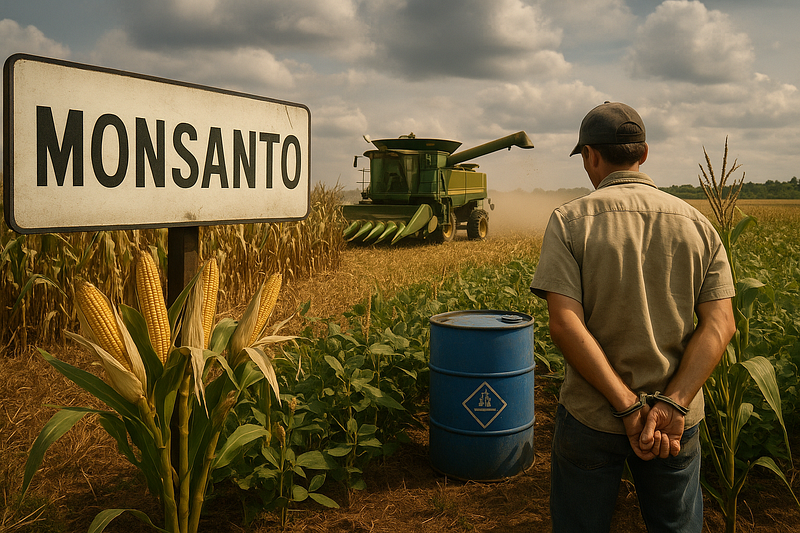
A farmer can own his land outright, every acre paid off, the deed clean, and still not own the thing that grows on it. Each spring he signs an agreement to buy seed he is not permitted to save. The seed is engineered to pair with a herbicide sold by the same firm or its licensees. When the harvest comes in, it moves to market through one of a handful of trading houses whose names most people have never heard. He owns the dirt. He rents the genetics, buys the chemistry, and sells into a channel he does not control. The land is his. The food is not.
This is the part of the food question that the usual framing misses, and it misses it by looking in the obvious place. Ask who owns our food and the mind goes to farmland, to the visible green expanse, to the millions of farmers spread across every country on earth. Farmland is in fact one of the most dispersed major assets in the world, held by a vast and uncoordinated multitude. If ownership of food were ownership of farmland, no one would control it at all. But control of the food system does not sit at the farm. It sits at the two narrow points the entire dispersed mass of agriculture is forced to pass through, one upstream and one downstream, and at those points ownership is not dispersed at all. It is among the most concentrated on the planet.
The determining variable was never the land. It is the chokepoint.
The Thing You Own and the Thing You Don't
Begin with the structure, because the structure is the whole argument. Picture the food system not as a map of fields but as an hourglass. At the wide top sit the inputs that every farm needs before it can grow anything: above all, seed, and the chemicals bound to it. At the wide bottom sits everything that happens after harvest on its way to a plate: the trading, shipping, processing, and distribution of bulk commodities across the world. In the vast middle, broad and dispersed, sit the farms themselves, hundreds of millions of them.
Now notice where the glass narrows. A farm can grow nothing without seed, and the commercial seed for the world's major crops, together with the agrochemicals engineered to work with it, flows from a tiny number of firms. A harvest of globally traded grain reaches the world market through an equally tiny number of trading houses. The hundreds of millions of farms in the middle are funneled, at both ends, through a few dozen corporate decision points. Whoever holds those points does not need to own a single field. The field is captive to them by structure, because there is no way to farm at commercial scale that does not pass through both necks of the hourglass.
This is why the question of who owns the land is the wrong question. Land is the part of the system that looks like control and isn't. The seed and the trade are the parts that don't look like control and are. To see the food system clearly you have to stop watching the wide, green, visible middle and start watching the two narrow, corporate, nearly invisible ends.
The Narrow End Upstream
Start at the top of the hourglass, with the seed, because that is where the concentration is sharpest and most recent.
Within roughly two years, between 2017 and 2018, the global seed and agrochemical industry was remade by a cluster of mergers larger than anything in its history. Dow and DuPont combined and then spun their agricultural arm into a new company, Corteva. The state-owned China National Chemical Corporation bought the Swiss giant Syngenta for around forty-three billion dollars. Bayer, the German chemical and pharmaceutical company, bought Monsanto for around sixty-three billion. BASF acquired the seed and trait assets that regulators forced Bayer to sell off as a condition of the deal. When the dust settled, an industry that had counted dozens of meaningful players a generation earlier had resolved into a handful.
The result is a level of concentration that economists do not hesitate to call an oligopoly. By the most recent accounting, four firms, Bayer, Corteva, Syngenta, and BASF, control around fifty-six percent of the global commercial seed market and around sixty-one percent of the global market for pesticides, according to figures compiled by the ETC Group in 2025. Bayer alone holds roughly a quarter of the world's commercial seed. The trajectory is as telling as the level. In the early 1980s the ten largest seed companies together held under fifteen percent of the market. Today the largest handful hold the majority of it. In the United States, the federal agriculture department's own researchers found that two firms accounted for more than half of all corn, soybean, and cotton seed sales. This is not a stable old structure. It is a recent and rapid enclosure, completed mostly within living memory.
What turns concentration into control is the legal architecture wrapped around the seed, and this is the genuinely modern part. A seed is a self-replicating thing. Plant it, and it makes more of itself, which for ten thousand years was precisely the point. The patent regime reverses that logic. A patented genetic trait remains the property of the firm that owns it even after the farmer buys the seed that contains it, and the technology agreements farmers sign forbid them from saving and replanting their own harvest. The United States Supreme Court affirmed in 2013 that planting the saved progeny of a patented seed infringes the patent, because the farmer is, in effect, manufacturing the patented invention without a license. International conventions on plant variety rights extend versions of the same principle across much of the world. The oldest agricultural act there is, saving seed from this year to plant next year, has been converted by law into the unlicensed reproduction of someone else's intellectual property.
Ivan Illich gave this condition a name before the technology existed to perfect it. He called it a radical monopoly: the state in which a commercial product does not merely outcompete its alternatives but becomes the only available way to perform a basic function, so that people no longer choose it but simply depend on it. A farmer in a fully commercial system does not weigh patented seed against saved seed as two live options. For the major crops, in the major markets, the saved-seed option has been engineered and legislated out of practical reach, and what remains is dependence wearing the costume of choice.
The Narrow End Downstream
Now go to the bottom of the hourglass, to what happens to a harvest after it leaves the farm, because the same shape appears again in a form even harder to see.
The global trade in grain and oilseeds, the bulk commodities that feed and are fed to most of the world, runs through four firms so dominant they are known simply by their initials. Archer-Daniels-Midland, Bunge, Cargill, and Louis Dreyfus, the ABCD of the grain trade, own or control the elevators, the port terminals, the inland logistics, the processing plants, and the trading desks through which the world's harvests move from where they grow to where they are eaten. Estimates of their combined share of the global grain trade range from around sixty percent to as high as seventy or ninety percent, depending on the year and the method, and the imprecision is itself part of the story. Most of these firms are privately held. They do not publish the figures that would let an outsider measure them exactly. The opacity is not incidental to the chokepoint. It is one of its features. A point that the whole world depends on, and that the world cannot fully see, is a point of unusual power.
The concentration here is not frozen. It is tightening in real time. In July 2025, after navigating regulators across several continents, Bunge completed its merger with the commodity trader Viterra, folding two of the world's large grain handlers into one. The merger is worth pausing on, because at first glance it looks like a counterargument and on closer inspection is the opposite. Bunge pursued Viterra in part because margins in the trading business had been squeezed, which is a sign that the sector is competitive. But the response to competitive pressure was not fragmentation. It was further consolidation, two large players becoming one larger one, the neck of the hourglass narrowing by another notch. When the answer to a margin squeeze is a merger, the long-run direction is concentration even when the short-run pressure is competition.
The engineer Nassim Taleb would recognize the shape of the risk this builds. A system that routes the great majority of a vital flow through a very small number of nodes is a system with a small number of single points of failure. The efficiency is real. A handful of integrated global traders can move grain from a surplus on one continent to a shortage on another with a speed and a coordination that a fragmented market could not match. But the same structure means that a disruption at one of those nodes, a firm, a port, a chokepoint, a decision, propagates through the whole system, and that the firms holding the nodes sit astride a flow that everyone else, exporters and importers and the hungry alike, must pass through and cannot route around at will.
The Third Node
There is a second input at the top of the hourglass, less discussed than seed but no less concentrated, and the events of recent years made its power suddenly visible. It is fertilizer.
Modern high-yield agriculture runs on synthetic inputs, above all nitrogen, phosphorus, and potassium, and the supply of each is narrow. Nitrogen fertilizer is made from natural gas, which ties the world's food production directly to the price and politics of energy. Potash, the main source of agricultural potassium, comes from a small number of deposits and producers, with the Canadian firm Nutrien and the American Mosaic among the largest, and with Russia and Belarus together accounting for roughly forty percent of world potash exports. When that last fact stopped being a line in a trade table and became a geopolitical event, the chokepoint revealed itself.
After the invasion of Ukraine in 2022 and the sanctioning of Belarus, fertilizer prices spiked across the board. Potash roughly doubled and at its peak traded well above eight hundred dollars a tonne, and nitrogen fertilizer surged with the gas price that underlies it. The effect rippled through every farm on earth that depends on purchased inputs, which is most of them, and from there into the price of food. No one had to embargo grain to threaten the world's harvests. It was enough that a narrow input, concentrated in a few hands and a few countries, became briefly more expensive and less available. The fertilizer shock of 2022 was a live demonstration of the hourglass logic: a disruption at one narrow input node propagated, within months, into the food security of countries that grow their own grain. Control of the inputs is control of the harvest, one step removed and one step harder to see.
Why Concentration Is Not a Conspiracy
It is tempting, standing in front of all this, to look for the villain. The genre that this subject usually attracts is built around one: a single evil company, a hidden plan, a deliberate scheme to capture the world's food and hold it hostage. It is worth saying plainly that this framing is both wrong and weaker than the truth, and that reaching for it is a mistake.
There was no plan. Each merger that built this structure was, on its own terms, an ordinary and defensible business decision. Seed and chemical research is enormously expensive, and scale spreads the cost. Global trading rewards networks and balance sheets that only the largest firms can sustain. Regulators in multiple jurisdictions examined each of these mergers and approved them, judging that enough competition would survive. No one sat in a room and designed an hourglass. The hourglass assembled itself out of decisions that were individually rational, the way a path is worn into a field not because anyone planned it but because each person sensibly walked where the walking was easiest. Friedrich Hayek spent a career insisting on this distinction between what is designed and what merely emerges, and warning against the human reflex to see a designing mind behind every ordered outcome. The concentration of the food system is an emergent order, not a directed one, and that is exactly what makes it so durable.
It is also what makes the villain story a trap. A conspiracy can be exposed and broken. You find the plotters, you reveal the plan, and the spell lifts. An emergent structure offers nothing to expose, because there is no secret and no plotter, only a sequence of legal, public, sensible steps whose sum is a concentration no single step intended. To insist on a villain is to look for a door that does not exist, while the actual mechanism, the slow logic of scale and barrier and merger, continues in plain sight. The honest account is more unsettling than the conspiracy, not less. No one has to be holding the world's food hostage for the world to end up funneled through a few hands. It is enough that every step toward that outcome made sense to the people taking it.
How the Node Went Global
The upstream chokepoint did not stay in the wealthy countries where it formed. It traveled, and the vehicle it traveled in was, for decades, the language of help.
The Green Revolution of the 1960s and 1970s was a genuine achievement and a genuine turning point, and both halves of that sentence matter. New high-yield varieties of wheat and rice, developed with funding from the Rockefeller and Ford Foundations and spread through development programs, dramatically raised yields and are credited with averting famine for hundreds of millions of people. That is real and should not be diminished. But the new varieties carried a condition. They delivered their high yields only when paired with synthetic fertilizer, reliable irrigation, and chemical pesticides, which meant that adopting them meant adopting a package of purchased industrial inputs. A form of farming that had been largely self-provisioning became a form of farming that depended, every season, on buying from suppliers. The yield was real. So was the dependence, and the dependence pointed back toward the narrow upstream node.
The channel through which this spread was development aid and the conditions attached to it. Programs run through national aid agencies and the major lending institutions promoted the input-intensive model, and structural-adjustment lending in later decades pressed countries to open their agricultural markets and liberalize their seed sectors, which made room for commercial seed where state and traditional systems had been. It would be an overstatement, and the kind of villain narrative this analysis avoids, to call this a single designed plot to capture the world's farmers. Much of it was driven by a sincere belief that industrial agriculture was simply better, and in raw yield terms it often was. But the structural effect, whatever the intent behind each step, was to extend the input-dependent model, and with it the upstream chokepoint, into the agriculture of much of the world. Food also became, in the hands of the countries that dominated the inputs, an instrument of leverage, because a nation dependent on imported seed, chemicals, and fertilizer is a nation with one more pressure point that others can reach. The node that formed in a few rich countries became, by way of the aid channel, a node the whole world passes through.
The Patent and the Commons
Return to the seed, because beneath the market structure lies a deeper transformation, and it is the one the original alarm about all this got right.
For almost the entire history of agriculture, a seed was a commons. It was saved, exchanged, and adapted, passed between neighbors and across generations, and it carried in its genetics the accumulated record of every season it had survived: the droughts endured, the pests outlived, the local soil learned. No one owned it because the idea of owning it made no sense. It reproduced itself freely, and its freedom to reproduce was its entire value. The shift to a system of patented, contracted, non-savable seed is not merely a change in who sells seed. It is the conversion of a self-renewing commons into a licensed product, the fencing of a thing that for ten thousand years had no fence.
The case of the Canadian farmer Percy Schmeiser is usually told as a parable of corporate cruelty, and it is more interesting than that. Monsanto's patented canola turned up growing in his fields, and the company sued him for using its patented invention without a license. In 2004 the Supreme Court of Canada ruled, narrowly, that he had indeed infringed the patent by growing the patented plant, regardless of how the seed had arrived. But the same court ruled, unanimously, that he owed Monsanto nothing, no damages and no costs, because he had made no profit attributable to the patented trait. The case is not really the story of a farmer financially destroyed. It is the story of a legal system concluding that a patent on a gene reaches into a living, self-spreading organism, so that the patent holder's rights travel with the pollen on the wind. That is the quiet, structural finding, and it is more far-reaching than any single verdict against any single farmer. It means the enclosure of the seed is not only contractual but biological, extending wherever the patented life can spread.
What is lost when the commons becomes a product is not only money or autonomy but memory. The diversity of traditional seed was a vast distributed archive of agricultural knowledge, hundreds of potato varieties in the Andes, thousands of rices across Asia, each one a solution to a particular place. A system that funnels farmers toward a narrow set of commercial varieties does not merely sell them seed. It thins the archive, replacing a wide and redundant base of genetic options with a narrow and uniform one. Uniformity is efficient and it is fragile, in seeds exactly as in trading networks. The same concentration that makes the system productive makes it brittle, and the brittleness is stored, invisibly, in the narrowing of what grows.
The scale of that narrowing is documented and stark. The Food and Agriculture Organization has estimated that roughly three-quarters of the genetic diversity of agricultural crops was lost over the course of the twentieth century, as a vast range of local varieties gave way to a small number of high-yielding commercial ones. Today a mere handful of crops, on the order of nine plant species, account for around two-thirds of all crop production by weight, and just three of them, wheat, rice, and maize, provide roughly half of the calories humanity derives from plants. A food system feeding eight billion people now balances on a genetic base far narrower than the one that fed a fraction of that number a century ago. Narrowness of this kind is invisible in good years and decisive in bad ones, because a uniform crop is a uniform target. A pest or a disease or a climate shift that defeats one widely planted variety threatens not one field but a continent of identical fields at once. The concentration of the commercial seed market and the thinning of the genetic base are the same process seen from two angles, and the fragility they build is the price of the efficiency they deliver, deferred to a year that has not yet come.
What Happens in the Middle
Stand the farmer back in the center of the hourglass and look at his economic position, because it follows directly from the shape and explains why the dispersed middle stays powerless against the concentrated ends.
He buys his inputs from a concentrated upstream, which means he is a price-taker on the way in. He sells his harvest into a concentrated downstream, which means he is a price-taker on the way out. He is squeezed from both directions at once by sectors that have pricing power he does not have, and he has almost no leverage against either, because he is one of hundreds of millions and they are a handful. A seller facing a concentrated buyer, and a buyer facing a concentrated seller, is in the weakest position a market offers, and the commercial farmer occupies both of those positions simultaneously. The structure does not merely sit above him. It presses on him from both ends.
The long consequence is visible in the slow transformation of farming itself. Across the industrialized world the number of farms has fallen for decades while their average size has risen, as the operations too small to survive the squeeze are absorbed into ones large enough to bear it. The share of what a consumer spends on food that actually reaches the farmer has trended downward, with the larger part captured by the input suppliers, the processors, the traders, and the retailers, the concentrated links on either side of the farm. This is not because farmers are inefficient. It is because they occupy the one part of the chain with no concentration and therefore no power, the wide middle of the glass, where the value generated by the land is real but the ability to hold on to it has migrated to the necks at either end. The farm is where the food is grown. It is not where the money, or the control, comes to rest.
The Cases People Argue About
There is a loud debate around the food giants, and it is worth seeing clearly, because the loudness of it does quiet work. It keeps the argument on the question of harm and off the question of structure.
Consider glyphosate, the weedkiller sold as Roundup, the most widely used herbicide on earth and the chemical companion to a generation of engineered seed. In 2015 the World Health Organization's cancer research agency classified it as probably carcinogenic to humans. The European Food Safety Authority and the United States Environmental Protection Agency reached the opposite conclusion, judging it unlikely to cause cancer at realistic exposures. The disagreement is genuine and remains unresolved, and it has been litigated at enormous scale. Bayer, which inherited the liability when it bought Monsanto, agreed in 2020 to a settlement program worth around eleven billion dollars covering tens of thousands of claims, and the litigation continues into 2026, with the company seeking to have the question settled by the United States Supreme Court. This is a real and serious fight, and nothing here resolves it. The point is what the fight does to attention.
The same pattern surrounds the introduction of insect-resistant cotton in India, which is often linked, in the popular telling, to a wave of farmer suicides. The peer-reviewed picture is more complicated and more sobering. The best-known assessments find no simple causal link between the engineered cotton and the suicides. The grim trend in rural suicides predates the seed's introduction, and the causes are agreed to be many: debt, failed monsoons, the price of inputs, the structure of rural credit, the exposure of smallholders to global price swings. The engineered seed entered an already desperate system and may in particular places have deepened particular debts, but to call it the cause is to compress a multifactorial tragedy into a slogan.
Hold these two cases together and notice what they share. Both are fights about harm: does this chemical cause cancer, did this seed cause those deaths. They are important fights. But they are also where almost all the public energy goes, and a fight about whether a product is toxic quietly concedes the prior question of whether a handful of firms should control the product at all. The toxicity debate is the visible story. The concentration is the hidden one, and the visible story, precisely by being so charged, keeps the hidden one out of frame. You can win or lose the argument about glyphosate and cancer without ever touching the fact that the world's seed and chemistry flow from four companies. The spotlight on harm is, among other things, a place where the question of structure goes to be forgotten.
The Steelman
The strongest objection to all of this does not dispute the concentration figures. It disputes the word chokepoint, and it deserves its full force.
High concentration, the objection runs, is not the same as a closed chokepoint. A chokepoint implies the system cannot route around it. An oligopoly merely means there are few large players, and few large players can still compete fiercely and can still be bypassed. Farmers are not, in fact, wholly captive. Public and university breeding programs still exist. Regional and independent seed companies still operate. Open-pollinated and non-patented varieties can still be saved and grown, and farmers can change which crops they plant. Downstream, grain is a fungible global commodity, and the ABCD traders are intermediaries, not owners of the harvest; new entrants have grown into serious global players, the Chinese state trader COFCO, the Singapore-based houses Olam and Wilmar, and the ABCD share of the trade may actually have been eroding rather than tightening. That erosion, the objection points out, is the likeliest reason Bunge needed to merge with Viterra in the first place. And the mergers that built the upstream oligopoly were each examined by antitrust regulators who concluded that enough competition would survive. Concentration, on this reading, reflects the real economies of scale in research and logistics, not a capture of the food supply, and the alternatives that remain are proof that no one holds a chokepoint at all.
This objection is correct about more than it is wrong about, and the honest move is to narrow the claim rather than defend an overstatement. The word chokepoint is defensible as a structural argument, not as a claim of closed monopoly. What makes these narrow points hold is not the absence of all alternatives but the height of the barriers around them: the cost of seed and chemical research, the capital and the logistics networks required to trade grain globally, the regulatory data requirements that only large firms can satisfy, and the patent thicket that fences the most productive seed. Those barriers do not make the chokepoints impossible to route around. They make routing around them expensive, slow, and partial, which for most farmers most of the time amounts to the same thing as captivity even though it is not literally captivity. The accurate claim is therefore the narrower one: the food system is governed at a small number of high-barrier nodes, the upstream node tightening over decades while the downstream node is genuinely contested and may be consolidating in response to its own competitive pressure. These are contestable oligopolies, not sealed monopolies. The distinction matters, and it is exactly the distinction the villain story erases.
It also names the condition under which this analysis would be wrong. If a major crop's seed supply visibly re-fragmented, if farmers began routing around patented seed at scale, if the grain trade dispersed among many new entrants rather than consolidating, the chokepoint claim would weaken and should. The Bunge-Viterra merger is current evidence pointing the other way, but the question is genuinely open, and an honest version of the argument has to say so.
What You Own When You Own a Farm
Go back to the farmer who owns his land and not his food. His situation is not a scandal in the sense the genre wants, a crime with a culprit. It is a structure, and the structure is the point. He stands in the wide, dispersed, visible middle of the hourglass, holding the asset that looks like control, while the actual control sits at the two narrow ends he is forced to pass through, in the seed he may not save and the trade he cannot bypass. Nobody took his farm. They did not need to. They took the two points the farm depends on, and left him the dirt.
This is the law worth carrying past the subject of food, because it is not really about food at all. Control of any dispersed resource concentrates not at the resource but at the chokepoints everyone who uses it must pass through. You do not need to own the farms if you own the seed and the trade, just as you do not need to own the ships if you own the canal, or the websites if you own the search, or the money if you own the payment rails. The visible asset, broad and divided among many, is the decoy. The narrow point upstream or downstream, where the many are funneled into the few, is where the ownership that matters quietly lives.
The farmer can own the field and not own the food. The holder of the chokepoint can own the food and never touch a field. That inversion is the whole story, and it is why counting acres tells you nothing about who is in control.
So the question who really owns our food has an answer, and it is not the name of a villain. It is a shape. It is the hourglass, and the few hands at its two necks, and the slow, sensible, unplanned logic that keeps narrowing them. The farmer owns the field. The question is who owns the neck of the glass, and whether a thing as basic as the food of the world should be permitted to pass through so few hands at all.
Evidence Map
Facts, interpretations, forecasts, and disconfirming signals.
Core claim. Control of the food system runs not through farmland, which is highly dispersed, but through two concentrated chokepoints: the upstream seed and agrochemical oligopoly and the downstream grain-trading oligopoly. The determining variable is concentration at these high-barrier nodes, not ownership of land, and the concentration is an emergent structural outcome rather than a directed conspiracy.
Evidence level. Facts: high. Documented: the 2017-2018 mega-mergers (Dow-DuPont to Corteva, ChemChina-Syngenta around 43 billion dollars, Bayer-Monsanto around 63 billion, BASF acquiring divested assets); four firms holding roughly 56 percent of the global commercial seed market and 61 percent of pesticides (ETC Group, 2025), with the top firms' seed share having risen from under 15 percent in the early 1980s; the ABCD grain traders' dominance and the completed Bunge-Viterra merger (July 2025); the patent and plant-variety architecture restricting seed-saving (including the 2013 US Supreme Court ruling). Interpretation: medium, marked. Reading these nodes as the determining variable, and as chokepoints rather than mere oligopolies, is an analytical conclusion. Contested matters (glyphosate's carcinogenicity, the Bt cotton and farmer-suicide link) are presented as disputed, not settled.
What would confirm this. Continued upstream consolidation; further mergers among grain traders; rising barriers to entry in seed and trading; persistence of patent restrictions on seed-saving.
What would disprove this. Visible re-fragmentation of a major crop's seed supply; farmers routing around patented seed at scale; dispersal of the grain trade among many new entrants rather than consolidation. The growth of new traders such as COFCO, Olam, and Wilmar is the live counter-signal to watch.
Watchlist. Whether the ABCD share erodes or the Bunge-Viterra pattern of consolidation continues; antitrust posture toward agribusiness mergers; the outcome of the glyphosate litigation; any shift in seed-patent and plant-variety law.
Related from The Manifest Archive