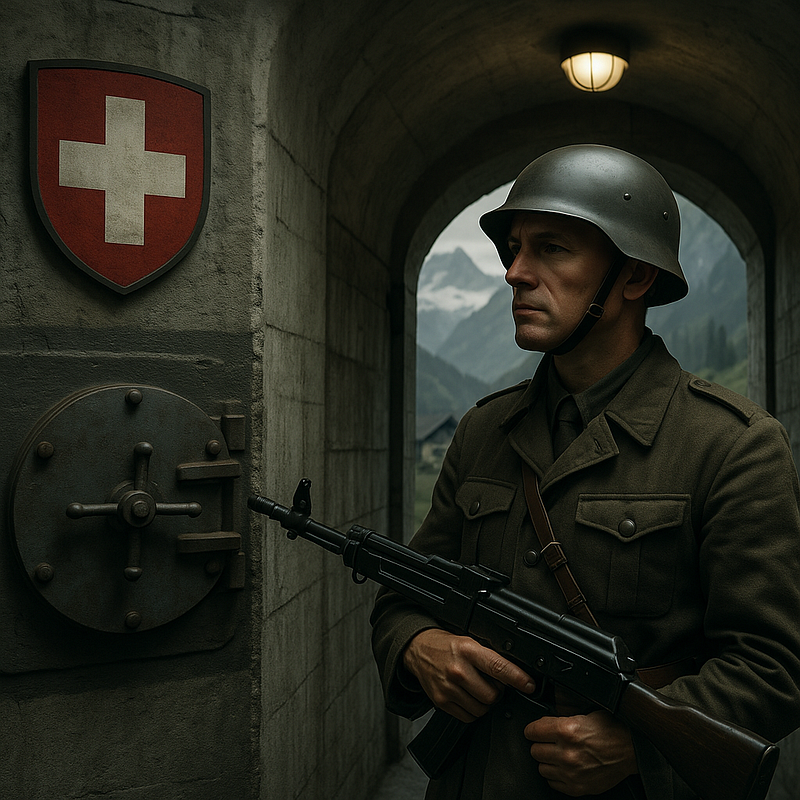
Beneath almost every Swiss house there is a second house, made of concrete and steel, built to outlast fire and radiation and the collapse of the one above it. For decades there was a rifle in the closet too, issued by the state. A country sold to the world as a postcard, peaks and chalets and trains beside turquoise lakes, turns out to be one of the most thoroughly fortified societies on earth. The two facts are not in tension. They are the same fact, seen from two sides.
This is the puzzle worth holding onto, because the easy reading of it is wrong. The easy reading is that Switzerland is peaceful and the bunkers are a quirk, a tidy nation's overcaution. The harder reading, the one the evidence supports, is that the peace and the bunkers are the same policy. Neutrality was never the opposite of war. It was a particular way of preparing for one, and a very expensive way at that. The neutral country is not the country that disarmed. It is the country that armed so completely, and made itself so useful, that invading it would cost more than leaving it alone.
Neutrality is the story the neutral tells the world. The fortress is the story it tells itself.
So the question is not whether Switzerland is neutral. The question is what neutrality actually is, once you stop taking the word at face value and look at what sits underneath it. And the answer, it turns out, is being tested right now, in real time, by two countries on the other side of Europe that have just decided their own neutrality is no longer enough.
The armed republic behind the postcard
Switzerland is small, landlocked, and ringed by mountains, and for most of its history that should have made it prey. The plains of France, the valleys of Austria, the German states to the north all sent armies across its borders. It never collapsed the way its neighbors did, and the reason was not luck. It was arms.
The Confederacy began in the thirteenth century not as an empire but as a pact: mountain communities swearing to defend their valleys together. They fought with pikes rather than cavalry, with discipline rather than numbers. In 1315 at Morgarten a force of farmers ambushed the armored knights of the Habsburgs on a narrow pass and destroyed them. In 1386 at Sempach they did it again. Out of those battles came a reputation that hardened into an export, and a lucrative one: by the fifteenth century Swiss mercenaries were the most feared infantry in Europe, hired by the kings of France, the dukes of Milan, and the pope in Rome, fighting in disciplined squares that moved like a single organism. The trade was so central to the economy that Europe coined a proverb for it, point d'argent, point de Suisse, no money, no Swiss. Their loyalty ran to the contract, not the crown. Whoever paid, commanded. When the trade turned on itself it was catastrophic: at Marignano in 1515 Swiss pikemen fought Swiss pikemen in French and Milanese pay, and by most accounts many thousands of them died in two days, perhaps as many as ten thousand, the defeat that turned the Confederacy away from foreign wars and toward the guarded posture it has held ever since.
That is the paradox at the root of the whole story. At home the Confederacy built independence; abroad it sold its sons. Neutrality, from the very start, was not the absence of war. It was the ability to fight everywhere while being conquered nowhere. The turn toward the modern posture came after a defeat. In 1515 at Marignano the Swiss were broken in Italy, and from that bloody lesson came a decision: no more wars of expansion, fewer soldiers sold abroad, and a new face presented to the world, the land that stood apart. When the Congress of Vienna declared Switzerland permanently neutral in 1815, it was not rewarding Swiss virtue. Europe's exhausted powers wanted a buffer in the Alps, a quiet space between them, and Switzerland was useful as that space. Neutrality was conferred because it served everyone, which is the only reason neutrality is ever conferred.
This is the machiavellian core of the matter, and it is worth saying plainly because the postcard works so hard to hide it. Machiavelli's oldest lesson was that there cannot be good laws where there are not good arms, and that a republic defended by its own citizens is stronger than one that rents its defense from others. Switzerland is the strange case that did both at once: it rented its soldiers out to the whole of Europe while keeping a citizen militia to defend itself, the mercenary abroad and the armed republic at home, two faces of the same refusal to depend on anyone's mercy. The chalets and the chocolate are real. They are also the visible surface of an armed republic that organized its entire society around the assumption that the surface could burn.
How literally it assumed that became clear in the Second World War. As the Reich closed around it in 1940, the Swiss commander General Henri Guisan gathered his officers on the meadow of the Rütli, the founding site of the Confederacy, and laid out the doctrine of the Réduit National: if Germany invaded, the army would not try to hold the populous lowlands or the cities at all. It would abandon them and withdraw into a fortified Alpine redoubt, mining the tunnels and passes behind it, and fight from the mountains for as long as it took to make the conquest worthless. The plan conceded the postcard and kept the fortress. It told Berlin, in effect, that taking Switzerland would mean inheriting a wrecked country and a war in the peaks with no prize at the end, which is precisely the calculation that armed neutrality is built to impose.
The fortress made literal
Most countries keep their defense in barracks, at the edge of daily life, out of sight. Switzerland did the opposite. It pushed the fortress down into the basement of every home and the closet of every household, until the distinction between a civilian and a soldier, a dwelling and an outpost, nearly disappeared.
The clearest proof is written into the building code. A 1962 law required that the country be able to shelter its entire population from nuclear attack, and it was met. Switzerland now has roughly 365,000 shelters offering close to nine million protected places, a coverage rate above one hundred percent, the only country on earth to guarantee a hardened space underground for every single inhabitant. These are not symbolic cellars. They are blast doors, air filters, water, and rations, beneath ordinary apartment blocks and beneath chalets with geraniums on the balcony. Above ground, a postcard. Below it, a nation rehearsing the end of the world.
Above the household shelters sat a far larger hidden architecture. Inside the mountains the state carved command posts, field hospitals, ammunition depots, and bunkers that could run sealed off from the surface, many of them disguised as barns or boulders, a few now opened as museums precisely because they are no longer secret. The most striking civilian example runs under Lucerne, where a motorway tunnel at the Sonnenberg was built doubling as a nuclear shelter for tens of thousands, with blast doors weighing hundreds of tonnes. A country does not hollow out its own Alps for storage. It does so to guarantee that something, the command, the records, the population, survives even if the surface is lost. The shelters were never only about protecting families. They were about the continuity of the system itself.
The rifle made the same point inside the home. Switzerland keeps almost no standing army; instead it made the citizens the army. Every man passes through compulsory service, is trained, and is sent home with his weapon, which lives not in an armory but in a wardrobe. The population could be mobilized in days. But here a precision matters, because it reveals exactly how the system is calibrated. Since 2007 the ammunition no longer goes home with the rifle. After a series of suicides and domestic killings with service weapons, the state recalled the rounds, and today only a few rapid-deployment and military-police units keep ammunition at home. Read that carefully. The country keeps the rifle in the closet as a standing signal of a mobilized citizenry, and keeps the bullets in central depots as a matter of public safety. Even the militia is an instrument tuned to the decimal: armed enough to deter, controlled enough to be safe. That is not the gun culture of the frontier. It is the discipline of a fortress.
The result is a society that is among the most heavily armed on earth and also among the most orderly, with gun-ownership rates near the top of Europe and gun-violence rates near the bottom, and the reason is built into the meaning of the weapon. In one political culture a rifle is a private claim against the state, a token of freedom and rebellion. In Switzerland it is the opposite, state property entrusted to a citizen, a token of collective duty. The same object that reads as defiance in one country reads as discipline in another, and the difference is not the gun but the system that hands it over. The armed Swiss home is not a frontier. It is a garrison, and a garrison does not riot.
And there was a layer beneath even that, one the public did not learn about until it was forced into the open. In 1990 a parliamentary commission revealed P-26, a secret resistance organization built in 1979 without parliamentary approval, a stay-behind network designed to keep up armed resistance if the country were ever occupied. Switzerland, the supposedly disengaged neutral, had quietly prepared a clandestine army for the day the surface fell, part of the wider web of European stay-behind networks of the Cold War. The neutral was never standing outside the conflict. It had simply buried its share of it deep enough that the tourists never saw.
Neutrality is a strategy, not a virtue
If the bunker and the rifle are the military half of the fortress, the bank vault is the economic half, and it does the same work by other means. A country can make itself hard to invade in two ways: by raising the cost of attacking it, and by raising the cost of doing without it. Switzerland did both.
Through the twentieth century its neutrality was porous in a very particular direction, always toward usefulness. In the First World War Swiss banks extended credit to both sides; it did not matter whether Paris or Berlin would ultimately pay, only that the creditor sat in Zurich. In the Second World War the entanglement ran darker, and it was documented in detail decades later by an independent commission of historians, the Bergier Commission, set up in the late 1990s. The Swiss National Bank bought roughly 440 million dollars of gold from the Reichsbank during the war, more than half of it looted from occupied countries and from the murdered, and the commission found the bank's own governors knew early where it came from. Swiss factories supplied precision instruments to the Reich while Swiss diplomats brokered quiet talks between the warring powers, and refugees were admitted or turned back to their deaths by selective decree, on the logic that the lifeboat was full. None of this was passive. It was a strategy of being indispensable to everyone at once, which is its own form of armor. A country that holds your gold, settles your deals, and shelters your secrets is a country you do not bomb. Half a century later the bill came partly due: in 1998 the major Swiss banks paid 1.25 billion dollars to settle claims from Holocaust survivors, dormant-account holders, and refugees the country had turned away.
This is the function the word neutrality conceals. Switzerland did not stand above the violence of the twentieth century. It positioned itself at the center of the violence as the one place that kept working while the rest burned, the vault that stayed calm while Berlin and London and Moscow did not. Its impartiality was real in the sense that it served all sides, and that is precisely what made it valuable. The mask of neutrality was not a lie laid over a peaceful country. It was the operating manual of a fortified one.
The economic half of the fortress is, if anything, stronger today than the military half, because indispensability does not age the way a rifle does. Geneva houses the European seat of the United Nations, the World Health Organization, and the Red Cross; Zurich and Basel remain among the deepest pools of capital on earth; and when enemies need ground neutral enough to meet on, they still choose Switzerland, as the American and Russian presidents did for their summit in Geneva in 2021. Each January the resort of Davos turns into a guarded citadel where presidents and bankers and billionaires gather behind soldiers and snow. A country that is the agreed meeting place of powers that trust nowhere else has built a deterrent out of usefulness: you do not destroy the one room everyone needs to sit in. The vault and the conference hall do the same work as the bunker and the rifle, by making the country too valuable to lose rather than too costly to take.
Neutrality was never the absence of war. It was the most expensive way of preparing for one.
The bet underneath the word
Now the pieces can be assembled into the thing the postcard exists to hide, the determining variable beneath two centuries of Swiss history. Neutrality is not a moral stance and not the laying down of arms. It is a bet on deterrence. The neutral state purchases its independence by making itself, at once, too costly to attack and too useful to destroy, and it pays for that deterrence privately, out of its own arsenal and its own indispensability, rather than borrowing it from an alliance. The bunkers, the militia, the secret army, the vaults: every one of them is a premium paid on a single insurance policy, the policy that says no one will find it worth the price to come through the Alps.
The law itself says as much, which is the part most people never learn. When the powers codified the rules of neutrality at The Hague in 1907, they did not define a neutral state as one that stays out of fighting. They defined it as one whose territory is inviolable and which is obliged to resist any violation of that territory, by force if necessary, without that resistance counting as an act of war. In other words, international law requires a neutral country to be armed and willing to fight for its neutrality; a state that let armies cross it unopposed would forfeit the status. Neutrality is not a legal exemption from force. It is a legal duty to hold force in reserve. The fortress is not a Swiss embellishment on the idea of neutrality. It is the idea of neutrality, written into the treaty.
A bet has conditions, and this is the part that matters most, because it tells you when neutrality ends. The Swiss bet works only as long as two things hold. The private deterrent has to stay credible, expensive and ready enough to raise the cost of attack above the prize. And the surrounding balance of great powers has to stay roughly stable, so that no single neighbor is both able and willing to pay that cost anyway. Neutrality is not a wall. It is a price, and a price can always be met by someone determined enough. When the deterrent weakens, or when the balance breaks and a great power decides the prize is worth any cost, the neutral faces a choice with only two answers. Arm further, or abandon neutrality and buy collective deterrence from an alliance instead.
That sounds abstract. It stopped being abstract in 2022.
The bet recalculated, in real time
For most of the modern era the armed-neutral posture was not a Swiss eccentricity. It was a recognized way for a smaller state to live beside larger ones, and two countries practiced it more seriously than almost anyone: Sweden, neutral for more than two hundred years, since the Napoleonic age, and Finland, which spent the Cold War in a careful non-alignment so distinctive it earned its own word, Finlandization, the art of staying free by never provoking the giant next door. Neither was disarmed, and neither, on close inspection, was pacifist.
Sweden's famous wartime neutrality was the Swiss pattern exactly: armed, and useful to the stronger side. It sold Germany around ten million tons of iron ore a year, the raw material of the Reich's weapons, so vital that the head of the German navy said outright that Germany could not make war without it, and it permitted German troops to transit Swedish railways to and from occupied Norway. Sweden was not standing above the war. It was feeding it, carefully, from a position too armed to bully and too useful to invade, and it kept that posture into the postwar decades with a doctrine of total defense, a domestic arms industry that built its own fighter jets, and even a nuclear-weapons program it pursued into the 1960s before setting it aside. Finland had earned its independence in blood, bleeding the Soviet army badly in the Winter War of 1939 to 1940 and then living beside it for half a century under a treaty of friendship that traded deference for survival. It built civil-defense shelters for some eighty-five percent of its population, around fifty thousand of them, a hardened underground on the Swiss model. Both had made exactly the Swiss bet: private deterrence, national usefulness, independence bought with their own arms.
Then the balance broke. In February 2022 Russia invaded Ukraine, and a great power demonstrated that it was willing to pay an enormous cost to take territory by force on the European continent. The condition the whole neutral bet rested on, a stable balance in which no neighbor would pay the price, was suddenly in doubt. And the neutrals did precisely what the doctrine, read honestly, always implied they would. They recalculated.
Finland applied to join NATO and became its thirty-first member on 4 April 2023, ending decades of non-alignment almost overnight. Sweden followed, becoming the thirty-second member on 7 March 2024, ending more than two centuries of neutrality, after Turkey and Hungary finally dropped their objections. Switzerland, still formally neutral, broke its own oldest taboo the same year the war began: in 2022 it adopted the Western sanctions against Russia and froze billions in assets, aligning its impartiality with one side in a way the absolute myth had always forbidden. Three of Europe's model neutrals, faced with the same broken balance, all moved in the same direction at once, away from private deterrence and toward the collective kind.
What the two brought with them shows how little of the change was about ideals and how much about hard deterrence. Finland's accession more than doubled NATO's land border with Russia at a stroke, adding roughly thirteen hundred and forty kilometers of frontier and one of Europe's most capable artillery armies and shelter systems. Sweden brought control of the air and sea approaches to the Baltic, an advanced defense industry, and the strategic island of Gotland, which it had quietly remilitarized years before. These were not small states seeking protection so much as heavily armed ones deciding that their private arsenals were better pooled than held alone. The accession was delayed for almost two years while Turkey and Hungary extracted their own concessions, a reminder that even joining an alliance is a transaction, not a profession of faith.
This is the thesis confirmed by its own crisis. If neutrality had been what the postcard says, a principled standing-apart from the quarrels of others, then a war in Ukraine would have been one more quarrel to stand apart from, and the neutrals would have stayed neutral. They did not, because neutrality was never that. It was a deterrence bet, and when the odds changed the holders of the bet changed their position, exactly as a gambler does when the table turns. Finland and Sweden did not abandon a principle. They upgraded a calculation. The arms had always been there; joining the alliance was simply topping up the deterrent when self-reliance no longer looked sufficient. The fireproof houses, after two hundred years, moved next door to the fire brigade.
Neutrality is deterrence a country pays for by itself. An alliance is deterrence it splits with friends. The neutral switches from the first to the second the moment the bill on the first comes due.
The strongest case for the postcard
The honest objection to all of this deserves to be put at full strength, because it is a good one. Neutrality, the objection runs, plainly worked. Sweden kept out of European wars for two centuries, an extraordinary record; Switzerland has not been invaded since the Confederacy took its modern shape; Finland survived the Cold War with its independence intact next to a superpower. If the posture delivered two hundred years of peace, calling it merely a bet on deterrence is a cynic's reduction of a genuine and successful tradition. And Switzerland, note, has not joined NATO even now. So perhaps neutrality is exactly what it claims to be, and the analysis here is straining to find a fortress where there is mostly just a sensible small country minding its own business.
Most of that should be granted, and granting it sharpens the point rather than dissolving it. Neutrality did work, for a long time, and that is the strongest evidence for the reading offered here, not against it. It worked because the deterrent was real and the balance held, which is precisely the claim. The argument is not that neutrality is a fraud or that the peace was fake. The peace was real. The argument is narrower and more durable: that the peace was produced by arms and usefulness and a favorable balance of power, not by virtue or by standing apart, and that this is why it bent the moment the balance shifted.
The countries that have not joined make the same point from the other direction, and they are the cleanest test of the claim. Austria has been constitutionally neutral since 1955, when it declared perpetual neutrality and a ban on foreign bases as the price the Soviets demanded for withdrawing their occupation troops; it sits in the protected interior of Europe, ringed now by alliance members, and its bet still pays, so it has stayed put. Ireland, neutral and sheltered for a century behind Britain and the Atlantic, has not joined either, but it has quietly edged closer, signing a tailored partnership with the alliance in 2024 to protect the undersea cables and networks it cannot defend alone. Neither has abandoned neutrality, because neither has yet felt its own balance break the way the Baltic's did. That is not a counterexample to the thesis. It is the thesis: the neutral moves when, and only when, the balance that made neutrality payable gives way. Geography decides who feels the shift first. Switzerland, deep in the interior behind an enlarged alliance, may never feel it at all, which is exactly why its formal neutrality survives while the Nordic version did not.
Even so, the Swiss bet is visibly being re-priced. Having frozen Russian assets in 2022, Bern began debating a doctrine of cooperative neutrality that would let it lean further toward European defense without formally joining it, and the political fight over how far it can bend without breaking has not stopped since. The hardware tells the same story: Switzerland chose the American F-35 as its next fighter, tying its air defense to the same supply chain and software as the alliance that surrounds it, and its parliament has reopened the question of rearming and even of returning ammunition to households. None of this is Switzerland abandoning neutrality. It is Switzerland topping up the private deterrent and edging toward the collective one, the early moves of a recalculation that the Nordics simply ran to completion first. The interior feels the tremor later, but it feels it.
The boundary of the claim is clean. If a neutral state had ever disarmed, made itself dispensable, and survived on declared principle alone, the thesis would fail. None did. Every lasting neutral was armed to the teeth and useful to everyone, which is the whole point.
The guard in Rome
There is a smaller emblem of the same logic, and it has stood in plain sight for five centuries. In 1506 the pope hired a company of Swiss soldiers, prizing exactly what made them valuable everywhere: discipline, fearlessness, and a loyalty that ran to the sworn contract rather than to any rival dynasty that might try to buy it back. The Pontifical Swiss Guard became, and remains, the oldest standing army still in service. Its loyalty was proven in blood during the Sack of Rome in 1527, when of roughly 189 guards the great majority died holding off imperial troops so that Pope Clement VII could escape, and only a few dozen survived. New recruits still swear their oath on the anniversary of that day.
Today the Guard wears Renaissance colors and is photographed as pageantry, which is itself instructive, because behind the costume sit modern small-arms training and close-protection tactics. The symbolism is almost too neat. The nation that sells the world an image of peace supplies the pope his most reliable soldiers, and both the Confederacy and the Vatican present themselves as sanctuaries while keeping a disciplined force behind the mask. The Guard is the rifle in the Swiss closet, dressed for tourists. Neutrality, once again, turns out to mean not disarmament but discipline kept out of sight.
Present peace, prepare for fire
Switzerland spent centuries teaching the world to see a postcard: glittering peaks, perfect clocks, chocolate, diplomacy under chandeliers in Geneva and behind the security cordons of Davos. The postcard is not false. The mountains are beautiful and the country is, by most measures, among the most stable and prosperous on earth. But it was always only the half of the story meant for outsiders. The other half is the bunker beneath the chalet, the rifle in the closet, the secret army in the files, the gold in the vault, the whole apparatus of a society built on a single quiet instruction repeated across seven hundred years: present peace, prepare for fire.
The clearest sign that this was always the logic is what the rest of Europe is now doing in a hurry. Since 2022, governments that had let their civil defense decay for thirty years have been rebuilding it on the Swiss and Finnish model: surveying and refurbishing shelters, reprinting survival guidance for households, restoring stockpiles, in Germany, Poland, the Nordic states, and across the European Union's new preparedness planning. For half a century the bunker beneath the chalet looked like a Swiss eccentricity. The moment the balance broke, it started to look like foresight, and the neutral fortress became the template the alliance copied. The postcard countries had simply been preparing all along for the condition everyone else assumed had ended in 1989.
The deepest thing the Swiss example reveals is not about Switzerland. It is about the word neutral, and how completely it can invert in meaning once you look at what holds it up. A neutral nation is not one that has stepped out of the contest of force. It is one that has armed and positioned itself so well that the contest, for a time, steps around it. That arrangement is not peace. It is deterrence wearing the clothes of peace, and like all deterrence it lasts exactly as long as the threat behind it stays credible and the world around it stays balanced. When Finland and Sweden read the balance breaking in 2022 and walked into NATO, they were not betraying a two-hundred-year tradition of neutrality. They were honoring its actual logic, which had never been about staying out of the fight. It had been about never being caught in it unarmed.
A neutral country is not the one that laid down its arms. It is the one that took up so many it was never worth the fight.
The question, in the end, was never whether these countries were neutral. It was what neutrality was always preparing for. The answer is now arriving in the form of accession papers and frozen accounts and shelters refurbished across northern Europe. Present peace, prepare for fire. The fire came close enough, and the fortress did what fortresses do.
Evidence Map
Facts, interpretations, forecasts, and disconfirming signals.
Core claim. Neutrality, in its armed form, is not the absence of war or a moral stance but a deterrence bet: the neutral state buys independence by making itself too costly to attack and too useful to destroy, paying for that deterrence privately. The bet holds only while the private deterrent stays credible and the surrounding great-power balance stays stable; when the balance breaks, the neutral arms further or abandons neutrality for an alliance. The 2022-2024 Nordic accessions are that recalculation in real time.
Evidence level. Facts (high): the 1962 Swiss shelter law and roughly 365,000 shelters / about 9 million places / over 100 percent coverage; the militia rifle-at-home system and the 2007 end of home ammunition; the 1990 revelation of the P-26 stay-behind organization (founded 1979); the Bergier Commission's documentation of wartime Nazi-gold transactions and Swiss economic entanglement; the Swiss Guard's founding (1506) and the 1527 Sack of Rome; Switzerland's 2022 adoption of sanctions against Russia; Finland joining NATO on 4 April 2023 and Sweden on 7 March 2024; Finland's civil-defense shelters for about 85 percent of its population; Sweden's 200-plus years of prior non-alignment. Interpretation (medium, marked): neutrality read as a privately-funded deterrence bet; the 2022-24 accessions as that bet being recalculated rather than a principle being abandoned. Marked as contested: the precise foreign command links of P-26 and the wider stay-behind networks remain partly redacted and debated, and are not load-bearing here.
What would confirm this. Continued correlation between a breaking regional balance and the abandonment or hardening of neutrality (further European states deepening defense or alignment as the threat persists); Switzerland's deep-interior position keeping its own bet payable and its formal neutrality intact.
What would disprove this. A neutral state that disarmed, made itself dispensable, and preserved its independence on declared principle alone would break the claim. So would Finland or Sweden having joined NATO in a period of stable great-power balance, with no triggering shift, which did not happen.
Watchlist. Swiss debates over rearmament and the 2025 proposal to return ammunition to households; the durability of Sweden's and Finland's integration; whether other historically neutral or non-aligned states (Austria, Ireland) move under sustained pressure.
Jerry van der Laan writes The Manifest Archive, a continuous investigation into how institutions, language, and systems shape what people are permitted to see as reality. He does not report events. He traces the structures beneath them.