The sea covers, absorbs, and waits. It turns force into distance and distance into silence, which is why so much of modern power lives below the waterline, in cables and pipelines and shipping lanes and the submerged corridors of steel that stay politically invisible for exactly as long as they keep working. They are noticed only when they stop.
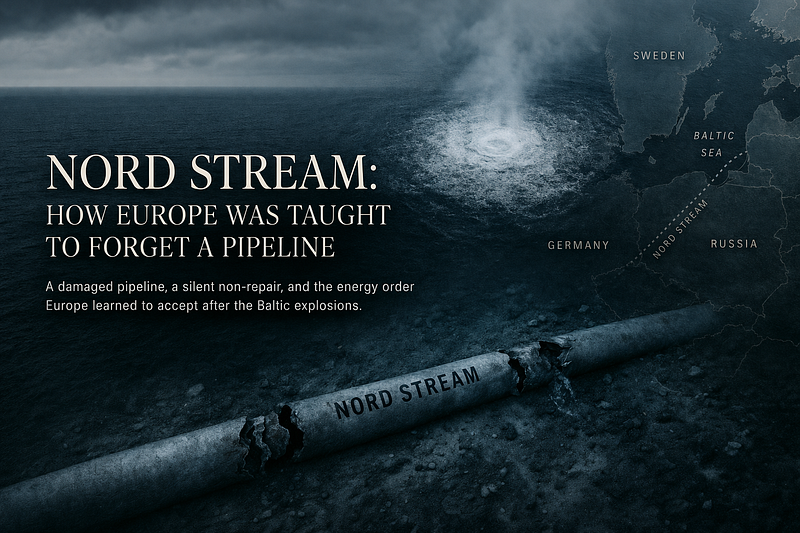
In late September 2022, something beneath the Baltic stopped. Pressure fell. Gas escaped. Wide pale circles rose to the surface near Bornholm as if the water had decided, for a moment, to show what states preferred to leave below language. Satellites caught the disturbance. Officials spoke carefully. Analysts widened the frame and then softened it again. The vocabulary settled almost at once into a set of words that would do most of the work for the next several years. Complex. Unclear. Ongoing. Under investigation.
The physical event was visible. Its meaning was kept at a distance.
And here is where almost all of the attention went to the wrong question. The question that filled the airtime was who did it: which navy, which divers, which intelligence service, which flag. That question is real, and it remains formally open, and this chapter will not pretend to answer it. But it is not the question that determined the outcome. A pipeline can be blown up on a Monday and, in principle, repaired by the following spring. Steel can be welded. Strings can be relaid. The explosion, in engineering terms, was a reversible event. What was not reversible, and what actually decided the future of European energy, was the thing that happened in the eighteen months after the blast, when nobody rebuilt it and a different order quietly hardened in its place.
The determining variable was never the bomb. It was the decision not to repair.
The Line That Made Europe Direct
For years Nord Stream represented the bluntest form of energy politics, and bluntness is exactly why it was disliked.
A pipe does not flatter language. It does not create the theater of optionality that diplomacy prefers. It links a source to a destination, and gas either moves through it or it does not. Nord Stream 1, two strings running under the Baltic with a combined capacity near fifty-five billion cubic meters a year, carried Russian gas directly into the German industrial bloodstream from 2011 onward. Nord Stream 2, a second pair of strings of similar capacity, completed in September 2021 at a cost around nine and a half billion euros, never entered commercial service. Germany suspended its certification days before the invasion of Ukraine, and so the most expensive new energy infrastructure in Europe sat finished and full of gas and legally frozen, an argument disguised as a pipe.
That distinction matters for everything that follows. Before the explosions, Nord Stream was already contested as a meaning. It stood for a relationship that German industry needed and German politics increasingly distrusted, a dependence that was cheap and reliable and, in the new climate, embarrassing. After the explosions, the contest over meaning was rendered moot, because the thing itself no longer functioned. The argument did not have to be won. The object of the argument simply stopped existing as a usable fact.
Not erased. Switched off.
What Actually Remained
Precision matters here, because the popular image of Nord Stream is of total destruction, and total destruction is not what happened.
The blasts on the twenty-sixth of September 2022 produced four leaks and ruptured three of the four pipeline strings. Both lines of Nord Stream 1 were severed. One line of Nord Stream 2 was severed. But one line of Nord Stream 2 remained intact, undamaged, technically capable of carrying gas. Steel still lay on the seabed along the whole route. The geometry survived. In a narrow engineering sense, a path from Russia to Germany still physically existed, and one string of it was ready to use.
And yet nothing flowed, and nothing has flowed since.
This is why the accurate word is not destruction but functional deactivation. The system remained materially present while its political and economic future was withdrawn. A connection can survive in steel long after it dies in policy, and the survival is more revealing than clean annihilation would have been. Total destruction closes the question. It tells you the thing is gone and there is nothing to decide. Partial survival does the opposite. It leaves a usable possibility lying on the seabed and forces a different question into view, the question the public was never quite asked to consider. Not what was damaged, but why a surviving line was allowed to drift so quickly and so completely out of serious thought. The intact string is the detail that turns an accident report into a study of choice. Something could still have flowed. The decision, made by no one in particular and by everyone through inaction, was that it would not.
The Sentence That Came Before the Event
Months before the Baltic blasts, the disappearance of Nord Stream had already been spoken aloud, and the speaking deserves exact handling.
On the seventh of February 2022, standing beside the German chancellor at the White House, the American president was asked about the pipeline. His answer was direct. If Russia invaded, he said, then there would be no longer a Nord Stream 2. We will bring an end to it, he added. A reporter asked how, given that the project sat under German control. He repeated that it would be done.
That sentence is not operational proof of anything. It does not establish who later carried out the sabotage, and it must not be read as if it does. To treat a statement of intent as evidence of authorship would be exactly the kind of shortcut this analysis refuses. But the sentence does something else, something structural, and it does it regardless of who held the detonator. It shows that the end of Nord Stream had already been named as an acceptable outcome before the event that would make that outcome real. A world without the pipeline had been spoken into the realm of the politically thinkable in advance. So when the explosions came, they did not arrive as an unimaginable rupture demanding reversal. They arrived as the early delivery of a future that had already been described.
This is the quiet work of sequence. The order in which things are said and done shapes what feels natural afterward, and an outcome announced before it happens is an outcome the public has already begun, faintly, to accept. The most consequential political statements are often not the ones that explain what happened. They are the ones that establish, ahead of time, which outcomes will later be absorbable.
The Gap That Decided
Now hold the engineering fact and the political fact together, because their intersection is the whole argument. The pipeline was reparable. The intact string could have carried gas. And yet, in the months after September 2022, no serious continental effort to restore the connection took shape. Instead, the space where Nord Stream had been was filled, with remarkable speed, by something else.
Liquefied natural gas moved in to take its place, and it did not move in like an emergency. It moved in like a plan. Floating import terminals were chartered and anchored along the German and wider European coast in months rather than years. American liquefied gas, which had supplied a modest share of European imports before the war, surged. United States deliveries to the European Union rose from under nineteen billion cubic meters in 2021 to over fifty billion in 2022, and the United States became and stayed Europe's largest single supplier of the fuel. The European Commission published its REPowerEU plan in May 2022, declaring the goal of ending reliance on Russian fossil fuels altogether. The dependence that Nord Stream embodied collapsed on a timetable that would have been called impossible a year earlier. Russian gas, which had been roughly forty percent of European Union imports in 2021, fell to around eighteen percent by 2024 and into the single digits by 2025.
This speed is the most revealing detail in the entire affair, and it is routinely mistaken for resilience. A true vacuum produces confusion, improvisation, visible scramble. What Europe displayed instead was the rapid, orderly installation of an alternative architecture, which is the signature not of chaos but of prepared absorbability. The space was not empty. It was waiting to be filled, and the filling went so smoothly that within a single heating season the question of restoring the old line had become almost eccentric to ask.
That is the mechanism, and it has nothing to do with who planted the explosives. The eighteen months of non-repair were not a pause before a decision. They were the decision. While the pipeline lay unrepaired, the cost of the alternative was being sunk into steel and contracts and terminals and habits, and every month that passed raised the cost of ever going back. By the time anyone might seriously propose a return, the return had become the expensive option, because an entire continent had already rebuilt itself around the substitute. The bomb opened a window. The refusal to repair, sustained just long enough, let a new order climb through it and lock the frame from inside.
There is a dry name for this in economics, path dependency, the property of a system whose available options are narrowed by the accumulated weight of the steps already taken. Each floating terminal anchored, each multi-year supply contract signed, each industrial process re-engineered for a different fuel, was a step that did not have to be reversed so much as outgrown, and the further the sequence ran, the more a return to the pipeline meant undoing not one explosion but an entire interlocking order built in its absence. The cost of going back did not stay constant while Europe deliberated. It rose, every month, automatically, as the substitute sank deeper into the continent's infrastructure. This is the same logic that governs every deep dependence: the determining variable is seldom the dramatic event but the switching cost that gathers quietly around it afterward. The explosion was spectacular and, by itself, changed little. The accrual was invisible and changed everything.
A pipeline can be rebuilt in a year. The order that replaces it cannot be unbuilt at all.
Fixed Power and Liquid Power
The substitution was not only a change of supplier. It was a change in the form through which energy, and therefore leverage, travels.
A pipeline is a particular kind of object. It is fixed, anchored, bilateral, relationship bound. It ties one supplier to one consumer in a mutual structure that resists daily improvisation, and the mutuality cuts both ways, because the seller is as bound to the buyer as the buyer is to the seller. Liquefied gas belongs to a different order entirely. It is movable, tradable, reroutable, priced by a global market, loaded onto ships that can change destination mid-voyage. It dissolves the rigid two-party bond of the pipe into a fluid web of cargoes and spot prices and long-term contracts with distant exporters.
This shift is regularly described as resilience, and sometimes it genuinely is. A buyer with many possible cargoes is less hostage to any single seller than a buyer wired to one pipe. But flexibility is not the same as freedom, and the liquid order has its own distribution of advantage. It favors the exporters with scale, with fleets, with terminal networks and contracting reach and the financial depth to play a global market. It replaces the blunt, cheap, legible interdependence of a pipeline with a looser, more expensive, more mediated dependence on maritime supply chains and the handful of powers that dominate them. Europe did not move from dependence to independence. It moved from one shape of dependence, fixed and direct and reciprocal, to another, liquid and distant and priced in dollars. That is not neutrality. It is a redesign, and redesigns have designers, or at least beneficiaries.
Who the New Order Rewards
If a redesign has beneficiaries, it is worth naming them, carefully and as a matter of structure rather than accusation.
The liquid order rewards those equipped to dominate it. The United States, which had been a marginal supplier of gas to Europe, became its largest, its export terminals running at capacity to fill the space the pipeline had held. Qatar and a handful of other large exporters gained leverage and long-term contracts. The pricing moved from the relative stability of a bilateral pipeline deal to the swings of a global market quoted in dollars, which means a portion of European energy security now depends on shipping lanes, terminal availability, and the willingness of distant suppliers to direct cargoes toward Europe rather than the higher bidder in Asia. None of this requires anyone to have plotted it. It is simply the distribution of advantage that follows from the form. A pipeline binds two parties to each other. A global LNG market binds many buyers to the few sellers with scale, and the few sellers compete far less fiercely than the many buyers.
This is the part most easily lost in the language of resilience. Europe did buy itself out of a dangerous dependence on a hostile supplier, and that is a real gain that should not be waved away. But it bought its way into a more expensive and more globally exposed dependence in exchange, and the difference between the two is not freedom. It is a different creditor. The continent traded a cheap, rigid, reciprocal bond for a costly, flexible, asymmetric one, and called the trade maturity. The asymmetry is the point. In the old order Russia needed European customers as much as Europe needed Russian gas. In the new one, Europe needs the global market more than the global market needs Europe.
The Room Where This Lands
All of this is usually narrated at the altitude of statecraft, in presidents and ministries and sanctions packages. But structures do not land at that altitude. They land in rooms.
A chemical works at Ludwigshafen does not experience Nord Stream as geopolitics. It experiences it as numbers that stop behaving the way they used to. Energy-intensive production that penciled out comfortably on one spreadsheet begins to look exposed on the next. Europe's largest chemical producer, anchored at that site for a century and a half, announced in the aftermath of the energy shock that it would permanently shut plants and cut thousands of jobs there, citing energy costs and the eroding competitiveness of European production. That decision was not made in the language of the Baltic or of sabotage. It was made in the language of margins, and margins are how a continental structural change actually enters human life.
This is the texture the geopolitical frame misses. Great shifts rarely arrive as drama. They arrive as revised calculations. Not first as history, but as a budget that no longer closes. Not first as speeches, but as a supply contract that has to be rewritten at a worse price. Not first as theory, but as a factory floor that hesitates before the next expansion and then quietly decides against it. The end of cheap piped gas did not announce itself to the German worker as the end of an era. It announced itself as a shift notice, a closed line, a town where the largest employer is now smaller. The macro becomes the micro without ever passing through a moment anyone would recognize as the decision.
What Europe Learned to Accept
The deepest layer of the story is not material at all. It is what the continent learned to feel about its own narrowing.
The disappearance of Nord Stream was followed not by a sustained demand to restore the connection but by adaptation to its absence, and the adaptation came wrapped in a particular vocabulary. Higher costs were moralized. Structural exposure was presented as maturity. The burden of a more fragile and expensive energy model was reframed as principle, as the price of standing on the right side of a war. Energy vulnerability was translated, almost seamlessly, into the language of strategic adulthood, so that to question the new arrangement began to sound like nostalgia for a compromised past.
None of this means the constraints were imaginary. The war was real. The case for cutting dependence on a hostile supplier was real and strong. But the reframing did something beyond responding to necessity. It taught a continent to experience a reduction in its room for maneuver as a form of virtue, which is the most durable way to make a reduction permanent. A people that resents a constraint will look for the first chance to escape it. A people that has been taught to see the constraint as evidence of its own maturity will defend it. Europe did not merely lose a line and absorb the cost. It learned a posture, in which the narrowing of its options reads as proof of its seriousness, and that posture is far harder to reverse than any pipeline, because it lives in how the loss is understood rather than in the steel on the seabed. A continent can be narrowed without ever being told, in a single plain sentence, that its room has been reduced. It only has to be taught to call the reduction by a better name.
The Reaction That Did Not Come
An attack on the critical infrastructure of a major economy should, by every ordinary expectation, produce a furious clarity. Urgent attribution. Escalatory language. A continental demand to find the culprit and a parallel demand to rebuild what was lost. Part of that did eventually happen, and part of it conspicuously did not, and the gap between the two is the point.
The forensic machinery did grind forward, slowly. Sweden and Denmark both closed their national investigations in early 2024, confirming sabotage while declining to bring domestic cases, and Sweden passed its material to Germany. The German federal prosecutor pressed on. Arrest warrants were issued for Ukrainian nationals alleged to have been part of a small team that planted the explosives from a chartered sailing yacht. One suspect, a former Ukrainian officer, was arrested in Italy in August 2025 and extradited to Germany that November, where a court ordered him held. As of the middle of 2026 no one has been tried or convicted, and the case continues.
That record demands a careful sentence, because it is the easiest place in this whole subject to overclaim. The German prosecution's theory points to a group of Ukrainian individuals. It has not established, and no court has found, that any state ordered the operation. Kyiv denies involvement. The honest position is that the perpetrators are, as a matter of law, undetermined, and that the strength of the argument here is precisely that it does not depend on the answer.
Because notice what the investigation was for, and what it was not for. It pursued the narrow forensic question of who physically planted the charges. It never addressed, because it was never its job to address, the far larger question that actually shaped Europe's future. Should the line be rebuilt? That question was never put to any parliament, any electorate, any continental debate equal to the scale of the loss. There were inquiries into the crime. There was no reckoning about the consequence. The machinery worked hard on the wound and left the amputation entirely unexamined. Silence, here, was not the absence of all activity. It was activity carefully confined to the question that changed nothing, while the question that changed everything was settled by drift.
Complexity as a Solvent
The words arrived early and stayed. Complex. Unclear. Ongoing. Possible. Under investigation. None of them is false. That is what makes them effective.
Their function is not to explain but to dissolve. They suspend closure. They prevent the event from concentrating into a single politically dangerous meaning that a public could rally around and act upon. An event that remains permanently complex is an event no one can be made to answer for, and an outcome no one is made to answer for is an outcome that simply stands. Complexity, in the modern crisis, performs the role that secrecy once performed more crudely. It does not hide the facts. It scatters them, finely enough that they never cohere into a demand. The result is not understanding. It is a managed diffusion, and in the time that diffusion buys, the replacement order finishes becoming normal.
The Decree That Came Late
There is an obvious objection to all of this, and the events of 2025 and 2026 sharpened it rather than answering it, so it has to be met directly.
The pipeline was reparable, the objection runs, and one string still works, and far from being quietly forgotten, Nord Stream became the subject of active efforts to bring it back. This is true, and it is documented. Through 2025 and into 2026 an American investor pursued the bankrupt owner of Nord Stream 2 with a view to buying the asset, pitching United States ownership as leverage in negotiations over Ukraine, and was reported to have met senior German officials about it as late as the spring of 2026. There were reports, attributed to German media, of quiet American and Russian discussions about a restart tied to a broader reset with Moscow. The line was not gone from the world. It was being actively fought over.
But look at how the fight resolved, because the resolution proves the mechanism rather than refuting it. The German government moved hard to block any restart. The chancellor said Germany would do everything to prevent it. And at the level of the whole union, the political answer finally arrived in the form of law: in January 2026 the European Union adopted a regulation banning Russian pipeline and liquefied gas imports, with the first prohibitions taking effect in March 2026 and a complete ban to follow. After more than three years, the decree that had never been issued was issued at last.
Notice what the decree did. It did not make a fresh choice. It ratified one that had already been made, structurally, by the eighteen months of non-repair and the years of LNG buildout that followed. By 2026 the cost of returning to Russian pipeline gas was no longer mainly a question of welding steel. It was the cost of unwinding an entire alternative system that had been physically built, contracted, and habituated in the interval. The ban did not close a door that was open. It bolted a door that had already swung shut on its own, and then declared the bolting to be policy. This is the modern shape of an irreversible decision: not a proclamation at the moment of action, but a long silence during which the facts settle, followed by a late decree that calls the settled facts a choice. The fait accompli comes first. The decision arrives afterward, to sign it.
Distributed Consent
What is striking about the whole sequence is that no single actor ever had to stand up and bless it.
No one announced that the era of direct Russian-German energy interdependence was over forever. No ceremony marked its burial. And yet every relevant party behaved as though the burial had already been agreed. Ministries adapted. Markets repriced. Industries recalculated their long-term assumptions, the chemical plants and steelworks that had been built on the premise of cheap piped gas absorbing the new costs as a fact of life rather than a question of policy. Publics adjusted their expectations. Allies refrained from reopening the wound at any scale that might have forced a confrontation. Agreement was never declared because it never needed to be. It was distributed across a thousand separate acts of adaptation, each individually reasonable, that together amounted to a continental decision no one had consciously taken.
This is one of the quietest forms of stabilization there is, and one of the hardest to contest, because there is no decision to point at and no decider to hold responsible. You cannot protest a drift. You cannot vote against an accumulation of margins. By the time the public might think to ask whether the old connection should return, the asking itself has come to feel historical, a question about the past rather than the present, and that feeling, more than any treaty, is the real achievement.
The Larger Pattern
Lift the case above the Baltic and the shape of it recurs, because ending by non-repair is not unique to a pipeline. It is becoming a general technique for how advanced systems retire things they no longer want without paying the political price of abolishing them.
Abolition is expensive. It requires a decision with a date and an author, and a decision with a date and an author can be opposed, litigated, voted against, reversed by the next government, and remembered as the act of the people who took it. To formally tear something down is to hand its defenders a rallying point and a villain. The quieter method avoids all of that. You let the thing stop, for whatever immediate reason, and then you simply decline to restart it. No date. No author. No proclamation to protest. The arms-control agreement that is allowed to lapse rather than be renounced. The institution that is defunded into irrelevance rather than closed. The program that is paused for review and never resumes. In each case nothing is killed, which means nothing can be mourned at a specific moment, and the absence is allowed to set into permanence while attention drifts elsewhere. By the time anyone asks whether the thing might return, the world has rebuilt itself around its absence, and the question feels like nostalgia.
What makes the method so effective is that it never produces the moment of confrontation that resistance needs. Opposition requires an event to oppose. A demolition is an event. A slow non-return is not. You cannot hold a protest against a thing that is merely still not happening, cannot vote against an accumulation of quiet adaptations, cannot name the official responsible for an outcome that no official ever signed. The decision dissolves into a thousand smaller behaviors, each defensible, none decisive, and the sum governs while remaining, formally, no one's choice at all. This is why the late decree, when it finally comes, feels so anticlimactic. By the time the European Union wrote Russian gas out of its law, the law was describing a world that already existed. The statute did not end the relationship. It notarized an ending that the silence had already accomplished.
The Manifest's recurring question is not who holds power but what determines an outcome, and the Nord Stream case answers it with unusual clarity. The outcome was not determined by the hand that placed the charges, whoever it proves to have been. It was determined by the structure of non-repair, by the speed of the replacement, and by the long interval in which a continent rearranged itself around a loss it was never formally asked to accept. The spectacular question, the one with the divers and the flags, will be answered eventually in a German courtroom. The structural question was answered years ago, in silence, by everyone and no one.
What Was Allowed to Function
Somewhere beneath the Baltic the steel still lies, cold and mute and partly intact. One string could still carry gas. An engineer could trace the route. A map can still draw a line from Russia toward Germany. The old geometry has not gone anywhere.
But history is not made only of what exists. It is made of what is allowed to function. Nord Stream is the case that shows the difference, because it was never fully destroyed and it was never formally killed, and it ended anyway. It ended in the gap between the explosion and the repair that did not come, in the months when an alternative hardened into permanence while everyone waited for a clarity that was never going to arrive. The bomb was the event everyone watched. The non-repair was the decision no one announced. Destruction would have been reversible. Abandonment, sustained just long enough for the replacement to set, was not.
That is the lesson worth carrying past this one pipeline. The modern way to end something is not to abolish it, which invites resistance and leaves a date to protest. It is to let it stop, decline to restart it, and allow the world to rearrange itself around the absence until returning becomes unthinkable. By the time anyone writes the decree, the decree is a formality. The thing was over long before, decided not by a hand on a switch but by the slow accumulation of everyone's adjustment to its being off.
Go back, one last time, to the surface of the Baltic in those first days, to the pale circles of escaping gas turning the grey water white. That boil was the only moment the whole hidden architecture was ever visible to an ordinary eye, the one time the submerged steel announced itself before sinking back out of attention. Within a week the sea had closed over the circles and was flat again, as if nothing had risen from below at all. The pipeline did not vanish in that disturbance. It was still down there, most of it intact, one line of it ready to carry gas the day anyone chose to send it. What vanished was the future in which Europe still expected to use it, and that future did not end in the explosion. It ended in the calm that followed, in the long flat years when the water gave nothing away and no one rebuilt what lay beneath it.
The pipe remains. The relation does not. And that is how Europe was taught to forget.
Evidence Map
Facts, interpretations, forecasts, and disconfirming signals.
Core claim. The determining variable in Nord Stream's end was not the September 2022 sabotage or its still-undetermined authorship, but the sustained decision not to repair the pipelines. During the months of non-repair, an alternative liquefied-gas order was physically built and habituated, sinking switching costs that made a return progressively unaffordable. The 2026 European Union import ban did not make this choice; it ratified a path dependency the non-repair window had already established.
Evidence level. Facts: high. Documented: Nord Stream 1 and 2 capacities (about 55 bcm each), NS2 completion in 2021 at roughly 9.5 billion euros and its never entering service, the 26 September 2022 sabotage rupturing three of four strings with one NS2 line intact, the 7 February 2022 statement by the American president, the closure of the Swedish and Danish investigations in 2024 and the German case including the 2025 arrest and extradition of a Ukrainian suspect (no conviction, no established state authorship), the collapse of the Russian share of EU gas from about 40 percent in 2021 to single digits by 2025, the surge of US LNG, REPowerEU (2022), the 2025-2026 restart efforts, and the EU import ban adopted in 2026. Interpretation: medium, marked. Reading non-repair as the determining variable, and the late ban as ratification of an existing path dependency, is an analytical conclusion. The piece makes no claim about who carried out the sabotage.
What would confirm this. Continued legal and physical entrenchment of the LNG order; the EU ban hardening rather than loosening; restart proposals failing on cost and path dependency rather than on politics alone.
What would disprove this. An actual restart of Nord Stream returning Russian pipeline gas to Germany at scale, which would show the abandonment was politically reversible and not a structural lock-in. The active 2025-2026 restart efforts make this a live and testable question rather than a settled one.
Watchlist. The fate of the bankrupt Nord Stream 2 AG and any sale; the durability of the 2026 EU import ban; whether any peace settlement over Ukraine reopens the pipeline question; the German prosecution's case as it moves toward trial.
Related from The Manifest Archive