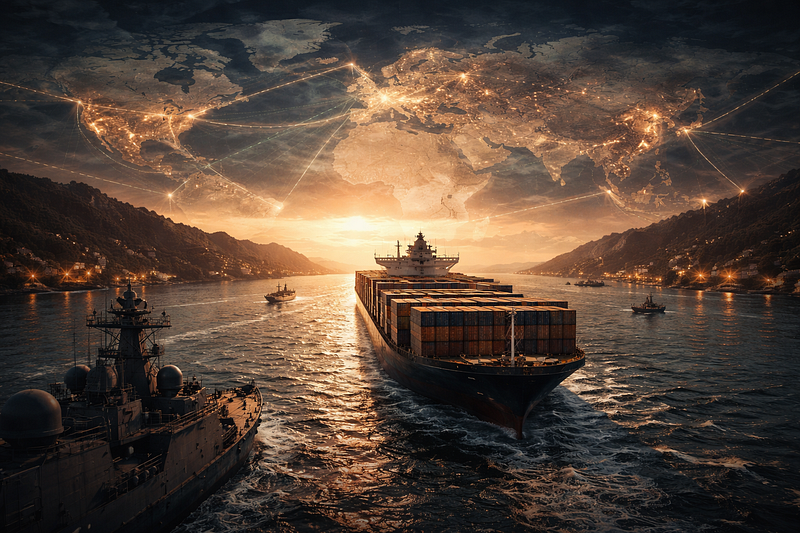
A container ship slows in open water.
Not because of weather.
Not because of damage.
A routing instruction updates.
An insurance threshold recalculates.
A port slot disappears.
No announcement is made.
No official explains the delay.
Nothing about the moment appears political.
And yet factories, supermarkets, energy grids, currencies, and employment curves depend on its uninterrupted motion.
On a school map, the world looks settled.
Continents are colored. Borders are drawn. Capitals shrink to dots. Oceans are filled with a single shade of blue. Background. Empty. Passive.
Nothing appears to happen there.
Somewhere far from any capital, the ship continues its slow correction. An AIS signal blinks on a logistics screen. A timetable shifts by minutes. An algorithm absorbs the cost.
If the ship slows, nothing happens at first.
Then something else does.
This chapter belongs to a broader line within the Manifest. One that does not ask who is right, but what keeps repeating, and why. It does not begin with belief or ideology, but with movement.
The Planet We Keep Misreading
More than seventy percent of the Earth’s surface is covered by water. By volume, roughly eighty to ninety percent of global trade moves by sea. Energy, food, raw materials, industrial components, and the ordinary objects that quietly sustain daily life all travel this way.
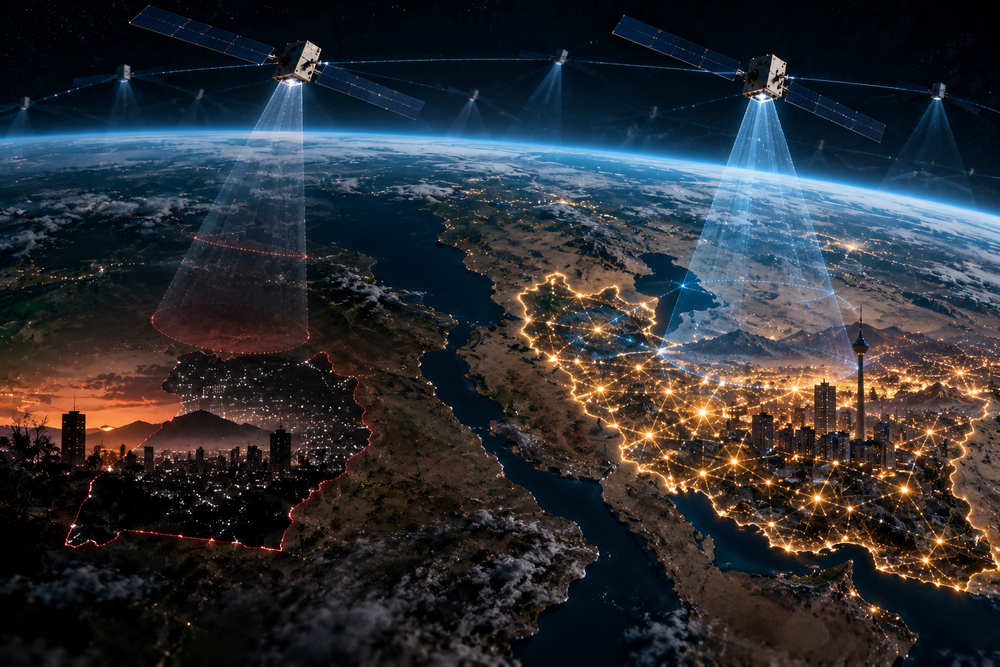
Even most intercontinental digital traffic does not move through satellites, but through fiber-optic cables laid silently across the ocean floor.
Most people only notice shipping when something they expect does not arrive.
And still, political analysis remains overwhelmingly terrestrial.
We debate borders, elections, alliances, sovereignty, ideology. Territory becomes moral. Institutions become theatrical. Logistics is treated as background, procedural, neutral.
Water is everywhere, yet politically absent.
Not because it is marginal, but because it resists narration. Water has no voters, no flags, no parliaments. It does not lend itself to speeches or moral claims. It does not ask to be believed.
It simply carries.
That quality makes it an ideal domain of power.
Power Without Ownership
Land-based empires rule by possession. They conquer territory, administer populations, extract resources. Their power is visible, bureaucratic, heavy.
Maritime power operates differently.
A sea-based system does not need to govern land in order to determine outcomes. It only needs to shape movement. Control of chokepoints, shipping lanes, ports, insurance markets, and access determines who trades, who grows, who stalls.
This is power exercised through continuity rather than conquest.
Smaller states understood this early. The Dutch Republic, constrained on land, expanded influence through shipping, finance, cartography, and insurance. The VOC was not a merchant venture that happened to carry weapons. It was a logistics system with cannons attached.
Britain refined the model. The empire did not dominate because it owned the seas, but because it kept them open for itself and precarious for others.
The United States did not invent this logic.
It inherited it, scaled it, and globalized it.
The United States as a Maritime System
The United States is commonly described as an ideological actor, driven by values, ambition, or exceptionalism. That framing obscures something more basic.
Geography made choice secondary.
Isolated by two oceans, bordered by weak neighbors, embedded in a global economy dependent on maritime trade, U.S. security became inseparable from sea control. Carrier strike groups, overseas bases, naval patrols, freedom-of-navigation operations.
These are not expressions of temperament.
They are maintenance.
American power appears global not because it seeks everywhere, but because the routes do. Administrations change. Language shifts. Corridors remain.
The system cannot simply withdraw. Retreat would mean relinquishing the very channels that sustain it.
When Routes Become Reflexes
This is where logistics quietly turns into politics.
Once trade routes are treated as vital, everything connected to them changes character. Economic interests become security interests. Commercial disruptions are reframed as threats. Infrastructure ceases to be neutral when its failure would cascade across systems.
What matters is not profit, but continuity.
This produces a specific pattern of behavior. Often read as aggression, but better understood as reflex. When a route appears vulnerable, response precedes deliberation. When access is questioned, escalation accelerates. When flow is threatened, restraint evaporates.
Political intention enters late.
Logistics enters first.
The Moment Maintenance Became Enforcement
In 1987, the United States Department of Defense published The Maritime Strategy.
The document stated explicitly that global sea lines of communication constituted a vital national lifeline, and that threats to these routes justified forward presence, pre-emptive positioning, and escalation outside formal declarations of war.
At the same time, internal assessments warned of the consequences. Escalation risks. Civilian disruption. Chokepoint instability. Blowback in narrow straits where commercial and military traffic converged.
Alternatives existed. Regional security frameworks. Shared patrol mechanisms. Multilateral maritime governance models. Diplomatic containment strategies.
They were examined.
They were not adopted.
Instead, presence was normalized. Patrols became permanent. Deterrence shifted from conditional to continuous. Maintenance hardened into doctrine.
From that point forward, withdrawal ceased to be a political option without systemic damage.
This is the moment continuity turned into compulsion.
The Scale We Rarely Picture
Most people associate global movement with air travel. Aircraft are visible. Airports are loud. People experience them personally.
But air transport is almost irrelevant to how the world actually functions.
By volume, roughly eighty to ninety percent of global trade moves by sea. Air freight carries a fraction of cargo weight, despite accounting for a disproportionate share of monetary value.
Aircraft move what is light, expensive, and urgent. Ships move what keeps societies alive.
A single ultra-large container vessel can carry more than twenty thousand containers in one voyage, the equivalent of hundreds of cargo planes or tens of thousands of trucks, at a fraction of the energy cost.
This is not a technological preference.
It is a physical constraint.
If air transport stopped tomorrow, economies would suffer disruption. If maritime shipping stopped, shortages would cascade within weeks.
Power follows what sustains life, not what captures attention.
Where Tension Always Returns
Once trade routes are treated as primary variables, the map reorganizes itself.
Cuba ceases to be an ideological anomaly and becomes a geographic fact, sitting astride maritime access to the Gulf of Mexico and the U.S. eastern seaboard.
The Suez Canal is not a regional issue. It is a global artery. When a single container ship blocked it in 2021, roughly twelve percent of global trade stalled.
Crimea is not symbolic. For Russia, access to the Black Sea is structural.
Taiwan is not primarily about political systems. It is about access to the Pacific and control over supply chains that move by water.
Greenland appears empty on land. At sea, it is a hinge.
Different regions. Same geometry.
A View From Outside the System
In European ports, this reality is felt differently.
For decades, maritime flow was experienced as background. Goods arrived. Energy moved. Schedules held. Security was assumed to be structural, not enforced.
Only recently did that assumption begin to thin.
When routes tightened, when insurance premiums shifted overnight, when escorts appeared where commercial traffic once moved alone, the message was not announced.
It was inferred.
Ports continued to operate. Containers kept stacking. Cranes kept moving.
But the sense changed.
Flow was no longer something Europe participated in. It was something it depended on, and no longer fully controlled.
In East Asia, the awareness came earlier.
There, the sea was never neutral. Routes were always watched, passages always weighed. Access was understood not as a given, but as a condition.
What surprised European observers was not the presence of power, but its sudden visibility.
What did not surprise Asian ones was that visibility followed dependence.Where Force Gathers, Flow Is at Stake
Once routes are centered, military presence across the globe reorganizes itself.
From the South China Sea to the Strait of Hormuz, from the Red Sea to the Black Sea, armed force concentrates where movement cannot be allowed to fail.
What is called instability often marks locations where flow is non-negotiable.
Djibouti hosts military installations from multiple global powers within a few kilometers of one another. The explanation lies offshore.
Where flow cannot fail, force does not withdraw.
As routes are defended, the boundary between civilian and military space erodes automatically. Ports unload consumer goods and host naval vessels. Shipping lanes carry grain and equipment.
There is no clean separation.
When the Actor Stops Explaining the System
At this point, U.S. decisions no longer explain U.S. behavior.
The pattern persists even when administrations change, warnings accumulate, and outcomes contradict declared values.
The actor is no longer driving the system.
The system is preserving itself.
Why Ideology Fills the Gap
This framework does not explain everything.
It explains why the same places absorb pressure long after their stated meanings change.
Acknowledging dependence exposes vulnerability. To admit that power rests on routes is to reveal where it can be disrupted. It shifts legitimacy from values to maintenance.
Ideology provides safer language.
No one needs to lie. The system simply avoids describing itself too clearly.
Water remains the blind spot because it is too honest.
Seen this way, many debates feel less like disagreements and more like rituals performed around conclusions infrastructure has already reached.
Closing Reflection
Within the Manifest, this chapter functions as a structural lens, not a conclusion. It is meant to reorder how other conflicts are read, not to close debate.
We live on a water planet.
We analyze it as if it were land.
As long as ideology substitutes for structure, behavior that is consistent will continue to appear surprising.
Remember where it began.
In movement, not belief.
And movement does not ask permission.
Related from The Manifest Archive