I keep thinking the world can’t sink lower. And then it does, quietly, efficiently, on schedule.
Not with a single cinematic rupture, not with a trumpet blast that announces a new era, but with the kind of movement that looks almost managerial. A briefing. A statement. A “response.” Another line added to the list of things we now absorb before lunch.
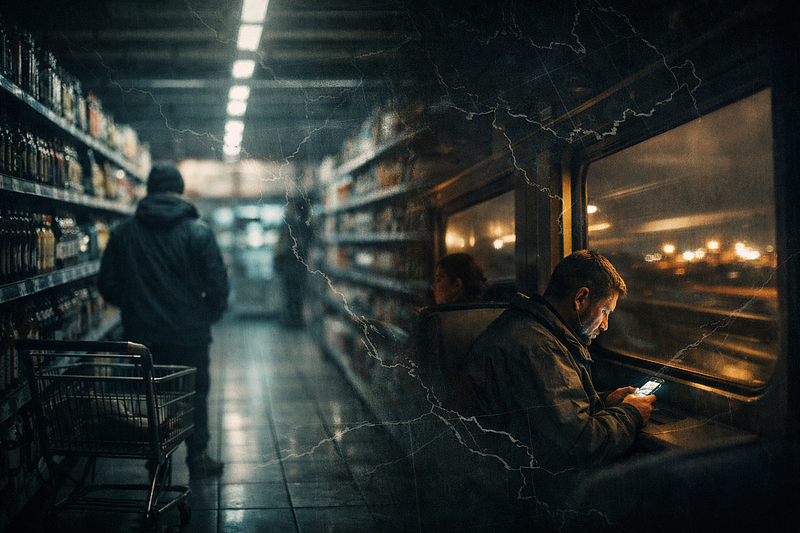
I felt it the other day in a place that should have been safe from geopolitics. A supermarket aisle, fluorescent light, a cart that squeaked on the tiles. Someone ahead of me hesitated over cooking oil and coffee, not because they could not choose, but because the numbers had become a mood. That is how it arrives now. The global turns up in ordinary life without knocking.
For a while, Ukraine held the role of the unthinkable made permanent. A European war that did not end, but hardened. A front line that turned into a system. Budgets, training pipelines, ammunition lines, drone footage that scrolls like weather.
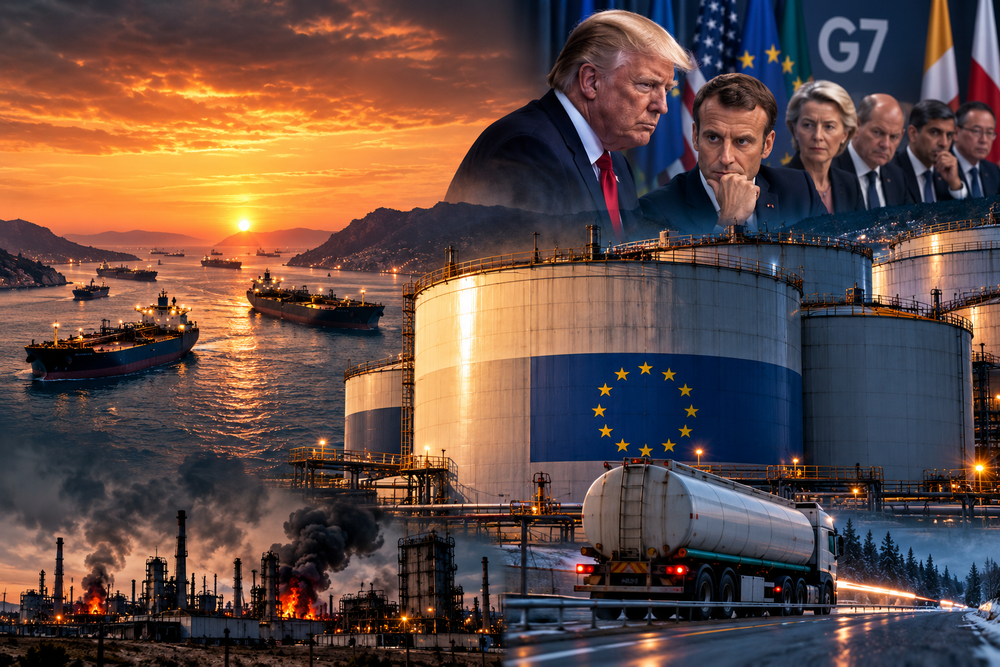
Now Iran enters the frame in a different way. Less like a distant theater and more like a spark near the wiring. Because the Middle East is rarely only the Middle East. It is fuel, shipping, insurance, political nerves, and the global economy’s thin margin for surprise.
And when a country is attacked while diplomacy still exists on paper, something subtle changes in the air. The map does not just shift. The meaning of restraint shifts with it.
“Every escalation teaches the world what it can get away with.”
Ukraine war: when endurance becomes infrastructure
Ukraine no longer feels like “an event.” It feels like a permanent load on the system. The kind of load that reshapes everything around it.
You can hear it in the language. The way people speak about “packages” and “capabilities” and “production capacity.” The way leaders frame the war as endurance, as resolve, as time. The way the public learns to accept a conflict as a background condition, like inflation, like weather, like a bad year that somehow becomes five.
The most disturbing part is not that wars last. Wars have always lasted.
It is that the war has become a machine with its own logic. Every week demands replenishment. Every shortage demands adaptation. Every new tactic becomes a new baseline.
Even the numbers have begun to sound like maintenance rather than momentum. One analysis cited today put Russia’s February 2026 advance at 123 square kilometers, its slowest monthly gain since April 2024. The figure does not signal peace. It signals something colder. This can continue. This can be sustained. This can become ordinary.
And in that ordinary, the moral and political space changes. What once sounded like escalation becomes “support.” What once sounded like risk becomes “deterrence.” What once sounded like panic becomes “planning.”
“A war that lasts long enough stops feeling urgent. It starts feeling normal.”
The war in Iran: the spark near the wiring
Iran is different because the coupling is faster.
Ukraine is a war of territory and attrition that slowly rearranges Europe’s security architecture. Iran is a war that can instantly rearrange prices, routes, and political stability far beyond the region.
If a strike hits near energy infrastructure, markets do not wait for confirmation. They move on fear. If shipping risk rises, insurance premiums rise with it. If premiums rise, prices rise. If prices rise, governments tighten. If governments tighten, people feel it.
That chain is not abstract. It is the spine of the modern world.
This is where the vertigo begins, because the conflict does not stay inside its own headlines. It travels through chokepoints. It changes the behavior of ships before it changes the behavior of armies. It moves through spreadsheets before it moves through speeches.
In the Strait of Hormuz, vessel traffic has reportedly fallen around 80%, with war risk insurance being cancelled and rerouting already pushing freight costs into extremes. That is the kind of detail that sounds technical until you realize it is the moment where the map reaches your daily life.
The war travels. Not with troops. With costs.
“Geopolitics reaches ordinary life through the checkout line.”
World economy: when the margin disappears
The world economy can absorb shocks. It has absorbed so many that we almost treat resilience as proof of invincibility.
But resilience is not the same as health.
Resilience often means that the cost is being carried somewhere, by someone, quietly. It means households adapting downward. It means governments borrowing more. It means central banks walking a line between stability and strain. It means businesses delaying investment because uncertainty is a tax that cannot be deducted.
The problem with overlapping crises is not that any one shock is fatal. It is that the margin disappears.
You can watch that margin get eaten in real time when energy risk returns. In the eurozone, inflation rose unexpectedly to 1.9% in February 2026, and the detail underneath it matters. Core inflation moved up to 2.4%, services inflation to 3.4%, and economists explicitly pointed to Middle East tensions as a source of renewed uncertainty. These are not dramatic numbers. They are the kind of numbers that tighten a society slowly, like a belt pulled one notch at a time.
Ukraine continues to demand resources and attention. Iran adds volatility to energy and shipping. Other tensions keep simmering, as if the world has forgotten how to return to a lower temperature.
This is how pressure becomes a permanent condition. Not spectacular enough to unify people, not calm enough to let them breathe.
“The global economy does not collapse all at once. It compresses.”
World War III risk: not one war, but collision
When people say “we are a step closer to World War III,” they rarely mean a single cataclysmic declaration.
They mean something more modern and more dangerous: coupling.
They mean that conflicts no longer stay in their assigned lanes. That every escalation sends signals across alliances, supply chains, cyber space, energy corridors, and domestic politics. That the world begins to resemble a room filled with exposed wiring, where one spark can travel.
You can keep calling this a sequence of separate crises. Or you can look at the architecture that makes escalation easier than restraint, the same logic explored in NATO: The Façade of Peace and the Architecture of Power
A world war is not necessarily a single war. It can be a collision of systems.
A strike becomes a precedent. A precedent becomes a policy. A policy becomes a doctrine. A doctrine becomes a trap, because stepping back becomes politically unaffordable. Nobody wants to be the leader who “blinked.” Nobody wants to admit miscalculation. Nobody wants to tell their public that restraint is wiser than revenge.
So the ladder keeps being climbed.
Not always because leaders are reckless, but because the incentives punish restraint and reward posture.
“World war rarely begins with one decision. It begins when the stop button disappears.”
How normalization works: escalation as procedure
What unsettles me most is not only what happens. It is how it is explained.
The modern age is fluent in justification. Every action arrives with a vocabulary that makes it feel inevitable. Self-defense. Proportionality. Red lines. Credibility. National security. Stability.
The words are designed to calm, not to clarify.
And when you hear them often enough, your nervous system adjusts. You stop reacting to the presence of war and start reacting only to its scale. You stop being shocked that something happened and start being shocked only when it is unusually big.
That is normalization.
It does not ask for your agreement. It trains your baseline.
Here is the sentence that has started to haunt me. Violence no longer needs to be sold as virtue. It only needs to be filed as necessity.
“Emergency becomes routine. Routine becomes permission.”
What it does to you: the half-life of shock
There is a particular exhaustion to living inside overlapping crises.
You can analyze the logic. You can track the alliances. You can explain the incentives. You can read the statements and see the structure.
But the body registers something else.
A low-grade tension. A sense that the future is narrowing. A feeling that the world is becoming less forgiving, less buffered, more brittle.
I noticed it one evening on a late train, the Netherlands sliding past as dark fields and scattered lights. Across from me, a man in a work jacket watched short clips with the sound off, his thumb moving with the practiced speed of someone who had been doing it for years. A woman nearby glanced at a headline, exhaled, and put her phone face down as if the gesture could make the world quieter.
Nobody spoke. Nobody argued. Nobody panicked.
Everyone just carried it.
The scroll becomes ritual. The update becomes pulse. The previous shock is replaced before it finishes landing.
You learn to live in a halfway-state. Not panicking, but never fully relaxed.
And this is one of the quiet tragedies of our time. We are being trained to tolerate more.
“We are becoming accustomed to the unthinkable, and that is a kind of defeat.”
Why this is a Manifest chapter: patterns, not headlines
In The Manifest, the point is not to chase the day’s outrage. The point is to see the architecture underneath.
Ukraine and Iran are not separate stories. They are different rooms in the same building.
In one room, you see industrial endurance and a war that becomes infrastructure. In another, you see escalation that touches energy, routes, and prices with immediate force.
Under both rooms lies the same floor: legitimacy, alliances, incentives, and the language that turns extreme actions into administrative steps.
Different flags. Similar mechanisms.
And this is why the personal voice matters here. Not because feelings are the proof, but because feelings often register the shift before the mind catches up.
Closing reflection
It is early March 2026, and for the first time in a long time, I feel pessimistic about where this ends. I hope I’m wrong. Not because hope is a strategy, but because silence isn’t. I keep writing as a way of refusing the numbness that makes escalation easy, the kind of numbness that lets people accept the next step simply because it arrived in the correct vocabulary.
I keep thinking the world can’t sink lower. And then it does.
Not loudly. Not dramatically.
On schedule.
Silence is consent. So I’m writing.
Related from The Manifest Archive