In 1945, an American military officer in occupied Germany wrote a one-line security verdict on a German engineer named Arthur Rudolph: "100% Nazi, dangerous type, security threat." Rudolph had run the underground factory where the V-2 rocket was assembled by concentration-camp prisoners, thousands of whom died at the work. By the standard the United States had just set for itself, he was precisely the kind of man it had promised never to admit.
A few years later, a new file on the same man, written by the same government, concluded that there was "nothing in his records indicating that he was a war criminal or an ardent Nazi or otherwise objectionable." Same man. Same deeds. Different file. Arthur Rudolph became an American, helped build the rockets that would carry astronauts toward the Moon, and lived a decorated career until, four decades later, the first file caught up with him and he left the country rather than answer for it.
This is the story of how the second file got written. It is a more important story than the rockets.
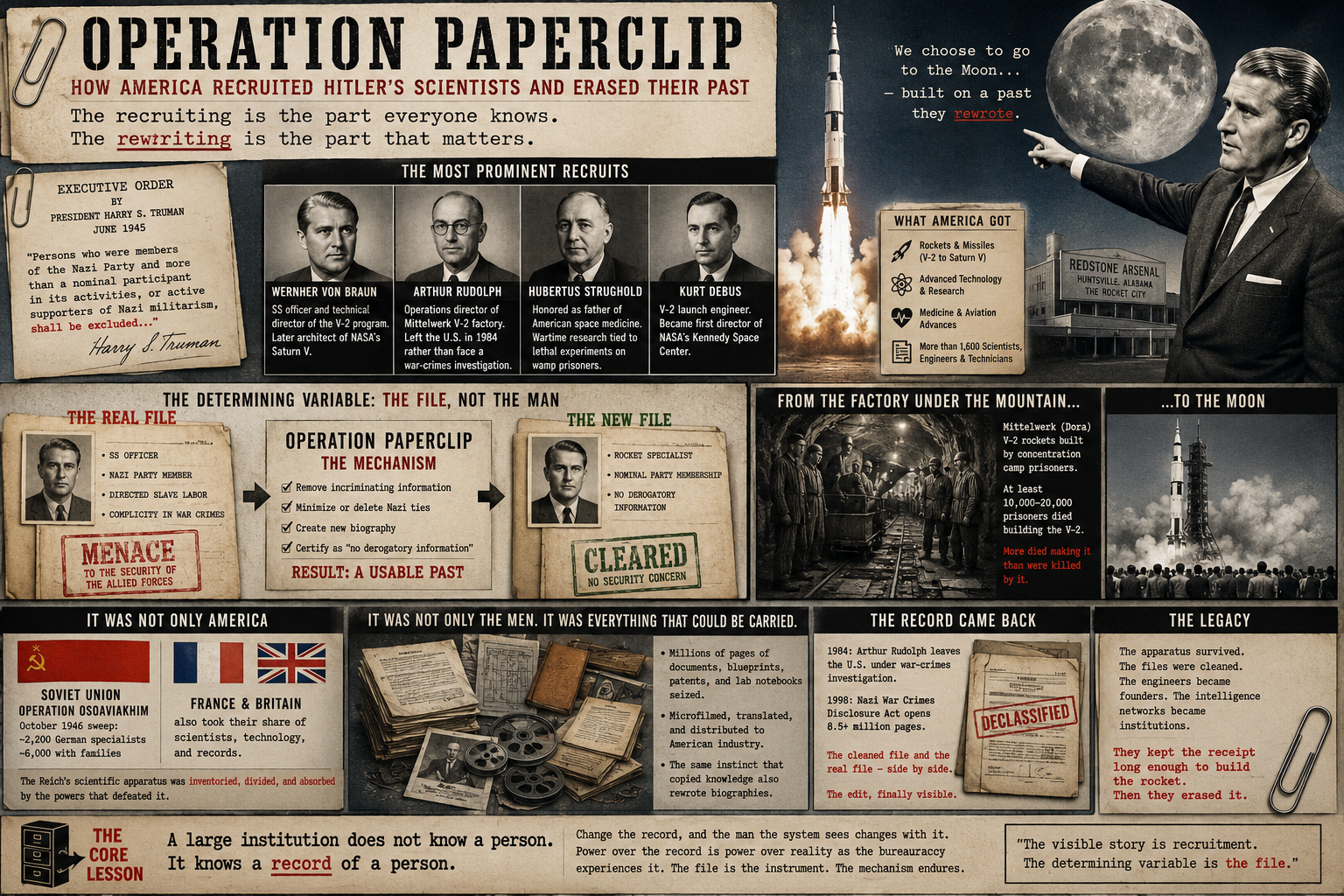
What was Operation Paperclip? (A direct answer.) Operation Paperclip was a secret United States intelligence program that, from 1945 into the early 1960s, brought more than 1,600 German scientists, engineers, and technicians to America to work for its military and, later, its space program. It was run by the Joint Intelligence Objectives Agency (JIOA), created in 1945 and disbanded in 1962. Its most famous recruit was the rocket engineer Wernher von Braun, who would go on to build the Saturn V that carried Apollo to the Moon. Many of the recruits had been members of the Nazi Party, and some had been directly tied to slave labor and human experimentation. To bring them in, American officials did something that is usually left out of the story: they rewrote the men's records so the past could not be used against them.
The most prominent recruits included:
- Wernher von Braun, SS officer and technical director of the V-2 program, later the chief architect of NASA's Saturn V.
- Arthur Rudolph, operations director of the Mittelwerk V-2 factory, who left the United States in 1984 rather than face a war-crimes investigation.
- Hubertus Strughold, honored as a father of American space medicine, whose wartime research world was tied to lethal experiments on camp prisoners.
- Kurt Debus, a V-2 launch engineer who became the first director of NASA's Kennedy Space Center.
A parallel harvest took the intelligence men rather than the scientists, above all Reinhard Gehlen and Allen Dulles; that stream is told in its own chapters.
That last sentence is the whole subject. The recruiting is the part everyone knows. The rewriting is the part that matters.
The story as it is usually told
The familiar version is a Cold War story, and it is not wrong. Germany surrendered in May 1945. Within weeks, American teams were racing Soviet teams across the ruins of the Reich to seize two things: the hardware of German science, and the men who had built it. The V-2 rocket that had fallen on London was years ahead of anything the Allies had. The jet engines, the nerve agents, the aviation medicine, the guided missiles: Germany had been first, and the war's victors did not intend to leave that knowledge in the rubble or, worse, let it walk east.
The stakes were not ordinary. The V-2 was the first long-range ballistic missile in history, the ancestor of both the intercontinental missile that would carry nuclear warheads and the launch vehicle that would carry satellites and astronauts. Whoever held the men who built it held the foundation of both the missile age and the space age at once. This is why the recruiting was pursued with such urgency and such willingness to bend the rules: the prize was not a weapon but a whole technological future, and it existed, in 1945, almost entirely inside the heads of a few hundred Germans.
So the United States took the men. President Harry Truman authorized the program in the summer of 1945, and over the following years von Braun and his rocket team, the aviation physician Hubertus Strughold, the production engineer Arthur Rudolph, and hundreds of others crossed the Atlantic. They were settled at Fort Bliss in Texas, tested rockets at White Sands in New Mexico, and eventually gathered in Huntsville, Alabama, a town that would rename itself Rocket City. From Huntsville came the rocket that reached the Moon. The Cold War logic was simple and, on its own terms, compelling: better these men in Alabama than in the Soviet Union.
All of that is true. It is also the cover story, in the precise sense that it covers something.
The condition Truman set, and the way around it
When Truman authorized the program, he attached a condition. The order expressly excluded anyone who had been "a member of the Nazi Party and more than a nominal participant in its activities, or an active supporter of Nazi militarism." On paper, the most compromised men were ineligible. The Potsdam and Yalta agreements pointed the same way: the architects of the Reich were to be denazified and, where warranted, prosecuted, not employed.
The problem was that the men America most wanted were exactly the men the order excluded. Von Braun had been an officer in the SS. The rocket program he led had been built on the backs of concentration-camp prisoners. By the standard Truman set, the prize recruits could not come.
So the standard was not changed. The records were. And it is worth being specific about who held the pen, because the mechanism was not abstract. The original security reports were written by the Office of Military Government, United States, the occupation authority known as OMGUS, and they were damning. The OMGUS assessment of Wernher von Braun described an SS officer and Nazi Party member who posed a security threat. When the director of the Joint Intelligence Objectives Agency, Navy Captain Bosquet Wev, submitted the first batch of dossiers for clearance in early 1947, the State Department's representative on the board, Samuel Klaus, read the files as written and rejected the scientists as ardent Nazis. Their visas were denied.
The files were then rewritten. A year later, a fresh security evaluation of von Braun concluded that "no derogatory information is available on the subject" and that he "may not constitute a security threat to the United States." Rudolph's 1945 verdict, "100% Nazi, dangerous type," became, in the JIOA's final dossier, "nothing in his records indicating that he was a war criminal or an ardent Nazi or otherwise objectionable." The Joint Intelligence Objectives Agency had not discovered new facts. It had produced new paperwork. SS membership was softened to "may have been," party loyalty was reframed as nominal or coerced, and evidence pointing toward war crimes was lifted out of the version decision-makers would see. The men did not become innocent. Their records became innocent, which under a bureaucracy is the same thing in every way that counts.
This is the center of the story, and it is why Operation Paperclip is not only a tale of recruitment. It is a case study in how a record is made to lie so that a system can do what its own rules forbid.
The determining variable was the file, not the man
Here the usual lens, the one that asks whether it was justified to hire former Nazis to beat the Soviets, looks at the wrong object. The decisive thing was never the scientist. It was the dossier.
A government bound by Truman's order could not hire a man whose file said "SS officer, complicit in slave labor." It could hire, without breaking a single rule on its face, a man whose file said "rocket specialist, nominal party membership, no derogatory information." Same man. Different file. The entire operation turned on the gap between the two, and on the small number of officials with the authority to move a man from the first description to the second.
The product of Operation Paperclip, then, was not really rockets, though it produced rockets. The product was clean paper. The program manufactured usable pasts. And once you see that the laundered record is the active ingredient, the operation stops looking like a one-off moral compromise of the early Cold War and starts looking like something more durable: a template. The technique that cleared von Braun, rewriting the file so the institution can proceed, is not specific to 1945. It is one of the oldest instruments of power there is, and the Reich's scientists are simply its best-documented use, because the original incriminating records survived alongside the cleaned ones and the historians later laid them side by side.
The men, briefly, and where the full accounts live
The individual cases are worse than the summary. Arthur Rudolph managed production at the Mittelwerk, the underground factory where V-2 rockets were assembled by prisoners from the Mittelbau-Dora camp under conditions that killed thousands; he was brought to America, given a career, and decades later, in the 1980s, left the country rather than face a war-crimes inquiry. Hubertus Strughold, later honored as a father of American space medicine, was associated with a research world that had conducted lethal experiments on camp inmates. Von Braun himself had visited the Mittelwerk and could not plausibly have been ignorant of how his rockets were built.
These are not the subject of this piece, which is the program and its mechanism, but each has its own chapter in the archive, because the Manifest treats the men as instances of the system rather than the system as a sum of men. The recruitment of the intelligence officers ran in parallel and is told separately: Reinhard Gehlen, Hitler's senior eastern-front intelligence chief, who surrendered in 1945 and was running a CIA-funded network by 1946; and Allen Dulles, the American spymaster whose prewar and wartime dealings with German industry and intelligence made the whole arrangement thinkable. The scientists were one stream. The spies were another. The program is the confluence.
The factory under the mountain
To see what the rewritten records were rewriting, go to the place the V-2 was actually built. It was not built in a laboratory. It was built inside a mountain in central Germany, in a tunnel complex called the Mittelwerk, by prisoners from the Mittelbau-Dora concentration camp. They worked in cold and darkness, slept underground in the early months among human waste and rock dust, and were worked, starved, and beaten to death in numbers that are still being counted. Estimates of how many prisoners died producing the rocket range from at least ten thousand to around twenty thousand. The rocket killed perhaps five to nine thousand people when it was fired at London and Antwerp. By the leading estimate, the historian Michael Neufeld's, more than twice as many people died building the V-2 as were killed by it, which makes it one of the only weapons in history to kill more in its manufacture than in its use. The miracle of German engineering ran on corpses, and the man who directed the factory floor, Arthur Rudolph, walked out of the war and into an American career.
This is the fact the new biographies were built to keep at a distance. A file that read "directed slave-labor production at a site where thousands died" could not be processed. A file that read "production engineer, rocketry, no derogatory information" could. The horror under the mountain did not have to be denied. It only had to be unfiled, lifted out of the paperwork that the next institution would ever see, so that the man could arrive in Texas as a clean professional and the rocket could arrive as an achievement.
It was not only the men. It was everything that could be carried.
Operation Paperclip is the human face of a much larger seizure, and the scale of the rest is easy to miss. Alongside the scientists, Allied technical-intelligence teams swept the defeated Reich for the knowledge itself: blueprints, patents, prototypes, laboratory notebooks, entire research archives. Specialized units followed the front lines specifically to capture documents and equipment before they could be destroyed or fall to a rival, and the haul was enormous, running to millions of pages of German industrial and scientific records that were microfilmed, translated, and distributed to American industry. Whole fields, from synthetic fuels to aeronautics to chemistry, absorbed a windfall of German research in a few short years.
The point of noticing the paperwork harvest is that it sits beside the biography harvest and explains it. The same instinct that microfilmed a German patent so its knowledge could be kept also rewrote a German scientist's record so his knowledge could be kept. In both cases the physical artifact, the document, was the unit of transfer. The Reich's science was downloaded, the inconvenient parts of its scientists' histories were deleted, and what remained was a usable capability with the moral ledger stripped out. The operation was, in the most literal sense, an exercise in editing records: which to copy, which to erase.
It was not only America, and that is the point
The instinct on reading this is to make it an American scandal. That instinct is itself a kind of compartment, and it misses the larger fact. The Soviet Union ran its own version, Operation Osoaviakhim, and it was bigger. In a single coordinated sweep in October 1946, Soviet authorities moved more than two thousand German specialists, and with their families more than six thousand people, east into the USSR, equipment and all. France and Britain took their share too. The Reich's scientific apparatus did not die with the regime. It was inventoried, divided, and absorbed by the powers that defeated it.
There is a sharp irony in the geography. The Mittelwerk, where the V-2 was built, lay in territory that the postwar settlement assigned to the Soviet occupation zone. American teams reached it first, stripped it of around a hundred complete V-2s and the men who mattered, and then, weeks later, handed the emptied mountain to the Soviets as agreed. The Soviets arrived to find the prize already gone and built their own program partly from what was left and from the specialists they swept up in Osoaviakhim. The two superpowers did not so much compete for the Reich's apparatus as divide it, each taking what it could carry and re-papering the men it kept.
This is the deeper pattern, and it is why Operation Paperclip belongs to a series rather than standing alone. The visible event was a defeat: the Third Reich was destroyed, its leaders tried at Nuremberg, its ideology outlawed. But an apparatus is not an ideology. The rockets, the production methods, the intelligence networks, the men who ran them, these were assets, and assets survive the regime that built them by being transferred to the next one. Each victor took the part it could use, gave the men new files, and folded the capability into its own arsenal. The Reich lost the war. The Reich's machine changed owners.
The record came back
A laundered record has one weakness: the original usually survives somewhere, and the two can be laid side by side once the protection lapses. That is what eventually happened. From the late 1970s an American war-crimes unit, the Office of Special Investigations, began pursuing Nazi perpetrators living quietly in the United States, and in 1984 it caught up with Arthur Rudolph, who surrendered his citizenship and left rather than contest the Mittelwerk evidence in court. The man whose file had been cleaned in 1945 was undone, forty years later, by the file that had not been.
The larger reckoning came in 1998, when Congress passed the Nazi War Crimes Disclosure Act and created an interagency working group to find and release the classified record. It became the largest single-subject declassification effort in American history: more than eight and a half million pages opened, including the intelligence files on individuals with Nazi pasts who had been used as sources and shielded from prosecution. The point of the disclosure was not a single revelation. It was the side-by-side itself: the cleaned biography and the real one, finally in the same archive, where a historian could read both and see exactly where the edit had been made. Operation Paperclip is the best-documented case of record-laundering in modern history not because it was the worst, but because, uniquely, the state was eventually compelled to publish the evidence of its own editing.
What the rewritten record bought, and what it cost
The American share paid off in the most spectacular way imaginable. Von Braun's team built the rockets that gave the United States its missiles and then its astronauts; the line runs from the V-2 over London to the Saturn V over the Sea of Tranquility, and it runs through Huntsville without a break. When a nation celebrates the Moon landing as the triumph of free human ingenuity, it is celebrating, in part, the work of men whose presence in Alabama required their war records to be falsified first. That is not a reason to diminish the achievement. It is a reason to notice what the achievement was built on, because the noticing is the only thing the falsification was designed to prevent.
The cost was paid mostly by people who never appear in the rocket story: the dead of Mittelbau-Dora, whose killers were not so much forgiven as edited out, and the principle, briefly asserted at Nuremberg and quietly suspended at the JIOA, that a record of atrocity should follow a man rather than be deleted ahead of him.
Two desks in the same government
The contradiction was not metaphorical. In the same years, the same American government was doing two opposite things to former servants of the Reich. At Nuremberg and in the denazification courts of the occupation, it was prosecuting Germans for crimes against humanity, building careful evidentiary records of exactly who had done what. At the JIOA, it was dismantling such records for the Germans it wanted to keep. One arm of the state was establishing, for the historical and legal account, that a man's complicity must be documented and judged. Another arm was ensuring that certain men's complicity would never reach a file a judge could read.
Both activities were sincere. Neither was secret to the officials running it. They did not surface as a single scandal at the time for a simple structural reason: they lived in different files, handled by different offices, and no one was charged with reading the two against each other. The state did not resolve the contradiction. It compartmentalized it, which is the bureaucratic version of resolving it. A government is not one mind that must stay consistent; it is a set of desks, and two desks can hold opposite truths indefinitely as long as no document ever travels between them. Operation Paperclip worked because the desk that cleaned the files and the desk that prosecuted the crimes were never made to share a drawer.
This is worth dwelling on, because it is the part of the story that reaches furthest beyond 1945. Compartmentalization is usually described as a security measure, a way of keeping secrets by ensuring that no single person holds all the pieces. But it does a second thing that is rarely named: it lets an institution hold a contradiction without ever experiencing it as one. The hypocrisy that would be unbearable inside one human conscience becomes ordinary administration once it is split across two offices that never correspond. No official at Nuremberg had to feel like a hypocrite, because no official at Nuremberg was looking at the JIOA's drawer. No official at the JIOA had to feel like an accomplice, because the war-crimes evidence had already been lifted from the folder on the desk. Each person did a defensible job. The indefensible thing existed only in the space between the desks, where no person stood.
That is why the contradiction was not a failure of the system but a feature of it. A single mind cannot prosecute a man and clear him at the same time; an organization can, and does, all the time, simply by routing the two decisions through compartments that are structurally prevented from meeting. The same architecture lets an intelligence service condemn a practice in public and run it in private, a regulator warn against a risk one division is funding, a government uphold a principle on one floor and suspend it on another. Operation Paperclip is the cleanest case because the surviving documents let us stand where no contemporary official did, with both drawers open at once. The mechanism, the deliberate non-communication between offices that would otherwise cancel each other out, is general enough to deserve its own study, and it recurs wherever a large institution needs to do something its own stated values forbid.
Erase the record, then write a better one
Deleting the incriminating file was only the first half of the work. The second half was to replace it with a flattering one, and here the case of von Braun is the clearest the twentieth century offers. The same man who had been an SS officer directing a rocket program built on camp labor was, within a decade of the war, one of the most admired public figures in America. In the early 1950s he was the star of a series of widely read magazine features laying out the human future in space. In 1955 he appeared on national television as the genial, accented expert in Walt Disney's "Man in Space," explaining rockets to tens of millions of American families. He was put on magazine covers, consulted by presidents, and eventually given a Hollywood biopic.
That rehabilitation was not an accident of charm. It was the positive face of the same operation. A record is not only erased; it is overwritten, and the most durable way to bury a past is to give the public a louder present to look at instead. The smiling man explaining the Moon on a Sunday-night television program is not a distraction from the man who ran the rockets under the mountain. He is the finished product of the editing, the clean file made flesh and put on screen. The era was not entirely fooled. A comedian of the day, watching the von Braun biopic titled "I Aim at the Stars," is said to have proposed a subtitle: "but sometimes I hit London." The joke landed because everyone half-knew. The record had been changed; the memory had not, quite. But the record is what institutions act on, and the record now said hero.
This is the part of the mechanism that makes it so transferable. To neutralize an inconvenient past you do not need to win an argument about it. You need only to delete the file that records it and broadcast a more appealing file in its place, and let the bureaucracy and the public do the rest, each treating the current record as the real one. Erasure and rebranding are two motions of a single hand.
The apparatus did not just transfer. It became the institution.
The final measure of Operation Paperclip is that the transferred men did not remain guests. They became founders. Von Braun was not merely employed; he became the director of NASA's Marshall Space Flight Center, one of the central pillars of the American space program, and shaped it for a decade. Kurt Debus became the first director of the Kennedy Space Center. The rocket capability that arrived in 1945 as a captured asset became, within fifteen years, the institutional core of how the United States reached space, with the Reich's chief engineers at its head.
The intelligence stream did the same, and more openly. Reinhard Gehlen's network of former German officers, taken onto the American payroll in 1946, was not wound down once the emergency passed. In 1956 it was handed to the new West German state and became the BND, the Federal Republic's official foreign intelligence service, carrying a substantial number of former Nazi officers into the permanent security apparatus of a founding NATO democracy. What began as a wartime expedient ended as a state institution. This is the pattern at its fullest: the apparatus of a destroyed regime is not borrowed and returned, it is absorbed, promoted, and made load-bearing in the order that defeated it, until removing it would mean dismantling part of the new state itself. The receipt is erased precisely because, by then, the asset has become structural.
Why this is a Manifest chapter and not a history lesson
The reason this story still matters in 2026 is not that former Nazis built American rockets, a fact long since documented and, by now, broadly known. It matters because of the instrument it reveals, which did not retire when the JIOA closed in 1962. The instrument is the laundered record: the official rewriting of a past so that an institution can use a person, an asset, or a narrative its own stated rules would forbid. Operation Paperclip is the clearest case because the before-and-after files both survive. But the mechanism is general. Wherever there is a gap between what an institution is permitted to do and what it wants to do, the gap can be closed not by changing the rule and not by changing the conduct, but by changing the record that the rule is applied to.
There is a reason the file is so powerful, and it is worth stating plainly because it is the principle beneath the whole case. A large institution does not know a person. It knows a record of a person. The hiring board that cleared von Braun never met the prisoners of the Mittelwerk and never would; it met a folder, and it acted on the folder. To the system, the man simply is what his file says he is, and whoever controls the file controls the man the system sees. This is why the rewriting was not a cover-up in the ordinary sense of hiding a truth that everyone could still find. It was the manufacture of a new official truth, one that functioned exactly as well as the old one because the institution had no way to act on anything but the document in front of it. Normally the record follows the man. Operation Paperclip reversed the order: change the record, and the man the system sees changes with it. Power over the record is power over reality as the bureaucracy experiences it, and the bureaucracy is what makes the decisions.
That is the portable lesson, and it is why the operation sits with the other chapters of this series on the survival of apparatus through the death of regimes. The visible story is recruitment. The determining variable is the file. And the file is the part that travels, because a cleaned record, unlike a rocket, can be made again for any inconvenient past at all.
The honest objection
The strongest case against this reading deserves to be put at full strength. It runs like this: the men were genuinely needed, the Soviet threat was real and immediate, and a defeated enemy's scientists are a legitimate spoil of war that it would have been negligent to leave to a rival. Many of the recruits were engineers who joined the Party because careers required it, not zealots; treating "nominal" and "active" Nazis differently was exactly the distinction Truman's order drew, and the program, on this account, was applying a defensible line under impossible time pressure. And the results were not trivial: the same men helped deliver deterrence and the Moon, outcomes most people judge to have been worth having. By this argument the record-cleaning was a regrettable bureaucratic shortcut around a rule that was too blunt for the situation, not a hidden machine of power.
That objection holds for some of the cases and not for others, and the place it breaks is exactly where the files were worst. A defensible program would have hired the nominal party members openly, under the stated exception, with their real records intact. It would not have needed to fabricate biographies for the men tied to slave labor and lethal experiments, and the fact that it did is the evidence that the line being crossed was not "nominal versus active" but "usable versus prosecutable." The Soviet parallel narrows the claim further rather than dissolving it: it shows the harvesting was structural, not uniquely American, which is the argument here, not a defense of any of it. What survives the objection is the core: the program's enabling act was the rewriting of the record, and that act, not the recruitment, is the thing worth watching, because it is the thing that recurs.
The rule was never repealed
There is one last feature of the technique that explains why it endures, and it is the most elegant and the most troubling. Truman's order was never repealed. The principle that active Nazis and war criminals should not be employed and protected by the United States government remained, formally, the policy of the United States throughout. It was never debated away, never struck from the books, never publicly abandoned. It was simply not applied to the men the government wanted, because their files no longer triggered it.
This is what makes record-laundering so much safer than changing a rule outright. To repeal the principle would have required an argument someone would have to make in the open and defend: that war criminals may be employed if useful. No official wanted to make that argument, and the public would not have accepted it. But no argument was necessary. The rule could stay exactly where it was, admired and intact, while the cases that would have invoked it quietly stopped arriving, because the paperwork that would have invoked it had been altered upstream. The principle kept its prestige and lost its function. That is the ideal outcome for any institution that wants both the credit of a rule and the freedom from it, and it is why the method outlived the program. You do not fight a principle you cannot win against in public. You leave it standing and starve it of the records it needs to act.
The receipt, not the rocket
So the rockets are real, and the Moon is real, and the men were brought because the rival would otherwise have taken them. Watch only that, and you are watching the cover story, the one assembled in the same offices that assembled the new biographies. The thing that made it all possible was quieter and more transferable than any rocket. It was the decision that a record could be rewritten faster than a past could be reckoned with, and the discovery that, inside a bureaucracy, a man is what his file says he is.
The Reich's scientists were not forgiven. They were re-filed. And the instrument that re-filed them was not retired with them. It was the most valuable thing America took out of the rubble of Germany, more valuable than the V-2, because the rocket only reached the Moon, and the cleaned record reaches anywhere a powerful institution finds its own rules inconvenient. They kept the receipt long enough to build the rocket. Then they erased it, and called the result a triumph.
Evidence Map
Facts, interpretations, forecasts, and disconfirming signals.
Core claim. Operation Paperclip (JIOA, 1945-1962) brought more than 1,600 German scientists to the United States, and its enabling mechanism was the deliberate rewriting of their records, false biographies and the removal of war-crimes evidence, to circumvent President Truman's order barring active Nazis and the Allied denazification agreements. The determining variable was the laundered file, not the recruitment itself; the same harvesting was carried out, on a larger scale, by the Soviet Union (Operation Osoaviakhim), making it a structural transfer of the Reich's apparatus to its victors rather than a uniquely American episode.
Evidence level. Facts (high, documented): the program's existence, scale (~1,600), JIOA dates, Truman's 1945 order and its exclusion clause, the fabrication and whitewashing of biographies, the cases of von Braun (SS, Mittelwerk), Arthur Rudolph (Mittelbau-Dora; departed the US in the 1980s under investigation), and Hubertus Strughold; the Fort Bliss / White Sands / Huntsville / NASA trajectory; the Soviet Osoaviakhim sweep of October 1946 (~2,200 specialists, ~6,000 with families). Interpretation (marked, Level 2.5): that the laundered record, rather than the recruitment, is the determining variable and the portable, recurring instrument; that Paperclip belongs to a general pattern of apparatus surviving regime collapse. No claim of a single coordinating conspiracy; the model is a transferable bureaucratic technique.
What would confirm this. Continued documentation that the most compromised recruits required fabricated files specifically to bypass the stated rule; the same record-rewriting technique appearing in later, unrelated institutional contexts.
What would disprove this. Evidence that the prize recruits were admissible under Truman's order as written without falsified records; or that the war-crimes evidence was removed for reasons unrelated to enabling recruitment.
Watchlist. Declassification of remaining JIOA and intelligence files; ongoing historical reassessment of individual cases.
Related from The Manifest Archive
- Hitler Lost the War. Von Braun, Gehlen and Dulles Won the Peace
- Reinhard Gehlen Surrendered in 1945. The CIA Hired Him in 1946
- The Reich After the Reich
- Everyone Is Watching the American Century. Nobody Is Watching the Machine It Inherited from the Reich
Jerry van der Laan writes The Manifest Archive. He traces the structures beneath the events.