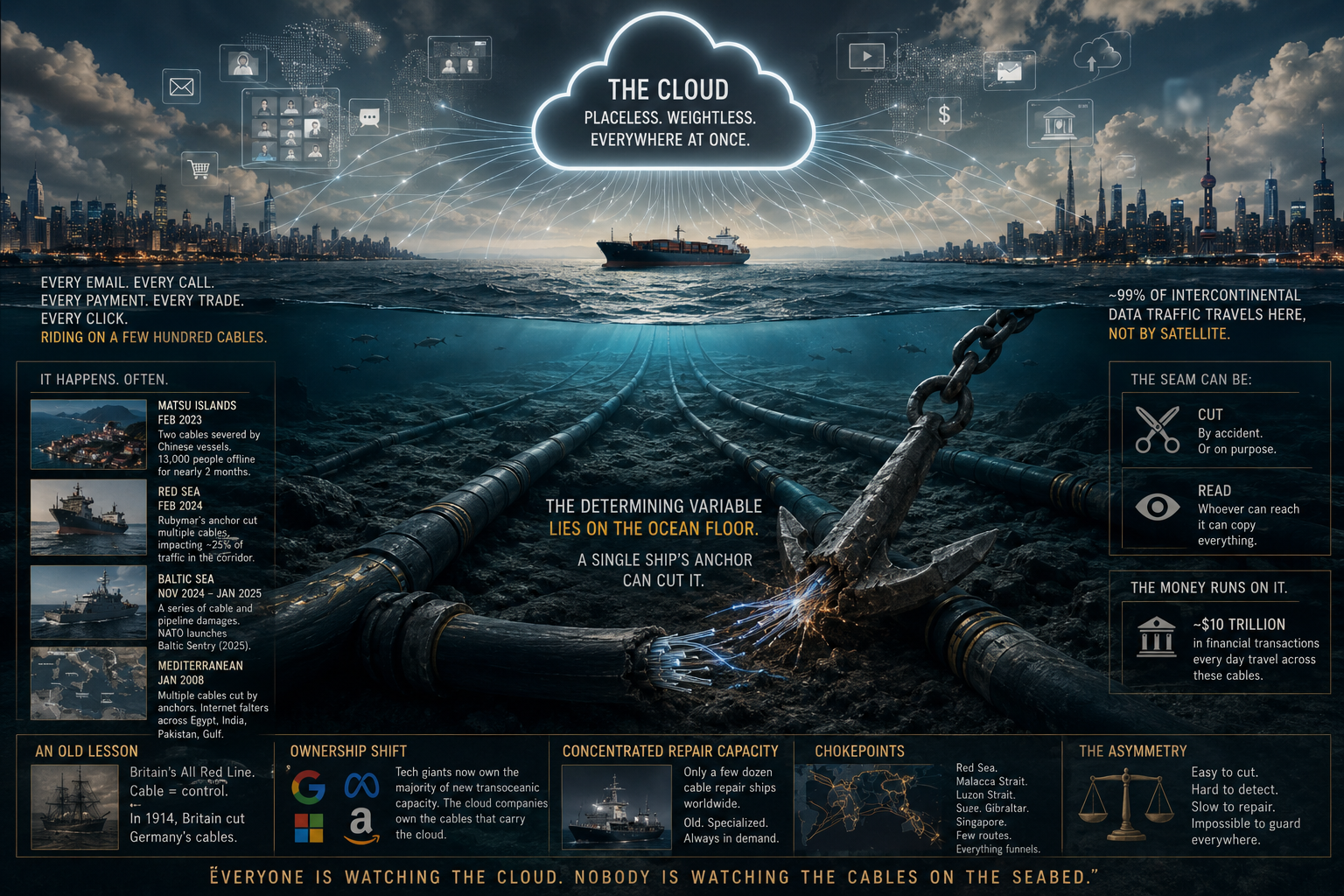
In February 2023, the roughly thirteen thousand people of the Matsu Islands, a small Taiwanese archipelago in the Taiwan Strait, lost the internet. Not slowed, not throttled. Gone. Two undersea cables, the only two connecting the islands to the digital world, were severed within days of each other, one by a Chinese fishing vessel and the other by a Chinese cargo ship, according to Taiwan's authorities. Cash machines failed. Card payments stopped. In one shop, a woman who had spent ten years teaching her customers to pay with a tap of the phone stood behind a till that would suddenly take only cash, on an island that had nearly forgotten how to carry it. A student lost an online examination halfway through. People who needed to reach the mainland for work or a sick relative found themselves shouting into a network that no longer existed. And the fix did not come quickly, because the nearest ship capable of repairing a deep-sea cable was not waiting offshore; it was weeks away, and the islands stayed dark or crawling on emergency microwave links for most of two months while the world's most connected region remembered, briefly, that connection is a physical thing.
The Matsu blackout is treated as a remote curiosity, a problem for a few thousand islanders far away. It is the opposite. It is the clearest small-scale demonstration of a fact that governs the entire planet and that almost no one keeps in view: the cloud is not in the sky. The word is one of the most successful pieces of marketing ever written, because it persuaded several billion people that their data lives in the air, weightless and placeless, when in truth it lives in cables, on the floor of the sea, in a few hundred fragile strands that a fishing boat can sever by accident and a navy can sever on purpose. What happened to Matsu can happen to a country. The only difference is the number of cables you have to cut.
The placeless world has a floor
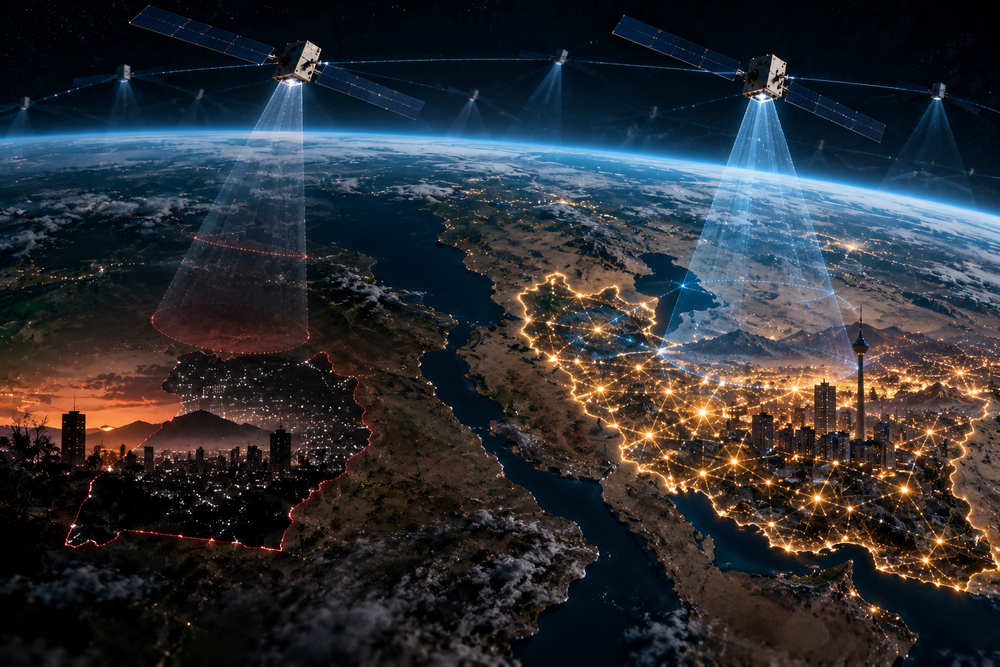
Start with the number, because the number is the whole argument. By the most commonly cited estimate, around ninety-nine percent of the world's intercontinental data traffic, the emails and video calls and bank transfers and market trades that cross oceans, travels not by satellite but through submarine cables, fiber-optic lines laid along the seabed between continents. Satellites, for all the attention they receive, carry a tiny fraction of the total. The internet between continents is, overwhelmingly, a set of wires on the bottom of the ocean.
And there are not many of them. The entire global system runs on roughly five hundred active submarine cables, give or take, spanning well over a million kilometers in total but concentrated into a small number of routes and an even smaller number of chokepoints. A single one of these cables, no thicker than a garden hose along most of its length, can carry a very large share of the traffic between two regions. A single modern cable can carry on the order of hundreds of terabits every second, enough to hold up a large share of the traffic between two continents on its own, which is why the loss of one is never a rounding error. This is not a sprawling, redundant web with infinite paths, the way the consumer internet is often imagined. It is a thin, mapped, physical lattice, and its maps are public, because ships need to know where the cables are in order not to drop anchor on them. The most critical infrastructure of the digital age is documented on charts that anyone can read, lying exposed on a seabed that anyone with a ship and a winch can reach.
The placeless world, in other words, has a floor, and the floor is closer and more fragile than almost anyone using it believes. Every time a person says their files are in the cloud, what they mean, whether they know it or not, is that their files are reachable through a cable on the ocean bottom that a trawler could hook tomorrow morning. It is the cloud that cables carry, and the cables that cloud cannot do without.
A single anchor
The vulnerability is not theoretical, and it is not rare. The undersea network suffers something on the order of one to two hundred cable faults every year, and the great majority of them have nothing to do with sabotage or sharks or any of the exotic causes the public imagines. They are caused by fishing gear dragged along the bottom and by ships' anchors, the ordinary commerce of the sea blundering into the nervous system of the planet. Most of these faults are repaired without the public ever noticing, because traffic reroutes and the damage is far from a chokepoint. But the routine nature of the accidents is precisely the point: if a cable is this easy to cut by mistake, it is trivially easy to cut on purpose, and the line between the two is a question of intent that the seabed does not record.
In February 2024 the point was made at scale. In the Red Sea, one of the most concentrated cable corridors on earth, where a narrow strait funnels much of the data traffic between Europe and Asia, a cargo ship named the Rubymar was struck and abandoned in the conflict off Yemen, and as it drifted its anchor dragged across the bottom and severed several major cables at once. By widely reported estimates the affected cables carried something like a quarter of the data traffic through that Red Sea corridor, and the cuts degraded connectivity across a swath of the Middle East and beyond, with repairs slowed for months by the danger of sending a cable ship into a war zone. One ship, one dragging anchor, one accident inside a conflict, and a meaningful fraction of one of the busiest data corridors on earth went down. The asymmetry is almost difficult to believe: the entire digital economy of a region, hostage to a single hull and a few tonnes of steel scraping the seabed.
The chokepoints
The reason a single anchor can matter so much is geography. Submarine cables do not spread evenly across the oceans; they funnel through a handful of narrow passages where the routes have no choice but to converge, and at those chokepoints the redundancy that protects the rest of the network thins to almost nothing. The Red Sea and the approaches to the Suez Canal carry a large share of Europe-Asia traffic through a corridor only a couple of hundred kilometers wide at points. The Strait of Malacca and the Luzon Strait near Taiwan funnel the cables of East Asia. The Strait of Gibraltar, the English Channel, the narrows around Singapore, each is a place where cutting a few cables does the work that cutting dozens would do in open water. One chokepoint is not even at sea: a dense bundle of the cables linking Europe to Asia comes ashore in Egypt and crosses the country overland between the Mediterranean and the Red Sea, so that a single state sits astride a large share of the traffic between two continents. The fragility of these seams is not a forecast either. In early 2008 several cables in the Mediterranean near Egypt and in the Gulf were severed within days of one another, attributed to ships' anchors, and the internet faltered across Egypt, India, Pakistan, and the Gulf at once, tens of millions of people degraded by a handful of breaks in a single corridor.
These chokepoints are the determining variable beneath the apparent resilience of the internet. Away from them, the network genuinely is meshed and self-healing; traffic flows around a cut without most users noticing. At them, the mesh collapses into a bottleneck, and a small number of deliberate cuts could isolate a country or sever a continent's main artery to another. The map of the world's data is not the map of the world's landmasses. It is the map of these few narrow seams, and whoever controls or threatens a seam controls or threatens everything that must pass through it. The cloud has chokepoints for the same reason a medieval city had gates: not because anyone designed a vulnerability, but because geography offered only a few ways through, and everything funneled into them. And the funnel does not end at the water. Every cable must come ashore, and it does so at a small number of landing stations, plain low buildings on a beach where the traffic of a continent surfaces in a single room, often unguarded behind an ordinary fence, the whole weightless internet briefly visible as a bundle of glass entering a wall.
The cables are not only cut. They are read.
Cutting a cable is the loud use of the seam. The quiet use is older and arguably more valuable: a cable you can reach is a cable you can read. Because the world's communications funnel through these physical lines, whoever can touch one can, in principle, copy everything passing through it, and the great powers have been doing exactly that for as long as the cables have existed. During the Cold War the United States ran an operation, later known as Ivy Bells, in which submarines placed a recording device on a Soviet undersea cable in the Sea of Okhotsk and returned to collect its tapes, harvesting Soviet naval communications from the ocean floor for years. The technique never went away; it scaled. The documents disclosed in 2013 described how Britain's signals agency tapped the transatlantic fiber-optic cables where they come ashore, buffering enormous volumes of the world's internet traffic as it passed through the landing points on British soil.
This is the dimension the cutting stories obscure. The seabed cable is not only a thing that can be severed; it is a thing that can be silently split, its light copied, its contents read, by whoever controls the water it crosses or the beach where it lands. The same geography that makes a chokepoint easy to cut makes it easy to tap, which is why the most surveilled places on the network are the same narrow seams the navies now patrol. To own or reach a cable is to hold two powers at once, the power to stop the traffic and the power to read it, and a state that can do neither to its own cables, because a foreign company built them or a foreign navy can reach them, has surrendered something it may not even know it has lost. A cut is loud and a nation notices at once. A tap is silent and the nation never does, which is why the tap, not the cut, is the prize.
The money runs on them too
It is worth naming what actually moves through these lines, because the abstraction "data" hides the stakes. The world's financial system runs on submarine cables. By figures cited within the industry and by officials, the cables carry on the order of ten trillion dollars in financial transactions every day, the settlement of trades, the messaging between banks, the instructions that move money between countries. A market is, at bottom, a flow of agreed information at speed, and the speed and the information both travel the seabed. When a major cable artery goes down, it is not only video calls that drop. On Matsu, the woman behind the counter did not care about global finance; she cared that her card reader had gone dead and her customers had no cash. But the gap between her silent machine and a stalled trade between London and Singapore was smaller than it looked. Both were waiting on the same kind of glass thread lying on the same dark floor of the sea, and when the thread broke, both simply stopped. The shopkeeper and the investment bank turned out to be neighbours on the seabed. It is the nervous system of global finance losing a limb, trades misfiring, transfers stalling, a region's connection to the markets degraded until the splice is made. The thing on the ocean floor is not a convenience layered on top of the real economy. For a financial system that is now almost entirely electronic and international, it is the real economy's circulatory system, lying in the dark where a dragging anchor can reach it.
The seam that is the Baltic
Through 2024 and into 2025, a slower and more deliberate version of the Matsu blackout played out in the Baltic Sea, and it turned the abstract risk into a standing crisis among nations. A series of submarine cables and pipelines on the Baltic floor were damaged in close succession: a telecommunications cable between Finland and Germany and another between Lithuania and Sweden were severed in November 2024, and weeks later an undersea power connector between Finland and Estonia, along with data cables, was cut as well. In several cases investigators focused on commercial ships that appeared to have dragged their anchors for long distances across the seabed, in one instance a tanker whose anchor was suspected of scraping the bottom for dozens of kilometers.
Here claim discipline matters, because the temptation to declare sabotage is strong and the evidence is genuinely contested. Investigations into the Baltic incidents have in several cases not reached firm public conclusions about intent, and dragging anchors do sometimes cause damage by genuine accident. What is not contested is the pattern and the response. The cuts came often enough, in a tense enough region, that the alliance treated them as a strategic threat rather than a run of bad luck: in early 2025 NATO launched a dedicated mission, Baltic Sentry, to patrol and protect the undersea infrastructure of the sea, deploying ships, aircraft, and drones to watch a stretch of water for the sake of the cables beneath it. A military alliance does not mount a standing patrol to guard against accidents. The deployment is the documented admission, written in warships, that the cables on the seabed have become a front line.
And it is a front line that cannot really be held. A border can be walled and a building can be guarded, but a cable runs for thousands of kilometers across open seabed that no navy can line with sentries. The most a patrol can do is watch the surface, track the ships, and hope that the knowledge of being watched deters the anchor that drags too conveniently, which is a thin kind of protection for the most important infrastructure a society owns. The defenders are reduced to guarding a thing they cannot reach by watching the water above it, and the attacker needs only a single vessel, a plausible excuse, and a few minutes over the right stretch of bottom. The asymmetry that governs the whole subject governs its defense as well: cheap to cut, ruinous to lose, and nearly impossible to guard along its entire length.
The empire that learned this first
None of this is new. It is one of the oldest lessons of modern power, learned and then forgotten, because the cable has been the hidden nervous system of empire since long before the internet. In the nineteenth century Britain wrapped the world in telegraph cables, the famous All Red Line that connected London to its colonies, and that network was not only commerce; it was control, because whoever owned the cables knew first, decided first, and could cut the others off. The strategy was deliberate down to the routing: the All Red Line was engineered, where it could be, to touch only British territory along its length, so that no rival could cut it on their own soil or tap it as it passed, a century-old version of the same instinct now redrawing cables around China. The dependence was so well understood that on the first days of the First World War, in August 1914, one of Britain's opening moves was to send a ship to dredge up and cut Germany's transatlantic telegraph cables, forcing German communications onto routes that Britain could intercept. The consequences ran straight through the war, including the interception that exposed the Zimmermann Telegram and helped draw the United States into the conflict. The cable was a weapon and a chokepoint a century ago, and the powers of that era treated it with the seriousness it deserved.
What changed is not the strategic reality but the public's awareness of it. The Victorians knew their empire rested on cables because the cables were a visible, contested, expensive thing. We have inherited a vastly larger version of the same dependence and persuaded ourselves it is weightless. The word cloud did to the cable what a good disguise does to a face: it did not remove the thing, it only stopped us from seeing it. The strategic logic that made Britain cut Germany's cables in 1914 is the same logic patrolling the Baltic today. The only thing that lapsed was our attention.
The owners moved upstairs
There is a second shift underneath the physical one, and it is changing who holds the seam. For most of the cable era the lines were owned by telecommunications carriers, consortia of phone companies that built and shared them. Over the last decade that has been overturned. The largest builders and owners of new transoceanic capacity are now the content companies, Google, Meta, Amazon, and Microsoft, the same handful of firms that own the cloud the cables carry. The companies that sell you the cloud are quietly buying the floor it stands on. Google alone has an ownership or investment stake in a large and growing number of submarine cables, some of them, such as its private transatlantic line Dunant and the Equiano cable down the coast of Africa, built largely for its own traffic; Meta has driven the enormous 2Africa cable that rings an entire continent. By recent estimates the big content providers account for the majority of the capacity in use across the oceans, a share that did not exist a decade ago.
This is the convergence that should be watched. The companies that own the platforms where the world's information lives are increasingly also the companies that own the physical cables through which it moves, which means a smaller and smaller number of private firms control both the road and the destination. The state that wants to understand its own connectivity must now ask a private company; the cable map and the cloud map are becoming the same map, drawn by the same few hands. The infrastructure that a century ago was the jealously guarded asset of empires is passing, quietly and with almost no public debate, into the ownership of a few corporations operating their own private oceans.
The great powers, at least, have woken to what the ownership means, and the cables are being redrawn along the lines of the new rivalry. When a consortium backed by American tech companies built a Pacific cable intended to land in Hong Kong, the United States government intervened to block that landing on national-security grounds, and the cable was rerouted to come ashore elsewhere; new projects increasingly plan their paths to avoid Chinese waters and Chinese landing points, while China builds its own. The seabed is quietly partitioning into spheres, the same map of suspicion that divides the surface world now being laid along the ocean floor in glass. A map of the cables is becoming a map of the alliances, which is the oldest thing in this whole story: the Victorians, too, drew their cables to stay inside the empire and away from rivals. The wire follows the flag, as it always has, and the brief illusion that the internet was a single borderless commons is ending on the seabed first.
The fleet that cannot keep up
The final fragility is the one that turns a cut into a crisis: the world's ability to repair these cables is thin, slow, and shrinking relative to the demand. Repairing a deep-sea cable is a specialized operation requiring a purpose-built ship that must locate the break, grapple the cable up from the bottom, haul it to the surface, splice it, and lower it back, a process that takes days or weeks even in calm water and friendly seas. There are only on the order of a few dozen such cable ships in the entire world, many of them old, and they are concentrated in the hands of a small number of operators. When several cables fail at once, or when the break is in dangerous water like the Red Sea, the queue lengthens and the repair that should take a week takes months.
The manufacture and laying of cables is just as concentrated. The whole world's capacity to build and lay submarine cable rests with a small group of firms, an American one, a French one, a Japanese one, and a Chinese champion that rose from the maritime arm of Huawei and has become a geopolitical flashpoint precisely because of what cable ownership and cable repair confer: the access, the knowledge, and the position to be near every cable that matters. Picture the actual remedy. A ship on the open sea, a grapnel dragging the dark bottom to snag a wire thinner than a wrist, hauling it dripping to the surface, a technician splicing strands of glass by hand under a lamp while the swell rolls the deck, and then the mended line paid back over the side into a mile of water. That is the emergency service standing between a continent and silence, and there are only a few dozen of it in the world, many of them decades old, none of them quick to replace. The fleet is a fixed and aging number, and it cannot scale up when the danger does.
And the demand is not flat; it is exploding, because the same artificial-intelligence boom that made data centers a global obsession runs on moving colossal volumes of data between those centers, across oceans, over these same wires. The world is asking the seabed to carry exponentially more in exactly the years the geopolitics around it is tightening and the repair fleet is not growing to match. A planet that runs almost entirely on submarine cables has built almost no slack into the system that keeps them alive. The day a major power tests it at a chokepoint, the binding constraint will not be whether the traffic can reroute. It will be whether there is a ship free to fix the cut before the rerouting runs out of room.
The strongest objection
The strongest objection is that the network is more resilient than this makes it sound, and that the alarm is overdrawn. The internet was designed to route around damage; most cable faults are repaired with no public effect at all; the system absorbs one to two hundred cuts a year and keeps running. New satellite constellations in low orbit are adding a layer of backup that did not exist a decade ago. And nations are now awake to the risk and investing in protection. A determined adversary, the objection runs, could cause disruption, but the idea that a few cuts could bring down a continent overstates a robust and self-repairing system.
The objection is right about the average case and wrong about the one that matters. Yes, away from the chokepoints the mesh is real and the rerouting works, which is exactly why the routine faults pass unnoticed; nothing here disputes that. But resilience measured on an average day is not resilience at the seam on the worst day, and the whole danger lives at the seam. At a chokepoint the alternative paths are few, the repair ship is far, and the cuts can be timed and concentrated rather than random and dispersed, which is the difference between an accident and an attack. The satellite backup, real as it is, carries a small fraction of cable capacity and cannot absorb the loss of a major artery; it is a lifeboat, not a second ship. And the proof that the experts share the worry is not rhetorical but physical: states do not patrol the Baltic with warships, and navies did not cut each other's cables in 1914, over a risk that reroutes itself away. The system is robust against the accident it suffers every week. It is the deliberate cut at the narrow place, the one it does not suffer every week, that it is not built to survive.
What remains
To be exact, the documented spine is firm and the reading laid over it is marked, and the contested attributions are flagged rather than asserted. Documented: the overwhelming majority of intercontinental data, by common estimate around ninety-nine percent, travels through submarine cables rather than satellites; the global system runs on roughly five hundred cables concentrated through a few maritime chokepoints; the network suffers on the order of one to two hundred faults a year, most from fishing gear and anchors; the Matsu Islands were cut off for weeks in early 2023 after two cables were severed by Chinese vessels; cuts in the Red Sea in 2024 from a drifting ship's anchor took down cables carrying a large share of the traffic through that corridor; a cluster of Baltic cable and pipeline damage in 2024 prompted NATO's Baltic Sentry patrol mission in 2025; Britain cut Germany's telegraph cables at the outbreak of war in 1914; and the major content companies now own or control the majority of new transoceanic capacity, served by a repair fleet of only a few dozen aging ships. The marked, interpretive part is the reading of these as one mechanism, the physical cable substrate, not the cloud's apparent ubiquity, as the determining variable beneath global communication. The genuinely contested part, whether specific recent cuts were deliberate sabotage or accident, is named as contested and not asserted; the structural argument holds either way, because a system this easy to cut by accident is a system this easy to cut on purpose.
The portable lesson is short enough to carry to any system that calls itself a network: the more placeless a thing is made to feel, the more total its dependence on a few real places no one is watching. It is true of the cloud and the cables; it is true of finance and its clearing houses, of supply chains and their ports, of energy and its few transformers. The word that hides the place is the word to distrust, because the place is where the system can be stopped.
What the seabed finally teaches is to distrust the words that make infrastructure disappear. The most consequential machinery is the machinery we have been taught to think of as no machinery at all, the cloud that is cables, the wireless that is wired, the placeless that has a precise and reachable place. A society that forgets where its connection physically lives has not escaped the cable. It has only stopped guarding it, which is a different and more dangerous thing. The Victorians could see their empire's nerves because the cables came ashore in plain sight and the powers fought over them openly. Ours run to the same beaches, into the same kind of small buildings on the coast, and out across the same ocean floor, carrying immeasurably more, watched by almost no one.
The Matsu Islands got their connection back, in the end. A repair ship reached the strait, hauled the broken lines up from the bottom, spliced them by hand, and laid them down again. In the little shop, the card reader on the counter beeped back to life, and a tap of a phone bought a bag of rice again, and the woman behind the till went back, like everyone, to forgetting the cable on the floor of the sea that had let her. The thing she had lived fifty days without had returned not from the sky but from a wire under the water, and the lesson the wire had taught did not outlast the week it came back. She had been made to see, for two months, what the rest of us have arranged never to look at.
Everyone is watching the cloud. The cloud is a few hundred cables in the dark, and a single anchor can find them. It always could.
Evidence Map
Facts, interpretations, forecasts, and disconfirming signals.
Core claim. The placeless-feeling digital world runs almost entirely on a few hundred physical submarine cables lying on the ocean floor in known, mappable, severable locations. That physical substrate, not the cloud's apparent ubiquity, is the determining variable beneath global communication, finance, and conflict, and at the maritime chokepoints a single ship's anchor can sever a continent's bandwidth.
Evidence level. Facts: high (around 99% of intercontinental data travels via submarine cables, not satellites; roughly 500 active cables over some 1.4 million kilometers, funneled through a few chokepoints; about 150 to 200 faults a year, the majority from fishing gear and anchors; the Matsu Islands cut off for weeks in 2023; the Red Sea Rubymar anchor cuts of 2024; the 2024-25 Baltic cable damage and NATO's Baltic Sentry mission of 2025; the 2008 Mediterranean cuts; Britain cutting Germany's telegraph cables in 1914; cable tapping from Operation Ivy Bells to GCHQ's Tempora; the major content companies now owning the majority of new transoceanic capacity; the US blocking the Pacific Light Cable Network's Hong Kong landing; a repair fleet of only a few dozen aging ships). Interpretation: medium (reading these as one mechanism, the cable substrate as the determining variable). Contested and explicitly not asserted: whether specific recent cuts, notably the Baltic incidents, were deliberate sabotage or accident; the structural argument holds either way, because a system this easy to cut by accident is this easy to cut on purpose.
What would confirm this. Connectivity, finance, and strategic competition continuing to concentrate on the same few cable corridors and landing points; cable routes redrawn along geopolitical lines; and the ownership and repair bottlenecks tightening as AI-driven data demand grows.
What would disprove this. Satellite or mesh redundancy proving able to absorb the loss of a major artery even at a chokepoint, making cuts inconsequential; or the substrate proving genuinely decentralized rather than funneled through a few severable seams.
Watchlist. The security of the Baltic, Red Sea, and Taiwan corridors; the partitioning of cable routes along great-power lines; content-company ownership concentration; and whether the repair fleet ever grows to match demand.
Jerry van der Laan writes The Manifest Archive, a continuous investigation into how institutions, language, and systems shape what people are permitted to see as reality. He does not report events. He traces the structures beneath them.
Related from The Manifest Archive