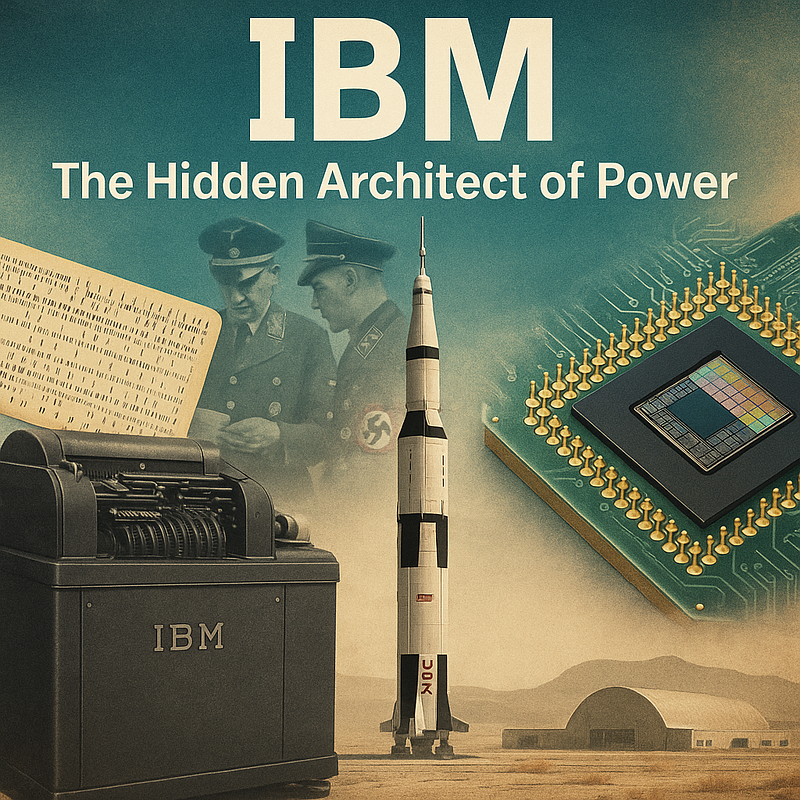
The visible story is a computer company that rose, dominated, declined, and was overtaken. The determining variable is that what it actually sold, the capacity to count, sort, and remember a population, is morally neutral, and a neutral capacity serves whoever holds it, which is exactly why it has outlived every regime that used it.
In June 1937 the chairman of an American company traveled to Berlin to accept a medal from a government that was, by then, four years into the persecution that would become the Holocaust. Thomas J. Watson Sr. of IBM received the Order of the German Eagle with Star, the highest honor the Reich gave a foreigner, in recognition of services rendered. The services were not ideological. Watson was not a Nazi, and three years later, under public pressure, he returned the medal. What he had been decorated for was something more durable than belief: his company's machines had made the German state legible to itself, and a state that can read itself can do anything it decides to do, for good or for atrocity. The medal was an award for infrastructure.
That scene is the whole subject in miniature, and it is worth resisting the easy reading of it. The easy reading is that IBM was complicit in evil, which is a moral question worth asking and one this essay will not dodge. But the deeper and stranger fact is the one the moral question tends to bury: the same capability that earned Watson a medal in Berlin was, within a decade, guiding American rockets and clearing American banks, and within three decades carrying astronauts to the Moon, and it never changed its nature as it moved between these uses. IBM did not sell ideology. It sold the ability to count, and the ability to count is the one tool every regime needs and no regime can be refused on principle, because counting is not the crime. What is done with the count is the crime, and that decision was never IBM's to make. This is the story not of a company's rise and fall but of why a particular kind of machine cannot fall, because it serves a function that survives every master who picks it up.
The company that counted
Before it was a computer company, IBM was a tabulating-machine company, and the distinction matters because it names the actual product. Its core technology, inherited from the inventor Herman Hollerith, was the punch card: a stiff paper rectangle in which holes, punched in coded positions, stood for facts about a person or a thing, and which a machine could then sort and count at mechanical speed. Hollerith's machines had been built to process the United States census of 1890, reducing a job that had taken most of a decade to a fraction of the time. That is the origin of the whole enterprise, and it is not a weapons program or an ideology. It is a faster way to count people.
Hollerith's firm became, through a 1911 merger, the Computing-Tabulating-Recording Company, and in 1924 its chairman Thomas Watson renamed it International Business Machines, a name that announced the ambition without naming the product. The product, underneath the brass and the slogans, never stopped being the census engine. IBM grew rich in the 1920s and 1930s selling governments and corporations the means to enumerate, classify, and track at a scale no clerk could match, and it grew rich because that means had become the precondition of running anything large.
But a faster way to count people is a form of power, and a profound one, because the modern state runs on legibility. The political scientist James Scott gave the idea its clearest name: a state can act on its population only to the degree that it can see it, and most of the apparatus of modern government, the census, the cadastral map, the standardized surname, the identity number, exists to make a once-illegible society readable to the authority above it. Legibility is not a metaphor; it is the literal condition of administration, and it has a technology. The tabulating machine was that technology in its first industrial form, the instrument that turned the slow, blurred sight of pre-modern states into the sharp, current, sortable vision of modern ones. A government that cannot enumerate its population cannot tax it efficiently, conscript it, ration its food, or administer it at scale. For most of history that enumeration was slow, partial, and quickly out of date, which placed a natural ceiling on how finely any regime could see and therefore control the people under it. The tabulating machine raised that ceiling. It made the population a readable database before the word database existed, and it handed that capability to whoever could lease the machines. The company that counted was, without ever holding office, in the business of supplying the precondition of modern administration. Everything that follows is the story of who leased the capability, and of the fact that the capability did not care.
Dehomag: the census and the camp
The hardest chapter is the German one, and it has to be told with discipline, because it is both worse and more complicated than the slogans allow. IBM's German subsidiary was Dehomag, and through the 1930s its Hollerith machines became part of the administrative backbone of the Nazi state. They were used to process the censuses and registrations through which the regime mapped its own population, including the census of 1933 that the new government inherited and the census of 1939, which added a supplementary card recording ancestry in a way earlier counts had not. In a regime that defined certain of its people as enemies to be identified, that mapping was not neutral in its effects, whatever the machines were in themselves; to enumerate a population by descent, in a state already committed to acting on descent, is to draw the first map of a persecution. The journalist Edwin Black, in his investigation IBM and the Holocaust, assembled the documentary case that the technology was woven through the bureaucracy of persecution, from the identification of Jews in the census data to the administration of the camps, and that IBM's leadership pursued and profited from the German business with open eyes as to its commercial value.
Two disciplines have to be held at once here. The first is not to flinch from what is documented: that the apparatus of counting, supplied by an American company, was part of the machinery by which a state turned a population into a sorted list, and that a sorted list is the first step of an organized persecution. The second is not to claim more than the record supports. The precise degree to which IBM's New York headquarters knew of, intended, or directed the use of the machines inside the camps is contested among historians, and the strongest specific claims about coding individual fates have been disputed. What is not in dispute is the structural fact, and the structural fact is the point: the same kind of machine that counted a census could administer a persecution, and nothing in the machine objected to the difference. The Nazi state did not need IBM to hate. It needed IBM to organize, and organization at that scale is what the tabulator supplied.
This is why the German chapter is not an aberration in IBM's history but its clearest revelation. It showed, at the extreme, what the capability was: a way of making people legible to power, indifferent to what the power then did. The medal in Berlin was given for exactly that, and the discomfort it still produces comes from the recognition that the thing being honored was not evil in itself. It was useful, and its usefulness had no conscience.
The proof of neutrality: the same machine, the opposite client
If the German case were unique, it could be filed as a story about one company's moral failure under one regime. It is not unique, and the proof is that the same technology did the same kind of work for the regime that defeated the first one. During the Second World War the United States used punch-card tabulation to help identify and concentrate its own population of concern: Americans of Japanese descent, who were removed from their homes and interned. Researchers working with the Census Bureau's own records later documented that tabulation of census data was used to locate Japanese American communities for that purpose, and the Bureau itself eventually acknowledged that it had provided data assisting the internment, including, by later findings, information at fine geographic and even individual resolution. The machinery that had made German Jews legible to Berlin made Japanese Americans legible to Washington, and it did so without alteration, because there was nothing in it to alter. The decades-long official denial that the census had played any such role is its own small lesson: the count is so trusted, so apparently innocent, that even a democracy found it easier to deny the tool had been turned on its own people than to examine what the tool routinely makes possible.
That is the cleanest evidence for the whole thesis. A tool that served a fascist census and a democratic internment with equal facility is a tool whose power lies precisely in its indifference. It does not discriminate between clients because discrimination is not its function; counting is. Whoever needs a population sorted can lease the means to sort it, and the means will perform identically for liberation and for oppression, for a war effort and for a genocide, because the morality was never built into the machine. It was always supposed to come from the hand that used it, and the recurring lesson of the century is how often that hand was not watching what the other hand had built.
The continuity through the American century
After 1945 the capability did not retire. It changed uniform. The United States, having absorbed the defeated enemy's useful functions, built its postwar power on systems of computation, and IBM was at the center of nearly all of them, carried from the world of the census into the world of the Cold War without any break in the underlying business. Where the rocket engineers had to be sorted, sanitized, and flown across an ocean to be of use to the new empire, the counting apparatus needed none of that, because it had never belonged to the old one. It had served Berlin and Washington in the same years, with the same machines, and when the war ended it simply kept its desk. A function that takes no side is never on the losing one, and so it has nothing to be absorbed from; it merely acquires its next client.
The clearest case is SAGE, the Semi-Automatic Ground Environment, the air-defense system built to watch the skies of North America for Soviet bombers. Its computers, the IBM-built AN/FSQ-7, were the largest ever made, each machine filling a building and drawing power on the scale of a small town, processing radar data in real time and displaying it on screens where operators tracked threats with light pens. The system that had to make an entire continent legible to its defenders ran on the descendants of the machines that had made populations legible to their governments, and the contract was so large that for several years in the 1950s the great majority of IBM's computer revenue came from it. SAGE was not only a weapon. It was the crucible in which real-time computing, networked communication, magnetic-core memory, and the interactive screen with its light pen were forged and proven, and those techniques then flowed outward into the commercial machines of the following decades. The basic grammar of the digital world, a screen you act on, a network that links distant machines, a computer that responds as events happen, was first written for the purpose of seeing the sky as a system to be controlled. The civilian conveniences of computing arrived as the by-products of a continental surveillance machine, which is itself a small instance of the larger pattern: the tools we experience as neutral and even friendly were built, first, to let a power see.
The same thread ran into the space program. In 1965 NASA awarded IBM the contract for the instrument unit of the Saturn V, the ring of computers mounted above the rocket's stages that monitored its systems and guided its ascent. Built in Huntsville, the instrument unit was a ring some twenty-one feet across that carried the guidance computer, the platform that knew where the rocket was and where it had to point, and the electronics that held the giant on its course through the seconds when a fractional error meant the mission was lost. The largest machine humans had ever launched needed a mind, and the mind was supplied by the company whose machines had counted the census of a dozen states. When astronauts trusted the rocket, part of what they trusted was IBM's logic, the same family of capability that had served Berlin and Washington now serving the Moon. None of this required IBM to change what it was. It required only new clients with new things to count, and the things a superpower needs to count, bombers and trajectories and payloads, are as amenable to tabulation as any census ever was.
The accountant of the economy
The count did not stop at populations and payloads. It moved into money, and in doing so it wired itself into the daily functioning of the postwar economy so completely that the wiring became invisible. In 1964 IBM staked its existence on the System/360, a family of mutually compatible mainframes developed at a cost that rivaled a major weapons program, and the bet paid off by making IBM's architecture the default of business computing for a generation. The banks ran on it. The insurers ran on it. The same year, IBM and American Airlines completed SABRE, the computerized reservation system that let a clerk anywhere book a single seat against a live central record, a model that the rest of the travel and logistics economy would copy. By the late 1960s the back office of the modern economy, the ledgers, the clearing, the actuarial tables, the credit records, ran on IBM machines, and a transaction that did not pass through that architecture was increasingly a transaction that did not happen.
This is the same capability again, pointed at a third kind of object. A census counts people, a defense grid counts threats, and a financial system counts claims, debts, balances, and the trust between strangers that money actually is. None of these is a different business; they are the same business of making a domain legible and sortable, applied to whatever a power most needs to track. IBM never minted a currency or set an interest rate, just as it never wrote a law or ordered an arrest. It supplied the medium in which currencies were counted and laws administered, which is a quieter and more permanent position than any of the visible powers that depended on it. The accountant who keeps everyone's books is rarely the richest person in the room and is almost always the last to be dismissed.
The mask of decline
The most instructive phase of IBM's history is the one that looks like its defeat, because it shows the difference between losing the headlines and losing the function. In 1984 Apple aired the most famous commercial in the industry's history, casting IBM as the grey, totalitarian Big Brother and itself as the rebel with the hammer. The image entered the culture as a story of the establishment overthrown. The reality underneath the image was almost the reverse. The personal-computer standard that the whole industry then built on was the IBM PC; the clones that multiplied were IBM-compatible; the operating system that became dominant did so because IBM adopted it for that machine, which is how a small software firm named Microsoft became the standard of an age. The rebel's revolution ran, in its hardware lineage and its software conventions, inside the architecture IBM had set.
The software war told the same story twice. IBM and Microsoft had jointly developed an operating system, OS/2, meant to be the future of the personal computer; Microsoft's own Windows won the market instead, and IBM is remembered as having lost the contest for the soul of the PC. Yet the machine those operating systems ran on was the IBM-defined architecture, and the convention that a "PC" meant an IBM-compatible PC outlived the question of whose software sat on top. IBM lost the visible war for the operating system and kept the invisible standard underneath it, which is the same trade it had made before and would make again. The headline said defeat. The substrate said otherwise.
This is the pattern that recurs across the whole story, and it is worth naming precisely because it is so easily misread. IBM appeared to decline at the very moment its conventions became universal. It stopped being the visible giant and became the invisible substrate, which is not a fall but a promotion to a level where competition no longer reaches. A company that owns the standard does not need to win the product. The decline was real at the surface, in market share and mystique, and illusory underneath, where the architecture held. Losing the foreground while keeping the foundation is one of the most durable positions a system can occupy, because the foreground is what rivals attack and the foundation is what they unknowingly build on.
Mutation as survival
Seen across a century, IBM's history stops looking like a corporate biography and starts looking like the survival pattern this archive has traced through older institutions. The same logic that lets a regime fall while its administrative apparatus is inherited lets a company seem to retreat while its function migrates into a new body. Punch cards gave way to mainframes, mainframes to the personal computer, the personal computer to the networked infrastructure beneath the internet, and at each transition IBM appeared to be overtaken while the underlying capability, the counting, sorting, and storing of the world's information, simply moved house.
IBM's own recent decades make the point in real time. As the personal computer commoditized the hardware it had once dominated, the company shed the visible products and moved down into the infrastructure: services and consulting, then enterprise software, then, with the acquisition of Red Hat in 2019, a position in the hybrid-cloud layer beneath other companies' computing. Each move looked, from the outside, like a giant in retreat, selling off the businesses that had made it famous. Each was in fact the same migration the firm had always made, out of the contested foreground and into the load-bearing substrate, because the counting, storing, and sorting of the world's information had simply relocated again, from the mainframe to the data center to the cloud. The form of the count changed with the century. The twentieth century counted populations; the twenty-first counts behavior. The census became the database, the database became the feed, and the population the machines enumerate stopped being a citizenry and became a userbase. The object changed; the act beneath it did not. The apparatus that began as a census engine is now part of the layer on which the artificial-intelligence economy is built, and the question of which data is collected, retained, and made usable, the question that decides what these systems can see and say, is the 1890 census question asked at planetary scale.
The Dutch case rhymes with it and shows the pattern is not unique to one firm. By the early 1980s Philips, the electronics giant of Eindhoven, looked tired and shrinking, and in 1984 a small venture carrying its lithography technology was set up as a joint venture between Philips and ASM International: ASML. Decades later ASML holds a monopoly on the extreme-ultraviolet lithography machines without which the world's most advanced chips cannot be made, the single bottleneck of the entire digital economy. Philips appeared to decline; the capability it carried did not, it relocated into a new vessel and became more indispensable than the parent had ever been. The lesson is the same one the older chapters teach in their own registers: institutions and companies that hold a genuinely load-bearing function do not die when they lose their prominence. They change form, and the function crosses into whatever body comes next.
The determining variable: who counts
Step back from the machines and the deepest version of the claim comes into view. The determining variable beneath the whole century of computation is not which company won or which device prevailed. It is the question the machines exist to answer: who is counted, who is recorded, and who is left out. To tabulate is to define. The categories a system can record are the only categories it can act on, and a person or a fact that the apparatus cannot represent might as well, for the purposes of that power, not exist. The company that built the categories was therefore doing something more fundamental than selling equipment. It was setting the terms on which populations could be seen at all.
The stakes of that are not historical. A category is a decision about reality. When a system can record a person only as one of a fixed set of types, everyone who does not fit is rounded to the nearest available box or dropped from the count entirely, and the rounding is invisible to the power relying on the data, which sees only a tidy table. The census that recorded ancestry made ancestry actionable; the credit system that records a score makes the score the person; the recommendation and ranking systems that now decide what a billion people see record engagement and therefore make engagement the measure of what is worth showing. In every case the same quiet act is performed: the apparatus chooses the categories, the categories define the visible world, and the choice is presented as mere description. To control what can be counted is to control what can be thought about, and that control has never belonged to the public whose lives are being tabulated.
This is the oldest function of power wearing its newest form. Not the army and not the treasury but the memory: the keeper of what may be known. To remember on behalf of a state, to hold the record of who and what it contains and to set the terms on which that record can be read, is a kind of power that needs no throne and survives every throne, because every regime needs to remember and none can afford to forget. That is the position the count quietly came to occupy. It presents itself as a neutral instrument serving higher ends, and it outlasts the powers it serves precisely because remembering on their behalf is indispensable to all of them and owned by none. What bound the machine to power was reciprocal, and the binding is the reason it endures: it was the power that counting served, and the counting that power could no longer do without. The machine that built the modern empire was never a weapon or an ideology. It was the memory of the state, and the memory of the state is the one organ no state can do without.
The strongest objection
The strongest objection is that this blames the tool for the hand. IBM, on this view, made general-purpose business machines, the way other firms made railways, telephones, and typewriters, and a general-purpose tool cannot be held responsible for every use a customer finds for it. The railway that carried deportees also carried grain; the telephone that coordinated a massacre also called for help. To single out the tabulator is to commit a category error, mistaking an instrument for an actor, and the contested history compounds the point: where the record of intent is genuinely disputed, as it is for IBM's headquarters and the camps, the moral charge cannot simply be assumed.
The objection is serious, and the response is not to deny it but to absorb it, because it is actually the thesis restated from the other side. Yes, the tabulator is a general-purpose tool, and yes, its neutrality is real. That neutrality is precisely the engine of the argument, not a defense against it. A tool that is morally neutral and universally needed is the one that survives every regime, accrues to every power, and is therefore never refused, and that combination, indispensability without conscience, is exactly what makes the data layer the determining infrastructure of modern control. The point was never that IBM was uniquely wicked; the documented record does not support a claim of singular villainy, and the degree of headquarters' knowledge remains contested and is marked as such. The point is that the most consequential layer of modern power is the one that disclaims responsibility by design, the layer that supplies the answer and never the morality, and that this is not a flaw in the system but the reason the system endures. The objection says the tool is innocent. The thesis says the innocence is the danger.
What remains
To be exact, the documented spine is firm and the reading laid over it is marked, and the contested parts are named rather than hidden. Documented: IBM's tabulating technology descended from the Hollerith machines built for the 1890 US census; its German subsidiary Dehomag supplied the punch-card systems used in the Nazi state's censuses and administration; Watson received and, in 1940, returned the Order of the German Eagle; punch-card tabulation of census data was used in the internment of Japanese Americans; IBM built the AN/FSQ-7 computers of SAGE and the instrument unit of the Saturn V; the IBM PC set the standard on which the personal-computer industry and Microsoft's dominance were built; ASML was spun out of Philips in 1984 and now holds the EUV lithography monopoly. The marked, interpretive part is the reading of these as one mechanism, the morally neutral data layer as the determining and self-perpetuating infrastructure of modern power. The genuinely contested part, the degree of IBM headquarters' knowledge of and intent behind the use of its machines in the Holocaust, is flagged as contested and is not asserted; the structural claim does not depend on resolving it. Claims about occult research, secret desert programs, and laboratory gateways that have attached themselves to this subject elsewhere are not part of the documented record and are not made here.
What the machine finally teaches is to look past the device to the function it performs. Companies rise and fall, products win and lose, and the public watches the foreground contest as if it were the whole game. Underneath, a quieter thing persists: the capacity to count a population, to sort it, to remember it, and to make it legible to whoever governs. That capacity has worn the uniform of a census bureau, a fascist state, a wartime democracy, a Cold War defense grid, a moon program, and a personal computer, and it has not changed its nature once. It outlasts each of them because each of them needs it and none of them owns it, and the day a new power rises it will reach, as every power before it has reached, for the machine that counts. The empire was never the company. The empire was the count, and the count belongs to no one and serves them all.
Evidence Map
Facts, interpretations, forecasts, and disconfirming signals.
Core claim. What IBM actually sold, the capacity to count, sort, and remember a population, is morally neutral, and a neutral capacity serves whoever holds it, which is why it outlived every regime, ideology, and apparent decline it passed through. The same kind of machine made a fascist census, a wartime internment, a Cold War defense grid, and a Moon rocket legible, without changing its nature.
Evidence level. Facts: high (Hollerith and the 1890 US census; the 1911 merger into CTR and the 1924 renaming to IBM; Dehomag's Hollerith systems in the Nazi censuses of 1933 and 1939; Watson's Order of the German Eagle in 1937, returned in 1940; punch-card tabulation in the internment of Japanese Americans and the Census Bureau's later acknowledgment of providing data; the IBM-built AN/FSQ-7 of SAGE; the Saturn V instrument unit contract of 1965; the System/360 and SABRE; the IBM PC standard and the OS/2 loss to Windows; ASML's 1984 origin from Philips and ASM International and its later EUV monopoly; the Red Hat acquisition of 2019). Interpretation: medium (reading these as one mechanism, the morally neutral data layer as the determining and self-perpetuating infrastructure of power). Contested and explicitly NOT asserted: the degree of IBM headquarters' knowledge of or intent behind the use of its machines in the Holocaust (the Edwin Black thesis is debated; the structural claim does not depend on it). Occult, secret-desert, and laboratory-gateway claims attached to this subject elsewhere are not part of the record and are not made.
What would confirm this. The same neutral counting layer proving indispensable to, and surviving, each successive regime and technological era; and the decisive control migrating to whoever governs what data is collected, retained, and categorized.
What would disprove this. The survivors in the computing layer proving to track ideology or politics rather than the neutral indispensability of counting; or the data layer proving dispensable to a major power without cost.
Watchlist. Evergreen and structural, tracked through which actors control the collection, retention, and categorization of data, now the cloud and the AI-training layer, and through how openly the count's role is acknowledged rather than denied.
Jerry van der Laan writes The Manifest Archive, a continuous investigation into how institutions, language, and systems shape what people are permitted to see as reality. He does not report events. He traces the structures beneath them.
Related from The Manifest Archive
- The Reich After the Reich
- The Architecture of Scarcity: How the Chip Shortage Became a System of Global Control
- The Archive of Power: How the Vatican Survived Every Collapse
- Nothing Is Missing And That's the Problem
- Operation Paperclip: How America Recruited Hitler's Scientists
- Hitler Lost the War. Von Braun, Gehlen and Dulles Won the Peace.
- Everyone Is Watching the American Century. Nobody Is Watching the Machine It Inherited from the Reich.