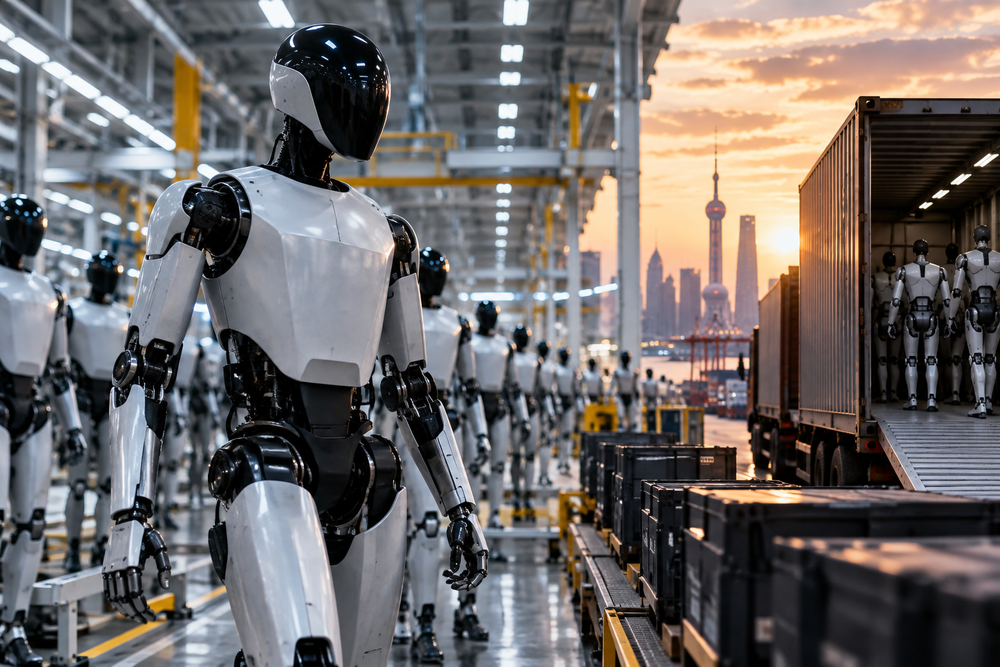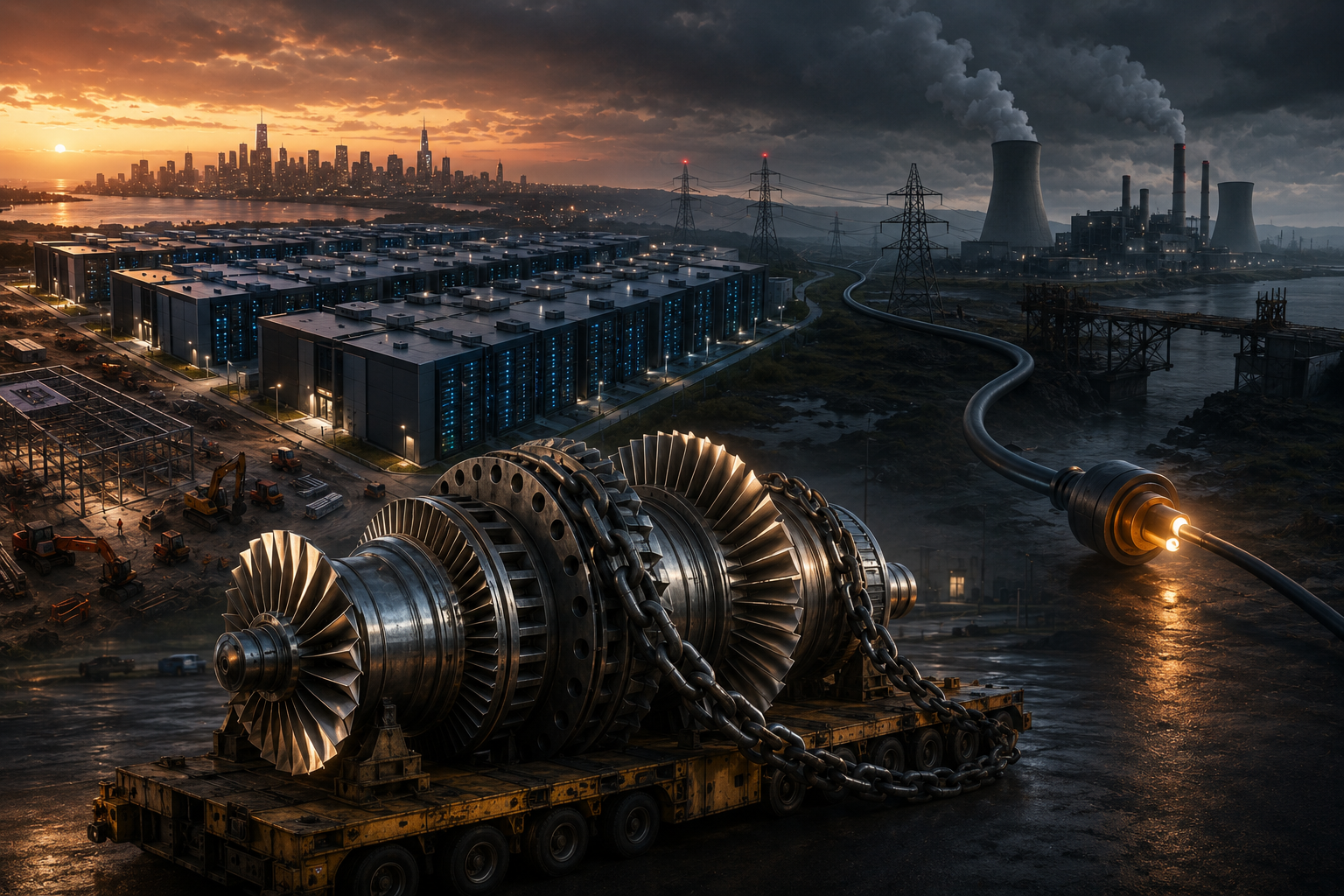
Everyone is watching the data centers go up. The thing that decides whether they ever switch on is the electricity to run them, which does not yet exist, and the one machine that could make it in time is sold out for the rest of the decade.
A modern AI data center can be built in about a year. The steel, the concrete, the racks, the cooling, the chips, all of it can be assembled, with enough money, inside twelve to eighteen months. This is why the maps of the AI boom fill up so fast with announced campuses, gigawatt by gigawatt, each one a press release with a render attached. And almost every one of those announcements contains a silent assumption that turns out to be the hardest part of the entire enterprise: that when the building is finished, there will be power to run it.
There will not be, or not nearly enough, and not in time. The electricity that an AI build-out of this scale requires does not exist on the grid today, cannot be conjured by spending more, and is gated by a piece of heavy industrial equipment with a lead time measured in years. Everyone is watching the data centers, the chips, the models. The determining variable is the power, and beneath the power, the single machine that makes firm power at scale, and that machine is sold out.
You Cannot Announce a Power Plant
Start with the asymmetry, because it is the whole story. Compute scales at the speed of capital. Firm power scales at the speed of heavy industry, and the two speeds are not close. A company can decide to build a data center and have it drawing load within a year and a half. The electricity to feed it, if it requires new generation, is a five to seven year proposition, and that is if everything goes right.
This is the mismatch that the AI conversation almost entirely ignores. The demand side moves at software speed, doubling in months, announced in quarters. The supply side, the actual generation of electricity, moves at the speed of turbines and reactors and transmission, which is to say at the speed of the physical world, in years and sometimes decades. You can announce a gigawatt of compute. You cannot announce a gigawatt of power. The one is a decision; the other is a construction project that depends on equipment somebody else has to build first, and the gap between those two timelines is where the entire AI build-out is now trapped. The buildings will be finished. The question is whether anything will come out of the wall when they flip the switch.
The Scale of the Demand
The numbers have left the territory of ordinary load growth and entered something without precedent. The International Energy Agency projects that global data center electricity consumption will pass a thousand terawatt hours by the end of 2026, roughly the entire annual electricity use of Japan, consumed by server halls. In the United States alone, analysts now estimate that data center power demand will nearly double from around eighty gigawatts in 2025 to a hundred and fifty gigawatts by 2028, driven almost entirely by AI. Current US data-center load is already approaching half the capacity of the entire US nuclear fleet. A single hyperscale AI training cluster can draw a hundred megawatts, enough to power a small city, and the largest planned campuses are specified in multiples of a gigawatt each.
Put those figures next to the speed at which they are arriving and the problem becomes obvious. This is not the gentle, plannable load growth that utilities are built to handle, a percent or two a year that you can meet by adding capacity on a comfortable schedule. It is a step change, tens of gigawatts of new demand appearing in a handful of years, concentrated in specific places, from a single industry. The grid was designed for an era when demand grew slowly and predictably, and the AI boom has presented it with the opposite of both. The system that took a century to build is being asked to expand by a meaningful fraction of itself in less time than it takes to permit a single large power plant.
What Broke the Forecast
To see why the system was caught so completely off guard, you have to know what the previous twenty years looked like. For roughly two decades, electricity demand in the United States was essentially flat. Efficiency gains, better appliances, LED lighting, more efficient motors and screens, almost perfectly offset economic and population growth, so that the total amount of power the country used barely moved from one year to the next. Utilities planned around that reality. They built for near-zero load growth, retired old plants without fully replacing the capacity, and assumed the future would look like the recent past. An entire generation of energy planning was built on the premise that demand had stopped growing.
Then, in the span of about two years, the premise collapsed. The combination of AI data centers, the reshoring of manufacturing, and the electrification of cars and heating turned a flat line sharply upward, and the forecasts utilities had relied on for a generation were suddenly worthless. This is why the response is so far behind: the system was not merely slow to react, it had spent twenty years actively organizing itself around the assumption that this would never happen. The flatness was not neglect; it was the plan. And a system optimized for no growth is the worst possible starting point from which to absorb the fastest demand surge in its history. The AI boom did not just arrive quickly. It arrived into an industry that had spent two decades preparing for the opposite.
The Turbine Is the Bottleneck
Here is where the constraint narrows to a single object, the way these constraints always do. To meet demand that is arriving this fast, you need firm power, electricity available on demand regardless of weather, and you need it in this decade. Renewables plus storage are growing fast but cannot, on their own, supply round-the-clock gigawatts to a data center on the timeline required. Nuclear, as we will see, arrives too late. That leaves, for the near term, one workhorse: the natural gas turbine. And the natural gas turbine is sold out.
The world's large gas turbines are made, by most estimates between two-thirds and three-quarters of them, by just three companies: GE Vernova, Siemens Energy, and Mitsubishi. All three order books are full for years. GE Vernova ended 2025 with a backlog on the order of eighty gigawatts of gas orders and slot reservations stretching into 2029, and its chief executive expects the book to be sold out through 2030. Siemens Energy's backlog reached well over a hundred and thirty billion euros. Mitsubishi has said that an order placed today will not deliver before 2028 at the earliest. The lead time for a combined cycle gas plant has stretched from two or three years to five to seven. And the tell, the single statistic that ties this whole story to AI, is that around sixty percent of Siemens' gas turbine orders in 2025 were tied to data center projects. The AI boom is not just consuming electricity. It has bought, in advance, most of the world's ability to make more of it.
This is the gate beneath the gate. The data center is constrained by power, and the power is constrained by the turbine, and the turbine is made by three firms whose factories are committed through the end of the decade. You can have the capital, the site, the chips, the permits, and the demand, and still wait years, because the machine that turns gas into electricity is on a waiting list, and no amount of money moves you up it past the people who reserved their slots first. The most software-paced industry in history has run into a piece of forged steel with a five year lead time.
Why You Cannot Hurry a Turbine
It is worth understanding why the turbine makers cannot simply build faster, because the reasons are physical and they explain why even a furious expansion stays sold out. A large gas turbine is one of the most demanding objects manufactured on earth. Its blades run white-hot in a stream of combusting gas and must hold their shape under stresses that would tear ordinary metal apart, which is why they are grown as single crystals from exotic alloys and cooled through internal channels finer than the process can comfortably hold. The largest rotating parts are massive forgings that only a handful of foundries in the world can produce, and those foundries are themselves a bottleneck behind the bottleneck. The supply chain is deep, specialized, and slow, and a turbine maker that wants to double output cannot do it by hiring a shift. It has to expand a global web of suppliers who each face the same constraint.
This is the same path-dependency that governs every piece of heavy infrastructure, and it sets a hard floor under how fast the supply side can respond. GE Vernova has said it can stretch toward roughly twenty four gigawatts of annual turbine production by 2028, an enormous increase, and against a demand curve adding tens of gigawatts a year it is still not enough, which is exactly why the order book remains sold out after the expansion. The capacity to make the machines that make the power is itself a multi-year project. You are not waiting for a turbine. You are waiting for the factory that builds the turbine to be enlarged, and behind that, for the foundry that forges its parts, all the way down a chain that no quantity of AI capital can compress, because the chain runs on furnaces and forging presses, not on code.
The Second Slow Clock
A turbine in hand still does not give you power, because the wires that carry it are a second slow gate with a crisis of their own. The high-voltage transformers that step power between a plant and a building, and the interconnection queue that governs the right to plug in at all, have become some of the longest waits in the energy system, and that transmission bottleneck is examined in its own place in this series. The point here is only that it stacks on top of the generation gate rather than replacing it. A project can clear the turbine and still wait years on the grid. Generation and transmission are two separate slow clocks, and the AI build-out has to beat both. This piece is about the first one, the making of the power itself, because that is the gate that has been least understood and the one where the constraint narrows to a single machine no amount of money can hurry.
Bridge Power and the Off-Grid Campus
Faced with all this slowness, the largest builders have started doing something that tells you how binding the constraint really is: they are going around the grid entirely. Rather than wait years to interconnect, data center developers are installing their own generation on site, often smaller aeroderivative gas turbines, the kind originally derived from jet engines, deployed as so-called bridge power to run a facility now while the permanent grid connection crawls through its queue. The newest and most aggressive AI campuses are being built with their own power stations attached, effectively off-grid or only loosely tied to it, burning gas next to the servers because that is the only way to get electricity on the AI timeline rather than the utility timeline.
This is a remarkable inversion of how electricity has worked for a century. For a hundred years the logic ran one way: you connected to a shared grid because no single user could economically make its own power. The AI build-out has grown demand so concentrated, and grid expansion so slow, that the biggest users are reverting to building private power plants beside their factories, the way a nineteenth-century mill sat next to its own water wheel. It is a confession written in steel. When the most sophisticated companies in the world decide it is faster to build and run their own gas turbines than to wait for the public grid, they are telling you, plainly, that the grid can no longer deliver power on the timeline that matters, and that firm generation, not anything upstream in the glamorous part of the stack, is the thing actually setting the pace.
Why the Bottleneck Is a Turbine and Not a Reactor
The obvious objection is nuclear, and the nuclear story is real, and it is also the clearest proof that the near-term gate is gas. The headlines have been spectacular. Microsoft signed a twenty year agreement with Constellation to restart the undamaged reactor at Three Mile Island, the eight hundred and thirty five megawatt unit now rebranded and pulled forward toward 2027. Amazon committed to small modular reactors with X-energy, potentially more than five gigawatts by 2039. Google contracted Kairos Power for around five hundred megawatts of small modular capacity by 2035. Meta issued a request for proposals for up to four gigawatts of new nuclear from the early 2030s. The hyperscalers have, quite suddenly, become the most important customers nuclear power has had in two generations.
But read the dates. The Three Mile Island restart is a one-off, the recovery of a single existing reactor that happened to be sitting idle and intact, not a template that scales. The small modular reactors that everyone is counting on are years from commercial deployment, with the earliest meaningful capacity arriving around 2035 and the larger commitments later still. Deloitte estimated that new nuclear could meet roughly ten percent of the projected increase in data center demand by 2035. Ten percent, a decade out. That is not a solution to a demand curve that doubles by 2028. It is a partial answer to the demand of the next decade, and the gap between now and then has to be filled by something that can be built now, which is gas. The nuclear announcements are real and important and almost entirely about the 2030s. The electricity the data centers need in 2027 comes from a turbine, and the turbine is sold out, which is why the constraint is the turbine and not the reactor.
The Power Decides What the Compute Can Do
Strip the story to its mechanism and the determining variable is a lead time. The binding constraint on how much AI the world can actually run is not the chip, not the model, not the data center, but the number of years it takes to add firm generating capacity, set against a demand that is doubling in a fraction of that time. The compute is ready and the power is not, and the power decides what the compute can do. For a century, power waited on demand. Now demand waits on power.
This is the inversion the whole industry is living through and mostly refusing to name. For decades electricity was the boring, abundant, assumed input, the thing you simply plugged into. The AI boom has turned it back into the scarce, determining, fought-over resource it was in the early industrial age, the thing that decides where you can build and how big and how soon. The spotlight is on the model and the chip because those are the glamorous, fast-moving objects. The actual limit sits at the slowest, least glamorous layer there is, the generation of raw electrical power, and it sits there precisely because that layer cannot be accelerated by the things that accelerate everything else in technology. You can write better code overnight. You cannot forge a turbine overnight, and you cannot, at any price, jump a queue that is already full to 2030.
The Map Moves to the Power
One of the quietest signs that power has become the determining variable is that it is now redrawing the map of where AI gets built. For years data centers were sited for land, fiber, cheap construction, and tax breaks, and power was assumed. That assumption is gone. The new campuses are being planned around electricity first, clustering wherever firm power can actually be found: beside existing nuclear plants whose output can be bought whole, in gas-rich regions where on-site generation is quick to permit, in the few grid areas with spare capacity, and increasingly in places chosen for nothing except that the electrons are available. The industry has reordered its own geography around the scarce input, which is what industries always do once a resource becomes the binding one.
This is the signature of a true determining variable. It does not just slow things down; it reorganizes everything around itself. When water was the limit, cities rose on rivers. When coal was the limit, industry massed on the coalfields. Now that firm power is the limit on artificial intelligence, the intelligence is migrating to the power, and the regions that happen to have spare generation are discovering that they hold something the most valuable companies on earth urgently need. The location of the AI build-out is no longer a question about real estate. It is a question about which patches of the map can deliver a gigawatt, and that map is short.
Who Gets the Power
There is a quieter and more consequential shift inside this, and it is about who the power belongs to. Faced with a grid that cannot supply them in time, the hyperscalers have stopped waiting for it. They are buying generation directly: signing twenty year agreements for the entire output of nuclear plants, building their own gas generation behind the meter, contracting future reactors, in effect privatising slices of the electricity supply for their own exclusive use. The Three Mile Island deal is the clearest emblem. An entire power plant, restarted, with its whole output committed to a single company for two decades.
This is the same anchor-tenant dynamic that runs through every layer of the AI build-out, and it has a public cost. When the firm power that does exist, and the turbines that could make more, are reserved years deep by the few buyers with the deepest pockets, everyone else is left competing for what remains, including the ordinary grid that homes and hospitals and existing industry depend on. The scarce resource is captured in advance by the largest players, and the public system is left to absorb the shortfall. Power that was built as a shared public utility is being quietly converted, plant by plant and contract by contract, into private infrastructure for a single industry, and the conversion is happening faster than any regulator has decided whether to allow it. The grid was a commons. The AI boom is enclosing it.
It Reaches Your Bill
The consequence lands, as these always do, on people who never bought a GPU. When a vast new source of demand arrives on a grid that cannot easily expand, the price of electricity rises for everyone connected to it, because the same generation is now contested by a buyer willing to pay almost anything. Utilities in the regions filling with data centers have begun warning of exactly this, and ratepayers in some of those regions are already seeing it in their bills. The cost of the AI boom's hunger for power is being socialised across every household on the same wires.
It reaches further than price. To keep the lights on against this surge, grid operators are delaying the retirement of old coal plants that were scheduled to close, and utilities are racing to build new gas plants whose emissions will run for decades, so the climate cost of the AI build-out is being paid in postponed closures and new fossil capacity that would not otherwise exist. The same companies making ambitious climate commitments are, through their power demand, keeping coal alive and pouring concrete for new gas. The bill for the AI boom's electricity is not only higher rates. It is a slower energy transition, charged to everyone, to power a thing most of those paying for it did not ask for.
The Honest Objection
The strongest case against this reading is that demand will not arrive as forecast and supply will rise to meet what does, and it deserves to be put fairly. Many announced data centers are speculative and will never be built; the projections are notoriously inflated by double-counting and hype, and a correction may slacken demand. Efficiency improves constantly, with each generation of chips doing more per watt. The turbine makers are expanding capacity. Behind-the-meter generation, renewables, storage, and eventually nuclear will all contribute. And the hyperscalers have the capital and the motive to solve their own power problem, which is exactly the kind of problem capital is good at solving. Give it a few years, the objection runs, and the bottleneck eases like every bottleneck before it.
This objection is partly right and it sharpens rather than dissolves the argument. Yes, some announced demand is vapor, and yes, efficiency and expansion will help. But notice what survives the concession. Even a heavily discounted demand forecast, with half the announced projects cancelled, still implies tens of gigawatts of new firm load on a timeline the supply side cannot meet, because the supply side's speed is set by physics and industrial lead times, not by optimism. Efficiency gains are real and are being eaten alive by the growth in total compute, the same way they were in every prior computing era. The turbine makers are expanding, and they are still sold out through 2030 after that expansion. The capital is there, and capital cannot buy a turbine slot that does not exist or compress a five year construction into one. The claim here is not that the lights go out. It is that firm-generation lead time is the determining variable on how fast AI can actually scale, that this variable is measured in years against a demand measured in months, and that no amount of money changes the speed of the physical world. The shortage may ease. The lesson, that the slowest physical layer sets the limit, does not.
The Slowest Thing Wins
Pull all the way back and the power story resolves into a single unfamiliar fact about the most advanced industry in history: it is rationed by forged steel. Not by software, not by capital, not by genius, but by the lead time of a machine that three firms make and that no amount of money can hurry, because its blades are grown as single crystals and its rotors are forged by a handful of foundries that were a bottleneck before AI existed. That is the part this layer owns that the chip and the cooling do not. The problem is not only that there is too little power. It is that the one device capable of making more is, by its own physics, the slowest thing in the entire chain, and the AI timeline has collided with it at full speed.
There is a second thing this layer reveals that the others do not, and it is what happens to power once it turns scarce. It stops being a shared public good and becomes a private one. The largest companies buy whole plants, build their own generation behind the meter, and reserve the firm capacity years deep, while the grid that everyone else depends on absorbs the shortfall in higher bills and postponed coal closures. For a century the grid grew to serve the public. Now the public subsidizes a grid being rebuilt to serve a handful of firms. The scarcity does not merely slow the build-out. It quietly transfers the commons.
We built a kind of mind that doubles in months, and found that it runs on a machine that takes half a decade to forge and on a power system it is steadily buying out from under everyone else. This piece is the last of a set, alongside the water that cools the servers and the packaging that assembles the chips, and the set makes one argument: the most advanced industry in history is gated, at every layer, by the heaviest and slowest things a civilization makes. The one that believed it had escaped the physical world is being rationed, in the end, by a turbine order book, and there is no version of intelligence, however advanced, that can think its way past the years it takes to build the thing that powers it, or pay its way out of the fact that the power it takes is power someone else no longer gets.
Evidence Map
Facts, interpretations, forecasts, and disconfirming signals.
Core claim. The binding constraint on AI scaling is the lead time of firm electrical generation, set against demand doubling far faster; in the near term the only firm power that can be added at scale is the natural gas turbine, which is sold out through roughly 2030 across the three makers that dominate it, while nuclear arrives too late to fill the near-term gap. The public watches the data centers and the chips, one layer above the actual gate, which is generation.
Evidence level. Facts (high): IEA projection of global data-center electricity >1,000 TWh by end-2026 (~Japan's annual use); US data-center demand ~80 GW (2025) projected ~150 GW (2028); current US data-center load rivals total US nuclear output; ~100 MW per hyperscale training cluster; GE Vernova ~83 GW gas backlog into 2029 with CEO expecting sold-out through 2030; Siemens Energy backlog well over EUR130bn; Mitsubishi delivery 2028+; combined-cycle lead times 5-7 years; ~60% of Siemens' 2025 turbine orders data-center-tied; three firms make ~75% of large gas turbines; Microsoft-Constellation Three Mile Island restart (835 MW, pulled toward 2027); Amazon-X-energy (5+ GW by 2039), Google-Kairos (~500 MW by 2035), Meta RFP (up to 4 GW early 2030s); Deloitte estimate that new nuclear meets ~10% of projected data-center demand growth by 2035. Interpretation (medium, marked): that firm-generation lead time is the determining variable; that gas is the near-term gate by elimination; that hyperscaler power-purchasing privatises a public commons. Forecast (speculative): that even discounted demand outruns supply this decade.
What would confirm this. Continued multi-year turbine backlogs despite capacity expansion; data-center-driven electricity price rises and delayed coal retirements; hyperscalers continuing to buy generation directly.
What would disprove this. A demand collapse (mass data-center cancellations) bringing load back within plannable grid growth; or a genuine acceleration of firm generation (turbine lead times collapsing, SMRs arriving early at scale) that matches the demand curve.
Watchlist. Turbine order books and lead times through 2030; US data-center load vs grid additions; electricity rate cases in data-center regions; coal-retirement delays; SMR commercial-deployment dates.