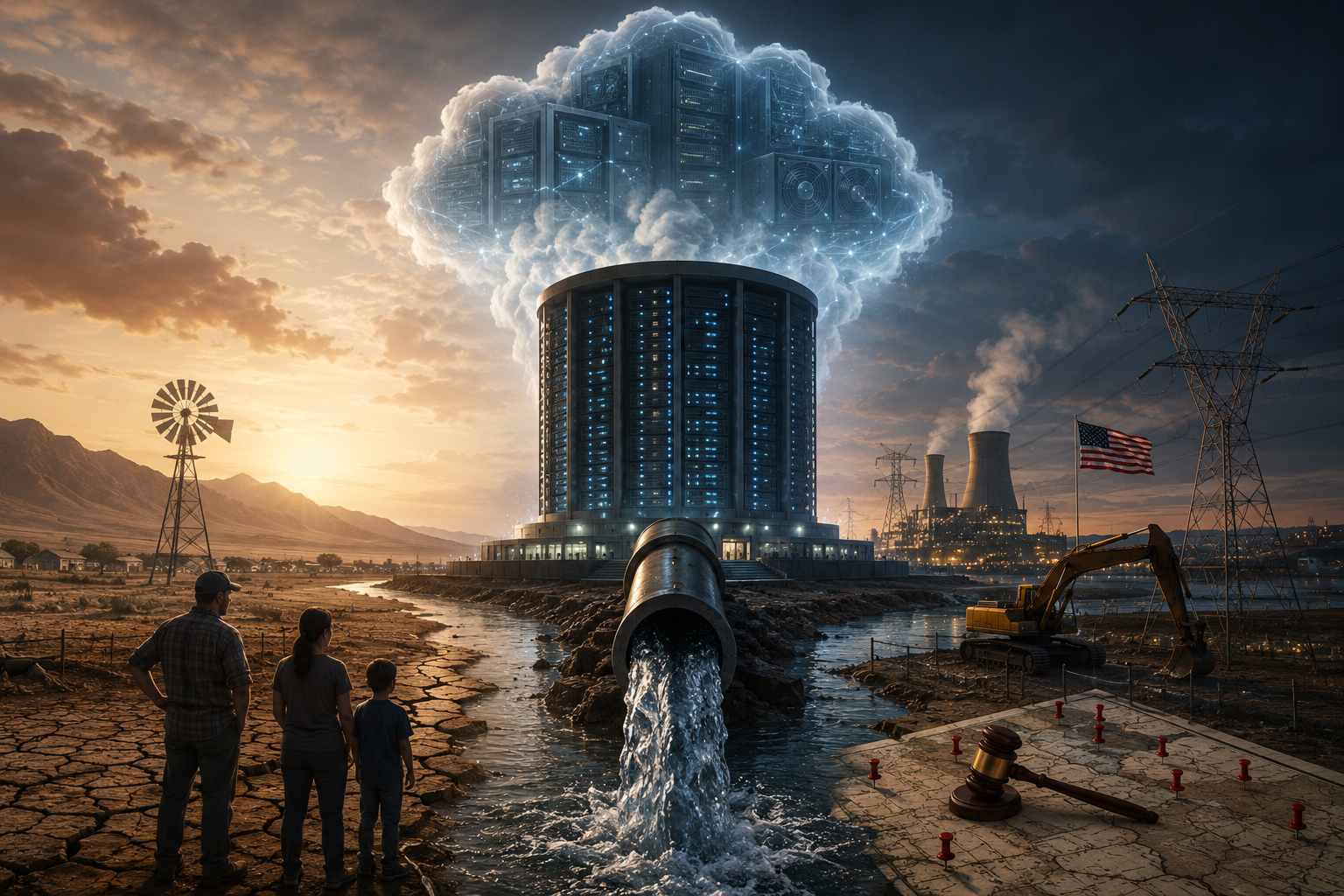
Everyone is watching the models. The determining variable is the water that cools them, drawn from the places that can least spare it.
Ask an advanced AI to write a short email and it will, somewhere you cannot see, draw water to do it. Not metaphorically. One peer-reviewed estimate in 2025, from researchers at the University of California, Riverside, put the cost of a single hundred-word reply at roughly five hundred and nineteen milliliters, close to a bottle of water, once you count the water that cools the servers and the water consumed generating the electricity those servers burn. Other estimates land considerably lower, and the precise figure is genuinely contested, but every serious accounting agrees on the direction. The query feels weightless and frictionless on the screen. It is neither. It is a small withdrawal from a watershed, and the watershed is usually somewhere dry.
The entire public conversation about artificial intelligence is about the models, their intelligence, their danger, their jobs, their alignment. Almost none of it is about the physical fact that a model is a machine that turns electricity into heat, and that the heat has to go somewhere, and that the cheapest way humanity has found to move that much heat is to evaporate fresh water. The determining variable in how large AI can grow is not the cleverness of the algorithm. It is the availability of cool water in the specific places the machines are being built, and those places, by a logic that is not accidental, are increasingly the places that have the least water to give.
Intelligence Is Heat
Start with the physics, because everything else follows from it. A data center full of AI accelerators is, thermodynamically, a furnace. Every watt of electricity that flows into a chip comes out as heat, and a modern AI server rack concentrates more heat into a square meter than almost any other human-built object that is not actively on fire. If that heat is not removed continuously, the chips throttle within seconds and fail within minutes. Cooling is not a feature of an AI data center. It is the precondition for the data center existing at all.
There are ways to move heat, and the cheapest and most common at scale is evaporative cooling, which works on the same principle as sweat. Water is run across the hot air or the hot equipment, it evaporates, and the evaporation carries the heat away into the atmosphere, and the water is gone, lifted into the sky rather than returned to the river. This is why data centers do not merely use water the way a factory uses water, drawing it and discharging it. They consume it, evaporating it permanently out of the local supply. The industry term is consumptive water use, and it is the relevant number, because consumed water does not come back to the basin it was taken from.
This is the hidden chain that the weightless interface conceals. A prompt becomes a computation, the computation becomes heat, the heat becomes evaporated water, and the evaporated water becomes a deficit in a reservoir somewhere far from the person who typed the prompt. The model's intelligence, measured in the only physical units that ultimately bind it, is a rate of water consumption. The smarter and larger the model, the more compute it demands, and the more compute it demands, the more water it drinks. There is no version of scaling the models that does not also scale the thirst, because the thirst is not a side effect of the computation. It is the computation, expressed as heat, expressed as water. The model drinks the river, and the river bounds the model.
How You Move a Furnace
Every method of cooling a data center is a choice about which scarce resource to spend, and understanding the menu explains why the water problem is so stubborn. The cheapest method at scale is evaporative cooling, which spends water to save electricity, running water across the hot air so that evaporation carries the heat away. It is popular precisely because it is efficient in energy terms, and it is efficient in energy terms because it is profligate in water terms. The two are linked. You are trading one resource for the other.
The alternatives rearrange the same trade rather than escaping it. Closed-loop systems recirculate the same water without evaporating it, which can cut consumptive water use dramatically, but they need more electricity to chill that water, and the extra electricity carries its own water cost back at the power plant. Air cooling avoids water at the site almost entirely, but it is far less effective for the extreme heat density of AI racks and demands more space and power. Direct liquid and immersion cooling, in which coolant touches the chips directly, is the emerging answer for the heat densities that AI hardware now produces, and it can reduce site water use substantially, but it is expensive, newer, and still being retrofitted into an installed base that overwhelmingly was not built for it. The point is not that a clean solution is impossible. It is that there is no free cooling. Every method spends water, or power, or capital, or all three, and the heat that has to be moved only grows as the models scale, so the question is never whether to pay but only in which currency, and in much of the world the currency the industry still reaches for first is water, because water is the one that looks cheapest on the invoice.
The Numbers Nobody Quotes
The figures, once you assemble them, are not marginal. By industry market-research estimates, data centers consumed on the order of a trillion liters of water in 2025, roughly two hundred and sixty-four billion gallons, with AI workloads accounting for a fast-rising share. Google alone reported using more than five billion gallons of water across its data centers in a recent year, and disclosed that nearly a third of its freshwater withdrawals came from watersheds it classified as having medium or high water scarcity. Microsoft's disclosed water use rose about a third in the fiscal year ChatGPT launched, though the company has not attributed that rise solely to AI. These are not the numbers that appear in the keynote presentations about the future of intelligence, and their absence is itself a piece of the story.
The trajectory is steeper than the present. The researchers who produced the per-query estimates project that global AI water withdrawal could reach between four and a quarter and six and a half billion cubic meters a year by 2027, the upper end approaching half the total annual freshwater withdrawal of the entire United Kingdom. In Texas alone, one study projected data center water use rising from around forty-nine billion gallons in 2025 toward as much as three hundred and ninety-nine billion gallons by 2030, a figure the authors compared to drawing down Lake Mead by more than sixteen feet in a single year. These are not the kinds of quantities that efficiency tweaks absorb. They are the kinds of quantities that empty rivers.
What makes the numbers land is the local version of them. In Newton County, Georgia, a single data center that opened in 2018 was reported to use half a million gallons of water a day, around a tenth of the entire county's consumption, before the current AI build-out even began. That is the asymmetry that defines this whole story. A facility most residents cannot enter, serving users most of whom live nowhere near it, computing for purposes the county has no stake in, drinks a tenth of the county's water. The visible thing, the AI boom, is global, abstract, and enormous. The binding thing, the water, is local, concrete, and small enough that one building can take a tenth of a county.
The Town That Sued to Keep the Number Secret
The clearest proof that the water is the real story is how hard the industry has worked to keep the water numbers hidden. The case that broke it open happened in The Dalles, a small city on the Columbia River in Oregon, where Google had operated data centers for years and the local newspaper, The Oregonian, asked a simple question: how much of the city's water do they use? The city refused to say. It went further. It sued its own newspaper to keep the figure secret, arguing that Google's water consumption was a protected trade secret under public-records law, and Google quietly agreed to pay the city's legal bills, concerned, in its own reported words, about competitors learning how it cooled its servers.
The fight ran for more than a year before the city gave up, and when the number finally came out it explained the secrecy. Google's water use in The Dalles had nearly tripled over five years, and its data centers had come to consume more than a quarter of all the water used in the entire city, around three hundred and fifty-five million gallons in a single year. A town of fewer than twenty thousand people was giving a quarter of its water to server halls, and the institution that should have told them, the city government, had spent public money in court trying to make sure they never found out. After the settlement Google said it would stop treating its site-level water use as a trade secret nationwide, which is to say it conceded the secrecy had been a choice.
This is the architecture of the thing in miniature. The physical cost is real and large and local. The information about the cost is suppressed, not through some dramatic conspiracy but through the ordinary machinery of trade-secret law and economic-development deals, until a journalist with a public-records request forces it into the light. The reason the public conversation is about the models and not the water is partly that the water numbers were, quite literally, kept off the record. You cannot watch a variable that has been classified as a trade secret, and for years, in city after city, that is exactly what the determining variable was.
The Map of the Thirst
Here is where the logic stops looking like an accident. You might expect that machines this dependent on water would be built where water is abundant. The opposite is happening. A Bloomberg analysis found that more than two-thirds of the data centers built since 2022 sit in water-stressed regions, and a separate investigation by The Guardian and the research group SourceMaterial found that around two-thirds of the eight hundred and nine planned US projects it examined were slated for land that had been in drought over the previous year. The machines that drink the most are being placed, deliberately, where the water is scarcest.
The reason is that water is not what the developers are optimizing for. They are optimizing for cheap land, cheap and available electricity, tax incentives, fiber connectivity, and cooperative local governments, and that combination is found disproportionately in hot, dry, low-cost regions, the American Southwest, west Texas, parts of the high desert, and their equivalents abroad. Water enters the decision late, as a problem to be managed rather than a constraint that determines the site, because water is cheap to the developer even where it is precious to the community. A municipality competing for the jobs and the tax base offers the water as part of the package, often at rates that do not reflect its scarcity, and the deal is frequently struck before the residents understand how much of their aquifer they have just committed. The siting is not irrational. It is rational for everyone at the table, and the watershed is not at the table.
So the thirst concentrates exactly where it does the most damage. A data center that evaporates half a million gallons a day in a water-rich basin is a rounding error. The same data center in a drought-stricken county in the West is a competitor for the water that grows the food, supplies the homes, and sustains the river, and it is a competitor that does not lose, because its water is contracted and its pockets are deeper than the farm's. The determining variable is not just water. It is water in the wrong place, and the wrong place is being chosen on purpose because everything else about it is cheap.
The Price That Is Not the Price
Underneath the siting decisions is a pricing failure that makes the whole pattern run, and it is worth stating because it is the lever that could in principle change it. Water, in most of the places these facilities are built, is radically underpriced relative to its actual scarcity. A municipal water rate is set to recover the cost of pipes and treatment, not to reflect what the last gallon in a failing aquifer is truly worth, and so to a developer with a continental budget the water is close to free even where it is, in real terms, almost priceless. The signal that should warn the buyer away, a price that rises as the resource grows scarce, is muffled or absent, because water has never been treated as the market good its scarcity would imply.
This is why the developer's calculation and the community's reality diverge so completely. The developer sees a cheap input and optimizes around the expensive ones, power and land and chips. The community holds a resource that is cheap on the invoice and irreplaceable in fact, and discovers the gap only when the well runs low. A resource that is mispriced will be misallocated, reliably and at scale, and the AI build-out is simply the largest new bidder to walk into a market that was never designed to ration water against a buyer this large. The thirst is not only a physical problem. It is a pricing problem, and the pricing problem is what converts a finite local resource into a cheap global input, one signed contract at a time.
The Water You Cannot See
The direct cooling water is only half of it, and the hidden half connects this story to every other bottleneck under the AI boom. Electricity is not water-free. The power plants that feed the data centers, the gas turbines and the nuclear stations and even many renewables, consume their own enormous quantities of water for their own cooling, and so every kilowatt-hour a data center draws carries an invisible volume of water consumed somewhere up the line at the generating station. This is why the per-query estimates count both the direct and the indirect water, and why the indirect often exceeds the direct. The model's thirst is not only the water that runs through the server hall. It is also the water that boiled to make the electricity that ran the server hall.
This is the seam that binds the AI infrastructure crisis into a single mechanism rather than a list of separate shortages. The electricity that the grid cannot deliver fast enough, because the transformers cannot be built in time, is also water, consumed at the power plant. The compute that waits on advanced packaging is also, once it runs, heat, removed with water. Energy, water, and silicon are not three independent constraints on the AI boom. They are three faces of one physical limit, the limit on how much heat a civilization can generate and move in a given place, and water is the medium through which that limit is ultimately enforced. You can argue about which constraint binds first in any given location, but you cannot escape the underlying fact that scaling intelligence means scaling a physical throughput, and physical throughput runs into water at every stage.
The People Who Were Not Asked
The cost of this lands on people who had no part in the decision, and that is the part the abstraction is built to hide. The user typing the prompt does not see the watershed. The shareholder counting the growth does not live in the county. The county that signed the water contract did so for jobs that a modern data center, once built, provides in surprisingly small numbers, because the buildings are mostly empty of people, run by a skeleton staff and a great deal of automation. So the community trades a permanent, consumptive claim on its water for a temporary construction boom and a handful of permanent jobs, and discovers, often only later, during the next drought, what it has agreed to.
This is the structure that should be named plainly, because it recurs across the whole AI build-out. A diffuse, global, enormously profitable activity is converted into a concentrated, local, physical cost, and the cost is imposed on populations selected precisely because they are too small, too poor, or too eager for investment to refuse. The benefit is socialized across the world's AI users and privatized into a few balance sheets. The cost is localized onto a watershed and the people who depend on it. No one in this chain is a villain, and that is exactly why it works. The developer follows the incentives, the municipality competes for the investment, the user enjoys the free-feeling tool, and the river falls, and there is no single decision anywhere that anyone would recognize as the decision to drain it. The draining is the sum of a thousand reasonable choices, each made by someone who was not looking at the water.
The Pushback Arrives
The communities are beginning to see the variable that was hidden from them, and the politics is starting to catch up to the physics. Across the United States and beyond, towns that once competed for data centers are now refusing them, imposing moratoria, demanding water-use disclosure before approval, and voting down projects that a few years earlier they would have courted. The reporting that exposed the consumptive water numbers, from The Dalles onward, has given residents the one thing the trade-secret regime had denied them, which is a figure to point at, and a figure changes a meeting. It is far harder to wave through a development that will take a quarter of the town's water once the phrase a quarter of the town's water has been spoken aloud in a council chamber.
This is the part of the story still being written, and it is where the determining variable becomes a political fact rather than only a physical one. The same dynamic that makes water the binding constraint also makes it the point of maximum leverage for the people affected, because water is local, visible once disclosed, and emotionally legible in a way that megawatts and teraflops are not. A community may not be able to evaluate a model or a chip, but it understands a dropping well. As the disclosures spread and the droughts deepen, the cheap-water assumption that the whole siting logic rests on is becoming the thing most likely to break it, not through national regulation but through a thousand local refusals, each one removing a basin from the map of available sites. The industry's quietest constraint is turning into its loudest political problem, and it is doing so in exactly the places the industry chose precisely because it expected no resistance.
The Honest Objection
The strongest case against this reading is technical and serious, and it should be put at full strength. The industry is not blind to its water problem, and the engineering is moving fast. New data center designs increasingly use closed-loop cooling, in which the same water circulates without evaporating, so that a facility fills its loop once and tops it up rarely, and the most advanced designs claim to approach zero operational water use. The chief executive of one of the largest operators has said its newest centers use about as much water annually as a restaurant. Air cooling and immersion cooling exist. And in absolute terms, the objection continues, data centers are still a small fraction of total water use, dwarfed by agriculture, which consumes the overwhelming majority of fresh water; to fixate on the data center while a single crop uses orders of magnitude more is to aim at the wrong target.
These points are real, and conceding them sharpens the argument rather than dissolving it. Closed-loop cooling is a genuine advance, but it trades water for energy, because circulating and chilling water without evaporation takes more electricity, and more electricity means more water consumed back at the power plant, so the saving at the server hall is partly an accounting shift up the line rather than a true elimination. The restaurant comparison describes the newest flagship designs, not the installed base or the bulk of what is being built at speed right now, where evaporative cooling remains common because it is cheap. And the comparison to agriculture, while true in aggregate, misses the entire point about place and time. Agriculture's water grows food and is spread across vast areas; a data center's water is concentrated onto one site, often in a basin already in deficit, competing directly with the homes and farms around it during the exact droughts when every gallon is contested. The question is not whether data centers use more water than farming. It is whether a new, fast-growing, geographically concentrated, drought-zone-sited consumer of water is a wise thing to add to basins that are already failing, and on that question the efficiency gains, real as they are, are losing the race against the growth.
There is one future in which this analysis is wrong, and honesty requires naming it. If direct-to-chip and immersion cooling were adopted across the whole industry, quickly, and genuinely decoupled compute growth from consumptive water rather than merely shifting that water up the line to the power plant, then the place-and-time argument would weaken and the binding constraint would move elsewhere. That outcome is not impossible, and nothing in this reading can fully foreclose it. It is only, so far, losing the race, and the analysis stands or falls on whether it keeps losing.
The Water Rights Grab
Here is the turn the story has been building toward, and it changes what the data center actually is. The basins these machines are moving into are not empty land waiting to be put to use. They are battlefields, some of them fought over for a century, and the AI build-out is not opening a new front. It is enlisting in an old war, on the side with the deepest pockets.
Consider the Colorado River, which waters some forty million people and seven states and which has been in a megadrought for more than two decades, its great reservoirs at record lows, its states forced in 2023 into emergency agreements to cut millions of acre-feet of use. This is the most litigated, most negotiated, most desperately rationed river in the world, and the precedent for what AI is now doing to it was set, before any data center arrived, by a crop. In the Arizona desert, a company called Fondomonte, owned by a Saudi conglomerate, pumped the state's groundwater at almost no cost to grow alfalfa, which it then shipped across the world to feed cattle in Saudi Arabia, a country that had already exhausted its own aquifers doing the same thing at home. A foreign-owned entity, extracting a drought-stricken basin's water nearly for free, to serve a distant purpose that returned almost nothing to the people whose water it was. The arrangement became such a scandal that Arizona's governor canceled the lease in 2023 and pledged not to renew the others.
Now look at a hyperscale data center in the same desert and the structure is identical. A globally owned entity extracts a stressed basin's water, on terms that approach free, to serve a distant purpose, the world's compute, that returns little to the community whose water it consumes. The only real difference between the data center and the Saudi alfalfa farm is the output. One ships hay to feed cattle abroad. The other evaporates the water to cool servers computing for users abroad. Both are the same move, the extraction of a scarce local resource for a globalized benefit, and the data center is in some ways the harder one to evict, because it arrives dressed in the language of the future and the promise of progress rather than as an obvious agricultural anachronism. The alfalfa farm looked like what it was. The data center looks like destiny.
The pattern is not confined to the American West. In the Cerrillos district of Santiago, residents of a drought-stricken Chile voted in a local referendum against a Google data center that proposed to draw scores of liters of water per second for its cooling, and the authorities ultimately reversed part of the company's permit. In Uruguay, during the worst drought the country had seen in seventy years, with Montevideo's own taps running brackish, Google proposed a data center that would consume on the order of seven and a half million liters of water a day, the daily domestic use of tens of thousands of people, and the resulting outrage forced the project to be redesigned to use air cooling instead. The same scene plays out across hemispheres with the same cast. A hyperscaler proposes to draw a community's water during a drought, the community discovers the number, and a fight begins that the company does not always win.
This is the escalation the water story has been concealing. AI did not create a new resource conflict. It joined the oldest one there is, the fight over who controls the water, and it joined on the side of capital and against the basin. The water wars of this century, already underway over the Colorado and the aquifers of the dry world, will be fought with a new and unexpected combatant in them, one that does not farm or drink but computes, and that wants the same shrinking river the farm and the city have been fighting over all along. The data center is the newest claimant in the longest war, and it has walked onto the field with more money than anyone already on it.
Water Was Always the Variable
There is nothing new about water deciding where power can concentrate, and the long view is what turns this from an environmental complaint into a structural law. For most of human history the determining variable in where a civilization could rise was water, and the great early states were hydraulic states, built on the control of rivers and irrigation, Mesopotamia and the Nile and the Indus, their power literally the power to allocate water. The control of who got water and when was among the first forms of political control that existed, older than money, older than writing in some places. To hold the water was to hold the society that depended on it.
The American West, where so many of these data centers are now rising, is the most recent chapter of that same story before this one. Its entire modern existence is an argument over water, the dammed Colorado, the drained Owens Valley that let Los Angeles grow, the legal doctrine of prior appropriation that turned water into a property right fought over for a century. The West learned, expensively, that water is the master constraint, that you can build a city in a desert only by reaching out and taking someone else's water, and that the reaching never stops because the demand never stops. The AI build-out has walked into this oldest of contests as the newest and best-funded claimant, and it has done so largely unaware that it is repeating a pattern as old as cities, in the very region that knows the pattern best.
This is why the water story is not a footnote to the AI story but a return to the deepest layer of it. We have built a new kind of mind, and discovered that it is subject to the same constraint as every settlement that came before it, that intelligence at scale, like agriculture and industry before it, is ultimately a question of how much water a place can spare. The technology is unprecedented. The limit it has run into is the most precedented limit there is.
The Race for Watersheds
It would be comforting to treat this as an environmental footnote to the real story of AI, the way water has often been treated as a footnote to every industrial revolution before this one. It is not a footnote. It is, increasingly, the binding constraint. That it is the binding constraint, rather than one limit among several, is a marked interpretation and not a measurement, because which limit bites first, water or power or silicon, varies by site and is weighted differently by serious analysts; what is not in dispute is that water has moved from an afterthought to a contender for the role. And the companies building the largest models appear to know it, which is why the competition among them is quietly becoming a competition for sites with secure water and power, for the specific basins and grid connections that can sustain a gigawatt-scale computing campus. The race that is reported as a race for talent and chips and capital is also, underneath, a race for watersheds, and the watershed is the part that cannot be manufactured, accelerated, or imported. You can build another fab. You cannot build another aquifer.
That is the law beneath this whole story, and it reaches past AI to every digital thing presented to us as weightless. The cloud is not a cloud. It is a set of enormous physical buildings that drink rivers, sited in the places least able to object, computing an abstraction for people who will never see the cost. The determining variable in the future of artificial intelligence may turn out to be the most ancient variable in the history of settlement, the one that decided where cities could exist for ten thousand years before anyone built a chip. Water decides. It always has. The novelty is only that we have built a kind of mind that is as thirsty as a city, and pointed it at the desert, and called the thirst a detail.
What a Civilization Must Control
Step all the way back and the AI water story resolves into the oldest political fact there is. The allocation of water is the purest form of power humans have ever exercised, older than money and older than law, because whoever decides where the water goes decides who eats, what grows, and which settlement lives or dies. Every durable civilization has, sooner or later, organized itself around that decision, and you can read what a society truly is by looking at what it builds to control its water.
The American West wrote its power into a single document in 1922, when delegates from seven states met in Santa Fe and divided the Colorado River among themselves by law, the Colorado River Compact, apportioning shares of a river before anyone knew how little water it would reliably carry. That act of allocation has governed the West for a century, and it is now failing in real time as the river shrinks below the promises made on paper, and it is into that failing, over-promised, fiercely litigated allocation that the data centers are now walking with their contracts in hand. China, facing the same problem at continental scale, chose to move the water itself, building the South-North Water Transfer, the largest water-moving project in human history, channeling more than forty billion cubic meters a year across hundreds of miles from the wet south to the dry north and the capital, at a cost beyond seventy billion dollars, because a state that cannot water its own heartland is not a state for long. And on the Blue Nile, Ethiopia built Africa's largest dam and filled its reservoir in six years over the furious objection of Egypt, which has depended on that river for five thousand years and which calls the dam an existential threat, because to a nation downstream, another nation's hand on the river is a hand at the throat. The dam was inaugurated in 2025. The tension did not end with it. It moved upstream, to whoever now controls the flow.
These are not environmental stories. They are power stories, the rawest kind, and they are the company the AI water question actually keeps. For ten thousand years, water decided where power could gather. Now power decides where the water goes. The deepest point is the one the whole essay has been circling. Every civilization eventually reveals what it truly is by what it must control in order to survive. The hydraulic empires revealed themselves through irrigation. The oil century revealed itself through the pipeline and the tanker and the strait. And the digital age, which told itself it had escaped the physical world entirely, which spoke of the cloud and the virtual and the weightless, reveals itself, in the end, through water. The cloud turns out to be a claim on a river. The most advanced thing our civilization has built, a mind made of electricity, has led us straight back to the first thing any civilization ever had to control. The machines are new. The thing they have made us fight over is the oldest thing there is, and whoever ends up holding the water to cool them will hold a power that no amount of computation was ever going to transcend.
Evidence Map
Facts, interpretations, forecasts, and disconfirming signals.
Core claim. The binding physical constraint on AI's growth is increasingly freshwater for cooling (direct evaporative cooling plus the indirect water consumed generating the electricity), and the industry is concentrating that consumptive demand in water-stressed, drought-prone regions chosen for cheap land and power, imposing a concentrated local cost on communities that had little say, in service of a diffuse global benefit.
Evidence level. Facts (high): the thermodynamics of cooling and consumptive (evaporative) water use; the ~519ml per 100-word query and ~500ml per 5-50 prompts estimates (Ren et al., UC Riverside, peer-reviewed 2025); ~264 billion gallons / ~1 trillion liters data-center water in 2025; Google's >5 billion gallons with ~31% from scarce watersheds; the Newton County, Georgia facility at ~500,000 gallons/day (~10% of the county); Bloomberg's finding that ~2/3 of post-2022 data centers sit in water-stressed regions and ~2/3 of 809 planned US projects on drought-classified land; the Texas 49B to 399B gallon projection; the 4.2-6.6 billion m³/year global projection by 2027; the Colorado River megadrought and the 2023 emergency cuts of roughly 3 million acre-feet; the Saudi-owned Fondomonte alfalfa operation pumping Arizona groundwater for export and the 2023 lease cancellation; the Cerrillos (Chile) referendum and partial permit reversal of a Google data center; the Uruguay project's ~7.6 million liters/day (forced to redesign for air cooling during the country's worst drought in 70 years). Interpretation (medium, marked): that water (not chips or even power) is the ultimately binding variable; that drought-zone siting is structurally driven; that the cost is socialized/privatized. Forecast (speculative): that competition among AI builders becomes, in part, a competition for secure-water sites.
What would confirm this. Continued data-center siting in water-stressed basins; rising water-related permitting fights and moratoria; per-site consumptive water disclosures rising with AI build-out.
What would disprove this. Industry-wide migration to genuinely closed-loop or air/immersion cooling that decouples compute growth from consumptive water (without merely shifting it to power-plant water); siting shifting decisively to water-abundant regions; AI compute plateauing.
Watchlist. Mandatory consumptive-water disclosure; closed-loop adoption rates across the installed base, not just flagships; the indirect (power-plant) water number as generation mix shifts; community water moratoria.