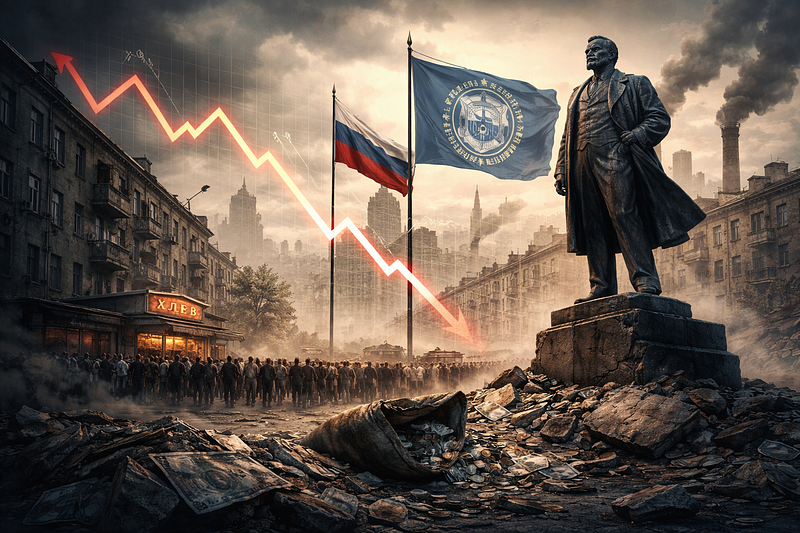
The decree took effect at midnight on the second of January 1992, and by the time Moscow woke the price of bread had multiplied. Within weeks prices across Russia were climbing at a speed no one living had experienced, and by the end of the year inflation would reach roughly two and a half thousand percent, prices rising some twenty-five fold in twelve months. Savings that had taken a working life to accumulate became, over a single winter, close to meaningless. A pensioner who had put aside enough for years of security discovered, somewhere between January and March, that it would no longer cover a month. The money in the bank had not been confiscated. It had simply been emptied of everything it once represented.
What followed was not a recession in any ordinary sense. Industrial output began to fall, and it kept falling, until within a few years Russian GDP had contracted by around forty percent against late-Soviet levels, a collapse comparable in scale to wartime destruction but without a single building bombed. Male life expectancy fell from sixty-four in 1990 to fifty-seven by 1994. Wage arrears became normal. Whole production chains came apart. The period is usually called the transition, a word that suggests movement from one settled state to another. It was also something more specific and more designed: the implementation, between 1991 and 1994, of a program known as shock therapy.
In practice that program meant a cluster of measures applied at once. Prices were freed almost overnight. State enterprises were privatized at speed. Fiscal policy was tightened, monetary policy harder still, and the economy was opened to global markets, all under heavy Western advisory influence and the conditions attached to International Monetary Fund support. And surrounding every part of it was a single sentence, repeated until it stopped sounding like an argument and started sounding like a fact about the world. There was no alternative. This chapter takes that sentence apart, because the sentence, not the inflation, is the architecture.
What freeing the prices actually did
The theory behind price liberalization was elegant and, in a vacuum, almost persuasive. Free prices would correct the distortions of central planning, clear the chronic shortages, and restore rational allocation by letting supply and demand find each other. The difficulty was that the Soviet economy had never been a market waiting to be uncovered. It had been an administrative organism, held together by allocated inputs, planned demand, and cross-subsidy between enterprises that had no independent existence as firms. Removing the price controls without first building the institutions that a market runs on did not reveal a hidden economy. It exposed the existing one to costs it had no way to absorb.
Inflation did the rest. When prices rise by hundreds of percent in a month, the damage is not captured by the statistic. Money is stored time, the deferred labor of everyone who saved instead of spending, and hyperinflation reaches back and erases that stored time wholesale. In 1992 alone industrial production fell steeply, and by 1994 output had dropped by more than forty percent against 1990. Some sectors contracted as if a war had passed through them. The reformers had an answer ready: inflation was the real enemy, and defeating it required tight money and fiscal discipline. The ruble had to be defended, deficits constrained, prices stabilized. And inflation did, eventually, come down from its peaks.
The factories did not come back with it. This is the sequence that decides everything, and it is worth stating plainly. Stabilization measured prices; collapse measured factories. Exposure came first and the cushioning came later, which is to say the monetary contraction landed in the middle of an industrial freefall rather than after a recovery. When output is collapsing and credit is being withdrawn at the same moment, productive capacity does not pause and wait. It disappears, and capacity that disappears does not reappear when the policy is judged a success. None of this required a conspiracy or even bad faith. It was arithmetic, performed in the wrong order.
The destruction of working capital
To see why the collapse fed on itself, follow a single enterprise. Under the Soviet system it had received its inputs through administrative allocation and sold into predictable state demand. When prices were freed, its input costs rose at once, while the market for whatever it produced turned uncertain overnight. Its working capital, the cash that let it buy materials and pay workers between one sale and the next, evaporated. A firm that might have reorganized over several years, given time and credit, instead found it could not finance even next month's operations.
Then monetary policy tightened on top of that. Because inflation had been named the enemy of credibility, credit expansion was deliberately curtailed at exactly the moment enterprises needed it most. Firms that could have survived a gradual reform simply closed. Wages went unpaid for months while workers remained nominally employed. Barter reappeared between companies because there was no liquidity to transact in, and as monetary exchange broke down, taxes became harder to collect, which shrank the state's revenue, which deepened the fiscal crisis, which justified further tightening. This is the mechanism by which a contraction stops being an event and becomes a structure. When liquidity disappears, adaptation becomes impossible, and impossibility compounds.
The alternative that was written down
The strongest evidence that shock therapy was a choice rather than a necessity is that a different plan already existed, on paper, with names attached. In the late summer of 1990 a team of Soviet economists led by Stanislav Shatalin, with the young Grigory Yavlinsky among its principal authors, produced a blueprint for converting the command economy into a market one over roughly a year and a half. It became known as the Five Hundred Days Program. It was not a defense of central planning. It was a market-transition plan, but a sequenced one, that tried to build institutions and maintain some coordination while the controls came off, rather than removing everything at once and trusting the rubble to organize itself.
The plan was not a fantasy debated in a seminar. The Supreme Soviet of the Russian republic adopted it in September 1990. Its progress was then blocked at the level of the Union, caught between Gorbachev's hesitation and the rival ministries, and when it became clear the program would not be carried out, Yavlinsky resigned. The point is not that the Five Hundred Days Program would certainly have worked; that cannot be known. The point is that gradual, institution-first sequencing was not an abstraction invented after the fact by critics. It was a concrete, adopted, then abandoned policy, written by reform economists, available in 1990, and set aside in favor of the faster path. The choice was never between reform and no reform. It was between sequencing models, and the country was told the choice did not exist.
The men who freed the prices
The faster path had authors too. Yegor Gaidar, the acting head of government who signed the January liberalization, and Anatoly Chubais, who would run the privatization, were the domestic faces of the program, and they did not work alone. Western advisers, the most visible of them the American economist Jeffrey Sachs, moved through the Russian ministries, and the International Monetary Fund attached its conditions to the financing the country needed. None of this was secret, and none of it requires the language of plot. It requires only attention to who was permitted to define the terms. Stabilization, credibility, success: each of these words had a meaning, and the meaning was set in Washington and the ministries rather than in the factory towns that would absorb the consequences. Technocrats do not invent the frameworks they serve. They operate inside them, and the framework decides in advance which outcomes count as victory.
Privatization under duress
Ownership was the second pillar, and it was meant to be the democratic one. Voucher privatization gave every citizen a paper claim, a share in the former state enterprises, on the theory that property spread across a whole population would produce a broad capitalism and prevent concentration. In a stable economy the design might have done something like that. It was launched instead into hyperinflation and collapsing wages, and the context inverted the intent. When a family cannot be sure its money will buy food next week, a long-term equity stake in a distant enterprise is an abstraction it cannot afford to hold. Millions sold their vouchers for immediate cash, often to the only actors with the liquidity and the information to buy at scale. Control of oil, gas, metals, and telecommunications began to gather into a small number of hands, not through theft but through the predictable behavior of desperate people in a destroyed monetary environment.
The decisive moment came in 1995, in a scheme whose mechanics deserve to be seen exactly. The government was short of cash, and a group of bankers, in a proposal associated with Vladimir Potanin and facilitated by Chubais, offered a solution. Private financial groups would lend the state roughly eight hundred million dollars, taking shares in twelve of the country's most valuable enterprises as collateral. When the government failed to repay by the deadline in late 1996, as it was widely understood it would, the collateral was auctioned, and the auctions were run by the same banks that had made the loans. The assets passed to the lenders at prices that bore little relation to their worth. Mikhail Khodorkovsky's Menatep acquired the oil company Yukos for around three hundred million dollars; by one account it was valued at six billion within months. Vladimir Potanin's group took Norilsk Nickel, one of the largest metals producers on earth. The net transfer of value from the state to a handful of private holders has been estimated at over seven hundred million dollars in the loans alone, a figure that vastly understates the worth of what changed hands.
The justification, again, was liquidity. The state needed cash and this produced cash. But liquidity raised by handing over strategic assets under conditions of extreme asymmetry is not a temporary expedient, because the cash is spent and the ownership is forever. Liquidity was urgent; ownership was permanent. By the middle of the decade the oligarchic concentration was entrenched, and undoing it would have required a direct structural confrontation with the very groups that now controlled the commanding heights of the economy. That confrontation did not come. The owners, having acquired the assets, acquired with them the power to keep them.
The election the assets bought
The full meaning of the loans-for-shares scheme appears only in its timing. The loans were extended in late 1995, but the auctions that would convert those loans into ownership were scheduled for after the presidential election of June 1996, and that gap was not an accident of the calendar. It made the men who had lent to the state into the people with the largest possible stake in the survival of the government that owed them. If a communist won the 1996 election, the favorable auctions might never happen and the assets might never transfer. The bankers needed Yeltsin to win, and they had the means to ensure it.
In late October 1996 the businessman Boris Berezovsky told the Financial Times that seven bankers controlled around half of the Russian economy and most of its mass media, and that they had bankrolled Yeltsin's re-election. The arrangement that lay behind that claim had been struck at the start of the year, at the World Economic Forum in Davos, in an understanding between Anatoly Chubais and the leading oligarchs: they would finance the campaign and turn their newly acquired television channels and newspapers against the communist candidate, and in return the structure of asset transfer would proceed. A president trailing badly in the polls at the beginning of 1996 won re-election by the end of it, carried by money and media that the privatization itself had created.
The International Monetary Fund did not stand outside this. In the spring of 1996 it concluded a three-year Extended Fund Facility with Russia worth about ten billion dollars, approved in the months before the vote, in what was widely read at the time as a political decision backed by the Group of Seven to secure Yeltsin's position. The lending was framed in the language of reform and stabilization, but its timing spoke a plainer language. The economic architecture and the political outcome had fused. The assets had bought the election, the election had secured the assets, and the external financing had underwritten both. This is the point at which the program stopped being a set of economic measures and became a self-reinforcing order, one in which ownership, media, and foreign credit all pointed the same way.
When the question was settled by force
There was a moment when the political system that might have reversed the course tried to, and was defeated. The Russian parliament, the body that had earlier adopted the gradualist plan, became through 1992 and 1993 the institutional brake on shock therapy, increasingly hostile to Gaidar's program and to rule by decree. In September 1993 President Yeltsin issued a decree dissolving the parliament, an act the parliament's own legality did not permit; the deputies refused to disperse and voted to remove him. The standoff ended in early October 1993 when the army shelled the parliament building in central Moscow and the resistance was crushed, at a cost of hundreds of lives. A new constitution followed that concentrated power in the presidency.
It is not necessary to assign motive to read the structural meaning of this. The economic program had encountered the one institution capable of stopping it, and the program continued while that institution was, quite literally, fired upon and then rebuilt with less power to obstruct. Whatever else the crisis of 1993 was, it was the moment the architecture demonstrated that it would not be voted down. Reform that cannot survive a parliament tends, in the end, to find a way around the parliament.
Debt that could not be renegotiated
A collapsing economy can sometimes be given room to breathe, and there was a precedent close enough that the contrast is unavoidable. At the end of the Soviet Union, Russia inherited a substantial external debt, and servicing it through the contraction consumed fiscal space that might have gone to cushioning the fall. Debt service is not a line in a ledger; it decides what a government is allowed to prioritize. In 1953 the London Debt Agreement cut West Germany's external obligations sharply and tied repayment to the country's export earnings, with reconstruction as the explicit goal. Relief was designed in, and it created the space in which the West German recovery became possible.
Russia in the early 1990s received nothing comparable. Creditor confidence was treated as essential to integration into world markets, and the expectation of full repayment remained a cornerstone of the stabilization logic. Reconstruction, for the defeated Germany of 1953, had been treated as the condition of repayment; for Russia, repayment was treated as the condition of everything else. Reconstruction was conditional. Repayment was not. When an economy must liberalize, privatize, tighten money, and service debt all at once, the space for any policy that protects its own population narrows to almost nothing, and the debt structure becomes part of the architecture that decides the rest.
The pavement economy
The statistics of the early 1990s have a human texture that the figures alone cannot carry. In the cities, ordinary people who had spent their lives in salaried work appeared on the sidewalks to sell what they owned, a coat, a set of dishes, a few books, anything that might convert into the day's food, because the wages that still arrived, when they arrived at all, no longer reached the end of the week. Pensioners stood for hours in the cold beside a single item. Teachers and engineers traded in doorways. A society that had organized its entire self-image around industrial labor and education found a large part of its population reduced, almost overnight, to improvised survival.
This was not the failure of the people who lived it. It was the lived form of a monetary collapse that had erased the value of work already done and the savings already made. The market that shock therapy promised did arrive, but for millions its first concrete appearance was a blanket on a pavement, the most basic market of all, conducted by people who had been told that the freeing of prices would make them owners and found instead that it had made them vendors of their own belongings.
The cost written in mortality tables
The deepest measure of what happened is not financial. Between 1990 and 1994 male life expectancy in Russia fell by about seven years, a peacetime demographic decline almost without modern parallel. No inflation index explains a drop like that. It records stress, lost work, alcohol, the breakdown of healthcare, the fragmentation of the social fabric that had given lives their shape. Economic collapse is an abstraction until it appears in the mortality tables, and there it stops being abstract.
And through it, the program continued. Monetary stabilization remained the priority, privatization deepened, integration into global financial norms went on. This is the threshold that matters most, the one that separates a policy mistake from something harder to name. A mistake is corrected when its damage becomes visible. Shock therapy continued in the presence of measurable, visible, demographic damage, and continuation in the presence of that damage is the point past which the program was no longer reacting to events. It was imposing a design over them.
The default that closed the decade
The architecture reached its own limit in 1998. To finance its deficits the government had built a tower of short-term debt, the GKO bonds, paying ever higher yields to keep foreign capital from leaving, until the yields themselves guaranteed that the tower could not stand. On the seventeenth of August 1998 the state devalued the ruble, defaulted on its domestic debt, and declared a ninety-day moratorium on commercial foreign payments. The ruble fell from around six to the dollar toward twenty-five, and the capital of the banking system was effectively wiped out. Only weeks earlier the International Monetary Fund had approved its share of a rescue package worth more than twenty billion dollars, assembled to hold the line. The lull it bought lasted about two weeks. The decade that had opened with the freeing of prices closed with the collapse of the currency those prices were denominated in, and with the spectacle of the largest emergency financing of the era evaporating almost on arrival. The default is often described as the failure of the reforms. It is better understood as their conclusion, the moment the logic of exposure-before-protection completed its own circuit.
The models that were not chosen
None of this was the only way a command economy could become a market economy, and the comparisons are not hypothetical. China began its reforms in 1978 by doing almost the opposite of what Russia would do. It liberalized prices gradually, kept capital controls in place, retained state control over strategic sectors for years, and built institutional capacity before exposing its economy to full global competition. It avoided hyperinflation, preserved industrial continuity, and grew, slowly and then enormously. Poland is the case most often cited as shock therapy's success, and it did liberalize fast, but Poland also received substantial debt restructuring and faced the near prospect of European integration, with Western markets open to absorb its goods. The shock was real, but it was buffered on both sides.
Russia got the speed without the buffers. It implemented rapid exposure without deep debt relief and without a guaranteed integration path in the early years, when they would have mattered most. Gradualism was not a fantasy and shock was not destiny. China showed that sequencing worked. Poland showed that buffering worked. Russia received neither, and was told that the result was simply what reform looked like.
Conditionality as a hierarchy of priorities
The IMF's programs are built around macroeconomic stabilization, fiscal discipline, and the control of inflation, and these are not destructive principles in themselves. Their effect depends entirely on when they are applied. Imposed during extreme institutional fragility and industrial contraction, tight money reduces liquidity exactly when liquidity is scarce, fiscal austerity cuts state support exactly when revenue is collapsing, and rapid trade liberalization exposes domestic industry to competition before it can possibly adapt. The framework is organized to protect credibility in international financial markets, and domestic continuity comes after. This is not a claim of hidden motive. It is a description of a hierarchy that the design states openly, once you read it as a hierarchy. Credibility abroad became discipline at home, and the order of those two things was the whole story.
Weakness as a geopolitical fact
Economic fragility is never only economic. A state that cannot pay its wages or service its debt negotiates from weakness in everything else, and Russia's condition in the early 1990s shaped the decade of geopolitics that followed. The debates over NATO's expansion opened within a few years; European integration accelerated; the post-Cold War order took its shape while one of its two former poles was preoccupied with survival. The economic architecture came first, and the political repositioning followed from it. Policy space contracts when financial architecture precedes political capacity, and a country reorganizing its entire economy under external conditionality has little capacity left for anything else.
The pattern that keeps its shape
What happened to Russia was not unique to Russia. The same sequence is visible in the structural adjustment programs across Latin America during the debt crisis of the 1980s, in the IMF interventions in East Asia in 1997, and in the austerity imposed on Greece after 2010. The details differ in every case, but the shape recurs with unsettling fidelity. A crisis arrives. A stabilization framework follows. Conditionality narrows the available options to a single approved set. Asset restructuring transfers ownership while the crisis is at its worst. And when the emergency passes, the realignment it produced remains. Shock is temporary in the rhetoric; structural realignment is what endures. Russia was simply the largest laboratory in which the pattern ever ran.
Sachs and the perimeter of the possible
Jeffrey Sachs, years later, argued that the transition had failed for lack of sufficient Western financial support and the absence of real debt relief, a critique that fits the fiscal record well. But there is a question underneath his, and it is the one that matters most. Who defines stabilization. Who defines credibility. Who decides what will count as success and what will be dismissed as unrealistic before it is ever funded long enough to be tested. The technocrats who carried out the program, Sachs included, were working inside a frame they did not set, and the frame decided the outcomes before the debates began. Frameworks do not announce themselves; they operate quietly, by determining which options are serious and which are never given the chance to prove themselves.
The order it left behind
The structure built in the 1990s did not dissolve when the decade ended. It changed owners. Vladimir Putin came to power in 2000 and offered the men who had acquired the country's wealth a simple understanding: keep your fortunes and stay out of politics, or lose them. The oligarchs who tested the limit discovered where it was. The television owners Boris Berezovsky and Vladimir Gusinsky, whose channels had criticized the new president, lost their companies and were driven into exile. Mikhail Khodorkovsky, the man who had bought Yukos for a fraction of its worth in 1995, was arrested in October 2003 after backing political opposition, and his oil company was broken apart by tax claims and absorbed into the state firm Rosneft, run by a close associate of the president. The commanding heights that voucher privatization and loans-for-shares had handed to private hands were, within a decade, brought back under the control of the state, staffed increasingly by men from the security services.
It would be easy to read this as the reversal of the 1990s, and it was nearly the opposite. The determining variable never changed. Ownership of the country's most valuable assets remained concentrated in a small circle held together by personal loyalty and shielded from public accountability; only the identity of the circle changed, from the bankers of the Yeltsin years to the associates of the Kremlin that followed. The architecture of the transition had established that strategic wealth would be held by a few, outside the reach of any institution capable of contesting it. Putin did not dismantle that arrangement. He inherited it, and made himself its manager. This is the connection, marked here as interpretation rather than proven cause, that runs from the freeing of prices to the politics of the following quarter-century: a population stripped of its savings and its industrial security, an ownership structure concentrated under duress, and a parliament that had already been shown it could be overruled by force, together left a country unusually prepared to accept a strong hand that promised order. The shock had been administered in the name of the market. What it left standing, in the end, was a state that owned the market and answered to no one for it.
The strongest case for the other side
The honest version of the opposing argument should be stated at its full strength, because it is not weak. By late 1991 the Soviet economy was already disintegrating. The monetary overhang of suppressed inflation was enormous, shortages were acute, and the state that would have administered a gradual transition was itself dissolving. On this reading, gradualism required functioning institutions that no longer existed, the hyperinflation was largely inherited rather than caused, and a slow path in a collapsing state might have produced not a gentle transition but a longer agony or an outright famine. Poland's fast liberalization worked; several economies that reformed more slowly, including Ukraine, fared worse over the following decade. The case that shock therapy was the least-bad option available in an impossible situation is real, and it deserves to be met rather than waved away.
It is met by narrowing the claim to what the evidence supports. The argument here is not that reform should have been avoided, nor that speed is always wrong. It is that the specific combination Russia received, rapid exposure without debt relief, without buffering, without sequenced institution-building, and enforced even through the destruction of the institution that opposed it, was a particular design among available designs, and that its consequences were distributed in a particular direction. The reading would weaken if no alternative had been on the table, if comparable economies had been offered the same buffers and still collapsed, or if the gradualist plan had never existed. None of those conditions holds. The alternative was written down and set aside. The buffers were extended to Poland and to West Germany and withheld from Russia. That is what makes the inevitability a choice.
Architecture and the illusion of necessity
Russia's collapse in the 1990s was not random improvisation. It followed a documented sequence: prices freed before institutions were built, money tightened during the freefall, ownership transferred under duress, debt serviced ahead of reconstruction, exposure imposed before any protection was in place. The word that held the sequence together was inevitability. There was no alternative. Yet the alternatives existed and can be named. Debt-relief precedents existed. Gradual sequencing models existed. Strategic buffering existed. They were not adopted. When feasible alternatives are consistently sidelined and then declared never to have existed, inevitability stops being a description of reality and becomes the design imposed on it.
This is how economic architecture works, and it does not work through drama. It works through the perimeter. It decides which policies are treated as serious and which are dismissed as unrealistic, which are funded long enough to prove themselves and which are starved before they can, what gets called reform and what gets called regression. It shapes the vocabulary before the argument starts, and a debate conducted in someone else's vocabulary is half-lost before it begins. By the middle of the 1990s the Russian transformation had crossed from crisis into structure. Ownership had hardened, debt framed every fiscal decision, monetary discipline had redefined what credibility meant, and what had begun as emergency policy had quietly become the baseline. The decree was meant to free the market; what it freed, in the end, was the architecture from the population's ability to argue with it.
That is the deeper legacy of shock therapy, and it is not inflation control and not privatization, though it was both of those. It is the internalization of a model in which exposure precedes protection, speed substitutes for sequencing, and stabilization is measured by the confidence of markets rather than the continuity of a society. The lesson is not that reform is impossible. The lesson is that the design of reform determines who bears its cost. When architecture is mistaken for nature, policy becomes fate, and fate, once accepted, rarely admits that it was ever a choice.
This is why the design of a rescue is never a technical matter. A stabilization program decides, before the first disbursement, whose stability it is protecting, and the answer is rarely the population whose savings and factories absorb the adjustment. The same question runs through every case where outside finance arrives to fix a crisis: who is cushioned, who is exposed, and who gets to call the arrangement inevitable. Russia answered that question on the largest scale the late twentieth century offered, and the answer was written into ownership, into mortality, and into the politics that followed. The market was freed. The people were not asked what it would cost them, because the cost had already been entered, somewhere else, as the price of credibility.
Frequently Asked Questions
What was shock therapy in 1990s Russia?
The rapid, simultaneous price liberalization, privatization, and fiscal tightening applied from January 1992, on IMF-backed advice, to convert the Soviet command economy into a market one all at once rather than gradually.
What did shock therapy do to Russia?
Prices rose roughly two and a half thousand percent in 1992, wiping out savings; GDP fell by around forty percent over the decade; and male life expectancy dropped from sixty-four in 1990 to fifty-seven, a collapse comparable to wartime without a war.
Did the IMF cause Russia's 1990s collapse?
The IMF backed and set conditions for the shock-therapy program that shaped the choices made, while Russian officials implemented them. The documented record supports shared responsibility for the design, not a single hidden hand.
What happened in Russia's privatization?
The rushed privatization transferred much of the economy's value to a small group of well-placed insiders, the future oligarchs, even as ordinary citizens' savings evaporated.
Evidence Map
Facts, interpretations, forecasts, and disconfirming signals.
Core claim. Russia's 1990s collapse followed a specific, chosen policy design, rapid price liberalization, tight stabilization during industrial freefall, privatization under duress, and debt-first credibility, rather than an unavoidable consequence of leaving communism. The determining variable was sequencing and buffering, not reform itself, and "there was no alternative" functioned as architecture: it narrowed the perimeter of acceptable policy and erased documented alternatives from view.
Evidence level. Facts (high): the 2 January 1992 price liberalization and roughly 2,500 percent inflation in 1992; the roughly forty percent fall in output by 1994; the fall in male life expectancy from sixty-four to fifty-seven; the 1995 loans-for-shares scheme and the transfers of Yukos and Norilsk Nickel; the existence and 1990 adoption, then abandonment, of the Five Hundred Days Program; the 1953 London Debt Agreement; the October 1993 shelling of parliament; the August 1998 default and devaluation. Interpretation (medium, marked): that the program continued past the point of visible demographic damage by design rather than inertia; that the 1993 crisis functioned as the removal of the institutional brake on the program; that conditionality embodies a hierarchy placing external credibility above domestic continuity. This is explicitly not a claim of hidden motive.
What would confirm this. Evidence that comparable buffers (debt relief, sequenced institution-building) were available and deliberately withheld; the recurrence of the same crisis-to-realignment sequence in other IMF programs.
What would disprove this. Evidence that no sequenced alternative was feasible in 1991-92; that economies given the same buffers collapsed identically; that gradual reformers consistently fared worse than Russia did.
Watchlist. The historiography of the transition as more archives open, and the comparative record of slower reformers over the long run.
Jerry van der Laan writes The Manifest Archive, forensic journalism on the systems beneath power, money, and history. He traces the structures beneath them.