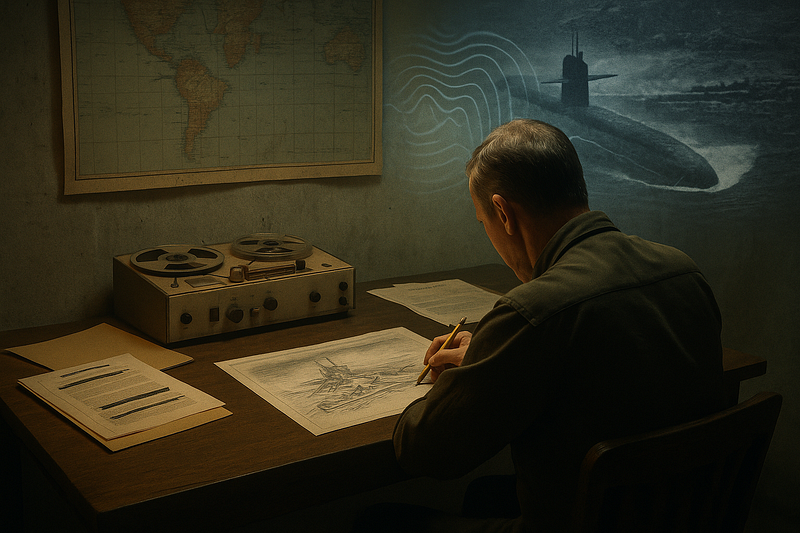
In a windowless room at Fort Meade, a man sat at a bare table with a pencil and a sheet of paper. He had been given a sealed envelope and a meaningless string of numbers, nothing else, no hint of what the envelope held. He closed his eyes, waited for impressions to surface, and began to sketch: a structure, something metallic, water nearby, a sense of something underground. The drawing would later be set beside a satellite photograph of a place he had never been told about and, sometimes, the shapes would match.
This was a real program. The United States government ran it, under a series of code names, for more than twenty years, and spent tens of millions of dollars on it. The easy way to tell the story is to ask whether it worked, whether the man with the pencil was really seeing a Soviet base or just guessing, and the files give enough ammunition for either answer. But that is the question the program was designed to make you ask, and it is the wrong one. The interesting fact is not what the viewer saw. It is that the room stayed open for twenty years, surviving ridicule, skeptical reviews, and a long parade of failures, and then closed almost overnight. Programs do not behave like that because of what they find. They behave like that because of what funds them, and what funded this one was never the evidence.
The question that explains the program
A program that produced results would be kept alive by its results. This one was not. From the first sessions at Stanford in the early 1970s to the last review in 1995, the output was exactly what its critics said it was: a handful of uncanny hits buried in a great deal of vague, unusable noise. That record never improved enough to silence the skeptics, and it never collapsed enough to end the program. For two decades it sat in the same ambiguous place, and for two decades the money kept arriving. A thing that survives independently of its own performance is being held up by something other than performance, and naming that something is the whole point of looking at this history.
The thing holding it up was fear, and a very specific kind. Not fear that remote viewing worked, but fear of being the side that had not checked whether the enemy's version did. That asymmetry, once you see it, explains everything the evidence cannot: why a program with no reliable results was rational to fund, why it outlived six different names and three agencies, and why it died in 1995 not because the question was finally answered but because the fear that paid for it had just dissolved on the far side of the world.
It did not survive because it worked. It survived because no one could afford to assume it didn't.
Born in a hall of mirrors
Remote viewing was not dreamed up by mystics. It was a Cold War reaction, and like most Cold War reactions it began with a report about the other side. Through the 1960s, Western intelligence picked up signs that the Soviet Union was pouring resources into parapsychology, telepathy, hypnosis at a distance, what its own researchers sometimes called mental radio and what Western analysts came to call psychotronics. In Leningrad the physiologist Leonid Vasiliev had run experiments suggesting that mental signals might be transmitted across distance, as if the nervous system were a radio. There was even footage: grainy Soviet films of a Leningrad housewife named Nina Kulagina appearing to slide small objects across a table without touching them, watched and re-watched by Western analysts who could not tell whether they were seeing a genuine phenomenon, an elaborate fraud, or a deliberate piece of Soviet theater designed to be leaked. The data was thin and the claims were mocked in open journals. In military circles, on both sides, they were not mocked at all, because the analyst's job was not to decide whether Kulagina was real. It was to decide what it would cost to be wrong if she was, and that number was always large enough to keep the file open.
The logic that took hold in Washington had nothing to do with whether any of it was true. It ran like this: if the Soviets were investing seriously in psychic espionage, and if there were even a small chance they were onto something, then a mind that could read a sealed room or sketch a hidden missile site would make every secret in the country vulnerable. Against that possibility, the cost of a few laboratory contracts was nothing. The United States could not afford to laugh and walk away, because the price of laughing at a real capability was unbounded and the price of investigating a fake one was small. So in 1972 the research began, at the Stanford Research Institute in California, under physicists Russell Targ and Harold Puthoff.
The fascination was never confined to the two superpowers, which is part of what made the fear so contagious. China ran its own state-backed studies under the banner of what it called extraordinary human functions, including widely publicized demonstrations of children said to read text while blindfolded; the claims were a mix of stagecraft and the untestable, but the state funding and military interest were real. Britain and France quietly monitored or ran small parapsychology evaluations, dismissing them in public reports while filing the data away. Czechoslovakia, where Soviet influence met an older European tradition of psychical research, produced rumors of military psi units. Everywhere the public posture was ridicule and the private posture was a budget line, the same split in every capital, because no government could be certain its rivals were as skeptical as it pretended to be.
What made it self-sustaining was the mirror. The Americans funded their program because the Soviets had one; the Soviets, it turned out, were partly driven by fear of the Americans. Each side pointed across the Iron Curtain at the other as proof that the work could not be ignored, and neither could see clearly what the other had actually achieved. The secrecy that hid the programs from the public also hid them from each other, so rumor answered rumor and fear confirmed fear. It did not matter whether the Soviets had succeeded. It mattered that they were trying, and that you could not be sure they had failed. A race had begun in which the starting gun was a guess about the opponent.
The sketches that kept the door open
The program needed just enough success to stay plausible, and in its early years it got it. The most celebrated case belonged to Pat Price, a former California police commissioner, who in a 1974 session was given only the map coordinates of a site in the Soviet Union, a weapons-research facility at Semipalatinsk in Kazakhstan, and proceeded to describe it in detail, including, in the account that hardened into legend, a giant gantry crane that later reconnaissance appeared to confirm. Ingo Swann, an artist who helped design the program's training method, produced descriptions striking enough to keep the contracts flowing. Joseph McMoneagle, an Army warrant officer who became the program's most prolific viewer with some hundreds of sessions, was eventually awarded the Legion of Merit, one of the military's high honors, in part for his classified intelligence work.
The program was also handed real operational tasks, the kind that leave a record. When the heiress Patricia Hearst was kidnapped in 1974, the SRI viewers were asked to help, and Targ later wrote that the team received a thank-you letter from the Berkeley police. When the Red Brigades kidnapped the American general James Dozier in Italy in 1981 and held him for forty-two days, McMoneagle and a second viewer reportedly placed him in Padua, chained, above a shop, a description striking enough to be remembered and useless enough that it changed nothing: Dozier was freed by Italian police acting on ordinary police work, not on a sketch. The program even had a foothold in respectable science. In 1974 Targ and Puthoff published their results in Nature, one of the most scrutinized journals in the world, and the paper passed peer review, which gave the work a citation no astrologer could claim and the believers a banner they would wave for decades.
Read in isolation, those episodes are arresting, and the believers were not foolish to be struck by them. But the same files that hold the hits hold the misses, and there were far more of the latter. Viewers described machines that did not exist, places that could not be found, targets that dissolved into fragments of color and mood. A session meant to locate a hostage might yield nothing usable at all. The honest summary, then and now, is that the program generated occasional detail too sharp to dismiss easily, embedded in a mass of material too vague to use. That is not the profile of a working intelligence tool. It is the profile of something that hovers permanently at the edge of plausibility, which, as it happens, is the most expensive place for a program to sit, because it can neither be trusted nor quite dismissed.
And here is the move that matters, the one that keeps this analysis honest. It does not actually matter, for understanding why the program lasted twenty years, whether any of those hits were real. If Pat Price genuinely saw that crane, the program ran on the fear that the enemy could do the same. If he was lucky or coached or pattern-matching, the program ran on the fear that he might not have been. Either way the fear is identical, and either way the door stays open. The believer and the skeptic, arguing about whether it worked, are both missing that the program's survival never depended on the answer.
The science that could neither prove it nor bury it
The reason the program could sit at the edge of plausibility for twenty years is that the science around it never resolved, and the story of why is its own small study in how evidence fails to settle a question that power wants kept open. The 1974 Nature paper was barely in print before the critics arrived, and the sharpest of them did real damage. The psychologists David Marks and Richard Kammann obtained the original session transcripts and noticed something the celebrated results had glossed over: the transcripts were full of incidental cues, references to earlier targets, dates, offhand remarks, that a judge trying to match a transcript to a location could use to score a hit without any psychic information at all. When the cues were stripped out, much of the dazzling accuracy went with them. The apparent signal, they argued in Nature in turn, was an artifact of sloppy procedure.
That should have been close to fatal, and in a normal scientific field it might have been. But remote viewing was not a normal field; it was a classified program with a budget and a constituency, and so the argument simply continued, each side tightening its protocols and rejudging the data and reaching the conclusions it had started with. The believers cleaned up the experiments and said the effect survived; the skeptics said the better the controls, the smaller the effect became, which is the signature of an effect that is not there. The single most telling verdict came in 1988, when the National Research Council, asked by the US Army to survey techniques for enhancing human performance, examined remote viewing among others and concluded there was no scientific justification for believing in it. A blue-ribbon panel of mainstream scientists had looked at the program and found nothing.
And the program continued. It was renamed STAR GATE three years later and ran on for another seven. That is the fact to hold onto, because it is the thesis in a single line. A definitive skeptical review by the National Research Council did not end the program, because the program had never been answerable to scientific review in the first place. It was answerable to fear, and the fear was still being paid.
The insurance logic
What the skeptics never grasped is that intelligence agencies are not in the business of certainty. They are in the business of possibility, and possibility is priced differently. For a scientist, a method that works ten percent of the time and produces vague results the rest is a failure, because science is trying to establish what is true. For an intelligence service, the same method can be worth funding indefinitely, because it is not trying to establish truth. It is trying to avoid catastrophic surprise.
Think of it as an insurance policy with a strange payout structure. The premium is small: a few laboratory contracts, a handful of analysts, a budget line invisible against the cost of a single aircraft. The likely return is nothing, year after year of unusable sketches. But the tail of the distribution holds two outcomes that dwarf everything else. One is the tiny chance that your own viewers locate something no satellite could, a single confirmed hit on a hidden submarine or a missing weapon that justifies a decade of failures at a stroke. The other, larger, is the chance that the enemy's program works and yours does not exist, leaving every secret you hold exposed to a capability you chose not to develop. Against a downside that large, a small, deniable, perpetual premium is not irrational. It is exactly what a risk-averse institution should pay.
The Cold War had run this logic many times before, with hardware instead of clairvoyants. In the 1950s American planners feared a bomber gap, a Soviet fleet of long-range bombers that turned out to be far smaller than the estimates; in the early 1960s they feared a missile gap that ran, when the reconnaissance finally came in, in America's favor. Both gaps were largely imagined, and both drove enormous real spending, because the structure of the fear did not require the threat to be real. It required only that the threat could not be ruled out and that the cost of being caught unprepared was catastrophic. Remote viewing is the same mechanism wearing a stranger costume. A psychic gap is harder to photograph than a missile gap, which made it not less fundable but more, because the uncertainty that drove the spending could never be resolved by a spy plane.
The public ridicule was not a problem for the program. It was part of how the program worked. A government that wants to fund something improbable without being held to account for it has every reason to let that thing be laughed at in the open, because ridicule is the cheapest possible cover. If the public believes psychic spying is a joke, no journalist demands a hearing on its budget, no committee is embarrassed to be associated with it, and the line item stays small and quiet and deniable. The split that the original tellers of this story found so damning, mocked in public, funded in private, is not hypocrisy revealed; it is the operating design of a deniable program. The laughter the citizen was taught to feel was doing a job, and the job was to keep the citizen from asking what the budget was for.
This is why the program survived every attempt to kill it on the merits. Skeptical reviews concluded the results were weak, and the program continued, because weak results were never the point. Ridicule in the press made it an embarrassment, and the embarrassment was tolerated, because being mocked is cheaper than being blind. Even the failures had a use: a viewer's inaccurate sketch of an enemy installation still suggested, to the enemy who learned of it, that nothing was truly hidden, and that suspicion alone was a kind of weapon. A program that pays whether it succeeds or fails, and whose largest risk is not existing, is almost impossible to end by argument. It can only be ended by removing the fear that priced it.
The apparatus that outlived its names
Nothing reveals how little the program depended on results better than how it survived its own institutional homes. It was never one stable project. It was a capability that kept being handed from host to host, renamed at each transfer, shedding agencies and budgets and keeping going. The early work was SCANATE and GONDOLA WISH. In 1978 a dedicated unit took shape at Fort Meade. By 1979 the research had folded into GRILL FLAME; in 1983 it was redesignated CENTER LANE under Army intelligence; when Army funding was cut in the mid-1980s, the Defense Intelligence Agency picked it up and renamed it SUN STREAK; in 1991 the pieces were consolidated under the name the public would finally learn, STAR GATE.
The people inside the program were not charlatans, which is part of what kept it alive. McMoneagle was a decorated career soldier who had taken a near-fatal heart attack and come back convinced of what he had experienced; he believed, plainly and without theatrics, that he was doing intelligence work. The analysts who received his reports were not occultists either; some were hard-headed officers who wanted to dismiss the sketches and found, now and then, that they could not. That mixture, sincere operators and unsettled professionals, is exactly what an institution needs to keep a doubtful program breathing. There was always someone inside who believed, and always someone above who could not be quite sure enough to sign the order killing it. Belief at the bottom and doubt at the top are not opposites here. They are the two hands that pass the program along.
Read that sequence as what it is. A program that loses its funding and its host agency and simply reappears under a new name, in a new office, drawing on a new budget line, is not being sustained by any single sponsor's belief in it. It is being sustained by a standing institutional reluctance to be the one who shut the door, passed from desk to desk across two decades. Each handoff was a small re-enactment of the original calculation: maybe it is nothing, but can we be the ones to kill it. The apparatus outlived every particular justification for it, which is the surest sign that the justification was never the reason. The reason was the fear, and the fear had no fixed address.
The day the fear stopped paying
Then the thing that had funded the program for twenty years went away, and the program went with it. The Soviet Union dissolved at the end of 1991. The adversary whose imagined psychic capability had justified every budget line, every renaming, every tolerated embarrassment, no longer existed. The mirror had nothing on the other side of it.
The end came formally in 1995, and the manner of it is as revealing as the timing. The program did not quietly wind down; it was pushed. The defense appropriations process for 1995 ordered the program transferred out of military intelligence and handed to the CIA, an agency that had largely walked away from remote viewing years earlier and had no appetite to own it again. Being made to inherit a program it did not want, the CIA did the institutionally obvious thing: it commissioned an outside evaluation that would let it close the file with a clear conscience. In a world still locked in superpower rivalry, no one had wanted to be the official who killed the program. In a world where the rivalry had just ended, the CIA wanted nothing more than to be rid of it, and an evaluation was the respectable instrument of disposal. The same institutional caution that had kept the program alive for twenty years now operated in reverse, and it pointed at the exit.
The evaluation itself was carried out by the American Institutes for Research. The review split, almost poetically, down the exact fault line the program had always straddled. The statistician Jessica Utts concluded that the laboratory data showed a small but statistically real effect that could not be explained away as chance. The psychologist Ray Hyman concluded the opposite, that the overwhelming bulk of the output was vague and off-target and the few hits were what guesswork and hindsight would produce anyway. They disagreed about whether the phenomenon was real. They agreed completely about the only thing that governed the decision: that even if it was real, the intelligence it produced was too vague and inconsistent to be operationally useful. The CIA accepted that verdict and shut the program down.
Look closely at what did and did not happen there, because it is the whole thesis in miniature. The program was not ended because remote viewing had been disproven. One of the two reviewers said the effect was real, and the question was left, scientifically, exactly as open as it had been in 1972. The program was ended because it had become useless to fund. With no superpower adversary to fear, the catastrophic downside that had priced the insurance policy for twenty years had vanished, and an insurance policy with no catastrophe to insure against is simply a cost. The phenomenon did not change in 1995. The fear did, and the moment the fear was gone the program that had survived everything else survived nothing at all.
It did not end when it was disproven. It ended when it stopped being feared.
The clearest proof that the phenomenon was not what ended is that the phenomenon did not end. After 1995 the research simply left the government. The SRI scientists kept writing, McMoneagle kept giving sessions and publishing books, and what funding parapsychology attracted migrated to private foundations and university fringes, where it continues in some form to this day. The questions Jessica Utts had refused to close stayed open, pursued by the same people, with the same inconclusive results. The only thing that had genuinely disappeared in 1995 was the United States government's interest, and its interest had never tracked the evidence. It had tracked the threat.
The strongest case for the believers, and why it does not rescue the program
The believers deserve their best argument made in full, because it is stronger than the skeptics like to admit. Utts, a serious statistician with no stake in the occult, examined the laboratory record and found a real anomaly. Pat Price's descriptions unnerved professional analysts who wanted to dismiss them. McMoneagle was decorated by an institution not in the habit of honoring frauds. A fair reading of the file is not that remote viewing was obviously nonsense; it is that something in the data resisted easy explanation, and resists it still. If you want to believe a faint human signal was detected in those rooms, the evidence does not forbid it.
Grant all of that, and the analysis here does not move an inch, because it was never a claim about whether remote viewing works. It is a claim about why the program lived and died, and that claim holds under either answer. If the signal was real, the program still survived on fear rather than on usable results, since even Utts's real effect was too vague to guide an operation, and it still died when the adversary vanished rather than when the science settled. If the signal was noise, the same is true. The believer's strongest case and the skeptic's strongest case lead to the identical conclusion about the institution, which is the tell that the institution, not the phenomenon, is the real subject. The boundary of the claim is clean: the one thing that would break it is evidence that the program was funded and ended on the strength of its operational results. The record shows the opposite. It was funded despite poor results and ended despite an unresolved question.
What the room at Fort Meade was really for
Step back from the sketches and the séance atmosphere and the program reveals an ordinary shape, the shape of a great many things a nervous superpower did during the Cold War. The bomber gap and the missile gap were feared into existence on thin evidence and funded long after the evidence thinned further. Capabilities were pursued not because they were known to work but because the cost of an adversary having them unanswered was unbearable. Remote viewing is the strangest member of that family, but it is a member, and it follows the family's law exactly. An institution facing a catastrophic and unknowable downside will fund the improbable as insurance, will keep funding it regardless of performance, and will stop only when the downside it feared disappears.
That is why the closing of the program is more revealing than anything that happened inside it. The variable that had quietly held the whole thing up for twenty years, the fear of an adversary's hidden capability, was invisible the entire time it was working. You could not see it in the sketches or the budgets or the renamings. It became visible only when it broke, when the Soviet Union fell and the program it had silently sustained suddenly had no reason to exist. The sketch on the table was never the secret. The fear in the building was.
This is the general shape worth carrying away from a story that looks, at first, like a curiosity. What an institution funds is governed by what it fears far more than by what it can prove, and the fear is usually invisible while it is doing its work, because a stable fear looks like nothing at all; it looks like a budget line that simply renews. You learn what was really holding a program up not by studying its results but by watching the moment it ends, because the thing that disappears just before it dies is the thing that was keeping it alive. Stargate is a clean specimen because its sustaining fear had a date of death, December 1991, and the program followed within four years, leaving the scientific question it had supposedly existed to answer exactly where it found it. A program built to resolve an uncertainty was killed not by resolving it but by ceasing to care.
The man with the pencil thought he was looking for the enemy's hidden installations. The institution around him was insuring itself against the enemy's hidden mind. When the enemy was gone, so was the room, the pencils, and the sealed envelopes, and the question of what had really been seen in twenty years of sessions was left open, unfunded, and quietly closed. The program was never kept alive by what it found. It was kept alive by what it could not afford to miss.
Evidence Map
Facts, interpretations, forecasts, and disconfirming signals.
Core claim. The US government's remote-viewing program survived more than twenty years not because it produced useful results, which it never reliably did, but because it functioned as cheap insurance against a catastrophic asymmetry: the unbounded cost of an adversary possessing a real capability that the United States had declined to investigate. Its stability variable was Cold War threat-fear, not evidence, which is why it was cancelled in 1995 when the Soviet adversary vanished, rather than when the phenomenon was resolved (it was not).
Evidence level. Facts (high): SRI research from 1972 (Targ, Puthoff, Ingo Swann); Pat Price's 1974 session and 1975 death; Joseph McMoneagle's role and Legion of Merit; the Fort Meade unit (1978) and the chain of code names SCANATE / GONDOLA WISH / GRILL FLAME (1979) / CENTER LANE (1983) / SUN STREAK (1985, DIA) / STAR GATE (1991); Soviet parapsychology research (Vasiliev) and "psychotronics"; the 1995 CIA transfer and AIR review with the Utts (real statistical effect) versus Hyman (no useful effect) split and their shared operational verdict; the 1995 termination and declassification; ~20 years and tens of millions of dollars. Interpretation (medium, marked): the insurance/threat-asymmetry logic as the program's load-bearing variable; the cancellation timing as the variable revealed by its break. Open question, Level 3, explicitly NOT load-bearing: whether remote viewing reflects any genuine anomalous effect (the scientific record remains contested and is deliberately not relied on here).
What would confirm this. Other Cold War "capability-gap" programs showing the same pattern of funding-despite-poor-results and termination-on-loss-of-adversary rather than on disproof; declassified internal justifications citing the cost of an enemy capability rather than the program's own hit rate.
What would disprove this. Documentation that the program was funded primarily on the strength of validated operational results and ended primarily because the phenomenon was scientifically disproven would break the claim. The record shows the reverse: funded despite weak results, ended despite an unresolved question.
Watchlist. Further declassification of STAR GATE and its precursors; comparative records of the Soviet and other national programs; modern revivals of "anomalous cognition" interest under new strategic anxieties.
Jerry van der Laan writes The Manifest Archive, a continuous investigation into how institutions, language, and systems shape what people are permitted to see as reality. He does not report events. He traces the structures beneath them.