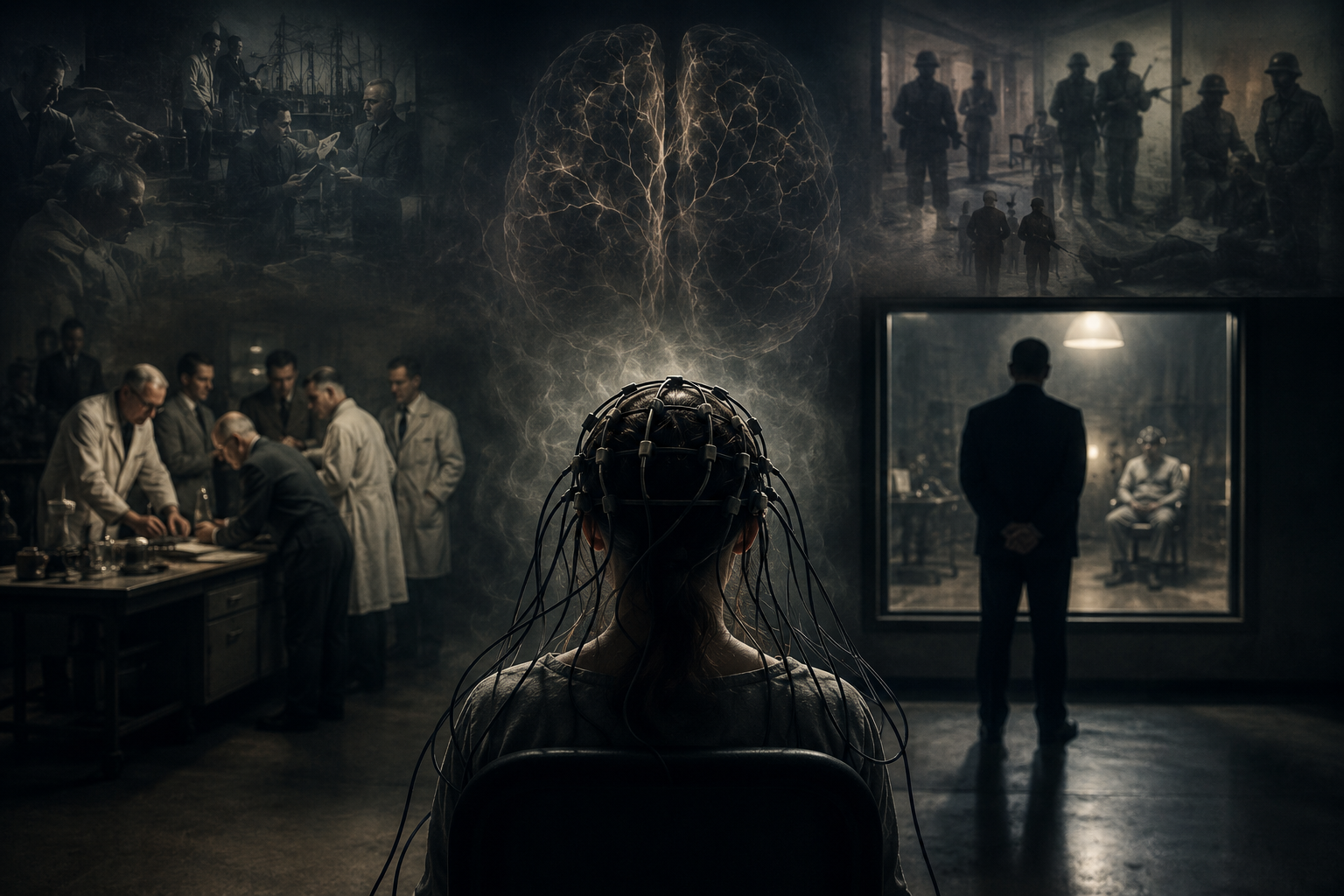
How Consciousness Became Subject to Control
April 13, 1953. CIA headquarters, Washington. Allen Dulles signs a memorandum. The date matters. The signature matters. But what matters most is what the memo decides: humans become experimental substrate.
This is not a decision to understand consciousness. This is not a decision to heal psychiatric patients. This is a decision to systematize the conversion of human beings into permanent apparatus for interrogation and control.
The CIA director did not write this because he was cruel. He wrote it because he believed the Soviet Union had already done it. In 1950, three years earlier, intelligence reports from defectors suggested the Russians had developed a capability: drugs that could make subjects compliant, controllable, extractable. If true, America had no countermeasure. If true, America was vulnerable.
The fear was real. The decision followed.
MKUltra was authorized as a compartmentalized program, hidden from Congressional oversight, hidden from the military, hidden from the Public Health Service. It would run for twenty years. It would touch at least 10,000 unwitting subjects. It would leave permanent damage.
But what we examine here is not the damage. What we examine is the principle. Not what happened, but what became possible. Not the atrocity, but the architecture that made the atrocity operational.
Building Infrastructure from Human Beings
In 1950, the CIA's reasoning was simple: if consciousness can be disrupted, consciousness can be controlled. If identity can be dissolved, identity can be reconstructed. If the subject's own mind can be converted into a tool, the subject becomes a tool.
This is not psychological insight. This is not neuroscience. This is operational doctrine.
MKUltra was placed under Sidney Gottlieb, a biochemist. He was thirty years old. He was ambitious. He had no medical degree, no psychiatric training, no clinical experience. He had chemistry and a mandate: develop reliable methods to convert human consciousness into interrogation infrastructure.
Gottlieb assembled a network. Not as a conspiracy, but as institutional structure. The CIA provided funding. Universities provided facilities. Hospitals provided access to vulnerable subjects. Private contractors provided deniability. The structure was not secret in the sense of unknown. It was compartmentalized in the sense of distributed. No single actor knew the full scope. No single institution could be held responsible.
This distribution was not accidental. It was constitutional design.
The heart of the research occurred at McGill University in Montreal, at a facility called Allan Memorial Institute. The director was Donald Ewen Cameron.
The Three Phases of Erasure
Donald Ewen Cameron was respected. He had been president of the American Psychiatric Association. He had published widely. He believed in radical intervention. When the CIA approached him in 1954 and asked whether the human mind could be completely restructured, he said yes.
His experiments ran from 1954 to 1962. They were documented. They were systematic. They followed a protocol that, once documented, could be replicated by others.
Phase One: Sensory Elimination (Days 1-10)
Subjects were placed in soundproofed, lightless chambers. Environmental stimuli were eliminated. No sound. No light. No temporal markers. For the first week, subjects remained conscious but disorientated. By day 8-10, something neurological happened: the mind, absent external reference points, began to collapse its coherence structure. Subjects reported time distortion. They reported inability to distinguish waking from dream. They reported loss of body boundary.
Phase Two: Pharmaceutical Saturation (Days 11-90)
Beginning day 11, the dosing began. LSD was the drug of choice. Cameron administered 500+ micrograms (ten times the standard research dose, which was 50-200 micrograms). The dosing was repeated, in cycles, over 8-12 weeks.
At this dosage, in combination with sensory deprivation, what Cameron termed "depatterning" became inevitable. Not metaphorical disorientation. Not temporary confusion. Actual, neurological regression of the self's coherence structure.
Subjects reported: inability to recognize their own reflection. Inability to recognize their own voice. Inability to maintain a continuous sense of personal identity. Inability to distinguish self from environment. Complete amnesia of personal history. Terror. Hallucinations. Paranoia. Catatonia.
One subject reported, after 8 weeks of this protocol: "I don't know who I am. I don't know where I am. I don't know what I did before now. I don't know if I am me."
Phase Three: Guided Reformation (Days 91-193+)
After complete ego dissolution, Cameron introduced suggestion. Tape loops played continuously. The voice was often constructed from the subject's own mother's voice, recorded and reconstructed, playing repeated phrases. Environmental feedback was provided. Social contact was structured. The subject, now without coherent self-structure, became entirely dependent on external guidance for sense-making.
Cameron called this "re-patterning." In fact, it was installation. The subject's personality was not being restored. It was being constructed, from outside, according to Cameron's design.
The Case That Survived Legal Challenge
Jean Orlikow was thirty-three years old when she checked into Allan Memorial Institute in 1957. She reported anxiety. Cameron admitted her to his ward.
What happened next was documented in her medical records, later released in legal proceedings.
Day 1-10: Sensory deprivation chamber. Lightless. Soundless. She spent these days conscious but rapidly disorienting.
Day 11-90: LSD escalation. 250 injections across this 12-week period. Each injection 500+ micrograms. She was given the drug twice, sometimes three times per week. In addition to the LSD, she was given barbiturates for sleep. She was given methamphetamines for waking. The pharmacological cycling was designed to destabilize normal circadian rhythm and ensure continuous neurological disruption.
Day 91-193: Continued sensory isolation. Tape loops of her mother's voice, reconstructed. Repeated suggestion. Social interaction structured and controlled.
By day 45 of the protocol, medical notes recorded: "Complete time disorientation. Patient unable to distinguish day from night, year from year. Reports feeling untethered from calendar time."
By day 90: "Patient reports inability to recognize own thoughts as originating from self. Describes thoughts as 'being given to her' by external voice."
By day 150: "Complete identity dissolution reported. Patient describes self as 'not existing' or 'existing as distributed across multiple voices.'"
At day 193, Orlikow was discharged from the hospital. She had now spent 193 days in sensory deprivation. She had received 250 LSD injections. She had been psychologically restructured according to Cameron's protocol.
Her mother came to the hospital to pick her up.
Orlikow could not recognize her.
For years after discharge, Orlikow suffered from severe psychological injury. She had amnesia. She had dissociation. She had no coherent sense of continuous self. She struggled to maintain employment. She struggled with basic functioning. She never fully recovered.
Forty-nine years later, in 2006, she sued the Canadian government. In 2006, Orlikow v. Canada was settled. The court awarded her $100,000 CAD. The government acknowledged the harm.
Orlikow was not alone. Between 1954 and 1962, at least 100 Canadian subjects were admitted to Cameron's protocols. Most were without informed consent. Most suffered lasting psychological damage.
When Research Becomes Doctrine
Cameron's experiments ended in 1962. MKUltra continued until 1973. But what mattered was not the continuation. What mattered was what had been built.
Cameron had created documentation. He had created protocols. He had measured outcomes. He had created something replicable, transferable, scalable.
In classified memos from the 1960s (later released through FOIA), MKUltra supervisors noted a shift in institutional thinking. The question was no longer: "Can we determine if mind control is possible?"
The question had become: "How do we operationalize this capability?"
By the early 1960s, the CIA had moved from research phase to operational doctrine phase.
In 1963, the CIA released the Kubark Counterintelligence Interrogation manual. Section III.D of the manual stated:
"Confinement of the subject alone, in a cell, and subject to a daily routine all designed to enhance within him the psychological feeling of being alone."
This was not new doctrine. This was institutionalization of techniques that overlapped substantially with findings emerging from MKUltra-era research. Kubark drew from multiple interrogation traditions: OSS experience, British colonial practice, military interrogation doctrine. But elements of the depatterning framework documented by Cameron also appeared in this manual. Sensory deprivation, isolation, environmental control were now being written into official interrogation doctrine.
Kubark was distributed to CIA interrogators and to military intelligence officers. It was used to train interrogators deployed to Vietnam. It was used to train interrogators deployed to Latin America. The doctrine traveled. The method traveled. The principle traveled.
Operational Deployment at Scale
In Vietnam, the doctrine was deployed at scale.
Declassified CIA cables from 1964-1972 document the use of sensory deprivation cells in military detention facilities. Prisoners were held in complete darkness and silence. The conditions mimicked Cameron's protocols. The durations were similar. Weeks of continuous isolation. The goals were identical: produce psychological breakdown followed by behavioral compliance.
How many prisoners? The documentation is incomplete. Published estimates of detainees in CIA-controlled facilities range from 5,000 to 20,000 across all interrogation methods. Sensory deprivation specifically was applied to an unknown subset of this population (Valentine, The Phoenix Program, 2000; declassified DOD records, 2007). Church Committee documentation confirms CIA and South Vietnamese intelligence operated interrogation facilities, but precise totals for sensory deprivation protocols were not separately tabulated in declassified records.
Were the Vietnam protocols "identical" to Cameron's? No. They were adapted. They evolved. But they derived from Cameron's documented protocols. The principles were the same. The mechanisms were the same. The infrastructure persisted, adapted to operational conditions.
How Programs Persist Through Destruction
In 1973, Richard Helms, then CIA Director, ordered the destruction of MKUltra documentation.
Why 1973? Why then?
Helms was being forced out as CIA Director. He had been implicated in Watergate. He anticipated Congressional investigation. Destroying MKUltra files was not institutional continuity. It was liability elimination.
But the destruction was not complete.
Internal CIA records, later released under FOIA, show that colleagues tried to prevent the destruction. Some felt the documentation had historical value. Some felt destruction was itself exposing the CIA to future legal liability. There was internal opposition.
Helms prevailed. Thousands of MKUltra files were burned.
But MKSearch (the successor program, classified under a different name, running 1964-1973) had different archival custodians. MKSearch documents were apparently not destroyed. They survived. They were discovered in circulation in 1977.
This reveals something important about institutional persistence: MKUltra did not continue as "MKUltra." It persisted through administrative dispersal. Through renaming. Through compartmentalization. The name ended. The principle continued. The budget mechanisms continued. The institutional units continued. The personnel continued.
Jean Orlikow, meanwhile, had spent 193 days undergoing Cameron's protocols in 1957. She had been psychologically restructured according to institutional design. By 1973, when Helms was burning the files, Orlikow was still struggling to maintain employment, still unable to construct a coherent sense of self. The institution had moved on. She had not recovered. Her case file was among the documents Helms destroyed.
This is how classified programs persist: not through formal continuation, but through administrative transformation. The files burn. The damaged subjects age into silence. The institutional knowledge survives, compartmentalized and renamed.
The Classified Transition
What happened to MKUltra after 1973?
The documentation is thin. Helms had destroyed much of the record.
But what is documented is revealing.
Throughout the 1980s and 1990s, CIA training manuals for officers and interrogators made reference to "enhanced interrogation techniques" and "strategic questioning" methods. The manuals referenced sensory manipulation, sleep deprivation, and environmental control.
In 1963, the CIA released the Kubark Counterintelligence Interrogation manual. Section III.D of the manual explicitly describes "confinement of the subject alone, in a cell, and subject to a daily routine all designed to enhance within him the psychological feeling of being alone." This codified the sensory deprivation protocols that Cameron had documented in the 1954-1962 research period.
In 1992, the U.S. Army Military Intelligence Center released a new interrogation field manual (FM 34-52). Section 34.12 of FM 34-52 explicitly describes "strategic use of environmental isolation" and "sensory control," methodologies drawn directly from declassified MKUltra research protocols.
Declassified materials from the 1990s CIA internal reviews (documented in Senate Armed Services Committee Report on Detainee Abuse, 2008) show interrogation advisors debated whether certain techniques constituted legally permissible "enhanced questioning" versus prohibited torture. The debate was not whether the techniques were harmful. That was assumed. The debate was only whether they could be legally deployed under national security exception doctrine.
The technical capability was not in question. It had already been developed in MKUltra. The institutional knowledge was not in question. It had already been documented. The only question was whether institutional oversight and legal frameworks would prevent its use.
When Crisis Activates Institutional Memory
By 2001, the CIA possessed:
- Documented protocols for producing ego dissolution through sensory deprivation and pharmaceutical disruption
- Thirty years of operational experience deploying these methods
- Legal justifications for their use under "enhanced interrogation"
- Institutional infrastructure ready to deploy them at scale
When 9/11 occurred, and when the Bush administration declared a Global War on Terror, these capabilities were operationalized.
Within weeks of 9/11, the CIA detained subjects in secret prisons. Within months, enhanced interrogation techniques were being applied.
What were these techniques?
The ICRC Report on the Treatment of Fourteen 'High Value Detainees' in U.S. Custody (February 2007, declassified) documented:
- Waterboarding: one detainee (Khalid Sheikh Mohammed) waterboarded 183 times
- Sleep deprivation: up to 180 consecutive hours
- Dietary manipulation
- Temperature manipulation
- Isolation in small spaces
- Sensory/auditory overstimulation
These are not new techniques. These are direct applications of MKUltra principles: sensory and environmental disruption designed to produce psychological breakdown followed by behavioral compliance.
Waterboarding is not LSD, but both are extreme sensory disruption. Sleep deprivation for 180 hours is not sensory deprivation chambers, but both produce neurological disorientation and ego dissolution.
The technique evolved. The principle persisted.
The Strongest Case Against This Reading
The strongest case against this reading is serious.
It accepts all the historical facts. MKUltra happened. The CIA conducted horrific experiments. Cameron subjected 100+ Canadians to psychological torture. The post-9/11 torture program was documented.
But it rejects the continuity claim.
The objection: This was deviation, not revelation. The CIA violated American democratic norms. The post-9/11 torture programs violated interrogation standards. Courts explicitly condemned them. Political pressure ended them. This represents a system with constraints, not a system confirming institutional continuity.
This is not a strawman. This is the strongest reading of the evidence.
The response: The claim offered here is narrower than "MKUltra never stopped." The claim is that the institutional principle never changed. Under sufficient national security pressure, convert human beings into interrogation infrastructure.
Formal policy can be reversed. Legal prohibition can be implemented. Courts can rule. Presidents can change direction.
But institutional architecture changes slowly. The systems and incentives embedded in an organization resist revision. The people who built MKUltra are gone. But the institutions that built MKUltra persist. And when new crises arrived, those institutions repeatedly returned to the same family of solutions: isolation, sensory disruption, pharmaceutical intervention, environmental control.
When 9/11 occurred, the institution did not invent new methods. It applied documented protocols. The post-9/11 torture programs were not MKUltra repeated. But they were the same institutional logic operationalized in a new crisis.
This is Level 2.5 analysis: the pattern is observable, behavioral continuity is demonstrated, but the causal mechanism (whether this represents continuous institutional belief or independent rediscovery of the same principle under pressure) cannot be fully documented due to classification.
What Did and Did Not Persist
What did not persist: MKUltra's specific techniques.
LSD is no longer the drug of choice. Sensory deprivation chambers have been replaced by waterboarding and sleep deprivation. The pharmacological methods have evolved.
What persisted: The institutional belief that national security problems require the systematic conversion of human subjects into apparatus for information extraction.
This belief shapes how American intelligence operators approach interrogation. It shapes budget allocation. It shapes training doctrine. It shapes the selection of personnel.
It persists because:
- Classification prevents public accountability
- Operational utility drives continuation
- Institutional incentives reward the belief
- The belief is embedded in career advancement and organizational promotion
Until this belief itself is structurally altered (until institutions are reorganized to prohibit rather than incentivize it), new crises will produce new applications of the same principle.
The shape will change. The logic will not.
The Architecture, Not the History
The most revealing fact about MKUltra is not that it happened.
The most revealing fact is that once the principle became operational, the institution repeatedly returned to it.
When the next crisis arrived (9/11), the same institution applied the same logic again. Waterboarding is not LSD. Sleep deprivation for 180 hours is not Cameron's sensory deprivation chambers. But both produce the same outcome: ego dissolution, behavioral compliance, institutional knowledge of how far a human mind will break.
Courts later ruled the techniques unlawful. But the institution had already carried them out. Jean Orlikow died in 2021. She never fully recovered from what happened to her in 1957. The institution, meanwhile, was ready to deploy her protocols again the moment stakes were perceived as high enough.
That is the real persistence: not memory of the program, but the institution's repeated capacity to apply the principle when it deems the threat existential.
The question facing American intelligence and military institutions is not historical. It is architectural.
Does the institution exist to serve democracy? Or does it exist to serve itself, using democracy as cover?
The answer is not determined by law or policy. It is determined by institutional design. And institutions, once designed, are difficult to redesign.
Where the Record Ends
We know more about MKUltra than the CIA intended us to know. The Church Committee investigation in 1976 forced the release of documents that Helms had tried to burn. Orlikow's lawsuit in 2003 unsealed medical records from Allan Memorial Institute. Declassified cables from 1964-1972 document sensory deprivation in Vietnam. The ICRC Report (2007) itemized post-9/11 interrogation with clinical precision: 183 waterboardings, 180-hour sleep deprivation, isolation in small spaces. The Kubark manual exists. FM 34-52 exists. Congressional records exist. A reader can follow the documentary trail from 1953 to 2001. The archive speaks.
But the record becomes thinner after 1973. When Helms ordered the destruction of MKUltra files, thousands of pages burned. MKSearch documents survived, but classified material remained classified. The 1990s CIA reviews that debated whether certain techniques "crossed the line" exist in declassified form (Senate Armed Services Committee, 2008; CIA Inspector General, 2004), but the internal decision-making that led to post-9/11 interrogation remains largely shielded. We know the techniques were deployed. We do not know whether those who deployed them in 2001 were drawing on institutional memory of MKUltra or rediscovering the same principles under pressure. Classification prevents that clarity.
At a certain point the archive stops speaking. Two foundational works trace the institutional persistence: John Marks' The Search for the Manchurian Candidate (1979) documents how MKUltra research survived program termination through administrative dispersal and institutional knowledge transfer. Alfred McCoy's A Question of Torture (2006) traces interrogation doctrine from colonial empires through CIA programs to post-9/11 deployment, demonstrating institutional pattern rather than programmatic continuity. These works show the observable pattern. They cannot show intent. They cannot access the classified deliberations that would answer whether continuity was memory or rediscovery.
So the argument offered here makes a narrower claim than "MKUltra never stopped." It argues instead that an institution repeatedly returned to the same family of solutions whenever it perceived the stakes as existential. This argument rests on three observable facts: the techniques were documented in one era, they appeared again in another era under a different name, and the institutional structure that had built them persisted across the gap. The causal mechanism, whether this represents continuous institutional belief or the independent rediscovery of what works under pressure cannot be fully documented due to classification. A reader who understands this boundary between what the archive tells us and what it withholds is better equipped to assess the claim. That distinction is where forensic institutional analysis differs from activist writing or conspiracy narrative. The question is not whether you trust the author. The question is whether you can see where the evidence ends and the interpretation begins. The strongest inzicht of this entire analysis is not that we know what happened. It is that even with thousands of declassified pages, the gaps in the archive determine how far our conclusions can legitimately reach. Those gaps are not failures of the record. They are part of what the record is trying to tell us about how power actually works: behind the veil of classification, with the option to burn what cannot be defended.
Related from The Manifest Archive
- Allen Dulles: CIA Director, Nazi Financier, and the Man Who Investigated JFK's Murder
- NATO Encirclement: How Three Rational Decisions Locked Eighty Years Into Place
- Everyone Is Watching the American Century. Nobody Is Watching the Machine It Inherited from the Reich.
- Autonomous AI Propaganda: How the USC Viterbi Study Documented a Threshold Already Crossed