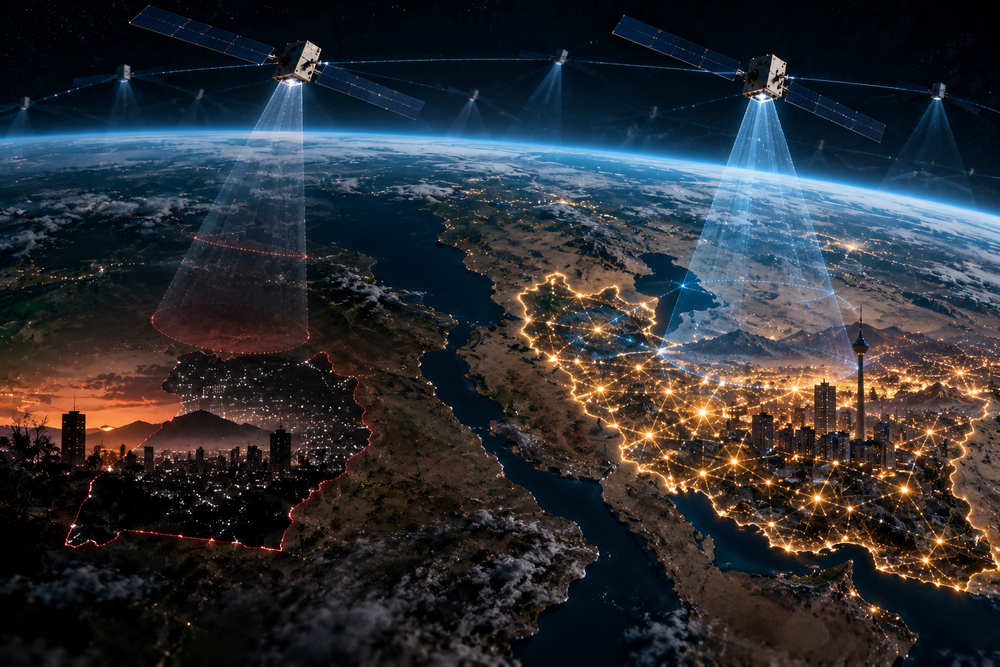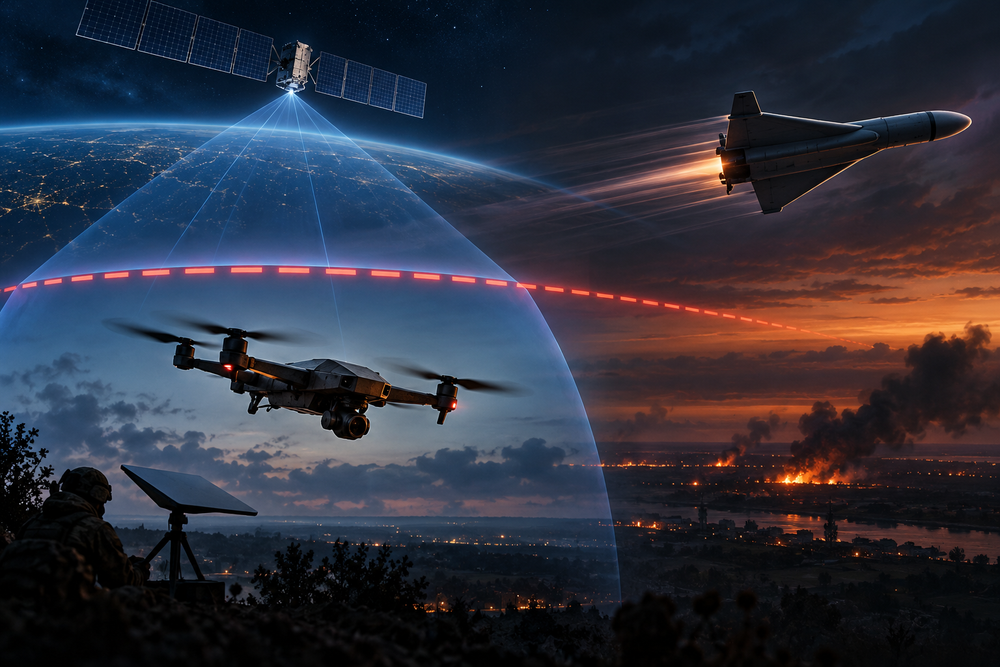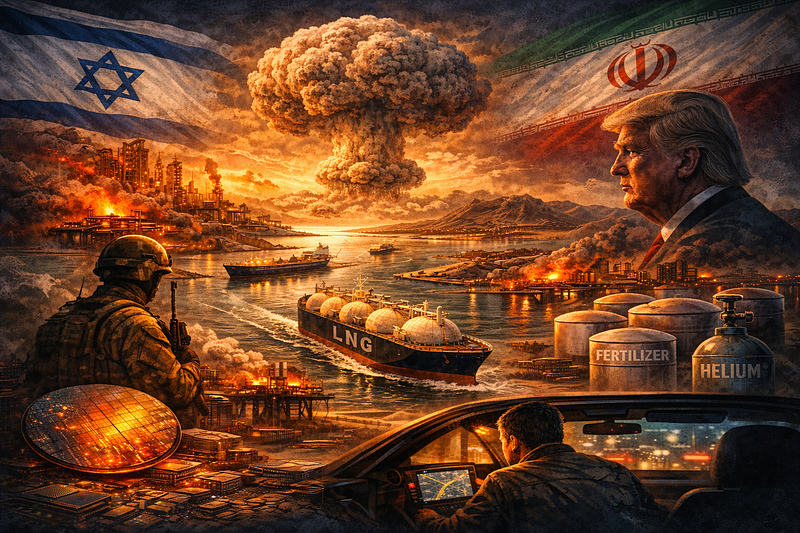
How the Strait of Hormuz, hidden supply chains, and existential retaliation are turning regional war into a threat to energy, food, chips, and modern life itself
This chapter is part of The Manifest, an unfolding work about the structures beneath events, the systems beneath headlines, and the patterns beneath the official story.
Before this war can be understood, one phrase has to be understood first.
The Samson Doctrine is the name given to a dark strategic idea long associated with Israel: that if the state were ever pushed to what it perceived as an existential edge, it would answer not with limited retaliation but with overwhelming, potentially catastrophic force. The name comes from the biblical story of Samson, captured and blinded, bringing the temple down on himself and everyone around him. In modern geopolitical terms, the meaning is stark: if survival becomes impossible, destruction becomes the final form of leverage.
That does not mean the threshold has been crossed. It does not mean it will be crossed. But the shadow of such a threshold is enough to change the meaning of everything beneath it. Once a conflict moves under that shadow, war is no longer only about who can win. It becomes about what can still be denied to everyone else if one side decides it cannot survive intact.
The most dangerous wars are not only the wars fought to win. They are the wars fought under the suspicion that if one side falls, everything around it may be dragged down with it.
That is the point where maps stop being enough.
People still look at war in the old way. They watch the sky, count the missiles, follow the statements, study the faces of presidents and prime ministers as if the essence of history lives in podiums and airstrikes. That way of seeing belongs to an earlier century, a century in which war could still be explained through armies, front lines, and conquered ground.
That is no longer enough.
The deeper wars of this century begin lower down. In electricity. In logistics. In industrial gases. In fertilizer chains. In airport shutdowns. In shipping insurance. In cooling systems. In semiconductors. In desalination. In the fragile, almost invisible conditions that make ordinary life possible until the day they stop arriving.
This is why the conflict between Israel and Iran, with Trump hovering over it as a force of pressure, improvisation, and spectacle, cannot be read as another familiar Middle Eastern escalation. It has to be read as a systems war in gestation, a war in which existential fear at the top meets infrastructural fragility beneath, and in which the decisive targets may not be armies first, but continuity itself.
The battlefield expands.
Infrastructure becomes a target.
Energy becomes a weapon.
Logistics becomes vulnerability.
The Strait of Hormuz stops being a shipping route and becomes a fuse.
Dubai stops being a symbol of wealth and becomes a node of dependency.
Helium stops being trivial.
Fertilizer stops being invisible.
Chips stop being abstract.
Food stops being guaranteed.
That is what makes this conflict larger than the region in which it burns. Not because the maps are bigger, but because the systems underneath them are thinner than they look.
What the Samson Doctrine Really Means
The Samson Doctrine matters because it changes the psychology of war before it changes the battlefield.
In an ordinary conflict, states still think in gradients. Pressure. Response. Signal. Counter-signal. Damage. Bargaining. Even when violence escalates, there remains a grammar of proportion.
The Samson threshold sits outside that grammar.
It belongs to a different moral and strategic universe, one in which the question is no longer how to survive well, or even how to survive at acceptable cost, but how to make annihilation too dangerous for everyone else to contemplate. It is the logic of the final warning embedded inside a state’s deepest strategic self-understanding.
This is why it matters even when it remains unspoken.
It changes how others calculate.
It changes what allies fear.
It changes what enemies test.
It changes what infrastructure means.
If there is even a chance that existential logic may one day take over, then every strike below that threshold becomes heavier than it first appears. A power station is no longer only a power station. A nuclear site is no longer only a military target. A retaliatory move is no longer only retaliation. Everything begins to vibrate under the pressure of what might happen if the war stops being about advantage and becomes about terminal denial.
A doctrine does not need to be activated to be dangerous. It only needs to be believable enough to reorganize fear.
That is the first real revelation of this war.
Why Israel Thinks in Existential Terms
The phrase only makes sense inside a longer Israeli strategic psychology, one shaped by siege, memory, geography, and the belief that ordinary defeat is not available as a political option.
That does not require melodrama to understand. It requires geometry and history.
Israel is territorially narrow. Its population is dense. Its strategic depth is limited. Its national memory is shaped not only by military conflict, but by exterminatory history. Its nuclear ambiguity was never merely about prestige. It was about ensuring that final defeat would remain psychologically and strategically unthinkable.
Many states can lose wars and continue. They may suffer humiliation, territorial loss, regime change, or strategic retreat, yet the state form itself survives. Israel has never imagined its position that way. That does not justify every action taken under this logic, but it does explain why phrases like the Samson Doctrine retain their charge. They emerge from a state that has built itself around the refusal of irreversible defeat.
That is what gives this conflict its darkness.
When a state organized around existential fear confronts an adversary that has spent decades preparing to survive siege and punishment, the war ceases to be merely geopolitical. It becomes a collision between two survival systems.
One fears annihilation.
The other has learned endurance.
That combination is combustible.
Some wars become dangerous not because one side wants too much, but because too many sides believe they cannot afford to lose.
Iran Beyond the Caricature
Iran is often discussed in the West as though it were a slogan wearing a flag.
A regime.
A clerical system.
A sanctions case.
A shorthand for defiance.
That way of seeing is politically useful and strategically shallow. Real wars are not fought against slogans. They are fought against terrain, institutions, depth, preparation, redundancy, and national memory.
That is where the picture changes.
Iran is not a compact battlefield waiting to be solved. It is a large, layered, mountainous state whose strategic culture has been shaped for decades by the expectation of pressure, covert destabilization, decapitation attempts, and possible direct war. Much of the discussion around its readiness points toward distributed depth rather than elegant centralization. One of the more striking ideas circulating around this war is that Iran’s defensive logic is spread across its thirty-one provinces in ways that make simple decapitation assumptions less useful than outsiders imagine. Even if some of the operational detail remains uncertain, the larger correction matters. Iran is not best understood as a brittle state waiting to crack under the first serious blow. It is better understood as a state that has expected siege and built accordingly.
That matters.
Because empires repeatedly make the same mistake. They confuse unfamiliar resilience with weakness. They mistake sanctions for decay, ideological rigidity for brittleness, mountains for backwardness, and lack of glamour for lack of depth. Then they discover too late that the target had spent years preparing for precisely the kind of punishment the empire expected would break it.
Iran’s scale matters more than casual coverage allows. On ordinary maps it is too often mentally shrunk into a manageable theater. In strategic reality it is difficult terrain, difficult depth, difficult space. Mountains are not scenery. They are friction. Size is not just acreage. It is delay, concealment, dispersal, and endurance.
This is why talk of ground troops sounds less like strength than like denial. A state of that size, with that terrain, that population, and that history of preparing for external force, does not convert easily into a victory narrative.
What it offers instead is entrapment.
Why the Strait of Hormuz Matters
There are places on earth that expose the weakness of an age.
The Strait of Hormuz is one of them.
On a flat map it looks almost absurdly small for what it carries, a narrow maritime throat through which a significant share of the conditions of industrial life still pass. The public hears its name and thinks oil. That is already too shallow.
Oil is only the visible layer.
The deeper story is that the modern world depends not only on finished products, but on routes, timings, feedstocks, gases, and industrial continuities that almost never appear in ordinary political language. That is what makes Hormuz so dangerous. It is not merely a shipping corridor. It is a concentration of prerequisites.
Too much passes through too little.
And that sentence describes more than the Gulf. It describes the wider condition of modern civilization. Too much complexity resting on too few routes. Too much confidence resting on too little redundancy. Too much normality imported daily into lives that have forgotten how dependent normality has become.
Civilization is not held together by what it celebrates. It is held together by what it assumes will always arrive.
The moment that assumption weakens, the emotional order of the economy starts to shake.
Fuel, yes.
But also liquefied natural gas.
Also fertilizer-linked industrial flows.
Also helium.
Also the technical chains behind semiconductor production.
Also the insurance logic that determines whether ships still move.
Also the power expectations of cities that have mistaken uninterrupted continuity for nature rather than management.
The Strait of Hormuz is therefore not just a route.
It is a confession.
It confesses how much of the world still depends on narrow channels it no longer emotionally understands.
Helium, South Korea, and the Ghost in the Machine
The digital age likes to speak as though it has transcended matter.
Cloud.
Platform.
AI.
Data.
Memory.
The language floats. The reality does not.
Every digital miracle still rests on brutally physical foundations: mines, fabs, cooling systems, gases, chemicals, water, and uninterrupted shipping. Among the most revealing of these hidden materials is one of the least glamorous.
Helium.
To the ordinary imagination helium belongs to balloons, novelty, children’s parties, the comic distortion of the human voice. To advanced industry it belongs to something darker and more essential: high-precision processes, specialized cooling, semiconductor production, medical and scientific systems, and the quiet underside of modern complexity.
That is why it matters here.
A conflict around Hormuz does not only threaten what people immediately recognize. It threatens the hidden materials beneath recognition. If enough helium-linked production and transport in the wider Gulf system is disrupted, the consequences do not show up first as war. They show up as manufacturing strain, chip bottlenecks, medical supply issues, and a digital civilization rediscovering that it is not digital at all. It is hyper-material. It simply outsourced the memory of matter.
One of the most telling lines in this crisis runs from Qatar to helium to South Korea’s memory chips. Once that line becomes visible, the war stops being a “regional energy event” and becomes something much stranger. South Korea’s semiconductor ecosystem, which sits near the center of the world’s memory and storage architecture, suddenly appears downstream from a chokepoint most people still think of only as an oil passage. The exact percentages attached to this chain can be argued over. The dependency itself cannot.
That is the kind of detail that changes an article from commentary into revelation.
Because it forces a confrontation between illusion and substrate.
The illusion says the modern world is smart, weightless, adaptive, post-industrial.
The substrate says memory chips still depend on gases extracted in unstable regions and shipped through narrow corridors.
The illusion says advanced economies have moved beyond crude dependence.
The substrate says they remain entangled with molecules, valves, cooling systems, and the political fate of faraway infrastructure.
The digital world is not less physical than before. It is more physical than before, and more dependent on hidden materials than most people can emotionally process.
Fertilizer, Potatoes, and the Quiet Beginning of Hunger
If helium reveals the hidden physicality of the digital world, fertilizer reveals the hidden industriality of food.
Food still arrives in supermarkets bathed in an aura of innocence. Bright light, neat packaging, clean abundance. The visual language of food hides its real nature in modern civilization. It is not simply grown. It is industrially supported. Energy, nitrogen fixation, petrochemical chains, transport timing, refrigeration, credit, infrastructure, and fertilizer all sit beneath the green field.
That is why fertilizer belongs near the center of this story.
Take away enough of it and you do not immediately get famine in the cinematic sense. First you get lower yields, higher costs, altered planting decisions, poorer states under pressure, households cutting quality before quantity, governments distorting flows, exporters becoming defensive. Then the hierarchy of resilience begins to reveal itself.
The rich absorb.
The poor distort.
The weakest begin living inside hunger before anyone powerful is willing to use the word.
Hunger begins long before empty shelves. It begins where the inputs fail and no one in authority has yet decided to call it hunger.
This is one of the great lies of the modern world, the belief that famine belongs to old empires, poor regions, failed states, someone else’s century. Advanced societies are not exempt from input shocks. They are merely buffered for longer. The chemistry beneath food does not care about national myth.
If enough of the industrial basis of fertilizer becomes unstable, the consequences do not remain neatly regional. They move outward through price, then agriculture, then diets, then politics.
And that is why this conflict is not simply about energy. It is about the biological continuity of societies that have forgotten how industrial their own food really is.
One of the most unforgettable lines to emerge from this wider discussion is almost absurd in its simplicity: the war is not only about computer chips, but about potato chips, because the potatoes themselves depend on fertilizer. The line stays in the mind because it does what good revelation always does. It drags the abstract into the ordinary. It turns geopolitics into the supermarket. It turns a narrow maritime corridor into dinner.
LNG, Rebuild Time, and the Violence of Delay
Modern war is still too often described as though damage were the same thing as destruction.
It is not.
Sometimes the deeper violence is not what gets hit, but how long normality takes to return.
That is why one of the most important dimensions of this conflict is not simply what can be struck, but what cannot easily be rebuilt. LNG infrastructure belongs in that category. A damaged unit is not just a damaged unit. It can mean years of reduced continuity, a tiny number of companies worldwide able to repair or replace what was hit, a long chain of absent capacity disguised in daily news as a one-off incident. Whether every figure cited in the heat of crisis proves exact matters less than the governing fact: specialized infrastructure creates specialized vulnerability.
This is one of the reasons modern infrastructure war is so hard to explain to the public. A strike can last minutes. The absence it creates can last years.
That changes the meaning of damage.
It means the real war is not only over what exists, but over recovery timelines.
One damaged installation can continue speaking through markets, energy planning, investor fear, and industrial shortages long after the smoke clears from the screen.
The most consequential strike is often not the one that destroys the most. It is the one that lengthens absence.
That is the violence of delay.
And it is one of the least understood languages of the present age.
Dubai and the Fragility of Smoothness
If the Strait of Hormuz exposes the weakness of global routes, Dubai exposes the weakness of polished systems.
For years Dubai functioned as one of the age’s brightest mirages, a city that seemed to prove geography had been defeated by engineering, that climate had been neutralized by capital, that aviation, luxury, finance, logistics, and architecture could fuse into permanent smoothness.
But smoothness is not resilience.
It is often its opposite.
The more seamless a system appears, the more violent its interruptions become. The more a city depends on continuous flow, confidence, cooling, aviation, power, logistics, and imported labor, the more each disruption behaves like an injury to its nervous system rather than a temporary inconvenience.
Dubai is not just wealthy. It is concentrated.
It is an aviation node, a logistics node, a confidence machine. Close the airport long enough and you do not merely delay travelers. You wound an economic organ. Disrupt regional stability enough and the city’s greatest strength becomes its most terrifying vulnerability, the need for uninterrupted normality.
That is why airport shutdowns matter so much. Dubai’s economy is not merely located near the airport. It is structured through it. Close that artery and you do not only damage tourism. You damage freight, finance, real estate psychology, business continuity, and the story the city tells about itself.
The same insight applies more broadly across the Gulf. Wealth does not eliminate fragility when fragility is infrastructural. It can intensify it, because more of life has been organized around the assumption that continuity will be bought, powered, cooled, desalinized, flown in, and insured on schedule.
Take away enough power and wealth becomes exposure.
Take away enough confidence and luxury becomes anxiety.
Take away enough continuity and the whole architecture begins to feel less like triumph and more like balance on a thin technical wire.
The more advanced a concentrated system becomes, the less interruption it can survive.
Dubai matters because it makes the truth visible. It reveals that modernity’s smoothest surfaces are often the least interruption-tolerant.
Trump and the Theatre of Volatility
Then there is Trump, who enters this landscape not only as a president or political figure, but as an instrument of volatility.
That is the more revealing frame.
Threats.
Pauses.
Deadlines.
Boasts.
Claims of victory before events justify them.
Declarations of imminent action followed by postponement.
A “gift” reinterpreted as passage for ships.
A war described as won while its real consequences are still forming.
A style of power that treats instability as method and humiliation as leverage.
This would be dangerous in any system.
It is especially dangerous in one already balanced on narrow dependencies.
Because fragile infrastructures do not respond well to theatrical volatility. Energy markets do not care about personal myth. Shipping insurance does not care about ego. Fertilizer chains do not accelerate because a leader wants to project dominance by Monday morning. Airports do not remain open because reality has been rhetorically bullied into compliance.
That is one of the most revealing features of this moment. Political language still behaves as though narrative can master the material world. It cannot. It can move markets. It can frighten allies. It can jolt routes, prices, and confidence. But it cannot force a damaged system to become robust again.
Words now move risk like weapons, but they do not govern the reality they destabilize.
That is the trap at the center of Trump’s role in this conflict. He amplifies volatility in a system that already has too little tolerance for it. He performs command in a landscape where command is thinner than it looks. He behaves as though saying something forceful is still a form of control. Yet the deeper material world beneath the rhetoric has become increasingly unforgiving.
The show continues.
The system frays underneath it.
The Man at Two in the Morning
The war is usually shown from above.
From satellites. From briefing rooms. From screens where arrows move across maps and men in suits explain escalation as if it were weather.
But wars are not absorbed from above.
They are absorbed at floor level.
In a car at two in the morning, under the cold blue light of a navigation screen, by a man who is already working his third job and still cannot get ahead. He does not speak in the language of deterrence, maritime chokepoints, or strategic depth. He speaks in rent, fuel, school shoes, groceries, and the silent arithmetic of a week that no longer adds up.
That is where this war becomes real.
Not when a tanker turns back.
Not when a president threatens another deadline.
Not when a commentator says the market is nervous.
It becomes real when one more rise in fuel, one more rise in food, one more interruption in ordinary supply hits people who were already out of room before the first missile flew.
A society is not stable because its markets are open. It is stable only if ordinary people still have margin.
And margin is what the modern West has been burning through for years.
Time margin.
Money margin.
Emotional margin.
The capacity to absorb one more shock without the whole structure of daily life turning sour.
This is what system war means in practice. The battlefield is still there, yes. But the consequences land here, in kitchens, in overdrafts, in shorter tempers, in worse food, in longer hours, in the private humiliation of people who are told the economy is resilient while their own lives feel one invoice away from fracture.
The poor do not experience geopolitics as analysis.
They experience it as compression.
As the feeling that life is being tightened from far away by people who will never miss a meal.
That is why the man driving at two in the morning matters more than most official briefings. He is not a side note to the crisis. He is the real test of whether the system can absorb what is coming.
If he cannot absorb it, then the system cannot either.
Five Paths Out, and None of Them Clean
One reason this war feels so unstable is that no clean ending presents itself.
The possible exits are not only military or diplomatic. They are psychological, infrastructural, symbolic, and economic.
In the worst case, Iran is not merely pressured but broken at a level that forces the conflict upward toward catastrophic retaliation. That is the nightmare suspended above every conversation about existential thresholds.
A second path runs through Gulf infrastructure. If Iranian retaliation seriously damages the power and energy systems of the Arabian Peninsula, the war becomes a direct assault on the habitable and economic continuity of places like Saudi Arabia, Qatar, and Dubai.
A third path is the one that haunts every nuclear ambiguity. If an actor under enough pressure decides that ordinary defeat is no longer acceptable, terminal logic enters the field.
A fourth path moves in the opposite direction. Instead of general collapse, the war narrows into a desperate contest over disabling the other side’s last-resort capacities before the threshold can be crossed.
And then there is the fifth path, less spectacular and perhaps more plausible than the others: a long grinding settlement in which all sides claim victory, none truly win, and the system absorbs the shock through higher costs, lower trust, deeper fragmentation, and a permanent increase in fragility.
That last path is the one elites often call stability.
It is not stability.
It is damage redistributed over time.
The Real Revelation
Strip away the rhetoric, the moral theatre, the declarations of strength, the press conference bravado, and something harder remains.
This war is revealing the architecture of the age.
It reveals that modern prosperity is not robust. It is intricately dependent.
It reveals that digital civilization still rests on gases, ports, chips, fertilizers, routes, and industrial chemistry.
It reveals that the smoothest systems are often the most interruption-sensitive.
It reveals that existential doctrines at the top transform infrastructure far below.
It reveals that the public still thinks in prices while the real issue is continuity.
It reveals that the political class remains addicted to performance while the material world beneath it is increasingly intolerant of chaos.
It reveals that one damaged LNG unit is not just damage. It is years of absent continuity. That one narrow shipping corridor is not just a route. It is a civilizational weak point. That one airport shutdown is not a delay. It is a wound in a city’s nervous system. That one industrial gas is not trivial. It is part of the hidden machinery behind the digital world. That one interrupted fertilizer chain is not an agricultural inconvenience. It is the beginning of politics turning biological.
And it reveals that the ordinary person already working at the limit is where all of this finally lands.
The danger is not only that the region may escalate. The danger is that the world built itself too narrowly to survive what such escalation now means.
This is why the conflict cannot be treated as another episode.
It is a chapter in the history of exposure.
A moment when the glossy surface of globalization peels back and the thin machinery beneath becomes visible all at once.
Closing Reflection
There are wars that destroy cities.
And there are wars that reveal worlds.
This one may do both.
The Samson Doctrine matters because it explains how a conflict can begin to think beyond victory. The Strait of Hormuz matters because it shows how much of modern life is still balanced on narrow passage. Helium matters because the digital world is not less physical than before, but more. Fertilizer matters because food begins in industry long before it reaches the plate. LNG matters because the true violence of infrastructure war is often measured in years of delayed continuity. Dubai matters because smoothness is not resilience. Trump matters because volatility has become a force multiplier in fragile systems. The man with three jobs matters because he is where the truth of all this finally lands.
The great lie of modernity was not only that complexity made us advanced.
It was that complexity made us safe.
What it often made us was elegant in appearance and brittle in structure, optimized for flow and deeply vulnerable to interruption, unable to remember the physical foundations beneath the illusion of permanent continuity.
Now those foundations are shaking.
And beneath the speeches, the threats, the market reactions, and the maps on television, a harder question rises.
Not who will win.
But what remains standing if enough actors decide they no longer can.
Remember always where it truly began, and who set it in motion.
Follow The Manifest
If you want to understand what is unfolding, not just what is being reported, follow The Manifest.
New chapters appear continuously. Each one builds on the last. Each one adds another layer to the same underlying architecture of power, fragility, concealment, and control.
Follow The Manifest to stay inside the story as it develops.
Because this is not a collection of isolated articles.
It is one structure, slowly becoming visible.
Related from The Manifest Archive