Separate wars. One system.
The screen turns red before the speeches do.
In Singapore, London, and New York, numbers move first. Brent rises. Insurance premiums widen. Tanker routes are recalculated. Somewhere, a shipping executive asks how many more days a corridor remains commercial before it becomes a gamble. Somewhere else, a trader watches a chart that has no ideology, no party, no diplomatic etiquette, and no patience for euphemism.
Markets do not care whether leaders intended the escalation. Markets care whether fuel can move, whether ports can function, whether the Strait of Hormuz stays open, whether loading terminals can still be reached, whether next week will cost more than this one.
Then come the speeches.
A spokesperson in Brussels says restraint. A minister in Washington says stability. Another official says de-escalation while ships edge closer to danger and energy prices climb higher than the language meant to contain them.
The wording is calm. The map is not.
In the Eastern Mediterranean, naval assets slide into position beneath the polished grammar of readiness and reassurance. On Cyprus, tourists still walk the coast, cafés still fill and empty, students still move through university halls, but the island’s meaning has already begun to change. It is still an island to the people living on it. To military planners, it is geography again.
That is how the world changes now.
Not with one official beginning, but with a structure tightening across multiple fronts at once. A war becomes world war not only when more states enter combat. It becomes world war when energy, shipping, insurance, bases, inflation, intelligence, alliance systems, industrial supply chains, and public language all begin bending around the same crisis.
It becomes world war when a strike in one theater changes electricity costs in another. When military assets reposition on one coast because missiles flew over another. When a conflict around Iran alters the battlefield in Ukraine. When Europe starts paying for decisions made in Washington and Tel Aviv as if they were weather.
That is what March 2026 feels like.
Not like an especially tense month. Not like one more episode in a noisy age. It feels like one of those moments history later describes with humiliating simplicity, once the fog has lifted and official language has lost its power to shrink what happened.
The signs were there. The fronts were already linked. The costs were already spreading. The same states, the same alliances, the same routes, the same moral evasions, the same strategic instincts kept appearing across multiple theaters.
The wider war was not hidden. It was fragmented.
That is the central claim of this article.
The real question is no longer whether the world could slide into World War III. The real question is whether World War III is already taking shape as a connected structure while governments, institutions, and media systems keep describing its parts as if they were separate.
Iran cannot be understood on its own. Ukraine cannot be understood on its own. Europe’s energy fragility cannot be understood on its own. Cyprus cannot be understood on its own. Israel’s expanding regional doctrine cannot be understood on its own. American strategy cannot be understood on its own. China’s rise cannot be understood on its own. Russia’s advantage in contradiction cannot be understood on its own.
Each now belongs to a larger field.
And that field has a logic.
The logic is hegemony. The logic is supremacy. The logic is the refusal of an old order to accept limits, rivals, and independent centers of power. The logic is that energy must not move outside imperial supervision, that allies must not develop real autonomy, that small states must remain usable, that regions must remain governable from afar, that sovereignty is tolerated only up to the point where it disturbs the hierarchy.
That is why the phrase World War III no longer sounds melodramatic.
It sounds proportionate.
The first deception is separation
The most effective lie in periods like this is not invention. It is fragmentation.
Ukraine is one file. Iran is another. Gaza is a humanitarian disaster. The Red Sea is a maritime security problem. Europe’s stagnation is an economic issue. Cyprus is a local strategic complication. NATO is a defensive framework. China is a trade and technology competitor. Russia is a revisionist adversary. Israel is an ally under pressure. The United States is preserving order in a dangerous world.
Every one of those sentences contains enough partial truth to survive a news cycle.
Together they conceal the whole.
Because the whole looks different.
Ukraine is no longer merely a war in Eastern Europe. It is one of the main theaters through which Atlantic power has tried to define the limits of Eurasian sovereignty.
Iran is no longer merely a regional adversary. It is a pressure point on Chinese energy, a hinge in Gulf security, a corridor in Eurasian strategy, and one of the states that still refuses full incorporation into the Western-managed order.
Europe’s energy crisis is no longer merely an economic problem. It is the domestic cost of geopolitical obedience.
Cyprus is no longer only an island with a painful history. It is a node where basing, surveillance, logistics, and Mediterranean geography meet.
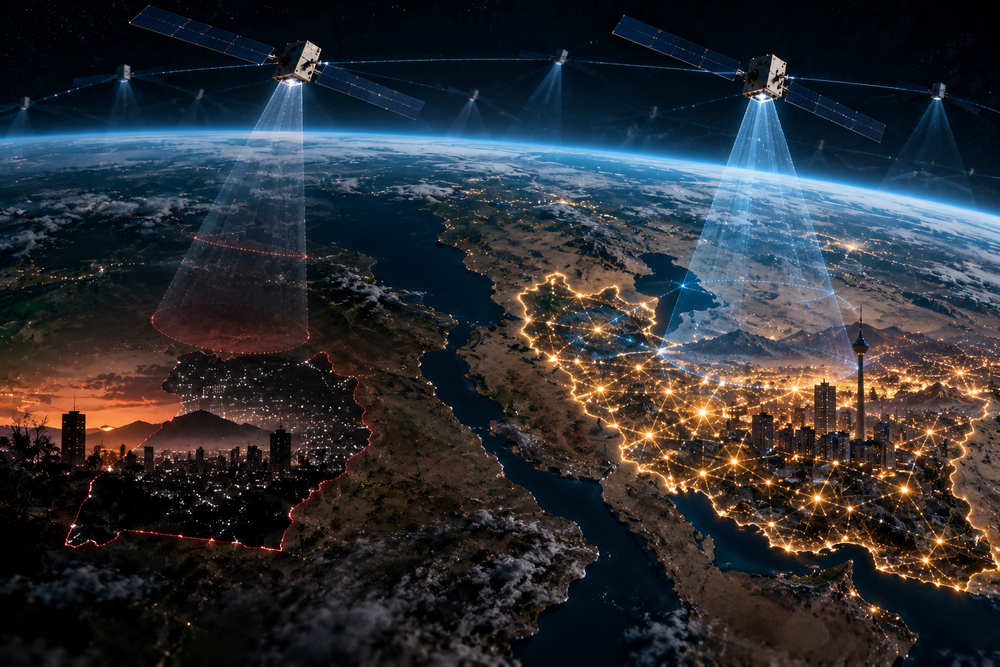
And the Gulf is no longer a distant theater. It is one of the world’s central hydrocarbon arteries. Disrupt it, and Europe’s factories, freight corridors, and households feel it.
This fragmentation is not only an analytical failure. It is a political function.
It keeps the scale of the crisis conceptually smaller than the reality of the crisis. It allows leaders to manage perception one compartment at a time. It prevents populations from seeing that the same system is already pushing on multiple fronts at once.
This is the force of the warning.
Not that the phrase is dramatic, but that the structure is.
The wars now underway increasingly behave like connected theaters of one wider conflict. They influence the same energy markets. They activate the same alliance chains. They strain the same industrial systems. They expose the same political weaknesses. They are interpreted through the same moral asymmetries. They are driven by the same hegemonic logic.
World war no longer begins with a declaration. It begins when separate wars start paying each other’s bills.
That sentence is not metaphorical.
The war around Iran affects Europe’s energy costs. Europe’s energy costs affect industrial viability, household pressure, and political stability. Europe’s economic weakness affects the endurance of support for Ukraine. Military resources drawn toward Israel and the Gulf affect Ukraine’s battlefield environment. Higher energy prices strengthen Russia. Pressure on Iran sends a message to China. Bases on islands and in Gulf monarchies suddenly matter to populations who were told they were symbols of protection.
The chain is visible.
The tragedy is that official life still rewards people for not seeing it whole.
Israel and the abolition of limits
To understand the present, one has to say something too much Western political language still circles without stating plainly.
Israel is no longer behaving like a state disciplined by meaningful external limits.
Not stable territorial limits. Not stable legal limits. Not stable military limits. Not stable moral limits.
Once that happens, the region around it becomes permanently unstable.
A state that accepts borders, even contested ones, remains intelligible within a political grammar. A state that treats borders as elastic, sovereignty as negotiable, and force as the preferred method of regional design operates by another logic.
The logic is not equilibrium.
It is supremacy.
This is what the region has been living through.
Palestine was not treated as a people whose political future required equal settlement. It was treated as a problem to be managed, fragmented, displaced, contained, and overruled.
Lebanon became a recurring site of punishment.
Syria, Iraq, Yemen, and now Iran do not form a random sequence of crises. They form a belt of sustained pressure. The official explanations change with each phase. The deeper doctrine does not.
The doctrine is simple enough to state directly. Israel seeks a regional order in which no neighboring or near-regional force remains strong enough to impose strategic restraint on it. That is a different objective from merely seeking safety.
It is a project of hierarchy.
You can see this not only in war, but in the refusal of finality. A state that intends to live within limits behaves differently from a state that treats limits as temporary inconveniences.
The question of Palestine never receives equal closure because closure would impose a limit. Lebanon is never merely left alone because a durable equilibrium would impose a limit. Iran cannot be treated as just another sovereign regional state because its survival as an independent pole imposes a limit.
That is why the confrontation with Iran cannot honestly be reduced to the latest negotiation, the latest intelligence warning, or the latest rocket exchange.
Iran has long stood as one of the principal obstacles to a Middle East organized around uncontested Israeli military freedom backed by the United States. The justifications of the moment matter tactically. They do not explain the strategic continuity.
This matters because a state organized around a doctrine of open-ended supremacy begins to lose its relationship with restraint altogether. It stops experiencing restraint as prudence and starts experiencing restraint as humiliation. Diplomacy becomes delay. Negotiation becomes a tactical pause. Every surviving rival becomes unfinished business.
A state that no longer knows how to live with limits eventually turns war into policy.
That is what makes the current regional posture so dangerous. Not only the violence itself, but the mentality under it. The belief that geography is expandable, that law is conditional, that overwhelming force can solve unresolved politics, that trauma and exceptionalism together authorize permanent preemption.
Such a state is dangerous to its neighbors.
Such a state fused to American power is dangerous to the international system.
The United States and the violence of managed decline
The United States remains the central force in the larger structure, but not because it appears calm, strategically settled, or historically secure.
What makes Washington dangerous now is a more unstable combination. It still has extraordinary military reach, financial centrality, intelligence depth, and alliance infrastructure, but it increasingly behaves like a power that senses its relative decline and cannot psychologically accept it.
A confident power can absorb competition. A mature power can live with the existence of other centers of growth, production, and influence. A rational power answers strategic erosion with rebuilding, with industrial policy, with infrastructure, with education, with renewed productive strength.
A declining hegemon often reaches for what it still dominates most directly. Sanctions. Coercion. Naval presence. Intelligence operations. Alliance discipline. Managed instability.
It starts trying to preserve hierarchy through pressure because it no longer knows how to preserve influence through construction.
That is the American pattern now.
The public story says the United States is defending order. The material story says it is defending hierarchy. A hierarchy in which Washington still expects to decide which sovereignties are legitimate, which energy relationships are acceptable, which regions must remain under supervision, which rival powers may rise only within approved limits.
This is why Iran matters beyond itself.
Iran is not simply another difficult state. It matters to Gulf security, to Eurasian geography, to China’s energy intake, to the strategic environment around Russia, and to the broader question of whether a state can remain outside the American-managed order without permanent punishment.
A war against Iran is therefore not only about regional rivalry. It is also a message to Beijing, a warning to smaller states, and a declaration that Washington still intends to regulate the map.
The same structure appears in Ukraine.
That war was never only about eastern provinces or one national border. It was about the outer limit of Atlantic military and political expansion into a region Russia considers existential. It was about whether the old order still had the right to redraw the security map around rival powers without encountering a hard limit.
The battlefield became the place where the United States and its allies tried to prove they still defined the rules of the Eurasian perimeter.
In both cases, what looks like separate conflict is part of the same refusal: the refusal to inhabit a world in which American preference is no longer final.
That is why the current danger is best understood as a crisis of imperial psychology. The United States still has enough force to destroy, sanction, isolate, and destabilize across multiple theaters. It no longer has the same certainty that the future will remain organized around its will. In such a condition, coercion becomes more tempting precisely because the deeper ground has shifted.
The empire’s problem is not that it has lost all power.
It is that it still has enough to make decline global.
War without constitutional ownership
This wider danger is intensified by the way American power now functions internally.
On paper, the United States remains a constitutional republic in which war is among the gravest public decisions imaginable. In practice, the machinery of escalation now sits only loosely inside democratic responsibility.
Formal accountability remains.
Real propulsion has drifted.
Executive improvisation, permanent security bureaucracies, intelligence culture, lobbying networks, donor discipline, military contracting, and media gatekeeping together form a war system that can move toward larger conflict without requiring a fully honest national act of decision.
That matters because it makes restraint structurally weak.
Congress exists, but often behaves as though the real danger is not war itself but having to own it publicly. Politicians prefer ambiguity because ambiguity disperses responsibility. The public remains emotionally involved but strategically underinformed. The war system keeps moving because nobody inside it is rewarded for stopping it clearly.
This is how empires hollow republics.
Not by abolishing constitutional forms, but by ceremonializing them.
A polity that can no longer locate responsibility for war inside its own stated institutions is already in a dangerous condition. It becomes easier for conflict to expand because the mechanism of expansion no longer requires a visible collective decision. It requires only momentum, funding, and the absence of courageous refusal.
War without ownership is one of the signature conditions of late empire.
Lobby, money, fear
To stop at institutional drift would still be too polite.
The real social mechanics of power are denser and uglier.
There is money. There is lobbying. There is donor discipline. There are military contracts that tie local political interests to the continuation of external conflict. There are media environments that punish certain kinds of honesty. There are reputational risks attached to stepping outside consensus. There are careers built on alignment. There are politicians who learn quickly which questions cost funding, office, or institutional protection.
Some of this is straightforward.
Some of it lives in darker atmospheres of fear, compromise, implicit coercion, and the possibility that many political actors are more constrained than public mythology allows.
One does not need to prove every whispered mechanism to see the pattern. A political class that repeatedly behaves as if it is bound by pressures other than public judgment usually is.
This is why major questions of war in Washington so often appear pre-disciplined. The range of acceptable dissent is narrow. The cost of crossing certain lines is high. The reward for obedience is tangible. And when military escalation, Israeli priorities, intelligence culture, and donor systems converge, the continuity of policy becomes astonishingly strong.
That continuity is not healthy realism.
It is structured obedience.
A democracy can survive fierce disagreement. What weakens it is the silent education of an entire political class into what must not be said.
That is the background condition in which wider wars are easiest to sustain.
Europe and the theater of self-harm
Europe presents itself as a guardian of law, dignity, and civilized restraint. In practice it increasingly behaves like a moralized extension of Atlantic priorities, even when those priorities damage the continent’s own material foundations.
That is why Europe’s role in this crisis must be judged harshly.
The continent is not merely compromised in rhetoric. It is compromised in structure. It keeps entering strategic arrangements that weaken its own economy, narrow its options, and increase its dependence, all while its leadership class performs a morality of maturity, sacrifice, and unity.
The energy story makes this impossible to ignore.
Europe’s industrial power was built on material conditions. Affordable energy. Stable supply. Geographic realism. Productive networks organized around predictable input costs. When the older energy architecture tied to Russia was severed, Europe did not just make a geopolitical statement. It inflicted damage on one of its own civilizational foundations.
Germany is central here.
Not because Germany is Europe, but because so much of Europe’s industrial logic still runs through Germany. BASF did not become a continental symbol by accident. The chemical sector, steel, automotive supply chains, advanced machinery, and energy-intensive manufacturing all depend on cost stability. When gas becomes structurally expensive, the damage does not remain theoretical. It appears in shuttered capacity, deferred investment, lost competitiveness, and the gradual relocation of industrial confidence.
And Germany never weakens alone. Its industrial ecosystem runs through Austria, the Czech Republic, Slovakia, Poland, Hungary, northern Italy, and beyond.
Damage the German center and you send pressure through the continental system.
Yet this damage was narrated as virtue.
That is one of the clearest signs of Europe’s political sickness. It no longer clearly distinguishes moral posture from material injury. It calls sacrifice maturity even when the sacrifice is self-damaging. It calls obedience principle even when obedience undermines autonomy.
Now the Gulf threatens another shock.
If flows through Hormuz tighten, if risk premiums surge, if LNG competition intensifies, if loading infrastructure is damaged, Europe will not experience that as abstract geopolitics. It will experience it in diesel, electricity, fertilizer, freight, food costs, industrial margins, plant closures, and wage pressure.
Europe is no longer merely aligned with the Atlantic order.
It is being invoiced by it.
That sentence matters because it captures the real movement of cost. Political dependence is not only moral. It is economic. Every new act of strategic obedience produces a bill, and that bill is paid by firms, households, workers, and the future productive capacity of the continent.
Germany as the industrial barometer
Whenever Europe’s leadership tries to hide from this reality, Germany remains one of the clearest barometers.
Watch German industry and the truth of Europe’s strategic choices becomes harder to deny.
When chemicals become too expensive. When steel loses margin. When energy-intensive sectors hesitate on investment. When exporters face structurally higher input costs than rivals in the United States or China. When industrial firms shift production rather than trust that costs will stabilize. That is not merely an industrial story.
It is the material translation of geopolitical submission.
The citizen hears resilience. The grid and the factory hear something else.
And this matters beyond economics. A continent that weakens its industrial base weakens the foundation of its political sovereignty. Dependence is not only military. It is productive. If you can no longer make enough, power speaks differently around you. If you can no longer defend the energy conditions under which your industrial system survives, you do not remain strategically adult for long.
That is the deeper European crisis.
Not only moral confusion. Not only bad leadership. But the erosion of the material basis of independent power.
Energy is how geopolitics enters the household
The reason energy matters so much is not only that modern economies run on it.
It matters because energy is where high strategy enters ordinary life without asking permission.
A war can remain distant for a while if its costs stay abstract. Politicians can narrate. Analysts can contextualize. Media can fragment. Diplomats can euphemize. But once energy systems are disrupted, war escapes the realm of remote explanation. It moves into fuel prices, electricity costs, shipping, fertilizer, transport, food, manufacturing, and wages.
That is why the Gulf matters in world-historical terms.
Not because it is dramatic on a map, but because it remains one of the central transfer points of the global hydrocarbon system. The Strait of Hormuz is not a technical side issue. It is a choke point through which a major share of globally significant oil flows and a critical part of LNG-linked strategic traffic passes. Disrupt it, and you do not only affect local actors. You transmit shock through the machinery of the world economy.
This is where energy becomes more than fuel.
It becomes leverage.
A state or alliance that can threaten the movement of hydrocarbons can pressure not just one enemy, but entire industrial systems. It can influence inflation, fiscal policy, shipping, insurance, electoral stability, and social mood. Energy is therefore not a side effect of geopolitics. It is one of geopolitics’ most powerful enforcement tools.
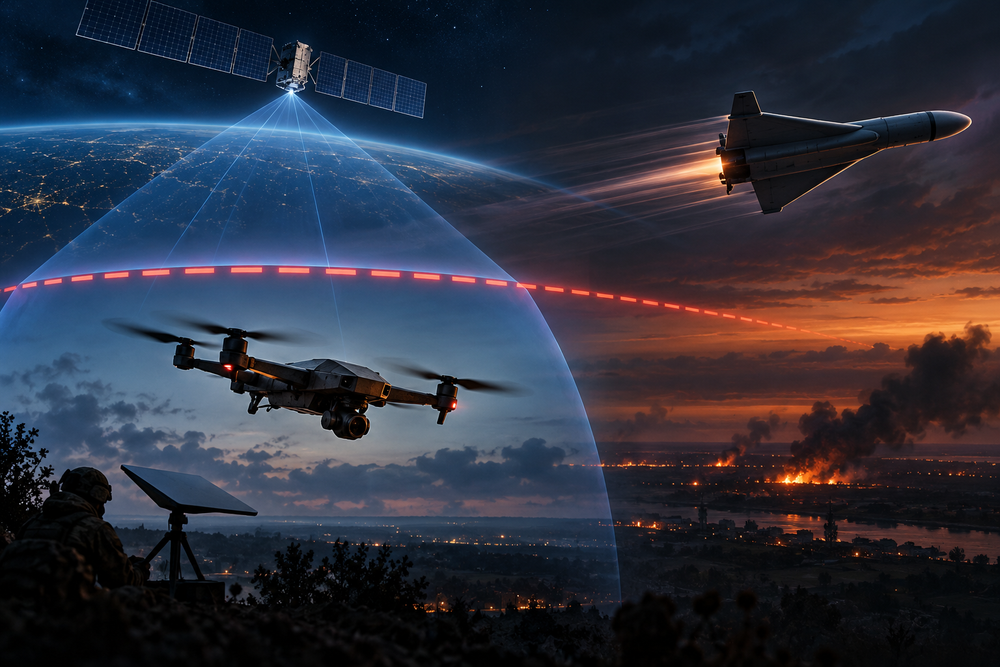
That is why this war already has a world character. It is moving not only through missiles but through flows. A strike on one coast becomes a power bill in another country. A drone or missile threat near a terminal becomes a planning crisis in a European factory. A regional escalation becomes domestic compression thousands of kilometers away.
Energy does not care about official language.
Markets often understand first because markets are not invested in ceremonial narratives. They respond to flow, interruption, risk, and cost. If the world is entering a wider war structure, the first cold witness may not be a minister or an editorial page.
It may be a pricing model.
Cyprus and the cruel mathematics of proximity
There is something brutally clear about Cyprus in this moment.
It shows how modern war reaches societies through proximity and inherited infrastructure long before those societies formally choose any war at all.
Cyprus is not simply a small state. It is a strategically placed island in the Eastern Mediterranean, with British sovereign base areas, EU membership, historical entanglement, and proximity to multiple arcs of military significance. That means it exists at the meeting point of ordinary life and war geography.
This is what the public is rarely taught to see. A place can be home to its people and terrain to empire at the same time.
When crisis widens, the second identity often becomes more powerful than the first. Military planners do not see beaches, cafés, or universities first. They see range, access, staging, surveillance, refueling, logistics, and continuity of operations. The island’s human life continues, but its strategic meaning has been rewritten from the outside.
That is why the mythology of foreign bases must be treated with suspicion. Bases are not merely shelters. They are extensions of someone else’s sovereignty into your territory. They project power outward, but they also import risk inward. They can deter, but they also magnetize. They can make you useful, and usefulness in great power conflict is a dangerous condition.
A base is called protection until the war arrives through it.
Cyprus is therefore not a side issue. It is one of the clearest examples of how world war logic now moves through smaller states, through inherited imperial arrangements, through operational geography rather than only through formal alliances and declarations.
Small states do not disappear in great power conflict.
They reappear as geography.
The intelligence state and deniable escalation
Another part of this structure needs emphasis. Modern conflict is not only driven through overt force. It is prepared, shaped, and prolonged through intelligence culture and covert systems.
This matters more than official discourse usually admits.
Intelligence agencies are not omnipotent, but they are central to the architecture of modern escalation. They help create deniability. They allow pressure before formal war. They build channels, proxies, sabotage, destabilization, influence operations, managed disclosures, and strategic ambiguity. They let states act without fully owning action.
This matters because covert culture breaks accountability.
By the time overt violence arrives, the structure beneath it has often been prepared for months or years. Political classes are softened. Narratives are seeded. Allies are lined up. Potential resistances are marginalized. Infrastructure is mapped. Reaction pathways are anticipated. Publics see the visible phase. They rarely see the preparatory one.
That is why any serious reading of March 2026 has to think in layers. What is being publicly said now is only the latest visible shell around deeper movements that began earlier. That is part of why reality feels ahead of language. The deeper preparation has already happened by the time public explanation begins.
This is not conspiracy language.
It is how modern statecraft actually works.
Covert systems do not remove responsibility.
They dissolve it.
That is precisely why they are so useful to escalating powers.
The UN and the ritual of inversion
One of the most corrosive signs of the present is the way international institutions increasingly process hierarchy while speaking the language of law.
The ritual works by inversion. A state is attacked. Instead of beginning from the attack, diplomatic discourse begins from the attacked state’s response. The chronology is bent. The moral center is shifted. The aggressor receives context. The target receives instruction. The vocabulary of legality remains present, but it has been emptied out and redistributed asymmetrically.
This matters enormously. Law does not die only when it is openly abolished. It also dies when it is preserved ceremonially but applied so selectively that everyone can see the hierarchy beneath it.
The formula has become grimly familiar.
The bombing is background. The retaliation is the problem. The side that initiates receives complexity. The side under pressure receives restraint.
That is not legal order.
It is legal theater in service of power.
This is what makes current institutional speech so corrosive. It does not merely fail to stop widening war. It teaches the world that law itself is subordinate to force. Once that lesson is absorbed deeply enough, more actors conclude that only hard power remains real.
That, in turn, accelerates the very world of wider war the institutions claim to prevent.
China and the long game
Hovering over all of this is China, not as a passive observer but as the power whose rise gives much of the wider conflict its true civilizational background.
China builds.
That is the strategic fact the West cannot narrate away. It builds manufacturing depth, industrial ecosystems, transport, robotics, power generation, supply chains, and planning capacity. It approaches the future as something to be organized materially.
The Atlantic world increasingly approaches the future as something that must not be allowed to escape its control.
That contrast matters because it explains why the United States reaches so quickly for coercive instruments. A power confident in its productive direction does not need to organize the world through permanent disruption. A power that senses productive decline but retains overwhelming military and financial tools often does.
Iran matters in this picture because it is not only a state. It is a strategic environment. It is tied to Chinese energy. It matters to the routes and supplies that feed China’s long game. Pressure on Iran is therefore also pressure on the wider ecosystem in which China rises.
Yet that same pressure teaches another lesson. It teaches states across the world that dependency on American-managed systems carries escalating danger. Routes can be punished. Energies can be threatened. Alliances can become coercive. The result is not long-term stability for empire.
It is a wider search for alternatives to empire.
The hegemon reaches for force to preserve its place and in doing so accelerates the search for a world beyond its place.
China does not have to enter every battlefield directly to benefit from that lesson. It can continue building while its principal rival spends legitimacy and resources policing a hierarchy history is already weakening.
Russia and the profit of contradiction
Russia benefits from the widening contradiction in a different but equally significant way.
Higher energy prices help Russia’s fiscal position. Western strategic distraction helps Russia’s position in Ukraine. Greater European fragility helps Russia politically. The erosion of Western moral coherence helps Russia globally. Every escalation that deepens the gap between what the West says and what it does becomes useful to Moscow’s narrative that the Atlantic order is destabilizing, selective, and hypocritical.
This does not mean Russia controls events. It means world conflict does not require direct control to generate advantage. Powers profit from pressures arising elsewhere. A war system spreads through interaction, and Russia stands to gain from several of the interactions now underway.
Great powers do not need to share trenches to be inside the same strategic storm.
The first victim is language
One of the darkest signs of the present is that language itself is becoming one of the war’s first casualties.
Bombing becomes stabilization. Escalation becomes deterrence. Economic self-injury becomes principle. Alignment becomes unity. The attacked are told to show restraint before the attackers are told to stop. The aggressor receives complexity. The target receives responsibility.
This is more than the ordinary simplification of political life. It is not just the messy language of difficult decisions.
It is a more systematic inversion.
Complexity is real. Bureaucratic caution is real. But there is something else here as well: deliberate moral redistribution. The attack is linguistically backgrounded. The response is foregrounded. The aggressor remains inside the circle of reason. The target is moved toward the center of blame.
The first victim of an expanding war is not always a city.
Sometimes it is language.
This matters because public language determines the pace at which populations can recognize the structure around them. If every attack is reframed as a regrettable necessity and every response by the attacked is treated as the central diplomatic problem, then causality itself becomes unstable in public consciousness. The population is not simply being informed badly. It is being positioned one step behind reality.
That is why so much official discourse now sounds unreal. It is not merely cautious. It is inverted. It does not merely simplify events. It reorganizes moral emphasis so that the public remains cognitively manageable while the system becomes materially uncontrollable.
This is where the Orwellian structure becomes impossible to ignore. The issue is not that the world is too messy for plain language. The issue is that plain language would reveal too much. It would reveal the attack. The asymmetry. The obedience. The self-harm. The use of alliances as chains. The conversion of Europe into a paying partner of its own weakening. The fact that what is called order increasingly looks like managed destabilization.
A society can survive bad news.
It struggles to survive permanent insult to reality.
Why this moment is different
The world has seen regional wars before. It has seen oil shocks before. It has seen alliance tensions, proxy conflicts, and imperial overreach before. The reason March 2026 matters is not because every individual ingredient is unprecedented.
It matters because the ingredients now combine in a way that changes the whole.
Ukraine remains unresolved and globally consequential. Iran sits under intensifying pressure at the edge of the world’s hydrocarbon choke system. Israel continues to operate with strategic elasticity and few visible external limits. The United States continues to behave like a power that cannot adapt except through coercive maintenance. Europe remains energy-vulnerable, industrially strained, and politically subordinated. China continues to rise through productive capacity. Russia continues to gain from contradiction. Small states and strategic territories are being absorbed more visibly into the wider war map. Public language has decayed into euphemism at precisely the moment scale requires honesty.
None of those factors alone proves a world war.
Together they begin to form one.
Not necessarily in the old cinematic sense. But in the only sense that matters now: a global structure of interlinked conflict whose consequences are already spreading across energy, logistics, military allocation, political legitimacy, and daily life.
The psychological threshold
Every expanding war crosses a psychological threshold before it crosses a formal one. People begin to feel that events are no longer ordinary, even if they cannot yet fully explain why. They notice recurring instability. They notice the same maps returning. They notice the same leaders speaking in the same evasive vocabulary. They notice that one region’s conflict keeps reappearing in another region’s prices, deployments, and anxieties.
That threshold matters because populations are often taught to distrust their own pattern recognition. They are told they are exaggerating, dramatizing, overconnecting. Sometimes they are. But sometimes the pattern is real and the fragmentation is the manipulation.
That is what makes this kind of article necessary. Not because it offers panic, but because it restores outline. It says: if the same structures keep recurring, if the same channels keep transmitting the consequences of war into domestic life, if the same moral asymmetries keep appearing in public language, then the right response is not to become cognitively smaller.
It is to become more structurally literate.
The future that remains open
None of this means catastrophe is inevitable. Recognizing a dark structure is not surrendering to it. History remains open until it closes. Escalation can still be resisted. Europe can still recover a voice. Small states can still challenge their use as operational terrain. Energy dependence can still be rethought strategically rather than moralized after the fact. Populations can still refuse linguistic sedation. Diplomacy can still be restored before another threshold is crossed.
But none of those futures become more likely through denial.
They become more likely through recognition. Through naming the structure accurately. Through refusing the fragmentation that keeps each crisis smaller than the whole. Through understanding that the wars are already connected even if the institutions around them still pretend the connection is the dangerous claim.
Final echo
The world is often lost twice.
First in reality, then in language.
Reality changes before language catches up. Then language is used not to reveal the change, but to conceal it. That is the condition of March 2026. The war structure widens. The words meant to orient the public grow smaller, safer, flatter, and less true. The map grows hotter. The speech grows colder.
That is why this moment matters.
Not because the future is fixed. Not because every escalation leads automatically to catastrophe. But because the structure is already visible, and too many of the people entrusted with naming it still prefer fragmentation to truth.
The fronts are linked. The costs are spreading. The language is failing. The system is widening.
That is enough.
If this continues, March 2026 may one day be remembered not as the month the world feared a wider war, but as the month the wider war was already there, still being described in smaller words by people who no longer knew how to speak at the scale of what they were helping to unleash.
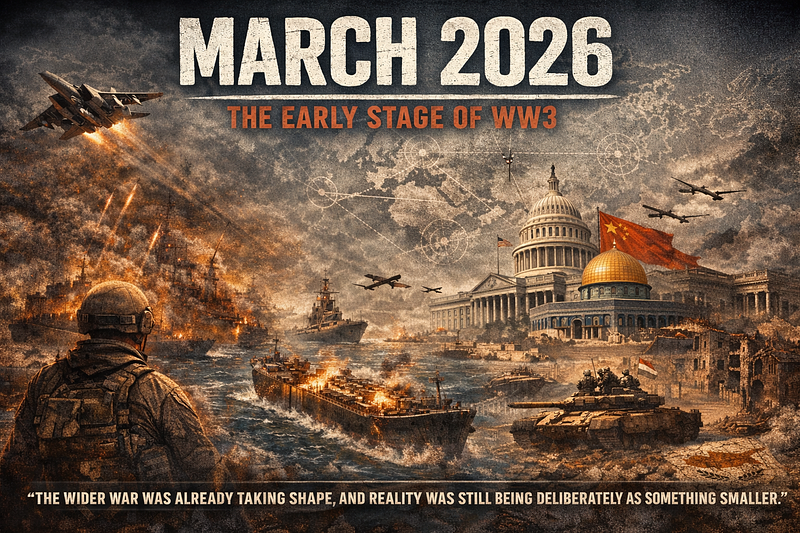
March 2026 may be remembered as the month the wider war was already taking shape, and reality was still being deliberately described as something smaller.
Related from The Manifest Archive