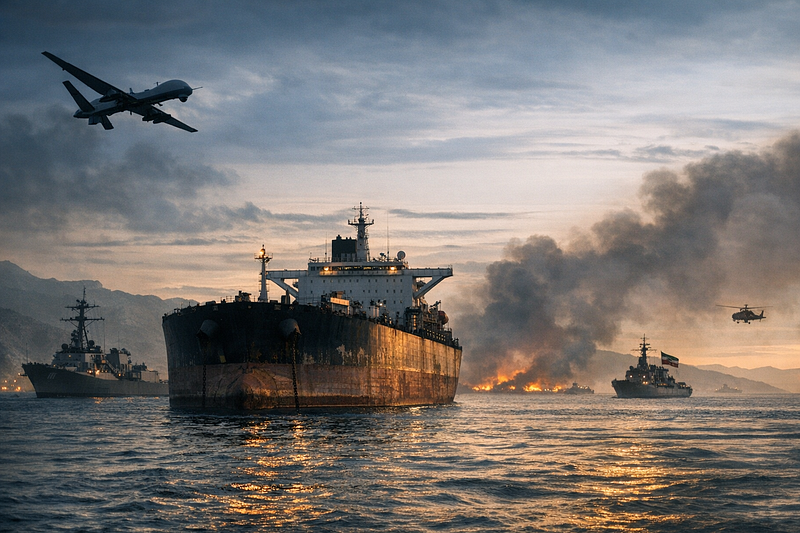
Sometimes it is a tanker that no longer moves with the old certainty. A crew waiting for clearance that, only days earlier, would have been routine. A route that still exists on the map, yet no longer behaves like a route. On television, the language has already softened. Diplomats speak of restraint, officials speak of de-escalation, markets call the moment fragile, insurers call it risk. The Strait of Hormuz calls it something else entirely.
It calls it unfinished.
Recent reporting makes that plain. Despite the ceasefire, shipping through Hormuz remains heavily disrupted. Vessel movement is still limited, passage rules remain uncertain, and major operators are still hesitating. The headline may have shifted, but the system underneath it has not recovered.
That is where this story really begins.
A ceasefire is a political sentence. A chokepoint is a living system. Systems do not recover because leaders decide to sound calmer.
The formal pause between Washington and Tehran did not restore normality in Hormuz. Reporting this week showed that the ceasefire was temporary from the start and tied directly to the reopening of the strait, while the wider regional disputes around it remained unresolved. Europe is now openly discussing multinational naval escort arrangements while rejecting Iranian toll demands, which tells you almost everything you need to know about how “postwar” this moment really is.
The missiles may have slowed. The leverage remained.
The Headline Ended Before the System Did
The modern news cycle loves declarations. War begins when someone fires. Peace begins when someone speaks. It makes for clean storytelling, but it makes for weak analysis.
A shipping corridor does not care about narrative closure. It responds to other forces entirely: marine insurance, escort capacity, legal clarity, route confidence, military oversight, backlog, sanctions exposure, charter risk, crew safety, and the quiet calculations of companies that lose money the moment governments pretend uncertainty is over before it actually is.
That is why Hormuz is so revealing now. The ceasefire did not restore trust. It merely shifted the argument to the terms of passage. Larger operators remain reluctant, insurance and sanctions risks remain unresolved, and only limited vessel movement has resumed.
A system like this does not snap back.
It remembers.
And that memory is where the war continues.
A Chokepoint Is Never Neutral
For years, globalization trained people to think of trade routes as technical, efficient, managerial, almost natural. Oil flows, gas flows, container traffic flows, markets adjust, and the world moves on.
But chokepoints are never neutral. They are only temporarily stabilized.
Hormuz has always been less a waterway than a pressure point, a narrow piece of geography through which a major share of the world’s oil still passes, and through which power is never absent for long. Even partial disruption there moves quickly outward into oil prices, freight uncertainty, alliance tension, and market volatility.
That is where the deeper truth appears. Iran does not need a perfect closure to alter global behavior. It only needs enough ambiguity to turn routine into negotiation, enough friction to force repricing, enough military and administrative pressure to remind every captain, insurer, trader and government that “open navigation” is not a law of nature. It is a political condition.
A route is no longer free the moment passage depends on permission.
The Ceasefire Changed the Domain, Not the Logic
This is the part much of the surface-level coverage still misses.
The ceasefire did not end the conflict. It changed the form in which the conflict now expresses itself.
Before the pause, the war was visible as escalation: airstrikes, threats, retaliation, force posture, the possibility of wider confrontation. After the pause, it lives in procedures, maritime rules, escort debates, toll demands, insurance models, naval positioning, diplomatic vetoes, and in the contested right to define what counts as normal movement through one of the world’s most sensitive arteries.
That is not a lesser phase of the war. In some ways, it is the clearer one.
This is where modern power often becomes easiest to read. Not only in destruction, but in the condition that follows destruction. Not only in the strike, but in the right to determine the terms under which normality may return.
A watered-down U.N. Security Council resolution aimed at reopening the strait still failed to command consensus after Russia and China vetoed it. That fact alone shows how unresolved the conflict remains beneath the ceasefire language. There is still no stable international agreement on the operating terms of Hormuz.
The violence cooled. The architecture of dispute did not.
Insurance Speaks More Honestly Than Diplomacy
Whenever governments become careful with language, it is worth watching the insurers.
Diplomacy is built to calm perception. Insurance is built to price danger. One manages the public story. The other measures what institutional actors actually believe about the next week, the next transit, the next escalation.
That is why the post-ceasefire commercial hesitation matters more than a dozen official statements. Major shipping firms and oil companies remain reluctant to resume normal transits because insurance and sanction risks are still unresolved. Energy markets, too, are reacting as though the pause is too fragile to trust.
This is the hidden grammar of contemporary war.
A state no longer needs to sink every ship to influence the lane. It only needs to make certainty expensive.
Once that happens, commerce itself begins to carry the conflict forward.
Europe Is Watching Its Dependency Become Visible
Each time a crisis like this erupts, Europe rediscovers the same uncomfortable truth. It is highly developed, heavily exposed, and still dependent on systems it does not fully command.
That dependency is not abstract. It is logistical, naval, financial and strategic. It appears in energy nerves, maritime insurance, industrial planning, escort coalitions, and in the recurring habit of speaking as though order were universal while relying on others to physically enforce it.
European leaders are calling for a negotiated settlement, rejecting Iranian toll demands, and discussing naval escort measures to preserve navigation through Hormuz. That is not the posture of an actor standing above the crisis. It is the posture of an actor exposed by it.
This is why chokepoints matter far beyond their immediate region. They expose who depends on continuity, who can interrupt it, who pays for “stability,” and who merely speaks its language while others carry its burden.
The West likes to present order as a principle. Hormuz keeps revealing order as an enforcement problem.
The Illusion of Neutral Trade Is Breaking
The larger significance of this moment goes well beyond Iran.
What is cracking here is the old post-Cold War illusion that critical infrastructure could remain outside coercion, that sea lanes could be discussed as if they belonged to efficiency rather than power, and that globalization had somehow solved geography.
It did not solve geography.
It merely covered geography with convenience for a while.
Hormuz strips that cover away. It shows that supply chains still rest on narrow physical passages, that those passages still sit inside military reality, and that commercial language often functions as a mask placed over strategic dependence. Once force re-enters the equation, everyone is reminded very quickly which parts of the world remain irreplaceable.
That is why the aftermath matters more than the announcement. The ceasefire headline suggests resolution. The strait itself suggests exposure.
And exposure is often the truest phase of any crisis.
The Vessel Waiting
The most honest image of this moment is not a podium in Washington, Tehran, Brussels or New York.
It is a vessel waiting outside certainty.
Its engines are ready. Its crew is alert. Cargo is delayed, costs are rising, charts are open, lawyers are cautious, underwriters are skeptical, naval planners are watching, traders are guessing. Everyone speaks as if this is temporary, while every system around them behaves as though a precedent has already been set.
Because that is what happened.
A route the world still needs has been transformed, once again, into leverage. And once leverage enters a corridor this vital, every future transit carries the memory of it. Even if traffic resumes, even if rates normalize, even if the headlines move on, the route will no longer mean what it meant before.
That is how power leaves residue.
The media reports the pause. Infrastructure records the scar.
Closing Reflection
The Strait of Hormuz is saying what official language still refuses to say plainly.
This war did not end with the ceasefire. It narrowed, hardened, and moved downward into the systems that keep the world supplied and moving. Into toll demands, military oversight, escort debates, insurance caution, trapped vessels, delayed cargo, and competing claims over who gets to define normal passage.
That is where modern conflict often becomes most truthful. Not at the peak of noise, but in the administrative afterlife that follows it.
The fire slowed. The route did not heal.
That is the harder lesson. A ceasefire can interrupt violence, but it cannot instantly restore trust, depoliticize geography, or erase the fact that one of the world’s central arteries now operates under visible coercive pressure. Recent reporting leaves little doubt that this remains the reality: vessel movements are still minimal, major operators are still hesitant, energy markets remain uneasy, and the diplomatic order around the strait is still fractured.
The war after the ceasefire has already begun.
Remember always where it truly began, and who set it in motion.
Further Reading from The Manifest
If this chapter resonates, continue deeper into The Manifest with these related chapters:
The Age of Managed CrisisFor the logic of permanent instability and the normalization of emergency.
The Architecture of Aid: How Help Becomes ControlFor the way dependency is renamed as support and power hides inside assistance.
How the ECB, Brussels and NATO Decide Your Life Without a VoteFor the European layer of managed dependency, institutional control, and the distance between formal sovereignty and actual power.
What Possesses Mark Rutte to Call War Inevitable?For the public language of escalation, and how populations are prepared psychologically for conflicts they are told to accept as unavoidable.
Follow The Manifest
Follow The Manifest for the next chapter.
Each article stands on its own, but none of them stands alone. Together they uncover how power hides in language, infrastructure, institutions, crises and history. If you want to keep tracing the pattern, follow the project and stay with the series as it unfolds.
Related from The Manifest Archive