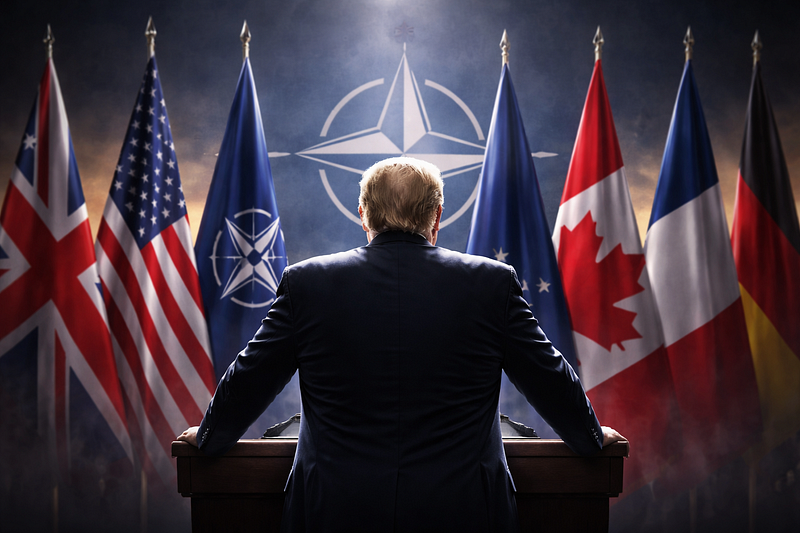
Trump’s outburst on March 17, 2026 revealed a deeper truth: Washington can still ask for allied backing, but it can no longer assume it will arrive.
There are moments when an alliance does not crack with a speech, a treaty, or a dramatic walkout before cameras.
It cracks when the call goes out, and the room stays still.
That is what this moment around the Strait of Hormuz feels like. On March 17, 2026, Trump reacted angrily after key allies refused to support a Hormuz mission. The statement itself mattered, but the reaction mattered more. It revealed something deeper than irritation, deeper than diplomatic friction, deeper even than one rejected request. It revealed that Washington can still issue the call, but no longer assume the alliance will move on reflex.
That is not a small change.
For decades, the Western alliance rested on an expectation so deeply embedded that it almost disappeared from view. When the United States defined the emergency, the broader structure would eventually align itself around the mission. There could be delay, debate, hesitation, bargaining. But the architecture held. The request went out. The machinery moved.
This time, it did not move in the same way.
NATO repeated that it is a defensive alliance and had not been consulted on the war. European leaders took visible distance. The refusal was not theatrical, but that made it more revealing. Nobody needed to raise their voice. The meaning was already there.
Sometimes an alliance does not reveal itself in the moment of attack, but in the moment the request for backup is quietly declined.
That matters because Hormuz is not symbolic terrain. It is not a remote patch of water that can be framed as a military technicality and then mentally filed away. It is one of the narrow arteries through which the modern system keeps itself alive. Oil flows through it. Gas flows through it. Freight calculations move through it. Insurance stress moves through it. Long before a household notices the pressure in an electricity bill, a transport contract or a supermarket price, the system has already begun to register it there.
The moment instability takes hold in Hormuz, the battlefield stops being local. It enters the bloodstream of the global order.
And that is exactly why this refusal matters more than one rejected mission. The real question is not whether European governments wanted to join a maritime operation. The real question is what their hesitation says about authorship, legitimacy, and the widening distance between American action and allied willingness.
Who widened the crisis, and who is now expected to carry it?
The Strange Part Is Not The No
If we are honest, the refusal itself is not the strange part.
The strange part is the expectation behind the request.
If allies were not meaningfully consulted before a war was widened, why should it be natural for them to automatically join the next phase of it? Why should governments expose their own ships, their own crews and their own political credibility to a conflict whose decisive authorship lies elsewhere? Why should obligation and ownership be treated as though they are the same thing?
They are not.
This is where the official language of alliance begins to thin out. Once a state acts first, defines the emergency later, and then invites others to help contain the consequences, the request no longer feels like partnership in the full sense. It begins to feel like pressure wrapped in institutional vocabulary.
The refusal is not the anomaly. The anomaly is the belief that others should automatically help contain a fire they did not choose to light.
That is the deeper shift now visible in plain sight. Washington still appears to expect the old reflex, the old architecture in which American urgency automatically translated into allied movement. But that reflex is weaker than it used to be.
Command still exists. Consent no longer follows automatically.
That may be the clearest thing Trump’s March 17 statement exposed. The anger was real. But beneath the anger sat an older assumption now colliding with a newer reality. The assumption was that the center could still ask and be followed. The reality was that the center asked and encountered resistance.
A Coalition Can Survive Costs. It Cannot Easily Survive Authorship
This is why the episode should not be reduced to a quarrel over burden sharing. Burden sharing is what allies argue about when they already accept the legitimacy of the operation. One country contributes more, another contributes less, a third complains about resources, a fourth drags its feet. But the basic premise is shared.
Here, the premise itself is unstable.
The problem is not only the distribution of risk. It is the origin of the risk. Many of America’s allies do not seem to experience this crisis as something jointly authored, jointly shaped, and jointly owned. They appear to see it as a crisis widened elsewhere, then pushed outward through alliance expectations as a collective responsibility after the fact.
That is a more serious fracture than a fight over assets or percentages.
A coalition can survive unequal costs more easily than it can survive unequal authorship. States tolerate imbalance longer than they tolerate becoming after-the-fact guarantors of decisions they did not meaningfully shape.
A coalition can survive unequal costs more easily than it can survive unequal authorship.
That is why this moment matters beyond a naval question. It reveals a legitimacy problem inside the Western order itself. The issue is not whether the system still has force. It does. The issue is whether it can still turn unilateral escalation into multilateral consent with the same ease it once could.
This time, that transformation looked weak.
Europe’s Refusal Is Rational
From a European perspective, the refusal is not mysterious at all. It is close to the only rational answer available under the circumstances.
To join such a mission would mean stepping deeper into a conflict whose decisive momentum did not originate in Brussels, Paris, Berlin, Rome or The Hague, while simultaneously exposing European vessels, European personnel and European governments to retaliation. It would mean absorbing danger without having possessed equal agency in producing it.
That is not strategy. That is absorption.
Europe’s leaders understand something Washington prefers not to dwell on. Once they move from political sympathy into military participation, they are no longer standing near the edge of escalation. They become part of the escalation itself. At that point, the line between support and entry begins to disappear.
So no, it is not strange that they said no.
What would be strange is the opposite. That governments not meaningfully consulted in the widening of the conflict would still behave as if automatic alignment were the natural order of things.
The real surprise is not that allies refused. The real surprise is that Washington still seems startled when they do.
That surprise tells its own story. It suggests that somewhere inside the American strategic imagination, an old expectation is still alive: that allied hesitation is temporary, that pressure will eventually work, and that the center of the alliance still has the right to expect participation after the fact.
But expectation is not the same thing as legitimacy.
Europe Can Refuse The Mission And Still Receive The Invoice
Yet the refusal is rational without being painless.
This is where the trap closes.
Europe can decline military participation and still remain deeply exposed to the economic consequences of the crisis. Hormuz does not need European signatures to damage European industry. It does not need European warships to push up shipping costs, insurance premiums, energy prices and industrial uncertainty. A chokepoint of this kind punishes vulnerability, not only participation.
That is why the moment is so revealing. Europe is no longer aligned enough to join automatically, yet still entangled enough to absorb the consequences. The split is no longer between war and peace. It is between authorship and exposure.
Europe can say no to the warship request and still receive the invoice.
That single reality says more about the current structure of the Western order than a dozen official communiqués. It shows that alliance systems now distribute agency and consequence unevenly. One center may generate escalation. Others may decline formal ownership. Yet nearly all still feel the fallout.
That is not unity.
That is asymmetry.
Europe can say no to the warship request and still receive the invoice.
The Alliance As Pressure System
For years, the West has described itself as a community of shared values, shared security, shared destiny. In calmer periods, that language feels convincing. It sounds principled. It sounds civilizational. It sounds as if the structure rests on mutuality.
Then a crisis like this arrives, and the harder mechanism underneath becomes visible.
Shared security sounds noble until one power acts first, enlarges the danger, and then asks the rest to participate under the banner of collective order. At that point, the language of alliance begins to blur into the language of pressure. Consultation narrows. Expectation expands. Refusal is treated as disloyalty, even when the refusal is the most rational response on offer.
An alliance changes character when consultation is replaced by expectation.
That is what this episode exposed. Not a shared plan formed in advance, but a widening war followed by a request for participation, as if sequence itself no longer mattered. First the crisis deepens. Then the request arrives. Then the refusal is made to look like the disruption.
But the disruption began earlier.
What Europe appears to be resisting is not merely a mission. It is a precedent. The precedent that unilateral escalation can still be converted afterward into shared obligation through moral pressure and institutional habit.
If that precedent weakens, the alliance begins to look different.
Not dissolved. Not finished. But altered.
Less automatic. Less obedient. Less able to pretend that risk, authorship and consent still move together.
This Is Also A Story About American Power
The episode is therefore not only a story about Europe’s caution. It is also a measurement of American power in its current form.
The United States remains immensely powerful. It can still dominate the military center of a crisis. It can still move markets. It can still reshape diplomatic language, force urgent meetings, trigger worldwide energy anxiety and command the attention of allies who know they cannot ignore it.
But it appears less able than before to transform that power into automatic allied participation.
That difference matters.
Empires rarely lose influence all at once. More often, they discover in stages that command and consent have begun to separate. They can still issue demands, still generate fear, still insist on loyalty. But increasingly, they encounter hesitation where they once expected obedience.
Power begins to thin when it can still demand loyalty, but can no longer summon it.
In Hormuz, that thinning became visible. The request was made. The machinery did not fully move.
That does not mean the United States is finished. It means something more precise, and in some ways more important. It means the machinery of Western alignment is becoming harder to activate on command when the legitimacy chain is weak.
Washington can still act alone. What it can no longer assume is that acting alone will automatically produce a coalition afterward.
And that is not a minor diplomatic inconvenience. It is a structural warning.
What This Moment Really Reveals
So what does it mean when Trump asked and his allies said no?
It means the issue is larger than Hormuz.
It means the fracture is deeper than one rejected maritime mission.
It means that inside the Western alliance, the center can still generate risk faster than it can generate legitimacy.
That is a dangerous condition for any bloc. It produces resentment at the core, caution at the edges and improvisation in between. It weakens future requests before they are even made, because every new escalation carries the memory of the last one. Once allies begin thinking this was not really our war, every subsequent appeal arrives diminished before it even lands.
That is how systems begin to lose coherence. Not necessarily through formal collapse, but through the widening gap between power and belief, between demand and willingness, between the act of asking and the expectation of being followed.
Washington may still possess the strength to move first. What it no longer fully possesses is the unquestioned authority to bring everyone with it afterward.
The most revealing part of this moment is not that Washington acted. It is that when Washington called, the alliance did not move as one. That is not yet collapse. But it is the kind of hesitation from which new geopolitical realities are made.
First the request weakens. Then the obedience. Then the story that the alliance still moves as one.
Related Chapters of The Manifest
- Europe and the Strait of Hormuz: Drifting Into a War It Cannot Control
- Strait of Hormuz: The Chokepoint That Could Break the World Economy
- The Iran Escalation Is Bigger Than the Headlines
- Europe’s Last Strategic Choice: Peace with Russia or Permanent Dependency
- The Growing Condemnation of the US-Israeli Attack on Iran
The Manifest is an ongoing investigation into power, history, finance, and the structures that continue beneath the surface of modern events.
If this chapter spoke to you, you can follow the publication here.
Related from The Manifest Archive