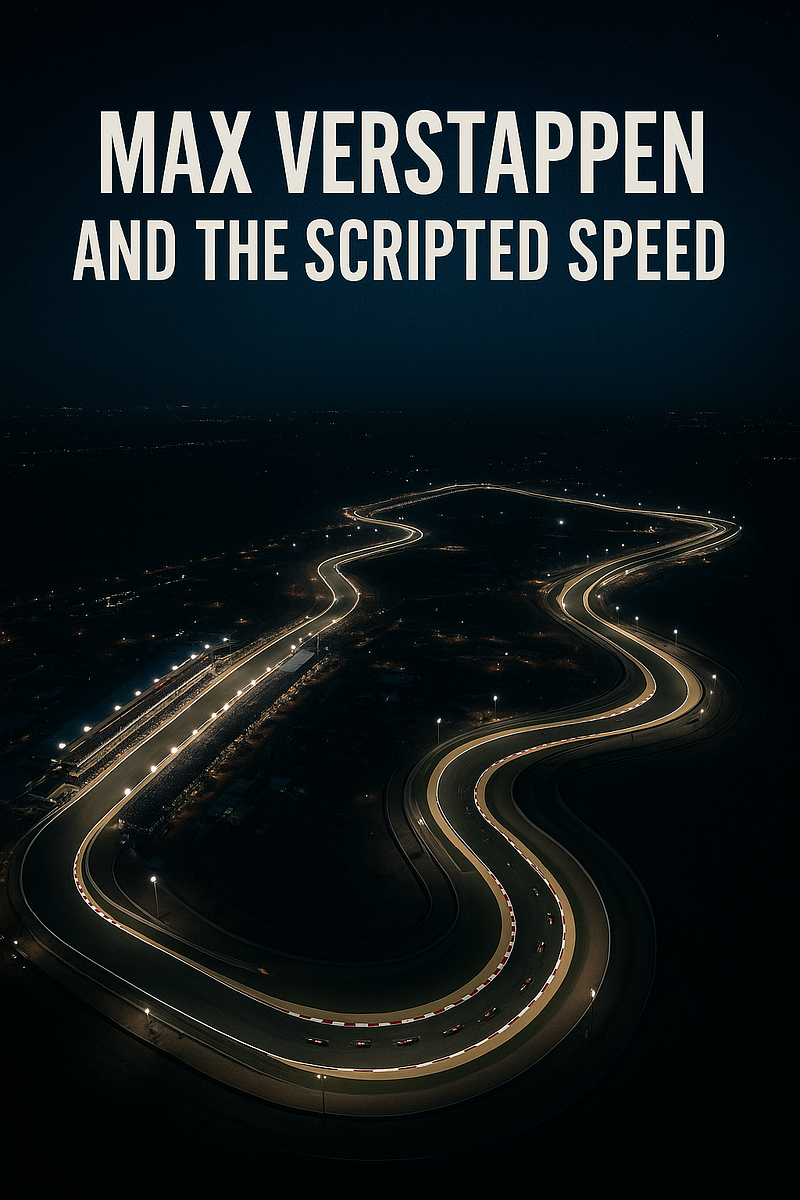
The moment the race became a story
The lights flicker red, then vanish.
Engines scream, tyres bite, and for three heartbeats the world is pure.
Twenty cars dive toward the first corner, each a blur of precision and violence.
For that instant, before the replays, the data, the sponsors, the edits, racing is still what it once was: a man, a machine, and the truth between them.
Then the cameras find their rhythm.
Commentators fill the silence.
The broadcast cuts to an aerial shot.
And the race becomes something else entirely, not a competition, but a narrative.
For Liberty Media, the American owner of Formula 1, this was the point all along.
Speed alone no longer sustains a global audience; tension does.
Suspense is currency, and unpredictability is the product.
But Max Verstappen, the most relentlessly consistent driver of his generation, has become the flaw in that formula, a man so good that he is bad for business.
He drives too perfectly for a sport that now depends on imperfection.
Each race he wins with surgical precision tightens the crisis: what happens when mastery destroys the story that pays for it?
He is, paradoxically, both the sport’s greatest asset and its greatest problem.
He is too good for his rivals, and too perfect for the narrative.
The rise of the scripted era
The transformation began long before Verstappen’s dominance.
It started when Drive to Survive turned the paddock into a television universe.
In the hands of Liberty’s producers, telemetry became plotline, strategy became conflict, and every driver a character.
The sport discovered that drama sells better than dominance, emotion better than engineering, chaos better than control.
Formula 1 was no longer just a race; it was a series about the idea of racing.
When Verstappen and Lewis Hamilton collided through the 2021 season, viewership exploded.
Two eras, two continents, two philosophies, their rivalry created the perfect storm.
Every penalty, protest, and safety-car restart fed the global appetite for theatre.
It was magnificent television.
And it changed everything.
The aftermath of the perfect drama
After Abu Dhabi, Formula 1 could never go back.
The world had tasted adrenaline as narrative, controversy as entertainment.
But once the curtain fell and Verstappen kept winning, the numbers flattened.
Perfect laps made poor episodes.
Audiences drifted, searching for drama that no longer existed.
Dominance kills suspense. Suspense keeps the lights on.
The system adjusted.
New regulations, strategic gambles, commentary that lingered on what might happen rather than what did.
Not a conspiracy, simply a correction, the machinery of a sport learning to feed its audience what it craved most: uncertainty.
And in that recalibration, Verstappen became an uncomfortable truth, proof that pure excellence no longer fits the algorithm of entertainment.
He didn’t break Formula 1. He revealed what it had already become.
The year that changed everything: 2021
The season began like a duel written by gods.
Two generations, two philosophies, two continents converging on the same stretch of asphalt.
Lewis Hamilton, the polished heir of Mercedes precision, carrying the moral weight of legacy;
and Max Verstappen, the insurgent, the disruptor, the pure racer who refused to read from the script.
Each circuit became an episode in a serialized mythology:
the clash at Silverstone, the rain at Spa, the chaos in Jeddah, the silence before Abu Dhabi.
It was rivalry as opera, and the world could not look away.
Viewership surged across every metric.
Markets that had ignored Formula 1 for decades now treated it as ritual.
Liberty Media’s gamble had worked: the story had become the sport.
The audience didn’t just watch the race; it watched itself watching.
But within that success lay the first fracture.
For the race directors, journalists, and engineers, the 2021 season became something far more volatile than a championship, it became content.
Every decision carried a double weight: sporting and narrative.
A penalty wasn’t merely a rule enforcement; it was a plot device.
A safety car wasn’t only about safety; it was pacing.
When rules became rhythm
Before 2021, the regulations were the silent skeleton of the sport, rigid, unseen, absolute.
That year, they began to flex under the gravity of the story.
When Verstappen and Hamilton collided in Silverstone, the discussion that followed wasn’t about speed or trajectory; it was about intent.
Who was the villain? Who was the hero?
The grid became a theatre stage divided by nationality, by memory, by loyalty.
Fans no longer argued in terms of engineering, but in moral terms: fairness, justice, redemption.
The FIA, once invisible, became a character, a kind of moral referee trapped inside the narrative it had tried to contain.
When a referee becomes a character, the story has already taken over the sport.
By the time the final race arrived in Abu Dhabi, the pressure to deliver a “worthy ending” had reached absurd proportions.
The entire world held its breath for a last act.
And when the call came, that infamous, ambiguous, world-altering call, Formula 1 crossed a line that could never be uncrossed.
Hamilton lost a championship; the sport lost its innocence.
Even those who celebrated knew something irreversible had happened.
The finish line had become a finishing touch.
The birth of the narrative economy
In the aftermath, Liberty Media and Netflix saw the metrics spike:
record viewership, unprecedented engagement, emotional investment measurable in millions of tweets.
The data proved a new law of modern sport, that controversy converts.
Every outrage extended attention; every argument became free advertising.
Drama, not dominance, was the ultimate renewable resource.
The Formula 1 machine learned to modulate itself like a streaming platform: cliff-hangers before summer break, redemption arcs after.
Fairness is finite. Suspense is scalable.
That realization didn’t require conspiracy.
It required only capitalism, the quiet understanding that the sport now lived by the logic of serial television.
The audience demanded unpredictability, and unpredictability would be supplied.
In the old world, the sport dictated the story.
In the new one, the story dictates the sport.
The fans who became the writers
The digital revolution made spectators omnipotent.
From living rooms and phone screens, they formed a secondary paddock, a swarm of opinion and outrage that could shift the emotional climate of an entire weekend.
They created their own cuts of the drama: TikToks, memes, mini-documentaries, analysis channels.
Every fan became an editor.
The circuit no longer ended at the barriers; it continued online, infinite and self-referential.
The modern fan doesn’t consume the sport, they co-author it.
They wanted truth, but preferred the story.
The 2021 season made them addicted not to speed, but to narrative voltage.
And once you’ve taught an audience that every race must deliver shock, redemption, or scandal,
you can never again give them silence.
The hangover: When perfection became the problem
By the next year, the roles had changed.
Verstappen was no longer the outsider; he was the empire.
He drove with the serenity of inevitability, each victory executed like a closing argument.
It was extraordinary, and commercially disastrous.
The same audience that had worshipped his audacity now drifted away, sedated by his precision.
Hamilton’s defeat had concluded the grand narrative; what remained was dominance without drama.
The cameras searched for emotion, the producers for subplots.
But Verstappen, indifferent to theatrics, simply raced.
A perfect driver is the worst thing that can happen to a scripted sport.
He won, and the ratings flattened.
He dominated, and the algorithms sighed.
Every lap was evidence that mastery, by definition, eliminates suspense.
The empire of risk: Ecclestone’s Formula 1
Before the sport became a show, it was an empire, and Bernie Ecclestone was its emperor.
He didn’t buy Formula 1 as a brand; he built it as a kingdom.
In an age before algorithms, when danger was real and speed was still a test of nerve, Ecclestone ruled with the precision of a banker and the obsession of a fan.
He began as a racer himself, short, sharp, and fiercely private, and he never lost that sense of belonging to the asphalt.
When he walked through the paddock, mechanics stopped speaking.
He knew their names, their budgets, and their fears.
He had one religion: control, not spectacle.
He sold danger, but never death.
The man who made chaos safe
Under Ecclestone, the sport faced the ghosts of its own creation.
The 1970s were brutal: fires, crashes, funerals.
Every season claimed lives, and every victory felt borrowed from fate.
Ecclestone understood that if the sport was to survive, it had to become safer, but never dull.
He professionalised risk.
Permanent medical teams at every track, safety cars, standardised barriers.
He designed circuits to frighten but not to kill.
He introduced a centralised television feed so that horror would never again be sold as entertainment.
Bernie didn’t hide the danger; he curated it.
He turned Formula 1 from a travelling circus into a global institution, a balance of elegance and risk.
He made the sport respectable without making it sterile.
For Ecclestone, chaos was the price of greatness, not a management tool.
The kingdom of exclusivity
His empire was feudal, not democratic.
Teams were vassals, circuits his provinces, and television his court.
He negotiated every contract himself, and he believed in scarcity.
Access was a privilege, not a right.
He wanted viewers to feel they were witnessing something they could never touch,
speed as ceremony, competition as creed.
The glamour of Monaco, the austerity of Monza, the danger of Spa:
each race a cathedral of velocity, not an episode of a series.
In Bernie’s world, drivers were gladiators, not influencers.
The paddock was a sanctuary for risk, not a stage for confession.
There were no behind-the-scenes cameras, no dramatized rivalries.
The story was written in lap times, not in soundbites.
The iron heart of the sport
He had flaws, ruthlessness, secrecy, arrogance, but they were the flaws of an architect, not a producer.
He protected the sport from external forces, even when it meant being its dictator.
He kept politics out, emotions measured, and the show secondary to the spectacle of skill.
The heart of the sport was once in the paddock. Now it beats in the boardroom.
Under his rule, Formula 1 felt dangerous, unpredictable, authentic.
Fans didn’t know what would happen, and that uncertainty was earned, not engineered.
It was a human chaos, born of wind, error, courage, not a manufactured one designed to trend.
And then, in 2017, the empire changed hands.
Liberty Media arrived with spreadsheets, studios, and the American art of narrative commerce.
They didn’t want to rule the kingdom; they wanted to franchise it.
The American show: Liberty takes the wheel
The new owners didn’t speak the language of risk; they spoke the language of engagement.
Their questions were not “How do we make racing greater?” but “How do we make it grow?”
In their world, success was measured not in victories but in viewership minutes.
Liberty Media saw a sleeping giant and gave it a digital mirror.
They opened the paddock, wired every moment, and placed microphones where Bernie had built walls.
What was once elite became accessible; what was mysterious became marketable.
They didn’t destroy Formula 1, they updated it for the age of algorithms.
But in the update, something vanished: the aura of danger, the silence of respect, the feeling that the race was more real than the story about it.
Under Ecclestone, the world watched a sport. Under Liberty, it watches a series.
The algorithm of emotion
Liberty’s first law was data.
They studied how long fans stayed on clips, when they cheered, when they scrolled.
Every metric became a steering input.
If the audience wanted heartbreak, they were given heartbreak; if they wanted redemption, a new hero was scripted.
The producers of Drive to Survive did not manipulate outcomes, but they curated meaning.
Through editing and sound design, they created a world where even silence had soundtrack.
The real season became raw footage for the emotional one.
And soon the drivers adapted.
Team principals rehearsed press conferences like performances.
Rivalries were accentuated, apologies delayed for maximum impact.
What was once instinct became PR choreography.
The sport no longer writes history; it streams it.
The desert of attention
Formula 1 under Liberty became omnipresent, screens, feeds, reels, but in that omnipresence came erosion.
Fans could access everything, but mystery evaporated.
Speed turned into spectacle, and spectacle into background noise.
The circuits glowed brighter, the trophies heavier, the drama safer.
And amid all that polish, Verstappen’s cold precision began to look subversive.
He was not there to entertain; he was there to win.
He raced as if the story didn’t exist, and in doing so, he made it visible.
He doesn’t play the character. He breaks the fourth wall.
The fan as believer
In the new Formula 1, the audience is not a witness; it is a participant.
Each viewer, phone in hand, connected to the race through commentary feeds and streaming dashboards, contributes to the pulse that drives the product forward.
The fan no longer waits for the truth of a result; they generate it in real time through reaction, outrage, celebration, and speculation.
Every emotion becomes a data point, every opinion a contribution to the next script.
The digital paddock has no fences.
It stretches from Reddit threads to TikTok edits, from YouTube breakdowns to Twitter storms that flare and fade before the next race begins.
Within this infinite circuit, Drive to Survive functions as a shared mythology, a highlight reel of human friction designed to keep the collective faith alive.
The believers feed the algorithm, and the algorithm rewards belief.
They came for the sport. They stayed for the story that made them feel part of it.
The audience algorithm
The Formula 1 feed no longer stops at the chequered flag.
Moments are repackaged, subtitled, and looped.
Every radio outburst becomes a meme, every podium a piece of theatre.
The media cycle doesn’t end; it renews itself like a heartbeat.
Fans watch, argue, and re-create.
They slow the footage, dissect strategies, compare telemetry.
In doing so they build a secondary universe, one where the narrative is more powerful than the numbers.
It is a world of opinion disguised as analysis, participation disguised as expertise.
The algorithm learns their rhythm.
It surfaces anger when interest wanes, leaks a controversy when the graphs flatten.
It does not need manipulation; it needs momentum.
The outrage of one weekend ensures the engagement of the next.
Outrage is loyalty wearing a louder costume.
The human signal
Inside that noise, Verstappen stands apart.
He speaks little, races much, and treats social media as if it were static on a radio.
He seems almost prehistoric, a driver from an older age, measuring himself against the stopwatch rather than the camera lens.
In an era of accessibility, his distance feels like defiance.
To many, that makes him cold.
To others, it makes him real.
He is the anti-algorithm: efficient, unsentimental, unmarketable.
When he wins, he does not produce a soundbite; he produces a fact.
And facts, in a world addicted to feeling, are radical.
He races as if truth were still enough.
The last belief
What keeps the believers coming back is not the finish order, but the hope that something authentic might still break through.
A moment unscripted.
A gesture that belongs to no sponsor.
A silence that no commentator can fill.
They watch Verstappen for that: the possibility that mastery might yet mean something more than metrics.
The irony is that the same audience that craves his purity also demands the chaos that distorts it.
They want a show, but they want a soul inside it.
That contradiction sustains the modern spectacle, sincerity packaged for streaming.
They want him to stay real, but not too real; human, but marketable; dominant, but vulnerable.
The mirror and the machine
Each race weekend ends the same way:
millions of screens, billions of impressions, a collective sigh of completion that feels more like anticipation.
The fans close their laptops and open their feeds, hungry for the next controversy, the next narrative fix.
The sport they love has learned to speak their language, to echo their heartbeat.
In that reflection, both sides disappear into each other, the believers and the system that believes in their belief.
The fan no longer watches the race; the race watches the fan.
The question at the finish line
The lights go out again.
Another weekend, another circuit, another retelling of the same pursuit.
Verstappen sits in the cockpit, eyes level, hands steady, indifferent to the theatre surrounding him.
For him, the race is still simple: go faster than anyone ever has.
For the world around him, that simplicity has become unbearable.
The paradox of modern sport stands complete.
Perfection no longer satisfies; it destabilises.
Authenticity no longer sells; it must be formatted.
And the audience, desperate for something real, keeps feeding the machine that replaces it.
Max Verstappen didn’t break the sport. He revealed what it had already become.
The future of Formula 1, and perhaps of all spectacle, depends on whether truth can survive its own performance.
If not, the chequered flag will keep waving over the same loop:
a race designed for reaction,
a story built to replace silence,
a champion too real for his own time.
He crosses the line again.
The crowd roars.
The story begins anew.
Closing reflection
In the end, the story of Formula 1 is not about cars or circuits; it is about control, over machines, over meaning, over what people believe to be real.
The sport has become a mirror of the age that made it: fast, efficient, endlessly mediated.
Every rule, every image, every outrage is engineered to feel spontaneous.
And yet, inside that choreography, one man keeps driving against the current of his own legend.
Verstappen’s dominance is not a flaw in the spectacle; it is a reminder of the truth it has buried.
That mastery still exists.
That silence can still speak.
That a human being, in a machine built for markets, can still reach for perfection without apology.
He mastered the race, and in doing so, exposed the script.
Perhaps that is all that remains of authenticity in the modern age:
not purity without audience, but defiance within it.
The refusal to slow down just because the world prefers suspense.
Further Reading from The Manifest
Related from The Manifest Archive