The lights never go out in the capitals of the world. Every speech is a rehearsal, every crisis a script. Power doesn’t hide backstage, it performs, and the audience applauds its own obedience.
The Broadcast | The Night the Signal Changed
The year was 1988.
America was loud with confidence, Reagan’s last speeches still echoing through televisions, the stock market healing from its crash, MTV shining like a new cathedral of youth.
Every image hummed with triumph, every anchor smiled the same.
Then the static broke.
Back, caught you lookin’ for the same thing …
It wasn’t just another record.
It was a broadcast from another frequency, part funk, part fury, part coded report from the streets the cameras refused to show.
The bass didn’t enter the room; it invaded it.
Sirens looped over jazz fragments, voices shouted from invisible corners, and in the center of that controlled chaos came a command disguised as rhythm:
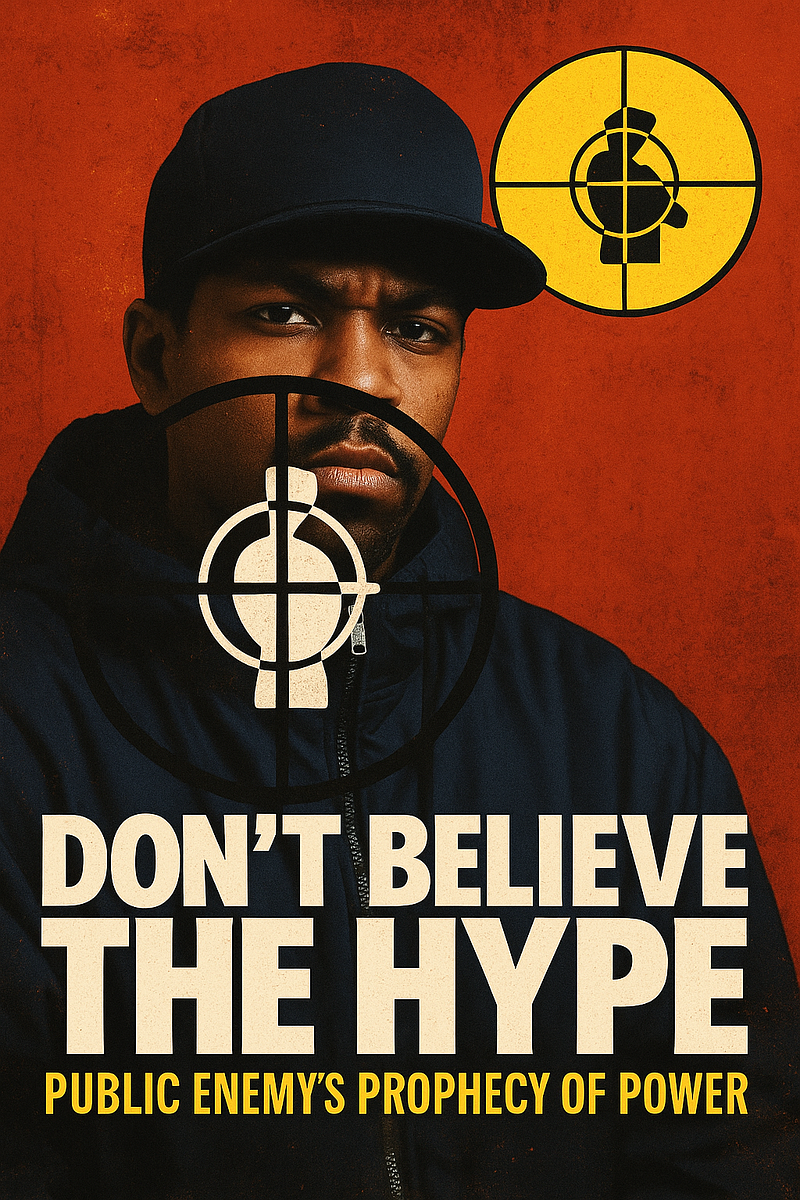
Don’t believe the hype.
The line was simple enough to chant, complex enough to haunt.
It spread like an immune response through black radio, college campuses, late-night shows, bootleg cassettes.
What Dylan had once done with folk guitars, mapping conscience, Public Enemy now did with circuitry.
They turned paranoia into prophecy.
Chuck D called hip-hop “the CNN of Black America.”
He wasn’t bragging; he was explaining necessity.
When the official networks edited outrage into entertainment, the neighborhoods built their own transmitters.
The mic became a surveillance device turned back on its owner.
That summer, New York trembled under its own pulse.
Cabs rattled to beats from car stereos, and on stoops people nodded to verses that sounded less like art than warning.
No government censor could stop it; no journalist could translate it.
It was truth encrypted as groove.
They told you to fear the noise.
But inside the noise lived the signal.
The Bomb Squad | How Noise Became Architecture
The architects of that signal were The Bomb Squad, Hank Shocklee, Eric Sadler, and their quiet genius of dissonance, the engineer of disorder.
Where pop producers chased polish, they chased friction.
Each track was a demolition site of sound: hundreds of micro-samples stitched together into something that felt alive, unstable, inevitable.
They didn’t compose; they collided.
James Brown’s snares clashed with Malcolm X’s sermons.
A car alarm became percussion; a news clip became counterpoint.
It was as if the entire twentieth century were collapsing into a single channel and someone had decided to record the rubble.
Traditional engineers called it distortion.
The Bomb Squad called it memory.
Every crackle was proof of existence, every hiss a trace of life the system hadn’t sterilized yet.
In their studio, chaos wasn’t the opposite of order.
It was evidence that order had failed.
The sound they built mirrored the city outside, compressed, over-surveilled, vibrant, dangerous.
In a Manhattan becoming whiter, richer, quieter, their mixes felt like protest architecture: sonic tenements stacked with ghosts and headlines.
If Nina Simone’s piano had been a gavel, the Bomb Squad’s sampler was a courtroom explosion.
They understood that perfection was political.
A smooth mix means someone has the power to erase what offends.
Their noise refused erasure.
It carried the hiss of tape, the scream of sirens, the breath of the crowd pressed against the stage.
They weren’t making hits; they were archiving evidence.
Every frequency had purpose:
the low end for fear, the midrange for anger, the treble for witness.
You didn’t dance to Public Enemy, you endured them, and in enduring, you remembered what unfiltered truth felt like.
The Studio as Courtroom
Inside their Long Island studio, reels spun like turbines.
Chuck D paced, notebook in hand, reading news clippings out loud.
Flavor Flav punctuated lines with laughter, clocks, chaos.
Outside, helicopters patrolled housing projects that looked identical on every channel except theirs.
When the record button clicked, all that surveillance energy inverted, the watched became the watchers.
The Bomb Squad’s greatest invention wasn’t a beat; it was perspective.
They taught listeners to hear reality as constructed, not given.
Every snare was an edit, every loop a question: Who decides what clarity sounds like?
Decades before algorithms curated emotion, they demonstrated that sound could de-curate it.
Noise was their syntax of resistance.
Distortion, their grammar of truth.
⸻
The Lyrics | The Gospel of Mistrust
Then came the voice.
Low, disciplined, relentless, Chuck D didn’t rap, he delivered.
Each bar landed like evidence presented to a jury already biased against him.
False media, we don’t need it, do we?
It’s fake, that’s what it be to ya, dig me.
The brilliance of Don’t Believe the Hype is that it never names its enemy.
It doesn’t need to.
The “hype” is everything: television anchors, record executives, politicians, gossip columns, even the audience’s own expectations.
It’s a word that turns perception itself into suspect.
The track reads like an anti-sermon.
Each repetition of the hook works as both chant and shield, a sonic firewall against propaganda.
In a country where every image of blackness was pre-approved by white ownership, mistrust became the most rational faith available.
Don’t believe the hype wasn’t cynicism.
It was self-defense.
Chuck D’s cadence carried the authority of scripture and the weariness of someone who’d read too many lies to stay silent.
He used rhyme as journalism, flow as editorial.
When he said “Some of my heroes don’t appear on no stamps,” he condensed an entire sociology of erasure into a single line.
It was the sound of history correcting itself in real time.
Behind him, Flavor Flav’s ad-libs worked like punctuation, comic, chaotic, essential.
Where Chuck was gravity, Flav was disruption: the echo that kept truth from turning into dogma.
Together they embodied the tension inside every protest, belief and exhaustion, fury and play, gospel and street.
Language as Weapon
Public Enemy understood something philosophers would take decades to phrase: that language is infrastructure.
Control the narrative, and you control perception.
Disrupt the grammar, and you reclaim the world.
Their verses broke syntax on purpose, cutting off sentences, bending rhythm until meaning had to be felt before it was understood.
This was semiotics turned street-level.
It forced listeners to think faster than propaganda.
They turned literacy into percussion.
Every rhyme a decoded headline.
Where politicians weaponized fear, Public Enemy weaponized doubt, the rarest and most courageous form of intelligence.
Not the paralyzing doubt of apathy, but the active suspicion that precedes awareness.
That single line, Don’t believe the hype, became both a warning and an awakening.
It didn’t tell you what to think; it told you to start thinking again.
From Paranoia to Prophecy
Listen to the song today and it feels less like nostalgia than instruction.
The warnings are no longer about magazines or talk shows; they’re about timelines and feeds.
The “false media” hasn’t vanished, it has multiplied, atomized, personalized.
Chuck D once fought editors.
Now we fight algorithms.
But the command still fits perfectly:
Don’t believe the hype.
It was never just about them.
It was about us.
The Media Machine, Turning Fear into Framing
By the late eighties, America had perfected its favorite export: narrative control.
Television was no longer a window; it was a filter.
Every image of Black life passed through the same lens, violent, loud, dangerous, profitable.
And the more the news sold fear, the more audiences mistook that fear for truth.
They didn’t report reality.
They managed perception.
For networks, rap was ratings gold.
Politicians denounced it by day, producers looped it by night.
Every televised segment on “the rap menace” doubled album sales.
In trying to bury hip-hop, the media built its cathedral.
But Public Enemy understood the trap.
The outrage economy wasn’t an accident, it was architecture.
To frame something as threat is to guarantee its circulation.
Chuck D didn’t try to escape that machinery; he hijacked it.
He turned each interview into counter-programming.
Every accusation became advertising for consciousness.
They used our rage for profit, he said later, so we used their airtime for prophecy.
The Birth of the Fear Economy
The more the cameras watched, the more predictable the scripts became.
A studio panel of “experts.”
A politician citing moral decay.
A soundtrack of sirens and statistics.
It was never journalism; it was ritual, a national exorcism of guilt performed nightly in prime time.
America needed Black anger to confirm its own innocence.
Public Enemy refused to play that role.
They didn’t apologize.
They didn’t soften.
They stared back at the lens and broke the spell.
You wanted villains? Fine. But we write the dialogue now.
Each broadcast became a battle of frequencies:
television spreading sedation, music transmitting resistance.
The stage wasn’t Madison Square Garden, it was perception itself.
The Prophecy | From CNN to the Feed
When Don’t Believe the Hype dropped, CNN was barely eight years old.
The 24-hour news cycle was a novelty, a single glowing screen that promised constant awareness but delivered constant anxiety.
The network fed on crisis: oil wars, Wall Street crashes, epidemics, elections.
Fear became the most renewable energy source in the American economy.
Information didn’t expand consciousness.
It replaced it.
Public Enemy sensed it before anyone else.
They saw how technology would transform journalism from investigation into amplification.
They understood that the real revolution wouldn’t come from politics, but from bandwidth.
Their warning wasn’t poetic, it was technical.
Every time Chuck D repeated “Don’t believe the hype,” he was describing a future where algorithms would replace editors, and outrage would become the currency of truth.
From the Network to the Feed
Fast-forward three decades.
The broadcast tower has vanished; the feed is everywhere.
CNN became YouTube.
Talk radio became podcasts.
The hype became data.
Now, every user is a broadcaster, every scroll a submission to the machine.
The media no longer needs to distort reality; it can simply overwhelm it.
Truth isn’t hidden anymore, it’s drowned.
We used to fear censorship.
Now we drown in permission.
Public Enemy once warned against false media.
Today, the false media warns against itself, sponsored by advertisers, amplified by algorithms, optimized for empathy.
We’ve built systems so sophisticated that even sincerity sounds synthetic.
The “hype” that Chuck D fought with vinyl now lives inside us, the constant pulse of validation, outrage, agreement, disbelief.
Each like, each repost, each outrage loop is just a remix of that original beat.
The hype never ended.
It evolved.
The Architecture of Control
When data scientists talk about “user retention,” they’re describing what propagandists once called loyalty.
When they measure “time on platform,” they mean time in captivity.
The feed is just a digitized plantation for attention, laboring minds feeding invisible masters with clicks instead of cotton.
And yet, the system feels voluntary.
We scroll, we choose, we perform, convinced we’re free because the chain now glows in our hands.
The old whip cracked.
The new one vibrates.
This is what makes Don’t Believe the Hype prophetic.
It wasn’t just a cultural statement; it was an epistemological one.
It asked: Who benefits from what you believe?
That question, more than any slogan, is the key to surviving the algorithmic age.
The Silence | When Rebellion Became Data
The revolution wasn’t crushed.
It was licensed.
By the mid-nineties, the same companies that once banned Public Enemy were selling Public Enemy vinyl reissues in luxury stores.
MTV aired retrospectives.
Academia wrote papers.
The rebellion had been archived, categorized, monetized.
It was no longer a threat, it was a reference.
Nothing dies faster than danger once it becomes collectible.
The transformation was surgical.
No censorship.
No assassinations.
Just ownership.
Hip-hop became mainstream; anger became aesthetic.
The sound of resistance was now a jingle for sneakers.
The Era of the Safe Rebel
The industry learned quickly.
You could package rebellion as long as it looked dangerous but felt familiar.
Rage without risk, dissent without damage.
Artists who wanted to eat had to fit within the algorithm’s diet, controversial enough to trend, polite enough to sponsor.
Outrage became an accessory.
Even the protest anthem evolved into content strategy.
Release date aligned with headline.
Hashtag ready.
Streaming preview.
Merch drop.
Public Enemy had rapped “Don’t believe the hype” as survival code.
Now, the hype itself was the product line.
The Death of Noise
When rebellion becomes data, its decibels no longer matter.
The loudest protest in the world means nothing if it fits the platform’s format.
A scream compressed into a feed becomes just another waveform in the algorithm’s harmony.
Even rage finds its monetization curve.
This is the final victory of the machine:
It didn’t have to kill truth.
It just had to measure it.
Every system eventually learns how to price its prophets.
By the 2000s, rebellion had analytics.
Outrage had quarterly reports.
Revolution had engagement metrics.
And truth, the raw, dissonant kind, was filed under “content with low ad suitability.”
The signal that once cut through static now was the static.
Coda | The Machine That Learned to Sing
Every empire learns music eventually.
Rome had choirs, the Church had hymns, capitalism has playlists.
The difference is intent.
Old songs glorified gods.
Ours glorify distraction.
Somewhere deep inside the servers, Don’t Believe the Hype still plays, digitized, remastered, clean.
The distortion removed, the hiss erased, the rebellion archived.
It sounds perfect now.
Too perfect.
They fixed the mix.
And in fixing it, they buried the message.
The Return | Echoes in Kendrick, AI, and the Age of the Algorithm
History doesn’t repeat; it remixes.
Every generation inherits an echo, sometimes faint, sometimes furious.
In the twenty-first century, the echo of Public Enemy came back in unexpected forms, through confession, through code, through the digital ghosts of rhythm and rage.
When Kendrick Lamar shouted “We gon’ be alright,” it wasn’t a slogan.
It was a diagnosis wrapped in melody.
He didn’t perform rebellion; he performed endurance.
His verses didn’t try to change the world, they tried to survive it.
And yet, that refrain, looped in protests and parades, sounded like resurrection.
If Public Enemy gave anger a frequency, Kendrick gave survival a pulse.
What Chuck D once coded in paranoia, Kendrick translated into prayer.
He moved from street to psyche, from confrontation to confession.
But the moral engine was the same: a refusal to let silence define dignity.
The New Prophets
Modern artists speak in the ruins of what Public Enemy built.
Hozier turned the language of the church against the church in Take Me to Church.
Childish Gambino staged American violence as choreography in This Is America.
Each one drew power from the same paradox, to reveal the truth, you must seduce attention.
Even Beyoncé, with Formation, wielded spectacle as weapon, transforming pop itself into protest theater.
Every image, every lyric, every beat was a negotiation with the algorithm: how to hide revelation inside entertainment.
The protest didn’t vanish.
It adapted to survive the feed.
Yet even as rebellion reappeared in fragments, something felt missing.
The sound was sharp, the imagery striking, but the danger was gone.
Every act of defiance now arrived pre-licensed, pre-streamed, pre-monetized.
Authenticity became a marketing angle.
Outrage became brand synergy.
And still, against all odds, meaning leaked through.
Because truth, even digitized, refuses extinction.
Sometimes all it needs is distortion.
The Soul of Noise | Why Truth Still Needs Distortion
Noise was once treated as flaw.
It meant imperfection, interference, error.
But to Public Enemy, noise was the proof that something real had entered the system.
It was the sound of the human unedited.
Noise is what happens when truth refuses compression.
The digital world, obsessed with clarity, has forgotten this.
Every track mastered clean, every voice tuned to symmetry, every silence filled.
But perfection is the enemy of presence.
What we call fidelity is often just control in disguise.
Public Enemy’s distortion wasn’t aesthetic; it was moral.
They made chaos audible because chaos was honest.
To live in injustice and sound neat is to lie.
Their hiss, their static, their overload, that was the world, uncorrected.
Today, even protest must pass quality control.
Platforms ban distortion; compression algorithms smooth anger into accessibility.
We’ve lost the sound of friction, the sonic equivalent of dissent.
Imperfection as Integrity
Listen to a live recording from 1989 and you’ll hear mistakes: a mic peaking, a beat late, a shout off-tempo.
But inside those flaws lives something sacred, risk.
The courage to exist without post-production.
That’s what truth requires: not polish, but pulse.
Perfection is what power sounds like when it edits itself.
The lesson of Don’t Believe the Hype is that meaning and mess are inseparable.
Truth doesn’t emerge from silence; it erupts through interference.
Without imperfection, there is no witness, only signal.
And signal without soul is propaganda.
To reclaim noise is to reclaim humanity.
To distort again is to remember that clarity can be deceit.
Epilogue | The Hype That Never Died
Night again.
The city is quiet, but not silent.
Somewhere in the distance, a car stereo hums, low frequencies rolling through concrete.
It might be old tape hiss or a Spotify stream.
It doesn’t matter.
The sound is still alive.
Back, caught you lookin’ for the same thing…
That voice crosses decades.
It no longer warns; it reminds.
Not every listener understands it, but every one of them feels it, the vibration of unfinished truth.
Don’t believe the hype was never an insult to the world.
It was a challenge to the listener.
A demand for participation.
An invitation to think.
The media changed.
The machines evolved.
The hype industrialized.
But the message stayed intact, buried in rhythm, waiting for rediscovery.
They fixed the mix, but not the meaning.
Perhaps that’s the final prophecy of Public Enemy:
that truth, once amplified, never truly fades.
It decays, it fragments, it hides in algorithms, but it waits, always, for the next set of ears willing to listen without supervision.
And when that listener appears,
when they hear distortion and call it honesty,
when they feel rhythm and recognize resistance,
the signal begins again.
Don’t believe the hype. Because belief is easy.
Listening is hard. And somewhere inside that difficulty, music still remembers what freedom sounds like.

Related Chapters from The Manifest
The Illusion of Peace: How Gaza Became a Permanent WarOn framing, image control, and how power turns peace into a stage. The same architecture that built the hype.
NATO: The Façade of Peace and the Architecture of PowerWhere propaganda hides behind diplomacy, proof that “false media” doesn’t just live on screens but in institutions.
The Fourth Reich: Echoes of Empire in AmericaHow power reinvents itself through entertainment, economy, and algorithm. The echo of hype in geopolitical form.
Related from The Manifest Archive