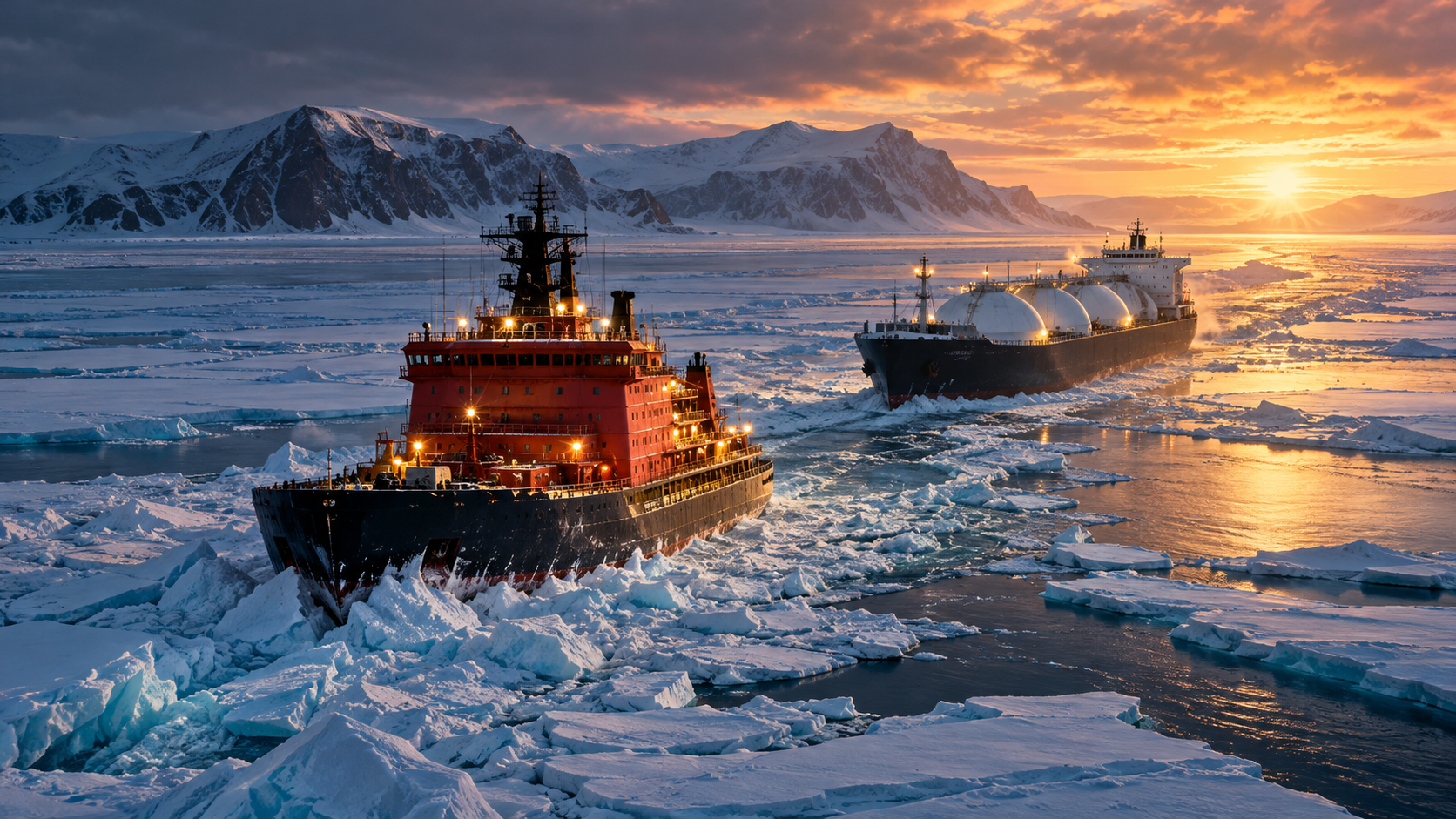
"MILITARY SHIPS MUST OBTAIN PRELIMINARY PERMISSION OF USSR GOVERNMENT THROUGH DIPLOMATIC CHANNELS." The message reached two American icebreakers in the Kara Sea on 29 August 1967, relayed by radio through the Soviet station at Dikson. It answered one the Edisto had sent the day before: the ships would make "peaceful and innocent passage" through the Vilkitsky Strait, which Moscow called Soviet territorial water. The Edisto and the Eastwind were trying to sail around the Arctic Basin in a single season, a voyage Captain William K. Earle of the Coast Guard had proposed the year before. Heavy ice had already turned them back twice. By the time Moscow answered, the voyage was over. That morning the Coast Guard had called it off.
The naval magazine Proceedings summed it up the following spring: two factors, a bad ice year and the territorial waters question, had "conspired to destroy the hopes" of the expedition.
Fifty-nine years later, those two factors still shape who crosses the top of the world on what is now called the Northern Sea Route. The ice is thinner, and the territorial question has grown into a system of permits, escorts and fees run from Moscow. The route has a new kind of customer, ships sent north because the passages further south have become riskier.
Three tensions run through that system. The ice still makes the route dangerous, and it gives Russia a legal argument for controlling access. Yet the permit system has admitted ships without ice class, including carriers of sanctioned Russian gas. And as the ice retreats, the passage becomes more useful while one of the legal grounds for regulating it may become harder to defend.
What the Northern Sea Route Is, and What It Is Not
The Northern Sea Route runs about 5,600 kilometers along Russia's Arctic coast, from the Kara Strait near Novaya Zemlya to the Bering Strait. Between northern China and Northern Europe it can cut a voyage nearly in half. In August 2026 the container ship Dubai Tower left China with about 1,370 containers, on a schedule of roughly three weeks to the United Kingdom. Via Suez, the same trip takes 30 to 35 days.
The route is open a few months a year, and it is mostly Russian. In 2025 it carried 37 million tonnes of cargo, slightly less than the year before and less than half of the 80 million tonnes a 2018 presidential decree had set for 2024. Most of that is Russian oil, gas and coal leaving Russian ports. Transit voyages, ships sailing the route's full length, numbered 103 in 2025, a record by the count of the Carnegie Russia Eurasia Center. They carried about 3.2 million tonnes, under nine percent of the total. So this is not a rival to Suez. Arild Moe of the Fridtjof Nansen Institute calls it "a seasonal supplement." The eight Arctic sailings the Chinese line Sea Legend planned for 2026 have less combined capacity than one large ship on the Suez route, according to Arsenio Longo of the logistics firm HUAX.
Nor is it cheap. The consultancy Drewry, as cited by Carnegie, put the cost of moving a container by the Arctic at about $8,500 this summer, almost double the August 2026 spot rate for a 40-foot container from Shanghai to Rotterdam. Rail from China to Europe averaged about $6,000 per container in January. The figures come from different months and contracts, so they show an order of magnitude rather than a like-for-like quote. The shorter road is the expensive one.
Small, seasonal and expensive: for most Arctic shipping that would settle the matter. So why do ships use the route at all?
The Door Opens When Others Close
Because, at certain moments, the others are worse. Mikhail Korostikov of the Carnegie Russia Eurasia Center put it in one line in September 2026: "Demand for the route only increases when alternatives are unavailable."
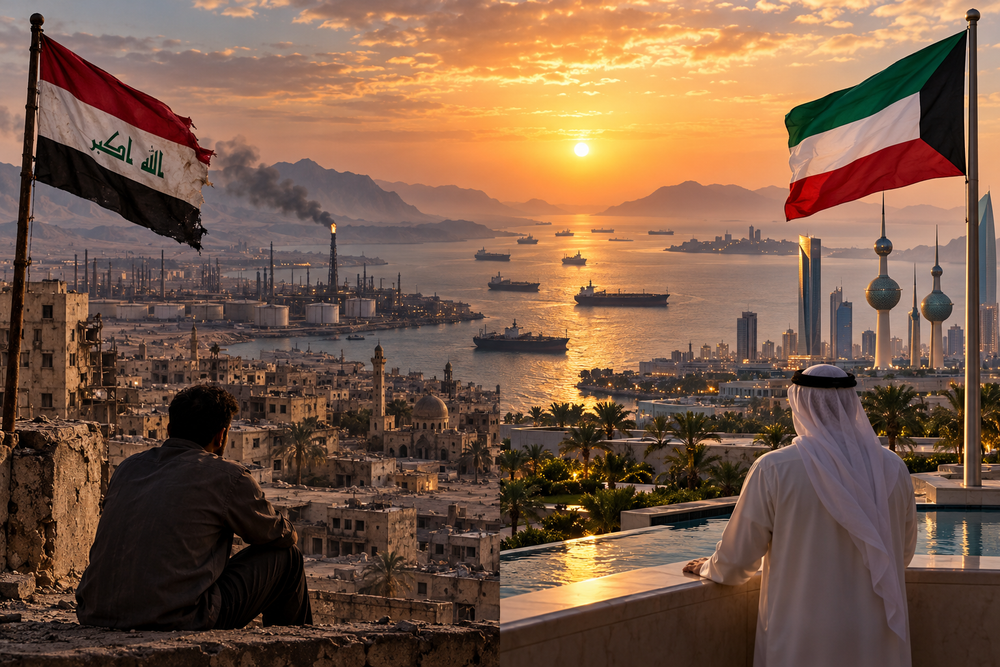
Traffic through Suez fell to about 244 ships a week at the end of 2025, from about 500 two years earlier. When Sea Legend launched what it called the first regular container service across the Arctic, its operations director, Li Xiaobin, named the reason: the crisis in the Middle East "has revealed the vulnerability of the Suez Canal and the Strait of Hormuz." South Korea sent its first commercial container ship to Europe through the Arctic in August 2026, and India and South Korea both cited the Middle East when they announced their plans.
How much of the route's traffic those crises created is impossible to separate from sanctions, ice and Russia's own exports. But the direction is plain. Rosatom, the state nuclear corporation that runs the route, expects more than 40 million tonnes in 2026, a record. When Suez slows, the Arctic route gets a hearing. When Hormuz is threatened, the route gets a timetable. What the Arctic offers is an alternative when the southern routes look riskier, with uncertainties of its own in ice, season and cost, through a door that one state controls.
That makes it a different kind of chokepoint. Suez and Hormuz matter because they can be shut, by war, by missiles, by one ship stuck across a canal. The Northern Sea Route is never simply open. It is made available on conditions, ship by ship and season by season, by the state that holds the permits and the icebreakers. Power over a passage can come from setting the terms on which others use it, as well as from being able to close it.
Article 234: One Sentence of the Law of the Sea
That control rests on more than one legal layer, and the distinction matters. Along parts of the route, Russia treats key straits as internal waters, behind straight baselines the Soviet Union drew in 1985, a position the United States rejects. Closer to shore lies the territorial sea. Most of the route, though, runs through Russia's exclusive economic zone, and there the foundation is a single article of the 1982 United Nations Convention on the Law of the Sea.
Article 234 gives coastal states the right to adopt and enforce rules to prevent pollution from ships in "ice-covered areas" within their economic zone, where severe climate and "the presence of ice covering such areas for most of the year" create exceptional hazards to navigation. The rules must be non-discriminatory and pay "due regard to navigation." It is a safety and pollution clause, not a title of ownership.
The article was largely Canada's work. Ottawa wanted legal cover for its own Arctic pollution law after an American tanker, the Manhattan, forced its way through the Northwest Passage in 1969. The clause written to protect Canadian ice became the clause that underwrites Russia's route.
On that basis, Russian law requires foreign commercial ships to obtain permission before entering the route's waters, and to follow its rules on icebreaker escort and ice pilotage, according to Cornell Overfield of the Center for Naval Analyses. Since a 2022 law, permits are handled by Glavsevmorput, a federal institution under Rosatom that took the task over from Russia's maritime transport agency. Rosatom's subsidiary Atomflot operates the eight nuclear icebreakers, the core of a national fleet of more than 40 icebreakers. Korostikov argues that requiring prior authorization and payment goes further than Article 234 allows.
So one state corporation, through its institutions, decides whether a ship may enter, assesses what escort it needs, and operates the ships that provide it. Moscow breaks the ice to sell the passage, and sells the passage because it can break the ice.
A safety rule becomes an access instrument once the body that enforces it also sells the remedy. Nothing in the public record shows those powers being misused.
The Ships Without Ice Class
This is where the safety logic can be tested. Article 234 lets a coastal state set special rules to prevent, reduce and control pollution from ships in ice-covered waters. Keeping unsuitable ships out of heavy ice is one of the things such rules can do.
In 2024 Rosatom issued 1,312 permits for 975 vessels. About a third of the permitted ships had no ice-class certification at all, and more than half of the tankers were over 15 years old, according to the Norwegian environmental group Bellona. Russia's own rules allow ships without ice class in some areas when the ice is light, so a permit for such a ship is not in itself a breach. But 2025 was not a light year. Ice formed early, and the open-water window in the East Siberian Sea lasted about two weeks. That season, Russian authorities approved passage for more than 20 cargo ships without ice class.
Among the ships without ice class on the route that summer was the Arctic Metagaz, a liquefied natural gas carrier serving Arctic LNG 2, a project under American sanctions. It had no ice class when it left Murmansk around 19 August. Ten days later it reached the ice edge in the East Siberian Sea, with the nuclear icebreaker Sibir close by. On the tracking data the carrier stopped, went astern, and then showed zero knots. Then it no longer appeared on Glavsevmorput's public daily traffic log. I found no published reason for its absence. The terms of its passage have not been published, so the record does not show whether it sailed under conditions that allowed the trip or broke them. It waited more than a week to be freed, and Glavsevmorput put the cost of icebreaker assistance for the rest of its route at more than $600,000. By late September it was off southern Japan, on its way to buyers in Asia.
Why would a gas project send a ship with no ice protection into ice at all? Because sanctions took away the ships the rules were written for. Novatek and its partners ordered 21 Arc7 carriers, tankers built to push through ice on their own: 15 at Russia's Zvezda yard and six in South Korea. Western suppliers left the Russian yard after 2022, and the South Korean builder cancelled at least one order when sanctions stopped the payments, according to an analysis by Spain's Elcano Royal Institute. The first Russian-built Arc7 carrier, the Alexey Kosygin, only began carrying cargo in January 2026. In September 2026, researchers at the Center for Strategic and International Studies wrote that sanctions have kept Russia from acquiring more foreign-built Arc7 carriers, that a growing number of tankers cross the route without sufficient ice class or escort, and that Moscow is "increasingly willing to compromise navigational and environmental safety" to keep the flows moving. Sanctions narrowed the supply of ships built for the ice, and Russia's permit system found a way to move the cargo anyway.
Several gas carriers serving the sanctioned project crossed the route that summer, the same summer China began accepting the project's cargoes: more than 552,000 cubic meters of LNG from the first four, according to Bellona. Russian oil sent east to Asia along the route reached 13 million barrels in 2025, a sliver of Russia's total oil exports but six times the 2019 level, and Korostikov ties the growth to sanctions: a route without Western ports is a route without Western inspections. The map of who benefits is short. Rosatom earns on escorts and answers to cargo targets set in the Kremlin; Novatek, the company behind Arctic LNG 2, needs a way to Asia that avoids Western ports; and Chinese buyers get gas that others will not touch.
This is not to say that Moscow waves ships through for money; the records cannot show that. Set the case beside another application instead. In August 2013 Russia's route administration, then part of the transport ministry, refused a permit three times to Greenpeace's Arctic Sunrise, an ice-strengthened ship, first citing doubts about its ice class and then missing information on the "ice belt breadth." Different year, different ice, different applicant: the comparison proves no rule was bent, and two cases cannot show a pattern. What they show is an office that has cited ice class to refuse one ship and has admitted many without it.
A clause written to prevent pollution from ships in dangerous ice now sits behind a system that admits ships without ice class and sells the icebreaker escort some of them then need, including when the cargo is its own. Whether that is favoritism or simply loose discretion, the public record cannot say.
The Ice Under the Law
There is a slower problem underneath, and it is physical. Article 234 applies where ice covers the water "for most of the year." The end-of-summer minimum in 2025 tied for the tenth-lowest on record, and the March 2025 winter maximum was the lowest in 47 years of satellite records, according to NASA and the National Snow and Ice Data Center. Lawyers have argued for years that as the ice retreats, the legal footing of Russian and Canadian rules under Article 234 may weaken with it.
That is a debated reading, not a settled one. What "ice-covered" and "most of the year" mean has never been decided by a court, and a warmer Arctic does not switch the article off on a given date. In 2025 the ice stayed for most of the year in the East Siberian Sea, and the ships that tried without protection got stuck. For now the ice still holds the law up.
But it describes a paradox at the center of the route. The less ice there is, the stronger the commercial case for the Northern Sea Route, and the more contestable the legal case for the permit office. Russia's control rests partly on ice that its own icebreakers exist to break and that the climate is thinning. Moscow's response has been to add law where ice may one day disappear. A draft amendment in 2022 would have required foreign warships to seek clearance 90 days in advance and allowed only one at a time in the route's internal waters. Overfield called it "plainly illegal."
Two clocks are running here. A longer summer season is what makes the route commercially useful, and it can lengthen while the same waters stay frozen for most of the year, which is what the article requires. The route's value can therefore rise for years before the legal question ripens. Even then, a weaker Article 234 would touch only the powers built on it, not Russia's claim to its internal waters and straits.
The Northwest Passage and What America Brings
The United States has never accepted Russia's claims to the straits along the route. It has not ratified the law of the sea convention, but it treats the convention's navigation rules as customary law and argues on that basis. In 1967 its icebreakers announced a right of passage by radio. Ice and the Coast Guard ended the voyage before the claim was tested.
It is in a weaker position to test it now. The Coast Guard has two aging polar icebreakers, the heavy Polar Star, commissioned in 1976, and the medium Healy, plus a commercial icebreaking vessel bought in 2025 for conversion. In October 2025 Washington signed a deal worth about $6.1 billion with Finland for up to eleven Arctic Security Cutters, four to be built in Finland and seven in the United States, with the first due in 2028. The presidential memorandum called it a "temporary measure to bridge a critical capability gap."
The same argument runs through North America, and it leads back to the clause. Canada claims the Northwest Passage, the route through its Arctic islands, as internal waters, and Washington has long rejected that claim as it rejects Russia's. The country that wrote Article 234 to guard its own passage is still defending its reading of it against the same objection.
The Strongest Case That This Is Overblown
The best argument against this reading is about scale and safety. The route carried about 3.2 million tonnes of transit cargo in 2025, a rounding error next to Suez. Its ships are small, because shallow straits limit their size. Arild Moe calls talk of it replacing Suez "an exaggeration," and Korostikov expects demand to fall back once the Middle East calms. Escort is not a racket in a year like 2025: the Arctic Metagaz shows what happens to unprotected ships, and an escort fee pays for real work. Article 234 does allow coastal states to set rules in ice-covered waters, and Russia's ice has not stopped covering most of the year. Equal treatment of every applicant would not change the fact that the route has one gatekeeper; it would only remove the suspicion of favoritism.
All of that narrows the claim. This piece does not argue that the Arctic will rival the southern trade routes, or that escort fees are extraction, or that Russia admits sanctioned carriers in breach of its own rules. It argues three narrower things: that the route is a gate held by one state corporation, that the route is justified in law by pollution safety in ice, and that in practice its discretion has extended to ships without ice class, sanctioned Russian cargo among them, at the very moments the world has the fewest alternatives.
What I cannot show is how Glavsevmorput decides between applications. It publishes the permits it grants and says nothing about why.
The Next Season and the Next Closure
The 2026 season closes in the coming weeks. If Rosatom's figures exceed 40 million tonnes, the route will have recorded its busiest year during a period of disruption to southern shipping. How much of that growth came from the crisis, rather than Russian exports and sanctions-driven rerouting, remains to be established. The test of this reading comes after. If traffic falls when Suez and Hormuz reopen, the route was a valve, not a road. If approvals for sanctioned carriers without ice class keep rising while the permit system is defended in the name of the ice, the gate is doing what this piece describes.
Two more markers will tell. The first American Arctic Security Cutter is due in 2028, and Russia's largest icebreaker, the Rossiya, is due around the end of the decade after repeated delays. Until then the balance on the water stays roughly where it was in 1967: the passage belongs, in practice, to whoever can break the ice and is allowed to say who follows.
The ice wrote the law. The icebreakers collect on it.
Evidence Map
Facts, interpretations, forecasts, and disconfirming signals.
Core claim. Access to the Northern Sea Route is controlled through a Russian permit and escort system. In the exclusive economic zone it is justified chiefly by UNCLOS Article 234, a pollution-safety clause for ice-covered waters; in key straits Russia relies on its claim to internal waters. Demand rises when southern chokepoints close. In 2024 and 2025 the system admitted many ships without ice class, including sanctioned LNG carriers in a heavy ice year, so the gate works as commercial and sanctions infrastructure as well as safety regulation.
Evidence level. Primary documents: UNCLOS Article 234; the 1967 exchange as published in Proceedings (April 1968). Secondary analysis of administrative data: permit counts and non-ice-class approvals (Bellona, citing the Barents Observer); NSR volumes and transits (CHNL, Carnegie). Reconstruction from shipping sources: the Arctic Metagaz timeline (gCaptain, Bellona). Two separately documented cases: the 2013 Arctic Sunrise refusals (Global News) set against the 2025 approvals. Interpretation: that the permit regime also works as a commercial and sanctions gate. Not shown: selective use in favor of Russian cargo. Contested reading: whether retreating ice weakens Article 234. Speculative: traffic after the Middle East crisis.
What would confirm this. Rosatom's 2026 total above 40 million tonnes while southern disruption lasts; transit traffic falling back once Suez and Hormuz normalize; further approvals of sanctioned carriers without ice class in heavy-ice seasons.
What would weaken this. Glavsevmorput publishing refusal reasons that show consistent safety-based denials, including of Russian cargo; non-ice-class approvals falling sharply; transit traffic holding up after Suez and Hormuz traffic normalizes.
What would contradict the selective-use reading. Evidence that sanctioned carriers face the same conditions and refusals as other applicants in comparable ice. That would remove the suspicion of favoritism, though not the structural point that one state controls access.
Watchlist. Rosatom's 2026 season total; Bellona and CHNL permit and voyage data; Arctic LNG 2 shipments; the first Arctic Security Cutter (2028); the Rossiya (delayed to the end of the decade); Arc7 carriers completed at Zvezda.
Sources. Proceedings, "The Icy Nyet," April 1968; Carnegie, "International Demand for Russia's Arctic Shipping Route Is Unlikely to Last" (30 September 2026); CHNL, NSR transit navigation 2025; Bellona, Russian Arctic highlights September 2025; gCaptain on the Arctic Metagaz; Interfax on the 2022 Rosatom law; CSIS, "The Melting Arctic Lifeline for Russia's Shadow Fleet" (23 September 2026); Elcano Royal Institute on sanctions and Arc7 carriers; gCaptain/Bloomberg on Arctic LNG 2's ice-class tankers (February 2026); Global News on the Arctic Sunrise refusals; Lawfare on Russia's warship law; AGBI on the 2026 Arctic container service; Maritime Executive on the US-Finland icebreaker deal.
Related from The Manifest Archive
- Why America Is Moving North
- Greenland: Why the Arctic Chokepoint Became the West's Fault Line
- Everyone Is Watching Hormuz. Nobody Is Watching the Other Five Passages.
- Trump Didn't Buy Greenland. He Bought Its Future Foreign Policy.
Jerry van der Laan writes The Manifest Archive, Forensic Narrative Intelligence Writing on the systems beneath power, money, and history. He traces the structures beneath them.