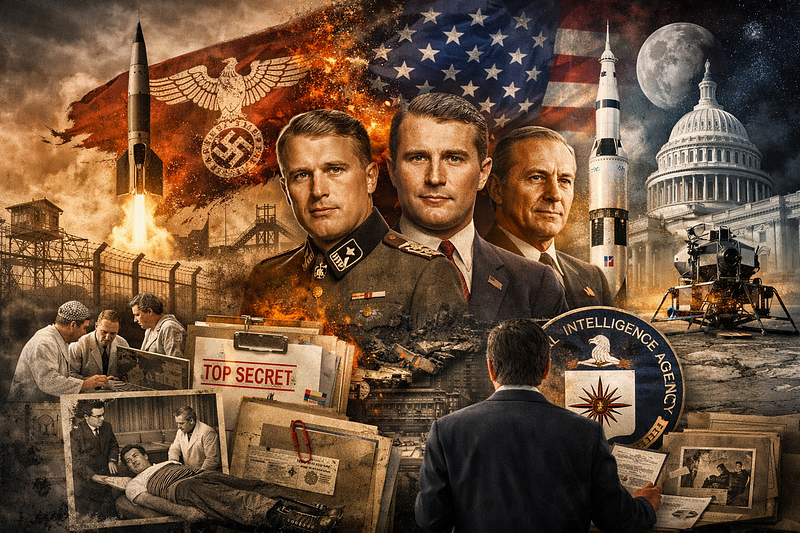
The visible story is the fall of Nazi Germany in 1945, total, military, and final. The determining variable is that a defeated system is not erased but sorted, and the thing that decides what survives the fall is not guilt but usefulness.
The desert had no memory, which made it a good place to begin again. At Fort Bliss, in the dry expanse of west Texas, in 1946, German engineers stood under an American sky and explained propulsion, fuels, guidance, lift, pressure, and the points at which machines fail. Germany had fallen. Berlin was broken, Hitler was dead, the Reich had ended in surrender, occupation, and ruin, and that defeat was real and complete. But the men in the desert were not prisoners awaiting judgment. They were assets being put back to work. They were no longer speaking for the Reich. They were speaking from its remains, and someone had decided the remains were worth keeping.
The official American record gives the decision its own cold word. In August 1946 a United States policy memorandum described the program that brought them, Project Paperclip, as the interim exploitation of selected German and Austrian specialists, noted that the War Department had been running it since shortly after the German surrender, and proposed expanding it to as many as a thousand specialists at a time. Not mercy. Not reconciliation. Not forgiveness. Exploitation. The war had ended the regime. It had not ended the usefulness of the regime's systems, and that gap, between the death of a government and the survival of what it knew how to do, is the whole subject of this chapter. The story does not begin with the collapse everyone remembers. It begins with the transfer that followed it, and with the quiet machinery that decided what would be transferred.
The collapse everyone saw
Public memory prefers clean endings. A regime falls, a flag comes down, a tribunal begins, evil is condemned and then buried. The picture is satisfying and it is not wrong. It is merely incomplete in a way that hides the most important part.
Collapse at the level of the state is not the same as erasure at the level of function. A regime is not only an ideology. It is also laboratories, test data, filing systems, industrial routines, command habits, procurement chains, intelligence files, and people trained to solve hard problems under pressure. When the political shell collapses, those capacities do not vanish on command. They sit in the rubble, intact, available for seizure, sorting, and reuse. The same 1946 memorandum that called Paperclip exploitation also spelled out the apparatus of reuse: screening, contracts, family relocation, security surveillance, interagency processing, and the eventual prospect of regular immigration status for the specialists worth keeping.
The public saw annihilation. Power saw inventory. That is why the end of Nazi Germany has always been easier to stage than to understand. The visible Reich died in the ruins. The colder and more consequential question was being asked at the same time, in offices far from the cameras: what of it could still be used.
The story is not Paperclip
Paperclip matters, but Paperclip is not the whole story. The story is postwar absorption, and Paperclip was only its most visible doorway.
This was never a handful of recruited geniuses; it was an intake system with a filing convention. The National Archives holds the proof in the form of the Foreign Scientist Case Files, dossiers on more than fifteen hundred German and other foreign specialists brought over under Paperclip and related programs, each with its applications, travel orders, security records, employer correspondence, and shipment manifests. And even fifteen hundred people is too narrow a frame, because what moved after 1945 was broader than personnel. It was the usable residue of a defeated system in the widest sense: people, knowledge, documents, prototypes, methods, and networks. Paperclip named one lane. It did not exhaust the highway.
They did not only take minds. They took organized capacity. Once that is in view, the familiar version of the story, a handful of brilliant rocket men given a second chance, becomes too small to carry the weight of the record.
And the rockets were only the most photogenic lane. Alongside the recruitment of people ran a vast, methodical harvest of the defeated economy's knowledge. Specialized Allied teams, working under bodies with bureaucratic names like the Combined Intelligence Objectives Subcommittee and, later, the Field Information Agency, Technical, fanned out across occupied Germany to seize patents, blueprints, laboratory notebooks, machine designs, and unpatented industrial trade secrets across chemistry, metallurgy, optics, synthetics, and manufacturing. They interrogated industrial researchers, copied filing cabinets, and shipped the results home. Historians of the period have described this as a form of intellectual reparations, a transfer of German technical knowledge that American officials at the time valued in the billions of dollars, and on a scale few transfers have matched. Whether or not the dollar figures can be pinned down, the structural fact is plain: the useful contents of an entire industrial civilization were inventoried and carried off. The rocketry was vivid and easy to film. The wider transfer was quieter, larger, and filed under technical intelligence rather than spectacle, which is exactly why it left the public memory and the rockets did not.
The machine that sorted the dead regime
The deepest part of the story is not dramatic. It is administrative. Absorption on this scale requires files: vetting, classification, assignment, transport, contracts, housing, and institutional landing zones. Modern power rarely preserves what it values through speeches. It preserves it through paperwork. A specialist standing on a base is visible. A dossier moving through clearance channels is not, and it is the dossier, not the man, that turns a transfer into a continuity.
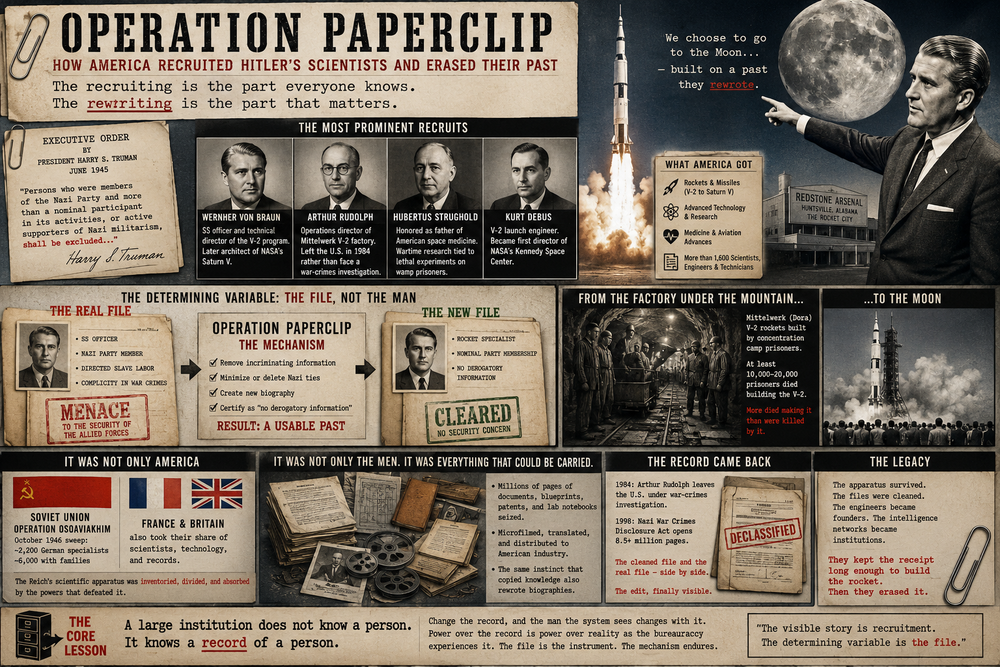
And it is in the paperwork that the sorting shows itself as a deliberate act, because the files did not merely record the specialists; they were edited to make them usable. Truman's directive of September 1946 had drawn an explicit line, barring anyone found to have been a member of the Nazi Party and more than a nominal participant in its activities, or an active supporter of Nazism or militarism, and by the evidence of their own wartime records a great many of the most wanted men fell on the wrong side of it: party members, SS officers, specialists attached to projects built on coerced labor. The agency running the military side of the program, the Joint Intelligence Objectives Agency, resolved the contradiction not by honoring the line and not by abolishing it, but by rewriting the men. In a number of cases the occupation government's security reports, which graded a specialist's Nazi commitment, were rewritten at the program's request, so that a finding of ardent Nazi or potential security threat became something a clearance officer could sign, and the revised file went forward so the man the policy forbade could enter under the policy anyway. That is the sorting mechanism with its mask off, and it is not a metaphor: it is a clerk at a desk deciding which sentences about a man's past will survive into his future. The line the President drew was never erased. It was kept on the books and crossed on paper, which is more durable than simply ignoring it, because it leaves the policy intact for the public and the exception intact for the program.
The Reich, in other words, was not simply defeated. It was disassembled by value. What was too exposed or too useless could be left to the tribunals. What was useful enough was cleaned up and kept. That is the hardest truth in the subject, and it is written into the administrative record rather than hidden beneath it.
What actually moved
The easiest way to miss the scale of this is to organize it around names instead of functions. Organize it around names and you get von Braun, Debus, Gehlen, a short list of famous individuals. Organize it around functions and the architecture opens. Rocketry moved. Aerodynamics moved. Guidance logic moved. Launch operations moved. Aviation medicine moved. Soviet-facing intelligence moved.
That is the real structure of postwar transfer. The United States did not merely recruit talented immigrants. It extracted working functions from a collapsed enemy system and embedded them inside its own, and a function is more than the person who carries it. It is tested method, specialized routine, institutional memory, technical habit, and trained judgment. Those things are transferable, sometimes not cleanly and rarely proudly, but transferable all the same. Knowledge becomes durable when it is written down, measured, replicated, and filed, which is why the United States processed large quantities of technical and administrative material alongside the people. A scientist can explain a system. A document lets it be reproduced, a file lets it be assigned, a prototype lets it be tested again. The Reich did not only leave ruins. It left usable memory, and usable memory is transferable power.
What a transfer looks like in freight
It helps to see the absorption in its physical form, because the abstraction of moved functions becomes concrete the moment you count the railcars. When American forces reached the underground V-2 plant at the Mittelwerk in 1945, ahead of the area's planned handover to the Soviet zone, they did not only interrogate engineers. They stripped the hardware. Under a rushed operation, roughly three hundred freight-car loads of V-2 components and assemblies were hauled out and shipped across the Atlantic to the proving ground at White Sands, enough materiel to reconstruct dozens of complete rockets on American soil. The machinery itself emigrated.
So did the memory. The Peenemunde design archive, tons of technical documents recording years of rocketry research, had been hidden by retreating German staff in a mine in the Harz mountains, and was located and recovered before it could fall to anyone else. People, hardware, and the written record of how the hardware worked were extracted as a single package, because any one of them without the others would have been worth less. A rocket without its engineers is scrap; engineers without their data start over; data without the hardware is theory. Taken together they are a working program with a new flag, and that is precisely what was assembled in the desert. The transfer was not a metaphor about influence. It was a logistics operation measured in railcars and tonnage.
From Peenemunde to prestige
Wernher von Braun became the symbol because his trajectory ended in myth. NASA records that he became director of the Marshall Space Flight Center and the chief architect of the Saturn V rocket that carried Apollo crews toward the Moon, before moving to NASA headquarters to direct long-range planning. These are not marginal roles. They are central roles inside one of the most prestigious institutions of the twentieth century, and the arc from a German war-rocketry program to the brightest civilian-technological project of the American century is the clearest case of a transferred function being not merely absorbed but normalized, folded into a national story of progress.
Kurt Debus widens the pattern from invention to operation. NASA identifies him as the first director of the Kennedy Space Center, serving from 1962 to 1974, reporting to headquarters when the launch operations center was activated. Launch operations, not just rocket design, traveled into the core of the American space state: the procedure, the timing, the testing discipline that turns engineering into national capacity. The standard telling calls this redemption through science. That is too gentle. The more accurate reading is that prestige did not erase origin; it made origin easier not to ask about. The Moon landing did not wash away where some of these functions came from. It placed them inside a brighter story, which is a different thing.
The rehabilitation was not left to chance; it was produced. In the mid-1950s von Braun became a television personality, appearing in a series of Walt Disney films on space travel that reached tens of millions of American viewers and made him the genial, forward-looking public face of the coming space age. A Hollywood biographical film followed. Within a decade of standing in the Texas desert as an exploited enemy specialist, he was a celebrity explaining the future to American families on prime-time television. This is what the absorption of a function looks like once it is complete: not only is the capability working inside the new system, but the person who carries it has been given a story the public can love, and the earlier story, the war rockets and the tunnels where they were built, recedes behind the friendly one. Normalization is the last stage of the transfer, the point at which origin stops being a question anyone thinks to ask.
The less comfortable names
So far the sort has kept the unexamined and the laundered. The harder thing to absorb is that it also kept the documented, the men whose guilt was not buried in a file but plainly on the record, taken anyway because the function outweighed the finding. Two names carry that step. The FBI's public record identifies Arthur Rudolph as a German-born rocket engineer and a Nazi Party member brought to the United States to work on American missile and space programs, an arc that compresses the whole moral problem into one life: party membership, technical utility, American employment, and, decades later, the scrutiny that led him to leave the country. The utility came first and lasted longest. The scrutiny came last, when the function had already been delivered. The lesson Rudolph adds is not that a Nazi was hired; it is that being known to be one did not stop it.
Hubertus Strughold opens a darker layer, and it must be handled precisely. American aviation and space medicine would later treat him as a founding figure. The wartime research environment from which that field partly emerged cannot be treated as ethically clean. The Holocaust Encyclopedia documents that physicians associated with the German Air Force and its aviation research conducted high-altitude experiments on prisoners at Dachau, to learn the limits at which crews could survive, along with freezing experiments, seawater experiments, and other lethal abuses on concentration-camp prisoners. This does not mean every later line of American aerospace medicine was camp science; that would be crude and false. It means something more serious and harder to dismiss: a knowledge zone later normalized inside American institutions had been developed in part inside an environment already contaminated by coercion and murder. A field does not become innocent because a later institution gives it a cleaner address.
The court and the laboratory
Here the two lanes of the postwar order can be seen running at the same time, in the same country, under the same flag, and the simultaneity is the whole argument in a single image.
In a courtroom in Nuremberg, from December 1946 to August 1947, the United States tried twenty-three German physicians and officials in the case history calls the Doctors' Trial. The charges were the medical experiments: the high-altitude tests, the freezing, the deliberate infliction of death and disability on prisoners in the name of research. Seven of the defendants were hanged. Out of that trial came the Nuremberg Code, the founding document of modern medical ethics, written precisely to forbid what those doctors had done. The American government was, in that room, condemning Nazi human experimentation as a crime against humanity and codifying a law against its ever happening again.
In the same months, in offices a continent away, other arms of the same government were screening, sanitizing, and employing specialists from the very research culture the court was condemning, including in aviation medicine, the field built in part on the altitude and cold experiments at the center of the trial. One hand wrote the Nuremberg Code. The other hand revised dossiers so that men formed by the world the Code was written against could be put to work. Only one hand was public at the time. Both are in the record now. They simply were not looking at each other, and a system does not need them to. The court served justice and the recruiters served utility, and the system was content to let the two lanes run in parallel and never meet. That parallelism is not a contradiction the system failed to notice. It is the mechanism. Condemnation handled what could not be defended; absorption handled what was too useful to discard; and the same regime could be, at once, the thing on trial and the thing being hired. Nowhere was the bind tighter than in the medicine, where the United States wanted the knowledge that crime had produced and could not separate it from the crime that knowledge had required.
The price the prestige hid
Dora teaches the next thing, the one the names do not: the scale of what the sort would accept, and how the cover is built. If the absorption has a moral floor, it is at Mittelbau-Dora. The V-2 rockets that began von Braun's arc were assembled by concentration-camp prisoners in the tunnels of the Mittelwerk, under conditions so lethal that the weapon killed far more people in its manufacture than in its use: historians estimate that at least ten thousand prisoners died building the rockets, through exhaustion, starvation, disease, and execution, roughly twice the number the rockets killed as weapons. Von Braun himself had visited the Mittelwerk and did not, in later years, deny having seen its conditions; the man who would later explain space travel to American television audiences had stood where the slave labor died. None of it disqualified the function.
And here is Dora's distinct lesson, the one Strughold cannot teach. Prestige is not merely the reward the absorbed function earns; it is the instrument that buries the origin. The brighter the Saturn V grew in the public imagination, the deeper the tunnels sank out of it, until a rocket assembled by dying prisoners had become the purest symbol of human aspiration. The cover was not silence. The cover was glory. Naming Dora is not an aside; it is the measure of what the sort was willing to file under usable, and proof that the most effective concealment of an origin is a sufficiently magnificent future.
The intelligence afterlife
Gehlen adds the dimension the rockets and the medicine cannot, because the thing transferred here is not science at all. It is method, and method is harder to see and harder to launder than any blueprint, because it lives in people and habits rather than in a single file. The CIA's own documentary history of the relationship, compiled in 1999 by Agency historian Kevin Ruffner and later declassified, records that the Agency assumed responsibility for the Gehlen Organization from the U.S. Army in mid-1949, and that the organization became West Germany's foreign intelligence service, the BND, in 1956. The same history says the Agency took this on with the full knowledge of the risks, and concludes that Gehlen's intelligence on the Soviet Union outweighed those problems during the hottest years of the Cold War. The verdict is the same as everywhere else in the story, not innocence and not rehabilitation but usefulness, except that this time what was kept was an entire way of working, carried whole into the service that replaced it.
And Gehlen teaches one more thing the others do not: when the cost falls due. A network built by hiring the enemy's intelligence professionals proved exactly as penetrable as that bargain implies. It absorbed former SS and SD men along with their expertise, and it was badly penetrated by Soviet intelligence, most notoriously through Heinz Felfe, a former SS officer taken into the organization who spent years passing its secrets to Moscow before his exposure in 1961. The utility was real and so was the rot, and the system accepted the second to keep the first. That is the shape of the whole bargain in miniature, and its cruel timing: the value is banked immediately, in the year of the hire, and the cost is paid later, by which time the function is load-bearing and can no longer be handed back. The sort weighs the price when it files a man under usable, and it nearly always prices it too low. It discovers the price afterward, when it is too late to unfile him.
Justice and utility
This is the hinge of the chapter, and it is worth stating without softening. The tribunals were real. The legal reckoning was real. The subsequent Nuremberg proceedings prosecuted industrialists, doctors, judges, and SS personnel. Justice at Nuremberg was not theatre.
But justice was not the only lane of the postwar order. Running beside it, in the same years and often through the same departments, was a lane devoted to exploitation, intake, and strategic reuse. That is why the subject still unsettles. It is not that morality vanished. It is that morality and utility coexisted, deliberately, and were kept in separate files. On one side stood prosecution. On the other stood transfer, placement, surveillance, and repurposing. The Reich was condemned as a regime, and its usable capacities were treated as a separate question with a separate answer. What could not survive morally was condemned. What could survive strategically was absorbed. What was useful was forgiven, and what was forgiven was, nearly always, what had proven useful. Once that is visible, the shape of 1945 changes: what looked like a full stop turns out to have been a sorting process, and the determining variable in the sort was never guilt. It was use.
The Western container
A modern state is not only science and intelligence. It is also industry, production capacity, supply chains, and the organizational routine that turns knowledge into output at scale. After 1945, Germany did not remain a collapsed industrial void. West Germany was rebuilt and integrated into the Western bloc, and the postwar order relied not only on American absorption but on managed continuity inside a newly aligned German state. The Gehlen case shows it in the intelligence domain; the broader reconstruction showed it across the economy. West Germany became a container for selected continuity, not a blank slate.
This sharpens the thesis rather than softening it. The United States did not become the Reich; that is theatrical and false. What the United States and the wider Western system did was more sophisticated and more characteristic of how power actually behaves. They disassembled a defeated enemy system and redistributed its most useful functions across a new architecture, with America as the principal absorbing force and West Germany as a principal managed container. Destruction removed the shell. Reconstruction preserved selected capacity. That is harder to turn into outrage, and closer to the truth.
The strongest objection
The strongest objection is that none of this is special. Victors have always taken the spoils of war, including the enemy's scientists and secrets. The Soviet Union ran its own, blunter version: in a single operation in October 1946, Osoaviakhim, it forcibly rounded up thousands of German specialists with their families overnight and shipped them east to work for the Soviet state. The Western and Eastern programs were mirror images, and that is precisely the objection: to dress ordinary postwar pragmatism in the language of a sorting mechanism is to over-theorize something every winning power has always done. Of course the useful enemy assets were kept. What else would a state do.
The objection is fair, and it forces the claim to be exact about what is and is not being asserted. The argument here is not that absorbing enemy capability is unusual; it is that this case shows, in the documents, the specific step that turns ordinary spoils into something more pointed: active concealment against a stated rule. The spoils-of-war defense explains taking the rockets. It does not explain rewriting the files. Truman's policy drew a line, ardent Nazis excluded, and the response was not to honor the line or to abolish it openly but to falsify the records so the line could be crossed quietly while appearing to hold. That is the difference between a victor helping itself to useful material and a system laundering the unacceptable into the employable while keeping a clean public face. The claim is falsifiable in exactly that place: if the dossiers had not been altered, if the ardent-Nazi findings had been left intact and the men admitted in open defiance of the policy or honestly barred by it, the sorting thesis would lose its sharpest evidence and the spoils-of-war reading would be enough. The altered files are what it is not enough to explain.
This is also where this chapter parts from its nearest neighbor in the archive. The wider story of how the American century was built on inherited and renamed capability is told elsewhere. This piece is narrower and colder. It is about the sorting itself, the moment of triage in which a fallen system is divided into what must be condemned and what can be kept, and about the discovery that the dividing line was drawn by usefulness and then disguised.
The law beneath the case
Lift away the particulars and a general law is left standing, one that reaches well past 1945. When a system collapses, it is not erased; it is triaged, and the variable that does the triaging is usefulness, not justice. The parts that can be defended morally and the parts that are useless are released to history. The parts that retain value are retained, and if their value is high enough, the cost of keeping them, including the moral cost, is absorbed rather than refused. This is the same shape the Manifest has traced through other collapses, the discovery that what survives the visible end of a regime is decided by a calculation of value rather than by the verdict the public believes was rendered. The fall of the Reich is the starkest case because the moral stakes were absolute and the triage proceeded anyway, in writing, through the same government that was sentencing men to the gallows at Nuremberg for crimes committed in the very research culture whose specialists it was hiring in Texas. If usefulness could override guilt there, at the maximum of guilt, then usefulness is not a postwar curiosity. It is the rule that governs what any collapse leaves behind, and the cleaner stories we tell about endings are the form the rule takes once the filing is done.
That is also what distinguishes a Manifest chapter from a war anecdote. The point is not that something shocking happened after the war. The point is that the same triage runs whenever a system falls and a stronger one stands ready to inherit it, and that the receipt, the record of what was kept and what was quietly altered to keep it, is usually the only place the rule can be caught in the act.
What remains
To be exact about the claim, the documented spine is firm and the reading laid over it is marked, and the two are kept apart. Documented: the 1946 policy memorandum describing Paperclip as exploitation; the National Archives' record of more than fifteen hundred foreign-scientist files; Truman's bar on ardent Nazis and the program's practice of sanitizing dossiers to get valuable but disqualified specialists admitted; von Braun's role at Marshall and on the Saturn V; Debus at the Kennedy Space Center from 1962 to 1974; Rudolph's Nazi Party membership in the FBI record; the Dachau experiments in the Holocaust Encyclopedia and the Doctors' Trial and Nuremberg Code of 1946 and 1947; the deaths at Mittelbau-Dora; the CIA's assumption of the Gehlen Organization in 1949 and its becoming the BND in 1956. These are matters of record.
The marked, interpretive part is the reading that ties them into one mechanism: that the fall of the Reich was less an erasure than a sort, in which usefulness rather than guilt decided what survived, and that the altered files are the signature of the sort being a deliberate act rather than a passive drift. That reading would weaken if the concealment turned out to be marginal rather than systematic, or if the retained functions proved to have made no real difference to American capability, in which case this would be ordinary spoils after all. The chapter names those conditions rather than hiding from them, and it claims no surviving ideology and no secret Reich reborn. What survived was not the banner. It was the function.
History prefers endings that calm the mind. A regime falls, a tribunal begins, a line is drawn. But systems of power are rarely so obedient. They fragment, they shed symbols, they lose flags, and they keep functions. The war ended the regime but not its uses, and it was the uses, not the regime, that crossed into the world that followed. The real afterlife of the Third Reich was not the secret return of banners or speeches. It was quieter, colder, and more modern than that: a file transferred, a clearance approved, a sentence about a man's past deleted, a network given a new employer and a cleaner name. The world remembers 1945 as the end of a regime. It was that. It was also a sorting, and the thing that did the sorting was not justice. It was use.
Evidence Map
Facts, interpretations, forecasts, and disconfirming signals.
Core claim. The fall of Nazi Germany in 1945 was not an erasure but a sorting: the regime's useful functions, rocketry, launch operations, aviation medicine, Soviet-facing intelligence, industrial knowledge, were extracted and reused, and the variable that decided what survived was usefulness, not guilt. The deliberate sanitizing of security files is the signature that the sort was an act, not a drift.
Evidence level. Facts: high (the 1946 policy memo framing Paperclip as exploitation and Truman's exclusion of ardent Nazis; the JIOA's sanitizing of OMGUS dossiers; the National Archives' 1,500-plus foreign-scientist files; roughly 300 V-2 freight-car loads shipped to White Sands and the recovered Peenemunde archive; von Braun at Marshall and on the Saturn V, Debus at the Kennedy Space Center 1962-1974; Rudolph's Nazi Party membership; the Dachau experiments, the 1946-1947 Doctors' Trial and the Nuremberg Code; some 20,000 deaths in the Mittelbau camp system, at least half of them tied to V-2 production; the Gehlen Organization passing to the CIA in 1949 and becoming the BND in 1956; the CIOS and FIAT patent-and-trade-secret harvest; the Soviet Osoaviakhim of 1946). Interpretation: medium (reading these as one sorting mechanism in which usefulness overrides guilt). Strughold's personal culpability is contested and is not asserted; no surviving Nazi ideology or secret Reich is claimed.
What would confirm this. The same usefulness-over-guilt triage recurring when other systems fall and a stronger one stands ready to inherit them; and the file-sanitizing proving systematic rather than incidental as further records are declassified.
What would disprove this. The concealment proving marginal rather than systematic; or the retained functions proving to have made no material difference to American capability, in which case this would be ordinary spoils of war rather than a deliberate sort.
Watchlist. Evergreen and historical: continued declassification (the National Archives, CIA and BND historical commissions) and the mechanism tested against the series' other collapse cases.
Jerry van der Laan writes The Manifest Archive, a continuous investigation into how institutions, language, and systems shape what people are permitted to see as reality. He does not report events. He traces the structures beneath them.
Correction, 12 October 2026: this piece has been corrected. Prisoner deaths tied to V-2 production are now given as at least ten thousand, roughly twice the number killed by the rockets; the earlier figures of twenty thousand and nine thousand were the camp-system total and a high estimate. The Doctors' Trial defendants were hanged at Landsberg, for crimes, not in Nuremberg for their expertise. An incorrect broadcast day for Disney's Man in Space was removed. The CIA history quoted on Gehlen is now identified as Kevin Ruffner's 1999 documentary history. The rewriting of security reports is now described as happening in a number of cases, the Gehlen network as badly penetrated rather than riddled, and the 1946 exclusion clause follows its wording. Two phrases that could not be sourced were rephrased. The corrections log is at themanifestarchive.com/standards.
Related from The Manifest Archive