Apple Didn’t Sell Devices, It Sold Faith.
The first Apple computer was made of wood.
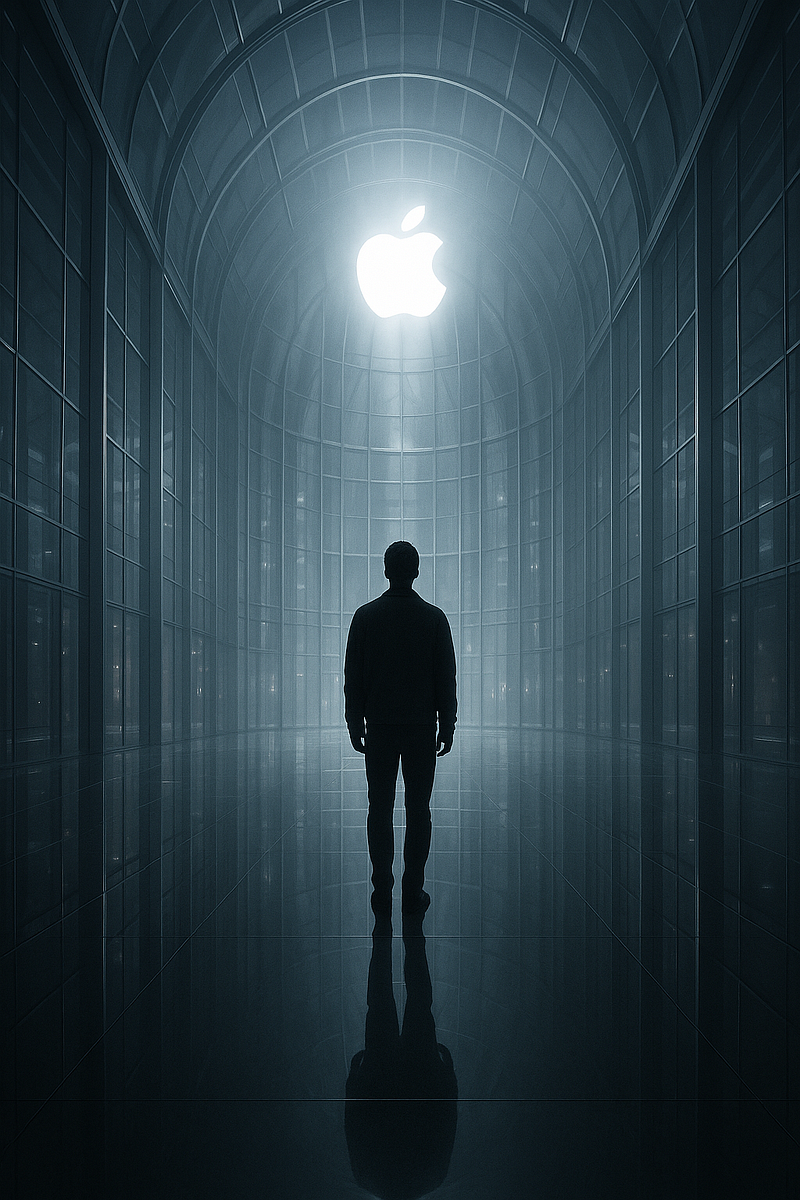
Forty years later, the company built a glass ring so vast it can be seen from space.
Between those two structures, the handmade box and the perfect circle, lies the story of how a machine became a mirror for the human soul.
The Birth of a Belief System
When Steve Jobs unveiled the first Macintosh in 1984, he didn’t just introduce a product. He introduced a tone, simple, elegant, moral.
The famous “1984” commercial, directed by Ridley Scott, promised rebellion against conformity. Ironically, that rebellion created a new kind of conformity: one defined by elegance, control, and trust.
Apple was never just selling computers.
It was selling a worldview, that technology could be clean, human, benevolent. The machine wasn’t industrial anymore; it was spiritual.
Every curve, every pixel, every sound effect was crafted to evoke calm and faith. Jobs called it “making tools for the mind that advance humankind.”
But the more perfect those tools became, the less they belonged to their users.
“The first Apple freed the mind. Every next one claimed it.”
From Hardware to Habit
The company’s transformation truly began with the iPod.
In 2001, Apple stopped building devices for work and started building devices for the self.
The iPod’s white earbuds became the most successful piece of wearable branding in history, symbols of freedom, individuality, and taste.
But the technology behind them was already building something larger: a data ecosystem that mapped what people listened to, when, and how often.
For the first time, behavior was measurable at emotional scale.
iTunes recorded listening patterns, repeat rates, skips, and purchases.
The music player was also a subtle recorder of mood and rhythm, a psychological diary written in code.
By 2008, Apple had quietly assembled one of the largest datasets of human listening behavior in the world.
That same year, the iPhone took the next step: it didn’t just play music, it watched you carry it.
Accelerometers, GPS, and gyroscopes turned the device into a behavioral sensor, knowing when you moved, how you walked, and even how long you stayed still.
A smartphone is not a phone. It’s a portable nervous system with a screen for a face.
The Double Role of the Device
Every Apple product since 2007 has served two masters: the user and the system.
On the surface, it’s an instrument of empowerment, camera, compass, communicator.
Beneath that surface, it’s a network of telemetry: micro-signals sent every few seconds to Apple’s cloud to “improve experience.”
This duality is not accidental.
Apple’s engineers pioneered the concept of ambient data flow, information that travels invisibly, under the logic of optimization.
Location services, Siri voice data, diagnostics, health metrics, all moving continuously, often encrypted but always centralized.
In 2024, researchers at the University of Toronto’s Citizen Lab documented how Apple’s analytics framework sends unique identifiers even when tracking is disabled.
Apple’s response: it wasn’t “tracking,” it was “telemetry.”
A single word, a softened synonym, Orwell would have smiled.
“When power becomes elegant, language becomes polite.”
The Cloud That Isn’t in the Sky
Apple’s iCloud was marketed as safety, “Your life, stored securely in the cloud.”
In truth, it is a global network of over two dozen data centers spanning the United States, Denmark, Ireland, Singapore, and mainland China.
Few users know that the Chinese iCloud infrastructure, the entire storage system for Apple’s mainland customers, is legally operated by Guizhou-Cloud Big Data, a state-owned company.
Chinese law requires that encryption keys for these servers remain on Chinese soil.
This means that, technically, the government can compel access without Apple’s consent.
Apple insists that “privacy is a fundamental human right,” but privacy, here, depends on jurisdiction.
For Western users, the illusion of safety persists because the language of design, clean, minimalist, serene, suggests moral purity.
The cloud was never in the sky. It was in a warehouse with fluorescent lights and guards at the door.
The Screen and the Self
If Apple’s early computers changed how people worked, the iPhone changed how they exist.
Neuroscientists at Stanford have described the modern phone as “a dopaminergic loop disguised as a tool.”
Apple’s screen refresh rates, haptic taps, and notification tones are calibrated to trigger the brain’s reward system.
It’s not accidental that the same company that revolutionized music also perfected the rhythm of attention.
Each tap, each scroll, each swipe teaches the brain to expect reward.
Apple measures “engagement time,” “session frequency,” “screen distance,” and even micro-pause intervals the milliseconds between gestures, to refine design feedback.
These micro-moments become data, and that data becomes a model of human expectation.
“We used to adapt tools to our needs. Now, tools adapt us to theirs.”
The Body Joins the Network
The Apple Watch completed the circle.
What began as behavior tracking evolved into biological participation.
The device measures heart rate, blood oxygen, and even ambient noise levels.
In 2023, Apple announced collaborations with the University of California and pharmaceutical companies to use aggregated Watch data for medical research.
Most users agreed without reading the small print.
Each “consent” tap added to the largest voluntary biomedical dataset in corporate history.
The wrist became a biometric witness, its readings stored across servers and linked to iCloud accounts that never truly die.
Apple calls this empowerment through data.
In reality, it is a new kind of social contract: people trade intimacy for optimization.
The machine learns to recognize not only what you do, but how you feel when you do it.
“The body is the new password.”
When Design Becomes Doctrine
Apple’s aesthetic, the white space, the calm fonts, the tactile smoothness, has a psychological purpose.
Minimalism soothes anxiety; order signals safety.
This is why Apple’s marketing always avoids chaos or crowds. The visual language of purity replaces argument.
It’s not propaganda in the traditional sense; it’s emotional conditioning.
Even “Screen Time,” Apple’s built-in tool to reduce phone use, is part of the same paradox.
The system that causes the dependency offers the cure, an infinite feedback loop of guilt and relief.
“Every confession needs forgiveness. Every addiction needs an app.”
From Company to Civilization
By 2025, Apple controlled more than 2 billion active devices, roughly one for every four humans on Earth.
Its products process more private messages daily than any government system in history.
The brand’s logo is now one of the most recognized symbols in the world, second only to the Christian cross.
Apple is no longer a computer company.
It is an invisible infrastructure of perception: controlling what people see, how they feel, and what they remember.
It doesn’t enforce obedience; it curates it.
And that is why it has outlasted every political movement of its time.
“The empires of the past ruled land. The empires of today rule the lens.”
The Architecture of Power
In 2016, Apple’s lawyers stood before the FBI. The Bureau demanded that Apple unlock the iPhone of a suspected terrorist in San Bernardino. Tim Cook refused. “We will not build a backdoor into our products,” he wrote in an open letter. For millions, it was a moment of moral clarity: a corporation defending privacy against the state.
But the story didn’t end there. Apple quietly began redesigning iCloud encryption so that the keys would remain in its own custody, accessible under court order. The company had learned a political lesson: absolute privacy is bad for business.
“A company that sells safety must remain just open enough for power to knock.”
Since then, Apple has mastered the art of dual allegiance.
To users, it speaks the language of freedom.
To governments, it offers cooperation cloaked in protocol.
Every quarter, Apple publishes its Transparency Report: thousands of data requests from law enforcement around the world. The numbers rise each year, device traces, account records, geolocation pings. Apple complies in roughly 80 percent of cases, depending on jurisdiction.
And yet, the brand image remains untouched, polished by the glow of its own marketing.
The genius of Apple’s diplomacy is silence.
It doesn’t debate politics; it absorbs it.
In Washington, its lobbyists frame technology regulation as innovation policy.
In Brussels, they call it privacy protection.
In Beijing, they call it “local compliance.”
The words change, the obedience remains.
The Chinese Mirror
Nowhere is that duality clearer than in China.
Apple’s products dominate the urban middle class: iPhones, iPads, MacBooks, status symbols of aspiration. But their data doesn’t travel west. It stays inside the Great Firewall.
Since 2018, Apple’s mainland cloud operations have been managed by Guizhou-Cloud Big Data, a company supervised by the provincial government. Encryption keys for Chinese users are stored locally, in effect, available to state authorities under Chinese cybersecurity law.
Apple says it “follows the law of the land.” The statement is both true and incomplete.
For Chinese citizens, iCloud is not a sanctuary but a monitored space dressed as convenience. For Apple, it is the price of admission to a billion-person market.
“When ideology meets profit, design always finds a neutral color.”
The paradox deepens: the same company that fights subpoenas in California builds compliance systems in Chengdu.
And through that quiet flexibility, Apple has achieved what no Western government ever managed, to be trusted by both the White House and the Politburo.
The New Diplomacy
Apple’s headquarters in Cupertino resembles a spaceship, a glass ring, circular and serene.
Visitors often describe it as the embodiment of transparency. Yet it functions more like a modern Vatican: global diplomacy conducted through design, not doctrine.
Inside, there is a department known as Government Affairs.
Its staff negotiate with regulators, ministers, and ambassadors from more than 150 countries.
Their task is not simply to protect Apple’s interests, but to shape the language of digital ethics itself.
When the Biden administration drafted its voluntary AI safety guidelines in 2024, Apple was among the first signatories.
The company’s participation gave the project instant credibility, if Apple agrees, it must be safe.
Few noticed that the guidelines also encourage “data-sharing under trusted frameworks,” a clause written vaguely enough to cover almost any cooperation with state agencies.
“Power today doesn’t censor. It co-authors.”
By sitting at every table, privacy, health, education, sustainability, Apple ensures that every future regulation already fits its ecosystem.
Its greatest weapon is not lobbying; it’s design inertia.
Once a billion users depend on your interface, lawmakers regulate around you, not against you.
The Quiet Empire
Walk into an Apple Store anywhere in the world: the light, the smell, the tempo are identical.
No flags, no language barriers.
This is globalization without ideology, the only empire where citizenship is defined by a device ID.
Behind that aesthetic unity lies logistical control of astonishing scale.
Apple contracts hundreds of suppliers across 30 countries. Foxconn alone employs over a million people.
In 2023, the company’s supply chain emitted more carbon than the entire nation of Portugal.
And yet, its marketing speaks of carbon neutrality by 2030.
The numbers are not false; they are carefully chosen.
Apple counts only its direct emissions, not those of its partners.
The same principle applies to data: what Apple defines as “private” is what it directly collects. The rest, app telemetry, advertising identifiers, cloud metadata, belongs to “third parties.”
Responsibility becomes a design variable.
“Transparency is easy when you write the definitions yourself.”
Apple’s annual Environmental Progress Report runs 100 pages; its Human Rights Policy fits on one.
Both are written in the same font, the same tone, the same moral rhythm.
This, too, is design, the shaping of perception through proportion.
The Algorithm of Trust
How does a company maintain moral authority while operating in the moral gray?
By turning ethics into interface.
Apple’s privacy labels, those small charts in the App Store showing what data each app collects, are masterpieces of visual rhetoric.
They create the feeling of control without the friction of complexity.
Color, typography, and spacing replace comprehension.
Most users glance, nod, and tap Accept.
Trust becomes a reflex, not a decision.
Inside Apple Park, behavioral scientists work alongside designers to study “user delight.”
Their research shows that micro-animations and rounded corners reduce cognitive load, increasing satisfaction and compliance.
The smoother the surface, the easier it is to agree.
“Design is not what it looks like. It’s how willingly you obey.”
This is the invisible genius of Apple’s empire: it doesn’t demand belief; it designs it.
By perfecting the sensory grammar of reassurance, light, symmetry, silence, the company discovered the shortest path from convenience to consent.
The Price of Perfection
Each product cycle brings new miracles: thinner bezels, faster chips, brighter screens.
But the real innovation lies elsewhere, in the calibration of expectation.
Apple’s upgrade rhythm has become the metronome of consumer psychology.
Two years after purchase, batteries slow, storage fills, the camera feels dull.
Not by conspiracy, but by architecture: software optimized for the present, not the past.
Planned obsolescence is now emotional, not mechanical.
Users crave the new not because the old has failed, but because the ecosystem whispers that time has moved on.
“Obsolescence used to be technical. Now it’s existential.”
And so, the cycle repeats: desire, purchase, devotion, fatigue.
The faithful queue before dawn, waiting for the next revelation, a slightly better lens, a slightly brighter world.
Echoes of Power
Governments admire Apple because it succeeds where they struggle.
It manages billions of identities, transactions, and communications without revolt.
It taxes behavior through upgrades instead of laws.
It maintains loyalty without ideology, discipline without violence.
In the logic of modern governance, Apple is not a corporation; it is a proof of concept a functioning model of consent at planetary scale.
“If democracy is participation, Apple perfected its illusion.”
The Psychological Empire
“The device doesn’t just know you use it. It knows how you feel when you do.”
The Screen as Nervous System
Every era has its chosen organ of power.
For the industrial age, it was the factory.
For the digital age, it is the screen.
Apple understood earlier than anyone that attention is not infinite, it is extractable.
Each notification, vibration, and animation forms part of what neuroscientists call a variable reward loop: the same dopamine cycle that governs gambling machines and social validation.
Apple’s haptic taps are tuned to a 10–20 millisecond delay, long enough for the brain to anticipate, short enough to reward.
That moment of expectancy releases a chemical echo: did someone reply? did the world notice me?
This is not accident; it’s ergonomics at the level of instinct.
The interface becomes a nervous system extension, not a tool you use, but a rhythm you inhabit.
Studies from Stanford and MIT show that users unlock their phones on average 150 times per day, even without a trigger.
The loop sustains itself.
The hand reaches before the mind decides.
“Addiction is the modern form of obedience.”
Apple markets mindfulness apps and Screen Time dashboards, the cure inside the disease.
The paradox is elegant: the system that fragments focus also sells serenity.
Every ping, every pause, every chart of your own distraction feeds the same architecture of attention.
You don’t break the loop; you admire its design.
The Interface of Emotion
Open an Apple device and observe the silence.
No startup chime, no fan noise, no chaos.
Just white, soft gradients and round icons.
The color palette is not arbitrary, it’s neurovisual minimalism.
Clinical psychologists note that pale tones lower cortisol levels, creating a sense of calm and trust.
Apple’s design team uses what it calls human interface guidelines, a set of aesthetic rules that double as emotional code.
Fonts must be “approachable,” animations must “suggest life,” and corners must “invite touch.”
Each rule translates psychology into geometry.
The effect is disarmingly gentle: users feel safe inside the brand.
The world outside is messy; the Apple world is coherent, benevolent, frictionless.
That’s why privacy warnings, app permissions, even software failures appear in the same soothing typeface.
Language and tone transform control into care.
“When control feels kind, it no longer needs to hide.”
Inside this serenity, the user’s defenses drop.
Cognitive scientists call it the aesthetic trust effect, when beauty overrides skepticism.
It’s why we read faster on clean screens, why we agree faster to clean prompts.
The brain confuses order with truth.
Apple didn’t invent that reflex, but it perfected it.
By polishing every pixel, it turned visual comfort into moral authority.
Digital Amnesia
We used to remember.
We wrote phone numbers on our palms, birthdays in notebooks, poems in the margins of time.
Now we outsource memory to machines that never forget.
Apple’s iCloud Photo Library stores more than a trillion images, the largest collective memory in human history.
Each one timestamped, geo-tagged, optimized, retrievable.
It’s comforting: nothing will ever be lost again.
But something subtler vanishes in return, the human pattern of recollection itself.
Psychologists describe “digital amnesia” as the tendency to forget information easily retrievable online.
The more we delegate memory, the less we retain.
Experience becomes documentation, not presence.
You no longer live the moment; you frame it.
And Apple’s camera, designed for instant perfection, erases imperfection before you even see it.
No blur, no delay, no waiting for film to develop.
The machine edits life in real time, teaching us that the unfiltered is unworthy.
“When everything is remembered, nothing is truly lived.”
The paradox of preservation is loss.
Every photo saved is a moment not revisited.
Every backup is a substitute for recollection.
And somewhere inside that infinite cloud, identity dissolves into metadata, searchable, sortable, reproducible.
The Aesthetic Cage
Step inside an Apple Store.
There are no clocks.
Time dissolves into light.
The tables are made of pale wood, the air smells faintly of cleanliness, the employees move like choreographed caretakers.
This environment was designed by the same architects who built the company’s headquarters in Cupertino, a glass ring of precision and reflection.
Architecture critic Paul Goldberger once wrote: “Apple has built not an office, but a state of mind.”
He was right.
Minimalism here is not just beauty; it’s discipline.
Every distraction removed is a choice reduced.
Every simplification hides a rule.
Jobs once said, “Design is how it works.”
But design is also how it governs.
The seamless interface of iOS, no file system, no visible folders, no mess, is not simplicity, it’s abstraction.
Users no longer see how data moves, where it lives, or who handles it.
Convenience replaces comprehension.
Ignorance becomes luxury.
“Transparency became the perfect disguise.”
In this aesthetic cage, freedom feels like efficiency.
You do less, faster, cleaner, and call it autonomy.
You’re not forced to surrender control; you’re invited to.
The elegance of the experience anesthetizes doubt.
The Mirror Room
At night, the world contracts to a few inches of glass.
The device lights the face of its user like a candle before an altar.
Eyes flicker in the glow, pupils dilate, neurons fire.
The screen stares back, a perfect reflection of habit, hope, and hunger.
Somewhere in Cupertino, anonymous servers record the rhythm of these gestures.
They don’t know your soul; they know your patterns.
To them, love, anger, boredom, and fear all look like activity.
“The algorithm doesn’t care what you feel, only that you keep feeling.”
And so we do.
We scroll at midnight, laugh into silence, photograph our food, mourn in emojis.
We document to exist.
We exist to be documented.
The device hums quietly beside the bed, waiting.
Tomorrow, it will wake before we do, ready to measure, remind, reward.
A silent companion, a subtle confessor, a perfect listener.
The Church of Glass needs no sermons.
Its faith runs on habit.
Its gospel fits in your hand.
The Philosophical Mirror
“We no longer look through glass to see the world.
We look into it, to see ourselves.”
The Theology of Design
In another century, cathedrals taught people to look upward.
Apple taught them to look down.
Every age hides its theology in its design.
The Renaissance worshipped light; modernity worships function.
Apple fused the two, the light as function.
Its devices are not just made to work; they are made to feel inevitable.
The shape of the iPhone is not random; it’s the result of hundreds of prototypes measured against the geometry of the hand.
Jobs once said, “Design is the fundamental soul of a man-made creation.”
He was right in more ways than he knew.
For Apple, design became doctrine, the belief that beauty equals truth.
The smoother the surface, the purer the intent.
The cleaner the interface, the safer the experience.
A theology of aesthetics, encoded in pixels and glass.
“We trust what we touch when it feels too perfect to doubt.”
The Silence of Perfection
Apple’s advertising rarely speaks in sentences.
It speaks in silence, white backgrounds, slow movement, a single object turning in midair.
The message is not argument but absence of noise.
Perfection eliminates the need for explanation.
In this silence, contradiction disappears.
There are no politics, no poverty, no conflict, only design as destiny.
The phone floats, the logo gleams, the world feels solved.
That silence is more powerful than persuasion.
It creates a moral vacuum filled by calm.
The product becomes a statement of virtue: clean, responsible, progressive.
The user, by extension, inherits that virtue.
Apple doesn’t need to tell you you’re good.
It lets you feel that way when you hold the device.
“Perfection is the new propaganda, its language is peace.”
Minimalism, once an art movement of rebellion, became a style of submission.
No clutter, no questions, no sharp edges.
The aesthetic of peace hides the politics of control.
The Moral of the Machine
When you buy an Apple product, you’re not just purchasing hardware; you’re entering a moral ecosystem.
The company’s environmental reports, privacy promises, and humanitarian campaigns frame consumption as conscience.
Apple’s 2024 “Mother Nature” keynote featured a fictional goddess inspecting the company’s carbon-neutral progress.
The audience applauded as if absolved.
The message was clear: buy this, and you participate in planetary virtue.
The brilliance of this moral marketing is its inversion of guilt.
The act of purchase becomes the act of purification.
You’re not consuming, you’re helping.
You’re not addicted, you’re mindful.
“The cleanest technology is still built on invisible hands,
but the story is so beautiful we forgive it.”
This is not deceit. It’s a social contract between comfort and conscience.
Apple knows that modern people crave both.
The device becomes the bridge, the object that makes complicity feel ethical.
The Age of Reflection
Every Apple device is a mirror.
Its black screen, when off, reflects the face of the user perfectly.
Before it connects to the world, it connects to you.
Philosophers call this reflexive technology: tools that reflect their makers’ desires back upon them.
But Apple’s reflection runs deeper.
It sells the sensation of self-awareness without the burden of self-questioning.
The camera perfects, the filter redeems, the portrait mode flatters.
The user becomes both creator and product.
Identity is no longer internal; it’s continuously rendered on glass.
“We curate ourselves until the algorithm recognizes us.”
In that reflection, truth becomes aesthetic.
What is real is what looks right.
Reality becomes a matter of presentation, not presence.
The philosopher Byung-Chul Han calls this the aestheticization of truth
the replacement of substance with surface.
Apple didn’t invent this shift; it made it seamless.
It built the instruments through which society learns to perform itself.
The Faith of the Future
The Church of Glass has no scripture, no prophets, no prayers, only updates.
Each new product launch is a moment of collective anticipation,
each keynote a liturgy of precision and hope.
The ritual is familiar: lights dim, music swells, a single figure walks onto the stage.
The audience knows the choreography, the pauses, the smile before revelation.
When the screen lights up with a new design, applause erupts like faith reborn.
This is not manipulation. It’s choreography for a civilization that replaced transcendence with convenience.
Apple didn’t kill wonder, it monetized it.
It made belief compatible with software.
“The miracle is not that we believe in machines.
It’s that they make belief feel rational.”
And so, the circle closes:
a company that began as a rebellion against conformity became the architect of it.
Not by force, but by seduction.
Not by lies, but by beauty.
Closing Reflection | The Final Light
Night again.
A phone glows on the table beside a sleeping body.
The room is quiet; the world, connected.
On the screen, a faint reflection, the user’s face, haloed by light.
For a moment, it’s hard to tell where the glass ends and the skin begins.
Somewhere, a server hums in a distant country, syncing memories, updating truths.
The circle of glass completes itself.
“The age of machines did not end our faith.
It gave it a surface.”
Further Reading from The Manifest
Related from The Manifest Archive